PENTAGRAMMA E TABLATURE - STANDARD NOTATION and TABLATURE

VICTOR MONGE "SERRANITO" IN CONCERT. TABLATURE

VICTOR MONGE "SERRANITO" IN CONCERT. TABLATURE

Product Description:
Victor Monge "Serranito" is a legend in the history of Spanish music. His virtuoso technique combined with his supreme musicality has confirmed the fact, well known in musical circles, that he is one of the greats in flamenco guitar. As a composer he takes the greatest care in the form and foundation of his compositions, something which has taken him to an astonishing level of perfection in his music. This book gives notation and tablature for six of his compositions, as performed on the video of the same title. A biography and performance notes are included in Spanish, English, French, and Japanese.

Victor Monge "Serranito" One of the "three magnificent maestros" of the 20th Century flamenco guitar

BIOGRAPHY
Victor Monge "Serranito" is a legend in the history of Spanish music. His virtuoso technique
along with supreme musicality confirms something well known in international music circles:
today he is one of the greatest flamencos. His untiring work and innovative ideas to enrich
flamenco music brought the admiration of the great maestro Andres Segovia.
He is one of the most conscientious composers, carefully balancing the foundation and form of
his compositions, something which produces a remarkable perfection in his music. At each
moment his interior richness is evident, and the emotional experience of human interaction with
his environment and his own isolation is illustrated.
Profound and transcendental, his live performances are filled with strength and brilliance, but
also austerity: rhythmic silence, strength and harmony, classic cadences highlighted by his
technique which grants each note a deeply Baroque colour.
Victor Monge "Serranito", Spanish composer born in Madrid, self taught professional from early
childhood is considered one of the most virtuosic Spanish guitarists of his era. He represents an
example of precociousness, genius and prolific work in the history of the Spanish guitar. He
received his first lessons in musical education at the age of eight. Gifted with a great capacity
for performing flamenco, he began composing at the age of eleven.
After accompanying the foremost figures of the style, he edited his first solo recording in 1963.
At 21 he was introduced to the maestro Narciso Yepes and a coincidence became an influence:
the three fingered scale. In 1969 he became an independent concert guitarist. In 1970 the
maestro Andres Segovia conferred an invitation via Jose Ramirez to hear him play. He gave
him his written, signed approval.
His first major recognition arrived in 1971 when he was awarded the Premio Nacional de
Guitarra 'Ramon Montoya', in Cordoba and the Premio Nacional de Guitarra in Jerez de la
Frontera, awarded by the Catedra de Flamencologia.
Since 1970, he has toured the world many times. Outstanding concertist of his time and
intensity he has passed into history as the first flamenco guitarist to take his art to India,
presenting Spanish music on the most diverse stages of the world, such as Strasbourg on the
occasion of Spain's entry into the European Parliament in 1978.
In 1982 he gave the premiere of his work for guitar and orchestra in the Royal Theatre of Madrid
with the Symphony Orchestra. He has composed music for film and the official music of Spain's
pavilion at the Universal Expo in Brisbane, Australia in 1988.
In 1993 he represented Spain in the Israel festival, Jerusalem, Damascus, Iran, Iraq and the
Lebanon, and he gave a tour of Tunisia, Naples and Rome.
In December of 1995 he performed with his group in Bosnia as part of the celebrations for the
Dayton peace agreement marking the end of the Balkan war. In the same year, during his tour
of Canada he is dubbed the Prince of Flamenco.
In 1997 he toured Russia in celebration of the establishment of diplomatic relations between
Spain and the Russian Federation.
 
SOME USEFUL ADVISES
We recommend, even for a trained musical reader, to look both stave and tablature because
one is complementary to the other. Stave let us value the "tempo", measure and timing of each
note, and tablature tell us which part of the fingerboard the artist is playing on.
It is also very interesting to observe the fingering used in each piece. Two main reasons: Right
fingering is almost essential to achieve a good performance and to obtain the "flamenco sound".
The second reason is that the transcription becomes a "true" method of learning flamenco guitar
if fingering is performed as the stave says.
In flamenco music, tremolos are played in groups of four notes in the same string preceeded by
a low note played with the thumb. That makes a sequence of five sounds in one beat (p-i-a-m-i),
so this technique is performed in quintuplets (for the english readers, p=thumb, i=index,
m=middle finger, a=ring finger). These three fingers must not rest on the next string after
playing, ("apoyando" technique). The thumb may do it to emphasize a note, but we do not
recommend it because you'll get a better sound and a more homogeneus playing with the
"tirando" technique. Arpeggios must be played in the same way, ("tirando''), as in the classical guitar.
To get a good sound in the "rasgueos" (strums), it is important that our fingers strike the strings
individually. This means that a finger does not "attack" the strings until the one before has not
finished its stroke. Let us say two little "tricks" which will help us to get a better rasgueo sound.
On one side, it is preferable to play on the strings "striking", better than "rubbing", so, the sound
will be shorter and more percussive; on the other side, we must not try to play ALL the strings of
the chord, this is not so important, but we should have in mind that the strums played with an
indexstroke must have the same force and sound volume in both directions, up or down.
It's also important to practise the p. a. i. Rasgueo (in Spanish, it is called abanico. =fan). This
type of rasgueo has three strokes: first, the thumb nail strikes from high to lower strings J,.,
second, the ring finger strikes from low to high strings i, and third, the index strikes from low to
high strings too i. Our wrist must be very relaxed to get a "round" and homogeneus sound.
Percussive taps on the soundboard x are made with the ring finger in the pickguard, between
the rose and bridge. They can be studied in three main different ways: one is doing it
simultaneously with a indexstroke rasgueo from low to high strings, another one is the same but
using a thumbstroke instead of the index, and finally we can practise it individually, without other finger movement.
The Alzapua is a thumb technique with three movements: 1.- bass note thumbstroke , 2.- low to
high strings thumbstroke i, 3.- high to low strings thumbstroke t. Sometimes this technique
begins in the second movement (this second one can be accompanied by a tap in the
soundboard). To obtain a "clean" sound with the alzapua, it is necessary to rest the thumb on
the next string under the played one on the first thumbstroke (bass note). The thumb joints
should be blocked to let all the finger muscles work together against the strings (the force
increases). As we have said before, we should not attack all the strings, it is better to do it with
less of them, we will get a more percussive sound.
 
SYMBOLS
It is necessary to use flamenco guitar techniques to play most of the rhythmic parts of the
pieces shown in this book. These techniques have been created by flamenco guitarists all over
the time, but in this case, we must observe particularly Victor Monge "SERRANITO"'s personal
technique. Thus, right hand playing is shown graphically in the stave and tablature through
symbols. We know most of them are probably well known by you, but, anyhow, they are
indispensable to practise the "toque" (playing), and get a good flamenco sound.
The "rasgueos", (strums), will be marked with one or several arrows placed under the chord,
and with small letters showing the right hand finger used to play the "rasgueo". We have used
"a" for the ring finger, "m" for the middle one, "j" for the index, and "p" for the thumb. The arrow
means a stroke from the low notes to the high ones (6th to 1st strings), and the arrow shows the
opposite, (1st to 6th
.). Thus, it will be possible to link the movements and make several different
rasgueos, if you know the chord, the adequate finger and the direction of the stroke.
The ( i )symbol, arrow in parenthesis, is a "muffled" stroke (toque "apagando"). It means a
stroke performed with the index or with index, and/or other fingers but inmediately after the
stroke, we have to muffle the sound with our right hand palm.
The ! symbol shows the action carried out simultaneously by the thumb, index, middle and ring
finger with the "tirando" technique, or any other combined action with the thumb and other right
hand fingers.
The X symbol placed above the stave, means a percussive tap on the sound board, done with
the ring finger.
Suspension points [... J placed near a small letter, mean that we should go on playing with the
same finger the letter says. When the suspension points are separate from the letters, it
means we should continue playing the last used finger sequence shown on the stave (arpeggio,
alzapua, picado, rasgueo, etc.).
Left hand action symbols: The most important ones are referred to the use of the barre (The
index finger presses several strings). Roman numerals show the fret where the barre should be
placed, and the numbers inside a circle show which strings the index must press (if there aren·t
any circles, the barre will be complete, with the 6 strings).
Slurs, (ligaduras), are shown by a curved line over the notes.
Numbers (0, 1, 2, 3, 4) placed beside a note show which left hand fingers are used to play it .
This symbol appears only if there are doubts, Most of the notes fingering is clear, looking at the
previous bars of the piece. (0 = open string).


Format: Book

Song Title: Composer/Source:
Calle de la sangre (Bulerías) Victor Monge "Serranito"
Cazorla (Taranta) Victor Monge "Serranito"
Llora la farruca (Farruca) Victor Monge "Serranito"
Paseando por Triana (Soleá) Victor Monge "Serranito"
Por la vera el Genil (Tangos) Victor Monge "Serranito"
Romance para un poeta Victor Monge "Serranito"

Prezzo: €33,95
€33,95

SERRANO JUAN FLAMENCO GUITAR SOLOS LIBRO CD TABLATURE CHITARRA BOLERO TIENTOS FANDANGOS

SERRANO JUAN, FLAMENCO GUITAR SOLOS. CD TABLATURE

Product Description:
This is a superb collection of 8 original flamenco concert guitar solos and two exciting guitar quartets. The selections feature Juan Serrano's usual technical brilliance and capture the vitality, fire and haunting Moorish moods characteristic of flamenco music. All solos are in notation and tablature. Selections include: Ensueno (Petenera for Four Guitars); Flamenco Dance (Sevillanas for Four Guitars); Canto Minero (Taranto); Mantillas de Feria; Capricho de Huelva (Fandangos); Alma (Bulerias in A minor); Andalucian Dance (Tanguillo); Blazing Guitar (Rumba); Memory of Love (Bolero); Ana Maria (Tientos). All of the solos are on the CD, but the quartets are not.

Format: Book/CD Set

Contents:

Capricho De Huelva (Fandangos) -- Juan Serrano
Flamenco Dance (Sevillanas For Four Guitars) -- Juan Serrano
Ensueno (Petenera For Four Guitars) -- Juan Serrano
Mantillas De Feria -- Arranged By Juan Serrano
Blazing Guitar (Rumba) -- Juan Serrano
Alma (Bulerias In A Minor) -- Juan Serrano
Ana Maria (Tientos) -- Juan Serrano
Andalucian Dance (Tanguillo) -- Juan Serrano
Canto Minero (Taranto) -- Juan Serrano
Memory Of Love (Bolero) -- Juan Serrano

132 PAGES

Prezzo: €24,95
€24,95

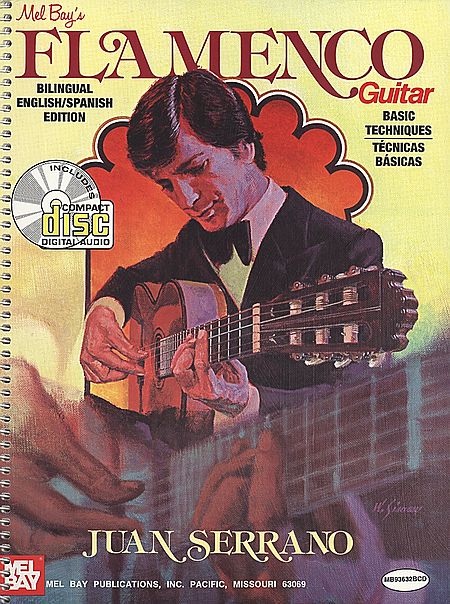
SERRANO JUAN FLAMENCO GUITAR TECNICAS BASICAS LIBRO CD TABLATURE CHITARRA METODO

SERRANO JUAN, FLAMENCO TECNICAS BASICAS. Metodo in inglese e spagnolo. CD TABLATURE

LIBRO DI SPARTITI DI MUSICA FLAMENCO PER CHITARRA, METODO CON CD E TABLATURE.


Product Description:
This book, written in both English and Spanish is the most authoritative method available on flamenco guitar technique. Juan Serrano is one of the world's premier flamenco concert soloist and is a seasoned teacher and performer in this vibrant, colorful musical genre. The text describes the history and development of flamenco music; teaches basic music theory; presents developmental studies on flamenco guitar techniques such as rasgueado and tremolo; and offers 14 exciting flamenco guitar solos. Written in notation and tablature.


The flamenco guitar descended from a long line of Spanish ancestors, and it is a deviation from its classical counterpart. According to one essayist on the subject, the guitar emanated from Egypt. Others like to believe that it evolved from the Greek~Assyrian cithara, brought into Spain by the Romans. However, the music of the guitar, that which accompanies the flamenco dance and song, in reality reveals evidence of Near-Eastem and Egyptian ancestry. During its acclirnatization in Spain, the minstrel and poet Bagdadi Ziryab added the fifth string. The Spanish guitar, accepted throughout the entire peninsula during the 10th Century, soon distinguished itself for the rasgueado technique. Since the beginning of the 19th Century it has had six strings: E, A, D, G, B, E. The music of the flamenco guitar depicts one of the rnarvels of the natural arts.


INTRODUCCION

La guitarra flamenca cuenta con una ilustre ascendencia hispana y marca una desviación de la clásica. Según algunos tratadistas, la guitarra es procedente de Egipto. Otros la suponen procedente de la citara Greco- Asiria importada a España por los Romanos. Pero la música de la guitarra tal como acompaña al baile o al cante flamenco acusa en efecto evidentes reminiscencias orientales. Durante su aclimatización en España el cantor y poeta Bagdadi Ziryab le añadió la quinta cuerda. La guitarra Española aclimatada en toda la peninsula en el Siglo X, pronto se distinguió por la técnica del rasgueado. Desde principios del Siglo XIX, la guitarra posee seis cuerdas: MI, LA, RE, SOL, SI, MI. La música de la guitarra flamenca constituye una de la maravillas del arte natural.


Format: Book/CD

Contents:

The history of flamenco
Music Theory
Learning Notes
Symbols
Tablature
Explanation of the Rasgueado
Preparatory Study
Rasgueado Exercises
Scale Study #1
Scale Study #2
Scale Study #3
Tremolo Study #1
Tremolo Study #2
Study for the Thumb
Studies in Legatos
Arpeggio Exercises
Study in C
Sevillanas I, II, III, and IV
Farrucas
Soleares
Alegrias
Alegrias para Baile
Fandangos de Huelva
Tempestad (Rumba flamenca)
Bulerias
Malaguena (Flamenca)
Malaguena (Regional)
Romance Flamenco

Prezzo: €34,99
€34,99

SERRANO JUAN KING OF THE FLAMENCO GUITAR CD TABLATURE CHITARRA LIBRO SPARTITI

SERRANO JUAN, KING OF THE FLAMENCO GUITAR. Mani vigorose e tendini tenaci, 230 pagine, Rapida introduzione alla tecnica di base della chitarra flamenca: rasgueado, studio sul tremolo, arpeggio, picado, golpe. SHEET MUSIC BOOK WITH CD & GUITAR TABLATURE. 

LIBRO DI MUSICA FLAMENCA. 

SPARTITI PER CHITARRA : 

PENTAGRAMMA E TABLATURE. 

Product Description:
Introduces basic flamenco studies, concert selections, and a brief history of the flamenco tradition. Includes the four basic song forms (siguiriyas, soleares, tangos, and fandangos) that influence all flamenco music.

Format: Book/CD Set
230 PAGES.

Contents:

Dos Colores -- Juan Serrano
Punta Umbria -- Juan Serrano
Tarifa -- Juan Serrano
Nostalgia -- Juan Serrano
Cueva Gitana -- Juan Serrano
Lamento Gitano -- Juan Serrano
Amigo Mariano -- Juan Serrano
Lagriamas De Granda -- Juan Serrano
Fantasy -- Juan Serrano
La Juderia -- Juan Serrano
Dos Colores -- Juan Serrano
Punta Umbria -- Juan Serrano
Tarifa -- Juan Serrano
Nostalgia -- Juan Serrano
Cueva Gitana -- Juan Serrano
Lamento Gitano -- Juan Serrano
Amigo Mariano -- Juan Serrano
Lagriamas De Granda -- Juan Serrano
Fantasy -- Juan Serrano
La Juderia -- Juan Serrano


CONTENTS:

Juan Serrano

Flamenco Guitar


Basic Techniques

Rasgueado

Tremolo Study

Arpeggio Exercise

Picado

Golpe

Farrucas

Soleares


Concert Selections

Lagriamas de Granda (Granainas) .

Nostalgia (Guajiras) .

Fantasy (Zambra) .

Dos Colores (Sole a por Bulerias) .


Flamenco Tradition

The Four Basic Flamenco Songs*


*Lamento Gitano (Siguiriyas) I

Techniques

Rasgueado

Tremolo

Alzapua

*La Juderia (Soleares)

*Cueva Gitana (Tangos)

*Punta Umbria (Fandangos)

Tarifa (Alegrias por medic-Derived from Soleares)

Amigo Mariano (Colombianas-Derived from Tangos) 

Prezzo: €43,99
€43,99

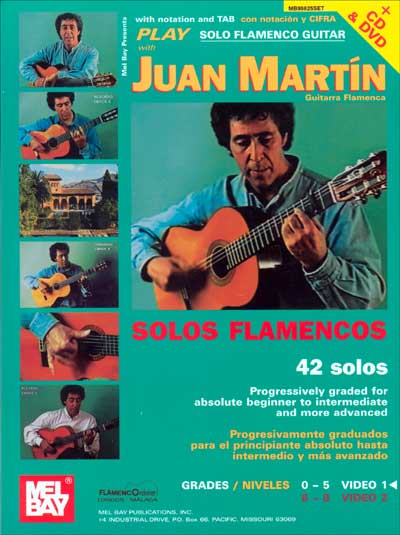
MARTIN JUAN PLAY SOLO FLAMENCO GUITAR VOL. 1 CD DVD TABLATURE CHITARRA METODO LIBRO

MARTIN JUAN, PLAY SOLO FLAMENCO GUITAR VOL. 1. SHEET MUSIC BOOK WITH GUITAR TABLATURE + CD + DVD. 

LIBRO METODO DI MUSICA FLAMENCO CON CD E DVD. 

SPARTITI PER CHITARRA CON: PENTAGRAMMA, TABLATURE. 


with notation and TAB    PLAY SOLO FLAMENCO GUITAR with

JUAN MARTiN


Guitarra Flamenca

SOLOS FLAMENCOS


42 solos

Progressively graded for absolute beginner to intermediate and more advanced

GRADES 0 - 5

con notacion y CIFRA

Progresivamente graduados para el principiante absoluto hasta intermedio y mas avanzado

CD Contents

Primera  Solea  First Solea

Tientos   Anhelo (Yearning)

Sevillana   Copla tradicional

Verdiales   Malaga, mi tierra

Alegrias en Mi   Alborozo (Jubilation)

Tangos   Festejo (Celebration)

Guajira   Fiesta cubana

Solea La base

Fandango de Huelva

Alegrias en mi con silencio

Bulerias por arriba

Rumba Rumba del dia nueve

Malaguelia Velez

Granadinas Albaicin

Solea para acompaliar

Tientos de Ricardo a Paco

Seguiriyas Sabicas y ritmeo

Alegrias Melocotones de Ronda

Verdiales Coplas malaguenas

Bulerias Diego en menor

Guajiras from Cania raja

Solea Solea gitana

Seguiriyas Falsetas clasicas

Zapateado Taconeos

Rumba Cancion popular, more advanced (mas avanzada)

Solea por Bulerias Raices

Tarantas Aires de La Union

Alegrias Tema inicial (Opening theme)

Sevillana   Mi copla

Solea   Falseta tradicional

Alegrias en la

Tarantos   Toque de las minas

Zorongo

Cantilias   Luz y sombra (Light and shade)

Seguiriya   Lamento

Rumba   Rumba flamenca

Solea Falsetas sencillas (Simple falsetas)

Fandango de Alosno

Rumba Cancion popular

Tangos Impulso

Carcelero

Farruca Ritmo del baile (Rhythm of the dance)


FLAMENCOVISION AND PATRICK CAMPBELL 

MEL BAY PUBLICATIONS, INC., PACIFIC, MO 63069. MADE AND PRINTED IN U.S.A.


Designed as a comprehensive multimedia teaching set, this book, CD, and DVD present 42 solos, progressively graded in 6 levels from absolute beginners to more advanced, to suit players of all levels. It contains examples of eighteen different palos (rhythmic forms) of flamenco, with a wealth of melodic falsetas and rhythms. The music for all these is accurately written in notation and flamenco tab (cifra) in the book, and is also recorded on the companion CD. The DVD video contains over 57 minutes of solo music, and also includes introduction by Juan Martín and brief scenes of Andalucia today, which help to place this profoundly exciting and deeply felt music in the landscape of its origins. Juan Martín has succeeded here is showing how even music which is simple and very easy to start with can express the essential sound and emotion of flamenco, to build step by step the skills necessary for the performance of concert solos. Written in English and Spanish.


INTRODUCTION

Welcome to my new video series! It can help you to play flamenco guitar whatever your present level of skill. Many people who would like to play flamenco on the guitar tell me they are discouraged by the apparent difficulty of the techniques required. I want to try to change that, because the marvellous art of flamenco is much more about feeling and rhythm, those essential components of aire and compas, than always about sheer speed or amazing technique. The exciting challenge for me has been to arrange and compose music which includes classic elements with more modern sounds and rhythms that will capture for the student the true essence of flamenco guitar right from the very start, without sounding too simplified or lacking that characteristic flamenco sound.

The solos in this project are in a progressive series of grades, from an initial Grade a up to grade 8. This book, CD and video, the first of two sets, contain the pieces for grades a to 5. The grades are intended to be in line with the levels of musical advancement required for the grade examinations of music colleges for any musical instrument. This is a new kind of challenge for flamenco, but the art is now becoming so international that I believe it is time to see flamenco guitar as an art that can be learned in a progressive way by anybody who has the necessary devotion, understanding and determination. To many devotees of flamenco the idea of a formal graded approach, possibly subject to examination, may seem quite alien and even unwelcome. I want to look to the future, however, and to join with others who now nurture the growing world-wide interest in this precious art and the need for systematic methods of teaching. The essence of flamenco is so strong and distinctive that I do not believe its future is threatened by the increasing numbers of people who find in its soul what they want to express and to enjoy in music, any more than the music of the Mississippi Delta has been impoverished by the world-wide interest in the art of the Blues. There are no formal standards or guidelines in flamenco that are widely established to mark the student's stages of progress. In this project, therefore, I have given much thought to what I believe should be the appropriate levels of skill and musicianship necessary for achievement of the grades which can mark the advancement of technical ability and musical understanding. The book contains more details about the contents and requirements of each grade.

I have been greatly encouraged in this project by my young son Carlos, whose need for interesting music to play from the start of his learning the guitar has given me a valuable purpose and focus in preparing the music, particularly with the earliest grades.

There is bound to be disagreement about whether a piece is right for the grade assigned, or whether it is too easy or too difficult. I think that sort of argument is both unavoidable and not really very helpful. I have tried to present a logical development of musical understanding and of techniques for the right and left hand, but the important thing is not to be too rigid about the sequence of grades. Students and players have to differ in their capacities and needs. The music always matters more than anything else! More advanced players will be able to incorporate the music of the video in their own arrangements, and they should find things worth learning at any grade.

My aim is to give the student music which he or she will enjoy playing and which will reward the effort to practise and learn. This is not primarily a project to explain technique, but I have included some brief notes about the individual pieces. I hope you will share in the enjoyment I have had in undertaking this project with my good friend and former student Patrick Campbell who has again worked hard to communicate my playing through video, the CD and the printed page. I would also like to thank Bill Bay and his team for their invaluable advice and encouragement with what we believe to be a new advance in learning methods for flamenco. Viva el arte - y vamos a tocar!


Contents:

CONTENIDO / CONTENTS
Introduction By Juan Martín
Introducción Por Juan Martín
The Elements of Flamenco Guitar-Playing
Los Elementos del toque de la guitarra flamenca
Symbols and Notation
Símbolos y Notación

GRADE / NIVEL O Notes and Requirements/Notas y requisitos
PRIMERA SOLEÁ First Soleá
TIENTOS Anhelo (Yearning)
SEVILLANA Copla tradicional
VERDIALES Málaga, mi tierra
ALEGRÍAS EN MI Alborozo (Jubilation)
TANGOS Festejo (Celebration)
GUAJIRA Fiesta cubana

GRADE / NIVEL 1
Notes and Requirements/Notas y requisitos
SOLEÁ Falsetas sencillas (Simple falsetas)
FANDANGO DE ALOSNO
RUMBA Canción popular
TANGOS Impulso
CARCELERO
FARRUCA Ritmo del baile (Rhythm of the dance)
SEVILLANA Mi copla

GRADE / NIVEL 2
Notes and Requirements/Notas y requisitos
SOLEÁ Falseta tradicional
ALEGRÍAS EN LA
TARANTOS Toque de las minas
ZORONGO
CANTIÑAS Luz y sombra (Light and shade)
SEGUIRIYA Lamento
RUMBA Rumba flamenca

GRADE / NIVEL 3
Notes and Requirements/Notas y requisitos
SOLEÁ La base
FANDANGO DE HUELVA
ALEGRÍAS EN MI con silencio
BULERÍAS POR ARRIBA
RUMBA Rumba del día nueve
MALAGUEÑA Vélez
GRANADINAS Albaicín

GRADE / NIVEL 4
Notes and Requirements/Notas y requisitos
SOLEÁ Soleá gitana
SEGUIRIYAS Falsetas clásicas
ZAPATEADO Taconeos
RUMBA Canción popular, more advanced (más avanzada)
SOLEÁ POR BULERÍAS Raíces
TARANTAS Aires de La Unión
ALEGRÍAS Tema inicial (Opening theme)

GRADE / NIVEL 5
Notes and Requirements/Notas y requisitos
SOLEÁ PARA ACOMPAÑAR
TIENTOS de Ricardo a Paco
SEGUIRIYAS Sabicas y ritmeo
ALEGRÍAS Melocotones de Ronda
VERDIALES Coplas malagueñas
BULERÍAS Diego en menor
GUAJIRAS from Caña rajá

APPENDIX: PUBLICATIONS BY/PUBLICACIONES DE IUAN MARTÍN

Prezzo: €32,99
€32,99

MARTIN'S JUAN GUITAR METHOD EL ARTE FLAMENCO DE LA GUITARRA CD TABLATURE RASGUEADO GOLPE

MARTIN'S JUAN GUITAR METHOD, EL ARTE FLAMENCO DE LA GUITARRA. 170 pagine fitte di musica, spiegazioni, interessanti fotografie delle diverse posizioni delle mani. SHEET MSUIC BOOK with GUITAR TABLATURE and 60' CD. 

LIBRO METODO DI MUSICA FLAMENCO CON CD.

SPARTITI PER CHITARRA CON :

ACCORDI, PENTAGRAMMA, TABLATURE.

A book and CD set for those wishing to learn the marvellous art of the flamenco guitar, presented by one of the most celebrated performers.

This comprehensive method assumes no knowledge of flamenco or music on the part of the beginner. 168 pages.

Juan Martin's playing of his music on the CD, along with many photographs and details in the text, vividly demonstrates the essential techniques, rhythms and toques of Flamenco. His Method also contains longer solos, daily exercises for developing tee and invaluable information about the flamenco guitar and its music. The Method has been designed for the player of any standard.

Prezzo: €49,99
€49,99

PACO PENA, TOQUES FLAMENCOS CD TABLATURE

Edizione sulla musica popolare spagnola, nelle diverse forme che la caratterizzano, direttamene dalla chitarra di uno dei suoi più famosi esecutori tradizionalisti, Paco Peña. 10 Pezzi completi, 85 pagine. CD TABLATURE


INTRODUCTION
Andalucla, whose musical tradition is embedded in its earliest history, must have built up that
tradition from the influences and remnants of the cultures left by the various peoples who passed
through or settled on its land. Among these different cultures one can note the Byzantine, Moorish,
Mozarabic and Jewish, whose influence must have finally crystallized and become integrated in the
songs and dances of the Andaluclan people. Andalucfa was under Moorish domination for many
centuries - Cordoba being at that time the capital of the Western Islamic world. Therefore the
music of this land already reflected the Oriental influence.
Later, in the 15th century, many tribes of gypsies found their way into Andalueta as a branch of
immigrants who around 1447 entered Spain by Catalonia. They lived mainly in the fields,
nomadically and in poor conditions. Traditionally the gypsies were not great poets - hardly surprising
considering their circumstances - but they had a remarkable facility for rhythm and music,
and in Andalucla they found a rich, colourful folklore of exceptional poetic charm. Unlike other
music they had come across elsewhere in Spain, this folklore suited their character and came to
form part of their lives. They assimilated it and added something different to it. This "marriage"
gave rise to the phenomenon of Cante Flamenco, neither "gypsy music" nor Andaluclan folklore,
but both. So, it can be said without doubt that there are two main elements in Flamenco:
Andalucla, with its old musical background, and the gypsies - without both, Flamenco would never
have existed.
Nobody knows for certain when it all started because there are very few written records available.
The first notice we have is about a singer of Seguiriyas, Tfo Luis el de la Juliana, around 1780.
But even that is a little dubious because it was not mentioned until a century later in 1881 - by
Antonio Machado Alvarez ("Demofilo"); in fact the Seguiriya seems to have developed later from
another style: Tonas.
There are three main periods in the history of Flamenco. From the beginning of the 19th
century to 1860 it was part of the life of Andaluclan gypsies and poor people who kept it for
themselves and never performed outside their communities. From 1860 to 1910 was the era of the
"Cafes Cantantes", special tablaos or places wholly dedicated to Flamenco music. Since then,
Flamenco has emerged from its original environment to become known throughout the world.
No evidence exists that guitars were used during the first period. But as Flamenco emerged
("Cafes Cantantes") the guitar, which was already the instrument of Spain, was brought in to
accompany and enhance the human voice. Paradoxically, it is the guitar as a solo instrument, rather
than the singing, which has made Flamenco popular, when in fact the guitar, like the dancing,
derives all its inspiration from the Cante Janda (Flamenco singing) - the purest expression of
Andalucfan art.
When accompanying, the function of the flamenco guitarist is to help the singer or dancer to
to bring out the best of his talent. He must create an atmosphere suitable to each piece, and he must
provide a good clear rhythm and follow the voice in whatever nuances the singer may bring to it.
Also he must colour it by playing falsetas, or brief melodic sequences, between verses. The guitarist
is then at the absolute service of the singing and from it he takes all his inspiration.
When playing solo, the guitarist must convey the whole atmosphere of Flamenco. The falsetas
become much more elaborate and musical to resemble the singing. The rhythm also becomes
stronger and more elaborate to resemble the "foot-work" of the dancer.


A La Feria (Sevillanas)
A Paso Lento (Tientos)
El Mantoncillo (Garrotin)
El Nuevo Dia (Colombiana)
En Las Cuevas (Farruca)
Herecia Latina (Rumba)
La Romeria (Alegrias)
Santuario (Soleares)
Son De Companas (Seguiriyas)
Tonos Levantinos (Tarantas)

Prezzo: €30,99
€30,99

LA SOLEÁ I GUITARRA FLAMENCA PASO A PASO IV DVD LIBRO SPARTITI TABLATURE LIBRO CHITARRA

LA SOLEÁ I: GUITARRA FLAMENCA PASO A PASO IV. DVD LIBRO TABLATURE

LIBRO DI MUSICA CON DVD, SPARTITI PER CHITARRA. PENTAGRAMMA E TABLATURE. 

Contiene video de 60 min. más un libro de partituras A4 de 22 páginas en música y cifra.Oscar Herrero, depsués de la interpretación de la soleá "Majestad", explica el ritmo de la soleá , y se hacen varios ejercicios con palmas. Posteriormente se estudia la estructura de los toques y parte de los elementos que componen la soleá como : el cierre, los compases rasgueados y las melodías 7-8-9. Multisistema - Español, Inglés, Francés y Japonés.

Oscar Herrero after playing the "soleá" "Majestad" explains the "soleá" rhythm, and some clapping exercises are made. Then explains the structure of basic rhythms and part of elements which the "soleá" is made up as: "el cierre", strummed measures and 7-8-9 melodies. 60-minute.

The accompanying 28-page book contains clapping exercises, the structure of the styles, a guide to notation, rasgueados, melodies, and a glossary. It also includes a guide to a piece which is made up of elements studied in this book and in the next volume, La Soleá (II). The music is in notation and tablature. The text is in English, Spanish, and French.

Product Description:
Oscar Herrero after playing the soleá Majestad explains the soleá rhythm, and some clapping exercises are made. Then he explains the structure of basic rhythms and part of elements which the soleá is made up as: el cierre, strummed measures and 7-8-9 melodies. 60-minute.

The accompanying 28-page book contains clapping exercises, the structure of the styles, a guide to notation, rasgueados, melodies, and a glossary. It also includes a guide to a piece which is made up of elements studied in this book and in the next volume, La Soleá (II). The music is in notation and tablature. The text is in English, Spanish, and French.

Format: Book+DVD
Notation signs
Falsetas
Remates / The finishing off
Llamadas
Introducciones / Introductions
Secuencia Am-C-F-E / Sequence
Secuencia G-C-F-E / Sequence
Secuencia Am-G-F-E / Sequence
Posición fija de "F" / Fixed position
Final / End
Atril flamenco (soleá)
Sendero (soleá)
Glosario Flamenco / Flamenco Glossary

Prezzo: €59,99
€59,99

LA SOLEÁ II GUITARRA FLAMENCA PASO A PASO V LIBRO DVD SPARTITI CHITARRA TABLATURE

LA SOLEÁ II: GUITARRA FLAMENCA PASO A PASO V. DVD TABLATURE

LIBRO DI MUSICA CON DVD, SPARTITI PER CHITARRA. PENTAGRAMMA E TABLATURE. 

DESCRIPCIÓN: Contiene video de 65 min. más un libro de partituras de 40 páginas en música y cifra. Oscar Herrero continúa con el estudio de los elementos que componen la estructura de la soleá, como: la falseta, el remate, la llamada y el final. Se explican en detalle falsetas "tipo" como introducciones, secuencias harmónicas y posiciones fijas. Para acabar interpreta dos soleares "Sendero" y "Atril flamenco". Los toques que en ambos temas han sido utilizados como base en los ejercicios y la explicación a lo largo de los dos videos "la soleá 1" y "la soleá 2". Multisistema - Español, Inglés, Francés y Japonés.

Oscar Herrero continues with rest of elements which the "soleá" is made up as: "la falseta", finishing of "el remate", and the call "la llamada". Typical traditional kinds of "falsetas" and introductions are explained in detail. At the end of this episode, he plays two "soleares" the "Sendero" and the "Atril flamenco". Both pieces were made up with elements studied into the two episodes "La Soleá 1" and "La Soleá 2". 60-minute.
The accompanying 44-page book contains patterns and exercises, including falsetas, remates, llamadas, introductions, sequences, fixed positions, and endings. The music is in notation and tablature. The text is in English, Spanish, and French.

Product Description:
Oscar Herrero continues with the rest of the elements which the "soleá" is made up: "la falseta", finishing of "el remate", and the call "la llamada". Typical, traditional kinds of "falsetas" and introductions are explained in detail. At the end of this episode, he plays two "soleares" the "Sendero" and the "Atril flamenco". Both pieces were made up with elements studied into the two episodes "La Soleá 1" and "La Soleá 2". 60-minute.

The accompanying 44-page book contains patterns and exercises, including falsetas, remates, llamadas, introductions, sequences, fixed positions, and endings. The music is in notation and tablature. The text is in English, Spanish, and French.

Format: Book+DVD
Date Published: 3/12/2004

Notation signs
Falsetas
Remates / The finishing off
Llamadas
Introducciones / Introductions
Secuencia Am-C-F-E / Sequence
Secuencia G-C-F-E / Sequence
Secuencia Am-G-F-E / Sequence
Posición fija de "F" / Fixed position
Final / End
Atril flamenco (soleá)
Sendero (soleá)
Glosario Flamenco / Flamenco Glossary

Prezzo: €59,99
€59,99

GUITARRA FLAMENCA PASO A PASO TECNICA BASICA I: FLAMENCO GUITAR STEP BY STEP VOL. 1. DVD TABLATURE

GUITARRA FLAMENCA PASO A PASO TECNICA BASICA I: FLAMENCO GUITAR STEP BY STEP VOL. 1. DVD. TABLATURE

Oscar Herrero, después de tocar la Bulería "De Colores", desvela los siguientes temas: Postura de sentarse y formas de sujetar la guitarra, posición de la mano derecha, técnica de los dedos pulgar y pulgar-índice, rasgueos con percusiones simples, golpe, rasgueos con golpe, rasgueos sin pulgar, Tangos flamencos, picado, falseta de picados por Tangos y compás de Soleá. Incluye libreto con partituras y cifrado. Multisystem: Pal y NTSC. En Español, Inglés, Francés y Japonés. Duración: 68 minutos.
booklet 25 pages.

Product Description:
For the first time, here is a flamenco guitar dvd instruction series produced entirely in the heart of Spain. Intended for those who already have a command of basic classic guitar technique and want to learn the flamenco style, this series of instructional videos explains each technique methodically and thoroughly. In this first volume, Oscar Herrero offers insights on sitting and hand positions and reveals the secrets of thumb/index technique-the "picado", the "picado falseta", and the "golpe". He also demonstrates various "rasgueos" executed with and without the thumb and presents the "tango" and "soleas" rhythms. Booklet included with English and Spanish text and music in notation and tablature. The dvd offers tracks in four languages: Spanish, English, French, and Japanese. The DVD is formatted for NTSC on one side of the DVD and PAL on the other.

Format: DVD
Date Published: 4/28/2003

Contents:

DVD
"De colores" (Buleria)
Introduction
Sitting Position
Tuning Up
Hands position
Thumb technique
Thumb index
Rasgueos
Golpe
Rasgueos with golpe
Rasgueos without thumb
Tangos
Picado
Soleá
Closing

Booklet
Introduction
Ex. 1-4 Thumb
Ex. 5-9 Thumb-index
Exercises A-M Rasgueos
Ex. 10-15 Tangos
Ex. 16-23 Picado
Ex. 24-30 Soleá
Flamenco Glossary

Prezzo: €49,99
€49,99
Condividi contenuti