PENTAGRAMMA E TABLATURE - STANDARD NOTATION and TABLATURE

THE CLASSICAL GUITAR COLLECTION-TABLATURE LIBRO SPARTITI CHITARRA MUSICA CLASSICA

THE CLASSICAL GUITAR COLLECTION. BOOK WITH TABLATURE

LIBRO DI MUSICA CLASSICA.

SPARTITI PER CHITARRA CON :

PENTAGRAMMA E TABLATURE. 

50 Favorites by 26 Composers
Series: Creative TAB
Arranger: Joseph Harris

50 works by J.S. Bach, Matteo Carcassi, Napoléon Coste, John Dowland, Enrique Granados, George Frideric Handel, Thomas Morgan, Gaspar Sanz, Erik Satie, Domenico Scarlatti, Fernando Sor, Francisco Tárrega, Antonio Vivaldi, Silvius Leopold Weiss, Giovanni Zamboni and other composers.

BACH - Air ('On the G String') from Suite No. 3
Allegro alla Francese (Vivaldi)
Allegro non molto from 'Summer' (Vivaldi)
Allemande from Suite No. 1 for Lute (Bach)
Andantino in C Major (Carcassi)
Bourree Anglais (Weiss)
Canarios (Sanz)
Cancion Triste from Preludios Vascos, Bk.1 (Donostia)
Capricho Arabe (Serenata) (Tarrega)
Chaconne (Losy)
Contredanse en Rondeau from Pygmalian (Rameau)
Spanish Dance No. 5 ('Playera') (GRANADOS)
Danza Mora (Tarrega)
Dolor from Preludios Vascos, Bk.2 (Donostia)
Espanoletas (Sanz)
Estrellita from Canciones Mexicanos (Ponce)
Fantasia No. 10 from Tres libros de musica en cifras para vihuela (Mudarra)
Fantasie (Weiss)
Gavotte en Rondeau (Dandrieu)
Homenaje Pour le tombeau de Debussy (Falla)
BACH - Jesu, Joy of Man's Desiring
Jig from Love and Honour (Morgan)
Lagrima (Tarrega)
Larghetto from the Royal Fireworks (Handel)
Largo from 'Winter' (Vivaldi)
Lecon in D Major (Sor)
Lecon in E Major (Sor)
Maria (Tarrega)
Menuet in G Major (Bach)
Menuet in G Minor (Bach)
Minuet in A Major (Sor)
Minuet in G Major, Op. 2, No. 1 (Sor)
Minuetto from Toccata No. 4 (Scarlatti)
My Lady Hundson's Puffe (Dowland)
Overture from The Messiah (Handel)
Petite Piece in E Major (Sor)
Prelude for lute (Bach)
Prelude from Suite No. 1 for Cello (Bach)
Preludio (Zamboni)
Romanza (Traditional Spanish)
Saltarello in D Major (Galilei)
Sarabande from French Suite No. 1 (Bach)
SATIE: Gumnopedie No. 1
Siciliana from Sonata No. 1 for violin (Bach)
Sonata in A Major (Scarlatti)
Sonata in G Major (Scarlatti)
Soneto No. 9 from Silva de Sirenas (Valderrabano)
Study in B Minor (Sor)
Study in C Major (Tarrega)
Tarantelle from Etides de Genre (Coste)

168 pages

Prezzo: €20,99
€20,99

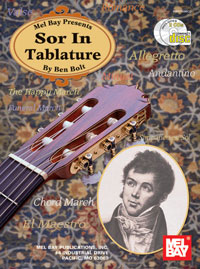
SOR IN TABLATURE BEN BOLT Libro 2CD TABLATURE allegro allegretto andantino andante moderato FERDINANDO

SOR IN TABLATURE, BEN BOLT. 2CD TABLATURE

LIBRO CON 2 CD E TABLATURE

Fernando Sor (1778-1839) è stato il più importante chitarrista-compositore spagnolo della prima metà dell’Ottocento. Si cimentò anche in altri generi come l’opera, il balletto, la musica corale, orchestrale e per pianoforte. ... essenzialmente nelle composizioni per chitarra sola e per due chitarre, il genere nel quale riuscì a esprimersi più congenialmente. La sua biografia – scritta dal musicologo britannico Brian Jeffery e validamente integrata dagli apporti di altri musicologi quali Josep María Mangado, Richard Long, Emili olcina, Matanya ophee – ci rivela un uomo dal carattere difficile e finanche conflittuale, affetto – almeno per quanto riguarda la sua presenza nel mondo della chitarra, allora fittamente popolato – dal complesso del primo della classe e acribiosamente impegnato nel dimostrare al mondo la propria superiorità. Questa era di per sé evidente nelle pagine per chitarra che egli andava scrivendo e non avrebbe avuto bisogno di alcun sostegno polemico: l’osservazione si rende necessaria di fronte al fatto che una considerevole parte della Méthode pour la Guitare, pubblicata a Parigi nel 1830, è spesa da sor nel difendersi dalle sciocche insinuazioni di chitarristi suoi coevi, dei quali non sapremmo nulla, se non fosse lui stesso a informarci della loro insignificante esistenza. sor era figlio di una famiglia della borghesia catalana ed era perciò destinato alla carriera nella pubblica amministrazione o nell’esercito. il padre, un impiegato, non incoraggiò, ma tollerò il suo spontaneo avvicinamento alla musica e, fin dall’infanzia, lo portò ad assistere alle rappresentazioni operistiche, quasi tutte di autori italiani. Alla prematura morte del genitore, il fanciullo, che cantava spontaneamente arie da opera, aveva ricevuto qualche lezione di violino e suonava la chitarra di suo, fu portato all’Abbazia di Montserrat, dove prosperava una famosa schola cantorum. L’istruzione musicale di sor ebbe quindi anche un’impronta polifonica, che più tardi si rivelerà chiaramente nella sua musica per chitarra.  


FOREWORD
The dream of Andres Segovia was to take the guitar out of the hands of the Spanish folklore guitarists, who
performed mostly in taverns and place it on the concert stage. He decided that in order to have the guitar
receive the respect that he felt it deserved, it would need to be taught in the colleges, universities, and conservatories. Because of this intense concert career and his mature years, for his dream to be fulfilled he had to
train teachers, who he called his disciples. Segovia accomplished his dream. Today the guitar has respect and
credibility because of his vision and work. Bravo to the maestro!
While my performing career began in Miami nightclubs, much like the Spanish folklore guitarist, I went on to
study with Segovia, who personally awarded me scholarships that he paid for. I have performed on the concert
stage with symphonic orchestras, and I am now a college professor. I have come to understand the significance
of his dream.
Ironically, my dream is the complete opposite to that of Segovia. I believe that for the acoustic classical style to
flourish, it must be put back into the hands of the people. My vision includes all guitarists, regardless of style
or background, becoming familiar with the classical guitar technique and repertoire. Tosee my dream fulfilled,
I have had to make learning fun and simple, without sacrificing the integrity of the information. By the mid
1980s my vision came to life in the form of a book entitled A Rock Player's Guide to Classical Guitar. It was the
first classical guitar book that included the notation / tablature / tape format. I chose the rock market because
at that time they were the only guitarists who were genuinely interested and eager to learn "classical" from me.
This, of course, didn't surprise me, since I too began as a rock guitarist. It was obvious that when classical
guitar was accessible to all guitarists, more people would hear and enjoy the beauty of the pure guitar style.
Since my first publication, thousands of new classical guitarists have surfaced.
All of my books come in notation / tablature / CD format. The recordings prove that all of my arrangements
have been tested and do sound guitaristic. All of the great late composers were fine musicians, as well as
composers. They could play the music they composed. You can also play the great classics! With the tablature
and the recording, great music is closer to your fingertips than you might imagine.
Ben Bolt


STROKES
Third String - p m a
The rest stroke using the thumb: Place a on the first string, m on the second string, and i on the third
string. Play the sixth string slowly.As you glide over the string, followthrough until you reach the fifth string.
You should end up resting on the string number 5. Practice on all bass strings (6, 5, and 4).
The rest stroke using the fingers: Place the thumb (p) on the sixth string. Play the third string slowly
with your index(i) finger. As your finger glides slowly over the string, follow through until you rest on string number 4. Practice using your middle finger (m) on the second string and your ring finger (a) on the first string. Also, practice alternating i m, i a, and m a on the treble strings (1, 2, and 3). I use i and a because they are similar in length on my hand. You should collapse the joint closest to the tip of the finger during the follow-through.
Free stroke: In using free stroke, the finger does not rest. The joint closest to the tip of the finger does not collapse. Youmust be careful not to get under the string and pull up with the finger. As an experiment, you can try pulling the string straight up and releasing it. This will cause a slap against the fingerboard and should be avoided. However, rock bass players use this technique as an effect that sounds good!
Regardless of which stroke is used, the flesh and fingernail should touch the string at the same time when you're preparing to play. This technique produces the best tone.


Ben Bolt is credited with being the first classic guitar instructor to introduce the classic style of pIaing
to the masses. Because of his worldwide success, his work has been mimicked throughout the
publishing world. Several Ben Bolt books have consistently appeared on Mel Bay's "Best Seller" list.
He also appears on Mel Bay's DVDs of the complete volumes of "The Modern Guitar Method", a huge
commercial success, selling in the millions of copies. His publications are distributed internationail
and have been featured at all the major conventions and music shows, including the National Association
of Music Merchants in Germany. His DVD "Anyone Can Play the Classic Guitar" has become a
reference for college students as the authority on the fundamentals ofclassic technique. He is endorsed
by D'Addario Strings and Takamine Guitars. He has recorded the classic guitar work for HGTV and
can be heard in the background of programs such as "America's Castles".
Ben Bolt first met Andres Segovia in the American Embassy in Madrid, Spain on his 18th birthday.
Bolt was registering for the draft as Maestro Segovia was getting his Visa together to tour the U.S.
This fortuitous meeting was the beginning of their relationship. Andres Segovia, the Father of the
classic guitar, was quoted saying "Ben Bolt is an excellent guitarist with fine tone." After studying
with Segovia, the Maestro personally paid for scholarships so that Bolt could continJue his studies
abroad, as well as setting up lessons with his assistants while he was on tour.
Ben Bolt first met Abel Carlevaro in Paris. Carlevaro then invited the 20 year old to study with him
under full scholarship at the yearly Master Classes held in Brazil. After Brazil, Bolt moved to Montevideo,
Uruguay. He won first place in the "Concurso Internacional Aemus" by unanimous decision.
Carlevaro awarded him the coveted "Premio de Merito" at the National Library of Montevideo for his
outstanding efforts in music. In 1978, Bolt assisted maestro Carlevaro in his first master's class in
the states held at the San Francisco Conservatory of music. Bolt completed his music studies under
the direction of Maestro Guido Santorsola, who bestowed him with an original composition for guitar
entitled "Seis Bagatelas" as a graduation gift. After returning to the States he became the first guitarist
inducted as a National Patron of Delta Omicron's International Music Fraternity.


Product Description:
This text includes fifty-eight pieces of music as well as a recorded CD of the entire book. Ben Bolt believes these pieces are the "best of the best" for developing technique, musicianship, and exposing the guitarist to the ingenious musical world of Fernando Sor. Regardless of your current level of expertise, this music will be a joy to learn and listen to. Titles include: Napoleon's Theme; E Minor at Midnight; Rhapsody in D; March of the Wooden Soldier; and Easter Hymn are sure to please any audience. Ben Bolt's digital recordings of his arrangements are superb. His warm tone and singing vibrato bring Sor's music to life. All interpretations are classically correct. He plays on his Fleta and Sons concert guitar made in Barcelona, Spain (1976). Fernando Sor was born in Barcelona, Spain (1778).

Song Title: Composer/Source:
A Minor March (Andante) F. Sor and Ben Bolt
Allegretto F. Sor and Ben Bolt
Allegretto in C F. Sor and Ben Bolt
Allegro in D F. Sor and Ben Bolt
Allegro Moderato F. Sor and Ben Bolt
Andantino in A F. Sor and Ben Bolt
Basso Profundo F. Sor and Ben Bolt
Best of Show F. Sor and Ben Bolt
Changing Tides F. Sor and Ben Bolt
Chord March F. Sor and Ben Bolt
D Minor Double-stop (Moderato) F. Sor and Ben Bolt
Diez (a Study in Tenths) F. Sor and Ben Bolt
Double Trouble F. Sor and Ben Bolt
E Minor at Midnight F. Sor and Ben Bolt
E Minor Etude (Allegro Moderato) F. Sor and Ben Bolt
Easter Hymn F. Sor and Ben Bolt
Easy Study in 3/8 F. Sor and Ben Bolt
Easy Study in C F. Sor and Ben Bolt
El Maestro F. Sor and Ben Bolt
Elegant Desire F. Sor and Ben Bolt
Estudio in Two (Andante) F. Sor and Ben Bolt
Etude in Six Eight F. Sor and Ben Bolt
Etude in Three Eight F. Sor and Ben Bolt
Forward Roll Arpeggio Study (Andante) F. Sor and Ben Bolt
Funeral March F. Sor and Ben Bolt
Harmony in G F. Sor and Ben Bolt
Hermosa F. Sor and Ben Bolt
Imitations F. Sor and Ben Bolt
Jig in G F. Sor and Ben Bolt
Lament of the Giant F. Sor and Ben Bolt
Lesson in A (Andante) F. Sor and Ben Bolt
Lesson in A Minor (Andante) F. Sor and Ben Bolt
Lesson in B Minor (Andante) F. Sor and Ben Bolt
Lesson in C (Andante) F. Sor and Ben Bolt
Lesson in Cut Time (Andante) F. Sor and Ben Bolt
Lesson in D (Allegro Moderato) F. Sor and Ben Bolt
Lesson in E (Allegretto) F. Sor and Ben Bolt
Lesson in E Minor (Movido) F. Sor and Ben Bolt
Lesson in F (Moderato) F. Sor and Ben Bolt
Lesson in G (Moderato) F. Sor and Ben Bolt
Lesson in Serenade F. Sor and Ben Bolt
Lullaby in Two Four F. Sor and Ben Bolt
March of the Wooden Soldier F. Sor and Ben Bolt
Melody on an E String F. Sor and Ben Bolt
Moderato F. Sor and Ben Bolt
Napoleon's Theme F. Sor and Ben Bolt
Rhapsody in D F. Sor and Ben Bolt
Romance F. Sor and Ben Bolt
Simpatico en Sol F. Sor and Ben Bolt
Singing Violins F. Sor and Ben Bolt
Song in D Major F. Sor and Ben Bolt
Song in D Minor F. Sor and Ben Bolt
The Happy Woodpecker F. Sor and Ben Bolt
The Precocious Pupil F. Sor and Ben Bolt
Three's a Charm (a Study in Thirds) F. Sor and Ben Bolt
Valse F. Sor and Ben Bolt
Victory Dance F. Sor and Ben Bolt
Waltz of the Robins F. Sor and Ben Bolt
When Guardsmen Sleep F. Sor and Ben Bolt

Prezzo: €31,99
€31,99

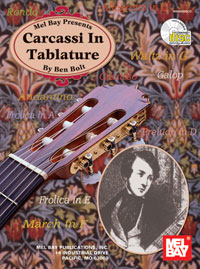
CARCASSI IN TABLATURE BEN BOLT LIBRO CD GUITAR TABLATURE ALLEGRO BRILLANTE ARPEGGIO ALLEGRETTO

CARCASSI IN TABLATURE, BEN BOLT.

LIBRO PER CHITARRA CON CD E TABLATURE

Product Description:
The book includes over 100 pages of the best of Carcassi's works. All music is digitally recorded by Ben Bolt in the order of publication. Carcassi has been proven to be a" best seller" among retailers. Now with the man who is credited with being the innovator of classic guitar in notation/tab/recording; this one is a no brainer. 128 PAGES

Song Title: Composer/Source:
Allegretto in A M. Carcassi, Arranged by Ben Bolt
Allegretto in C M. Carcassi, Arranged by Ben Bolt
Allegretto in D M. Carcassi, Arranged by Ben Bolt
Allegretto in E M. Carcassi, Arranged by Ben Bolt
Allegretto in F M. Carcassi, Arranged by Ben Bolt
Allegretto in G M. Carcassi, Arranged by Ben Bolt
Allegro Brillante M. Carcassi, Arranged by Ben Bolt
Allegro in D Major M. Carcassi, Arranged by Ben Bolt
Allegro in E Minor M. Carcassi, Arranged by Ben Bolt
Allegro in Triplets M. Carcassi, Arranged by Ben Bolt
Andante in G M. Carcassi, Arranged by Ben Bolt
Andantino M. Carcassi, Arranged by Ben Bolt
Andantino in E M. Carcassi, Arranged by Ben Bolt
Andantino in F M. Carcassi, Arranged by Ben Bolt
Andantino in G M. Carcassi, Arranged by Ben Bolt
Arpeggio in A M. Carcassi, Arranged by Ben Bolt
Arpeggio in A Minor M. Carcassi, Arranged by Ben Bolt
Arpeggio in D M. Carcassi, Arranged by Ben Bolt
Arpeggio in E M. Carcassi, Arranged by Ben Bolt
Arpeggio in E Minor M. Carcassi, Arranged by Ben Bolt
Arpeggio in F M. Carcassi, Arranged by Ben Bolt
Arpeggio in G M. Carcassi, Arranged by Ben Bolt
Dance in A M. Carcassi, Arranged by Ben Bolt
Danza in C M. Carcassi, Arranged by Ben Bolt
Frolica in A M. Carcassi, Arranged by Ben Bolt
Frolica in E M. Carcassi, Arranged by Ben Bolt
Galop M. Carcassi, Arranged by Ben Bolt
Grazioso M. Carcassi, Arranged by Ben Bolt
Grazioso in C M. Carcassi, Arranged by Ben Bolt
Intro in A M. Carcassi, Arranged by Ben Bolt
Jig in A M. Carcassi, Arranged by Ben Bolt
March in A M. Carcassi, Arranged by Ben Bolt
March in F M. Carcassi, Arranged by Ben Bolt
Melody in C Major M. Carcassi, Arranged by Ben Bolt
Melody in F Major M. Carcassi, Arranged by Ben Bolt
Moderato in G M. Carcassi, Arranged by Ben Bolt
Music Theory
Octave Study M. Carcassi, Arranged by Ben Bolt
Prelude in A M. Carcassi, Arranged by Ben Bolt
Prelude in A Minor M. Carcassi, Arranged by Ben Bolt
Prelude in B Minor M. Carcassi, Arranged by Ben Bolt
Prelude in C M. Carcassi, Arranged by Ben Bolt
Prelude in C# Minor M. Carcassi, Arranged by Ben Bolt
Prelude in D M. Carcassi, Arranged by Ben Bolt
Prelude in D Minor M. Carcassi, Arranged by Ben Bolt
Prelude in E M. Carcassi, Arranged by Ben Bolt
Prelude in E Minor M. Carcassi, Arranged by Ben Bolt
Prelude in F M. Carcassi, Arranged by Ben Bolt
Prelude in F# Minor M. Carcassi, Arranged by Ben Bolt
Prelude in G M. Carcassi, Arranged by Ben Bolt
Frolica in A Minor M. Carcassi, Arranged by Ben Bolt
Romance in E Minor M. Carcassi, Arranged by Ben Bolt
Rondino in D M. Carcassi, Arranged by Ben Bolt
Rondo M. Carcassi, Arranged by Ben Bolt
Study in A M. Carcassi, Arranged by Ben Bolt
Study in A Major M. Carcassi, Arranged by Ben Bolt
Study in E Major M. Carcassi, Arranged by Ben Bolt
The Left Hand
The Right Hand
Triste in E Minor M. Carcassi, Arranged by Ben Bolt
Waltz in A M. Carcassi, Arranged by Ben Bolt
Waltz in C M. Carcassi, Arranged by Ben Bolt
Waltz in D M. Carcassi, Arranged by Ben Bolt
Waltz in E M. Carcassi, Arranged by Ben Bolt
Waltz in F M. Carcassi, Arranged by Ben Bolt
Waltz in G M. Carcassi, Arranged by Ben Bolt

Prezzo: €25,99
€25,99

WELL-TEMPERED BLUES, 8 New Blues Tunes for Classical & Fingerstyle Guitar. William Beauvais. CD TABLATURE

WELL-TEMPERED BLUES, 8 new tunes for classical & fingerstyle guitar. William Beauvais. CD TABLATURE

Product Description:
The blues present an opportunity to be deeply expressive. Every note can be colored with pitch bends, slides, vibrato, and all manner of attacks. The style makes it easy to own the music, to close your eyes and play as if you wrote it. These pieces are designed to be fun and entertaining as they work through the sharp keys, which are most friendly to the guitar. By working through these keys however, they develop a player's awareness of the different tonalities and the way patterns may be altered to facilitate key changes. Written in notation and tablature.


Preface

Well Tempered Blues is a collection of twelve bar blues pieces. I have sometimes used the baroque style of notation: writing a single line to make the music and rhythms more obvious. In these cases, such as "Chicago Style Blues" and "Twisted Fingers," try leaving the bass notes down as long as possible, and let your ear tell you what sounds the best. Slides have not been indicated but have been left for the player to decide. Try sliding into various notes and choose what sounds the best. There is a great deal of room for flexibility in these pieces. Some people have also suggested that these pieces can be used for jamming, with an improviser adding a solo line over the guitar part.

Blues is a style that demands that the player be deeply expressive. Every note can be colored with pitch bends, slides, vibrato and all manner of attacks. In tastefully adding these nuances, a player begins to own the music, to make it their own, to play each piece as if they wrote it. These pieces are designed to be fun, and entertaining as they work through the keys that are most idiomatic to the guitar.

About the Author: William Beauvais has been commissioned to write for the Royal Conservatory Children's Choir, the Canadian Music Centre, Philip Candelaria, Jeffrey McFadden, the Evergreen Club, and the Echo Women's Choir. His music has been heard across Canada, the United States, Denmark, and most recently in Chile, Argentina and Uruguay. His guitar music is recorded on 2 compact discs: TRACES [1996] and bridges [1994]. An associate of the Canadian Music Centre and a member of the guitar faculty of The Royal Conservatory of Music, Beauvais is an accomplished classical guitarist. He won first prizes at the Canadian Music Competition, and at the Martinique world Centre for Guitar. He is presently developing curriculum for group based learning system at the Royal Conservatory in Toronto. His music is published by: Mel Bay, Frederick Harris, Editions d'Oz, and Tuscany Publications


Format: Book/CD Set
Song Title: Composer/Source:

Chicago Style Blues    William Beauvais
Cutback Blues        William Beauvais
Deep Down Blues     William Beauvais
Drinking Water Blues     William Beauvais
Gridlock Blues     William Beauvais
Rainy Weekend Blues    William Beauvais
Snaky Blue Line     William Beauvais
Twisted Fingers     William Beauvais

Prezzo: €15,99
€15,99

FINGERSTYLE LOVE SONGS-15 Classic Arranged for Solo Guitar-Bill Piburn CD TABLATURE SPARTITI

FINGERSTYLE LOVE SONGS, 15 Classic Songs Arranged for Solo Guitar. SHEET MUSIC BOOK WITH CD & GUITAR TABLATURE. 

LIBRO DI MUSICA CON CD.

SPARTITI PER CHITARRA CON: 

ACCORDI, PENTAGRAMMA, TABLATURE.

Arranger: Bill Piburn
Artist: Various

"Bill Piburn is one of the best players, arrangers and teachers I have known." Chet Atkins

15 love songs masterfully arranged by Bill Piburn, editor of Fingerstyle Guitar magazine. Includes:

1971  -  Always On My Mind  -  Wayne Thompson, Mark James, Johnny Christopher
1970  -  And I Love You So  -  Don McLean
1930  -  Dream A Little Dream Of Me  -  Wilbur Schwandt, Fabian Andree
1991  -  Beauty And The Beast  -  Alan Menken, dal film della Disney
1979  -  How Deep Is Your Love  -  Gibb Brothers, dal film "Saturday night fever"
1961  -  I Love How You Love Me  -  Barry Mann, Larry Kolber
1968  -  I Will  -  John Lennon & Paul McCartney
1977  -  Just The Way You Are  -  Billy Joel
1968  -  My Cherie Amour  -  Stevie Wonder, Sylvia Moy, Henry Cosby
1955  -  Only You (And You Alone)  -  Buck Ram, Ande Rand
1962  -  Our Day Will Come  -  Garson
1968  -  This Guy's In Love With You  -  Burt Bacharach
1955  -  True Love  -  Cole Porter
1955  -  Unchained Melody  -  Alex North
1934  -  The Very Thought Of You  -  Ray Noble

48 pages

Prezzo: €24,99
€24,99

LES MAITRES DE LA GUITARE FLAMENCA VOL.1 Worms Serranito Sanlucar Paco de Lucia CD TABLATURE LIBRO

LES MAITRES DE LA GUITARE FLAMENCA VOL.1. Worms. Serranito, Manolo Sanlucar, Paco de Lucia. CD TABLATURE

LIBRO DI MUSICA PER CHITARRA CON CD E TABLATURE.

Ce volume fait partie d'une série d'ouvrages consacrés aux grands maîtres du flamenco. Ces recueils vous permettront donc de vous familiariser avec le style des principaux maîtres de la guitare flamenca et ainsi de refaire le parcours des jeunes guitaristes contemporains, qui ont tous construit leurs propres falsetas à partir d'une connaissance approfondie de l'?uvre de leurs aînés. Pour ce premier volume, nous avons sélectionné les falsetas caractéristiques de 3 grands maîtres qui ont incontestablement marqué l'histoire de la guitare flamenca au XXème siècle : Francisco Sánchez Gómez "Paco de Lucía", Victor Monge "Serranito", Muñoz Alcón "Manolo Sanlúcar". Pour chacun de ces guitaristes, nous vous proposons dix falsetas essentielles (soleá, soleá por medio, siguiriya, tientos et fandangos) que vous retrouverez sur le CD joint à cet ouvrage. Ici, vous l'aurez compris, pas de bla-bla inutile, l'ouvrage est intégralement consacré à la musique en elle-même!

PACO DE LUCIA
Paco de Lucia est sans aucun doute l'artiste le plus emblématique du flamenco contemporain, le principal responsable de la diffusion mondiale du flamenco, bien au-delà du cercle restreint des "aficionados".
Francisco Sanchez Gomez "Paco de Lucia" est né à Algeciras en 1947. La famille est d'un milieu social très modeste. Le père de Paco multiplie les emplois occasionnels: estimable guitariste amateur, il part chaque nuit à la recherche de fêtes privées ("juergas") pour complèter les maigres ressources de la famille. Pour les Sanchez, le flamenco est d'abord un moyen de "s'en sortir" : deux de ses frères deviendront aussi musiciens professionnels, son ai né Ramon de Algeciras guitariste, et son cadet Pepe de Lucia chanteur.
Paco doit quitter l'école à neuf ans et opter pour un métier ou étudier la guitare huit à dix heures par jour ... Sa virtuosité dépasse rapidement celle de ses premiers maîtres, son père, Nino Ricardo (un ami de la famille) et son frère Ramon, qui lui enseigne de nouvelles falsetas à chaque retour de tournée (les deux frères jouent d'ailleurs les mêmes falsetas, empruntées à Nino Ricardo ou composées par Ramon, dans leurs premiers enregistrements en accompagnement d'une multitude de cantaores).
A douze ans, Paco accompagne son frère Pepe pour un concours de chant à Jerez: premier prix de chant, et le jury doit créer une mention spéciale pour Paco, trop jeune pour participer au concours.
Les deux frères sont immédiatement repèrés par Hispavox qui les enregistre sous le nom de "Chiquitos de Algeciras". Paco est engagé comme second guitariste par José Greco, qui dirige l'une des meilleures troupes de danse flamenca du moment, et part en tournée aux USA (le premier guitariste de la compagnie est Ricardo Modrego, avec lequel il enregistrera plusieurs disques en duo).
Suivent plusieurs tournées européennes avec le "Festival flamenco gitano" des imprésarios Lippman et Rau, au cours desquels il travaille notamment avec Camaron de la Isla: début d'une longue collaboration qui donnera au flamenco l'un de ses meilleurs duos chant / guitare, et une dizaine de disques mythiques entre 1969 et 1977 ("Castillo de Arena").
Au cours de sa tournée aux USA avec José Greco, Paco a rencontré Sabicas qui l'a vivement encouragé à composer, ce dont il ne se croyait pas capable ...! "La fabulosa guitarra de Paco de Lucia" parait en 1967, avec neuf compositions originales et une reprise de Mario Escudero ("Impetu") : premier jalon d'une Tmuvre discographique qui va profondément marquer l'histoire de la guitare flamenca.
En se basant sur cette discographie, il est possible de diviser l'évolution musicale de Paco de Lucia en trois périodes: 
- 1967/1973 ("Fuente y caudal") : la période "classique", marquée par les influences de Nina Ricardo et Ramon de Algeciras pour les lignes mélodiques, Sabicas pour la rigueur rythmique et les accords dissonants (cordes à vide superposées aux accords de base), et Mario Escudero pour l'harmonie (systématisation des accords de passage et usage de neuvièmes, treizièmes ...). Le génie de Paco réside dans sa capacité à fondre ces diverses influences en un langage très personnel, et surtout dans son inspiration mélodique inépuisable (il est l'un des rares guitaristes, avec Nino Ricardo et Esteban de Sanlucar, dont on puisse chanter les falsetas). Notons aussi que pendant cette première période, Paco de Lucia continue à accompagner un grand nombre de chanteurs: ses meilleurs réussites en ce domaine sont ses collaborations avec les cantaores les plus rythmiquement précis, notamment Nino de Barbate, Chato de la Isla, El Lebrijano, Fosforito et, bien sûr, Camaron. - La période 1973/ 1981 ("Solo quiero caminar") est une phase de transition. Pour "fuente y caudal", Paco avait enregistré la fameuse rumba "Entre dos aguas" avec une basse et des percussions. Les rencontres ultérieures avec Larry Coryel, Carlos Santana, John Mc Laughlin, AI di Meola ... l'amènent à jouer de plus en plus en se posant sur une rythmique, et à tenter d'improviser sur une trame harmonique (deux choses absolument nouvelles pour la guitare flamenca). "Libéré" des contraintes du jeu en solo, n'ayant plus à assurer les ponctuations harmoniques ni un cadrage audible des cycles métriques du compas (rôles dévolus à la basse et aux percussions), son jeu y gagne en fluidité ce qu'il y perd en polyphonie: il peut dès lors phraser comme un chanteur. Le résultat de ces expériences sera la création d'un premier "sextet", avec Ramon à la guitare "rythmique", Pepe au chant, Jorge Pardo à la flûte et au sax, Caries Benavent à la basse, et Rubem Dantas aux percussions (ces trois derniers venus du jazz). La structure des morceaux s'apparente à celles du jazz (thèmes, "chorus" ...) et la composition du groupe oblige aussi Paco à se préoccuper du son, tant pour les concerts que pour les enregistrements (amplification, réverb ...). Paco doit aussi repenser l'accompagnement, en particulier pour les solos de flûte et de sax : les rasgueados sont moins fréquents, souvent remplacés par des ponctuations harmoniques jouées au pouce et imitant la sonorité de guitaristes de jazz comme Wes Montgomery. Cette nouvelle manière d'accompagner sera ensuite aussi utilisée pour le chant, et est devenue un tic de langage dont usent (et parfois abusent...) tous les jeunes guitaristes actuels.
- 1981 /1998 : avec "Siroco" (1987), Paco revient au jeu en solo, mais en y intégrant les innovations de la période précédente: le discours musical se déploie en longues lignes mélodiques, ignorant le plus souvent le morcellement en falsetas distinctes et les "barres de compas".

PACO DE LUCIA: SOLEA -SOLEA POR MEDIO -SIGUIRIYA -TIENTOS -FANDANGOS

SERRANITO: SOLEA -SOLEA POR MEDIO -SIGUIRIYA -TIENTOS -FANDANGOS

SANLUCAR: SOLEA -SOLEA POR MEDIO -SIGUIRIYA -TIENTOS -FANDANGOS

Prezzo: €22,99
€22,99

CLASSICAL MASTERPIECES FOR ELECTRIC GUITAR TABLATURE LIBRO Mussorgsky CHITARRA SPARTITI

CLASSICAL MASTERPIECES FOR ELECTRIC GUITAR. SHEET MUSIC BOOK WITH GUITAR TABLATURE .

LIBRO DI MUSICA CLASSICA,
SPARTITI PER CHITARRA :
PENTAGRAMMA, TABLATURE . 

Geared toward performers and students wishing to expand their knowledge of the classical repertoire, this newly engraved collection features famous and popular works. Special arrangements include pieces by Bach, Sor, Clementi, Byrd, Rameau, Grieg, Moussourgsky, and Paganini. Tablature, historical notes, and performance tips appear with each piece

Contents:
Introduction
Glossary

Study In C [Sor, Fernando]

Study In G [Sor, Fernando]

In The Hall Of The Mountain King (Peer Gynt Suite) [Grieg, Edvard]

Sonatina In C [Clementi, Muzio] FOR 2 GUITARS

The Flute And The Droome [Byrd, William] FOR 2 GUITARS

Le Tambourin [Rameau, Jean-philippe] FOR 2 GUITARS

Invention In D Minor [J.S. Bach, Johann Sebastian]

Prelude [Tarrega, Francisco]

The Old Castle (Pictures At An Exhibition) [Mussorgsky, Modest]

Suite In G (Six Suites For Unaccompanied Cello, Bwv1007) [Bach, Johann Sebastian]

Prelude (Partita No.3 For Violin, Bwv 1006) [Bach, Johann Sebastian]

Caprice No.24 [Paganini, Niccolo]

Prezzo: €99,99
€99,99

LA CHITARRA REGGAE, LATINA E AFRICANA TABLATURE DVD-Salsa-Latin-Soca-Zouk-Biguine SPARTITI

LA CHITARRA REGGAE, LATINA E AFRICANA. Michele Spalvieri. TABLATURE DVD

VIDEO LEZIONE METODO DI MUSICA REGGAE, LATINA, AFRICANA, DVD CON LIBRETTO.

LIBRETTO DI SPARTITI PER CHITARRA CON:

NOTE, PENTAGRAMMA E TABLATURE.

 
Circa tre ore di un vero viaggio musicale nel cuore dei caraibi e sul continente africano, durante il quale imparerete non solo a sviluppare delle ritmiche e delle melodie, ma anche ad improvvisare sia con la chitarra elettrica che con quella acustica. La prima parte del DVD è dedicata alla musica delle diverse isole caraibiche, ossia il Reggae, la Salsa sotto tutte le sue forme, il Latin Jazz, la Soca, il Compas, lo Zouk, la Biguine ed altre musiche derivate. La seconda parte del DVD si orienta verso l’Africa e mostra tutte le tecniche di esecuzione utilizzate nella musica africana: finger style tradizionale africano, utilizzazione degli arpeggi e dei trilli, miscuglio di canti e di formule ritmiche, uso della sordina, ecc. con tante applicazioni musicali (esempi e brani) quante necessarie. DVD + Booklet

Prezzo: €35,99
€35,99

POPULAR GUITAR STYLES SAMBA & BOSSA NOVA Burkhard Buck Wolters FINGERSTYLE CD TABLATURE LIBRO

POPULAR GUITAR STYLES SAMBA & BOSSA NOVA, Burkhard Buck Wolters. BOOK WITH CD & GUITAR TABLATURE

LIBRO DI MUSICA PER CHITARRA CON CD.

SPARTITI PER CHITARRA FINGERSTYLE CON:

PENTAGRAMMA E TABLATURE. 


Product Description:
Popular Guitar Styles: Samba and Bossa Nova reflects recent popular Brazilian styles as played with classical or fingerstyle technique. This collection of original pieces will delight both listeners and guitarists who want to add samba and bossa nova music to their repertoire. The playing level is intermediate to advance. Left-hand difficulties like barrés and stretches are minimized to make it easy to make the music groove. Written in standard notation and tablature.

Caminho do coracao (Afoxe) Buck Wolters (Path of the Heart) Caminho do coração
Copacabenny (Samba) Buck Wolters
Giro do gaviao (Partido Alto) Buck Wolters (Falcon's Cicle) Giro do gavião
Jobinho (Bossa Nova) Buck Wolters 
Papagaio apaixonado (Choro) Buck Wolters, dedicato a Carlo Marchione (Parrot in love)

Illustrazioni di: Petra Hartmann

Ingenniere Audio della registrazione del CD: Marcus Pipke

Brazil is one of the musical melting-pots of the world. The mixture of African and the native Indian culture,
a highly developed European classical tradition, joyful Caribbean and melancholic Latin American mood, the
expressive freedom and complex harmony of jazz characterizing altogether the music of this extraordinary country.
Within the limited space of this book I just have chosen five styles from this extensive range of music. I hope
you will enjoy these five Brazilian compositions of mine. The styles that they represent are explained briefly in

the following. Buck Wolters
 
Caminho do coracao (Afoxe)
Also known as Ljexa, Afoxe is originally a dance and singing style performed at religious processions in honor
of Oxum (goddess of love), sung in Yoruba, a language of African origin. Afoxe is also a word for a special shaker
(Xequere).
 
Copacabenny (Samba)
Originally Samba was a collective name for many dance-styles that where brought to Brazil by African slaves.
The word Samba comes from "Semba" which means "belly-dance". Because the slaves got their feet and hands
tied they could only dance with their bellies. Also The Maxixe (known as "Brazilian Tango") which was the first
original Brazilian urban dance in the late 19th century contributed to the development of Samba.
Copacabenny is dedicated to my dear friend and drummer Benny Mokross.
 
Jobinho (Bossa Nova)
Bossa Nova (translated: "New Wave") had it beginnings in the late 1950th and can be seen as a mixture of
Samba and Cool Jazz. One can say, that Bossa Nova is a "cooled down" Samba, played with a smoother and softer
attitude. Samba and Bossa Nova share the same rhythmic basic-pattern, the Samba- or Bossa-Nova-Clave:
 
Jobinho is dedicated to Antonio Carlos Jobim (1927-1994), who made Bossa Nova popular all over the
world.
 
Giro do gaviao (Partido Alto)
Partido Alto is a style with stronger pop- and jazz influences. It is mostly played in the big cities of eastern
Brazil, normally performed by electric bands. Of all styles that are presented here it is the most modem. Partido
Alto is also based on the clave mentioned above.
 
Papagaio apaixonado (Choro)
Choro came into being from a mixture of Habanera, Polka, and African dance styles in the 2nd half of the
19th century. It is mainly instrumental music, which demands much virtuosity from the players, because it is to be
played in a constant rush of eighths, or sixteenths. Like in Jazz, the players improvise on the form, and harmonic
structure of the Choro. Often they improvise collectively as in a competition. Probably the word Choro comes
from "chorar" which means "crying" or from the African dance Xolo.
Papagaio apaixonado is dedicated to my dear friend Carlo Marchione, one of the world greatest classical guitarists.
Prezzo: €24,99
€24,99

PACHELBEL JOHANN CANON IN D GUITAR SOLO TABLATURE CHITARRA CLASSICA SPARTITO PAUL HENRY

PACHELBEL JOHANN, CANON IN D GUITAR SOLO. TABLATURE

SPARTITO DI MUSICA CLASSICA,

PER CHITARRA CON PENTAGRAMMA E TABLATURE

Series: Guitar Sheet
Composer: Johann Pachelbel
8 pages

Prezzo: €8,99
€8,99
Condividi contenuti