PENTAGRAMMA E TABLATURE - STANDARD NOTATION and TABLATURE

ASAP CLASSICAL GUITAR Learn How to Play the Classical Way James Douglas Esmond LIBRO CD TABLATURE gymnopedie

ASAP CLASSICAL GUITAR, Learn How to Play the Classical Way, James Douglas Esmond. CD TABLATURE.

LIBRO PER CHITARRA CON CD E TABLATURE


Per chi incomincia a suonare la chitarra classica, ASAP, As Soon As Possible, con il significato di: "al più presto possibile".

Serie: Guitar
Editore: Centerstream Publications
Copertina morbida con CD - TAB
Autore: James Douglas Esmond

Manuale facile anche per studiare da soli. Questo libro e CD per i principianti e chitarristi di livello intermedio propone pezzi classici ed esercizi presentati progressivamente nelle note e tablature, con le spiegazioni precise e brani eseguiti sul CD. Un perfetto metodo per imparare a suonare Più veloce possibile! 36 pagine.

Teacher-friendly or for self-study, this book/CD pack for beginning to intermediate guitarists features classical pieces and exercises presented progressively in notes and tab, with each explained thoroughly and performed on the accompanying CD. A great way to learn to play ASAP! 36 pages.


List of piece playing tips and explanations of exercises

R.H.Exercise Group #1
An easy introduction to the most basic finger patterns used in these pieces as well as good reading for the open strings.

R.H.Exercise Group #2
Moreindex and middle combinations. Start slowly and work for balance in the hand and an even tone.

L.H.Exercise #1
Stay on one string for as long as necessary to get perfect. Moving each finger deliberately and independent of others.

L.H.Exercise #2
Work to keep fingers down until they absolutely need to move.

Spanish Theme
Use this as a reinforcing piece for first position reading by saying notes out loud while playing. Index and Middle throughout for the top line. Work this line separately for awhile before adding the Bassline.

Ode to Joy
This piece, like the last is introduced in two parts and the Bassline will require a bit more attention.

Minuet in C
This piece should be approached like the last two but the parts require even more attention. Follow the left hand fingerings very closely. Get the left hand and the Bassline very good before adding together.

R.H.Exercise Group #3
These arpeggiations will be useful and comprehensive in regards to learning the next pieces in the book. Take one at at a time and practice very slowly.

L.H.Exercise #3
The L.H. and RH. should be practiced equally in this exercise. Practice the right hand alone and don't go too fast.

Pastoral Theme
Feel the left hand being free even thought the 3rd finger is rooted to the low G. Practice the top line by itself as well.

Gymnopedie #1
This is the first Chordal piece and therefore working on it by "Blocking" the left hand and just practicing the motions that the left hand uses from ms. to ms. will be beneficial. Also practice the Bassline and right hand motions alone.

New World Theme
Approach this piece the same way as the first three "Break-Down" pieces.

Etude in C
For this piece just looking at the tablature and practicing the arpeggio patterns by themselves with no left hand is a good way to start. Then incorporate blocking the left hand motions as well before putting together slowly.

Etude in A minor
Approach this piece the same way as the Etude in C.

Musette
Approach this piece by breaking up the two lines, but pay very close attention to the top line. De-emphasize the
Bass notes as much as possible. A light touch when holding down the repeated C and G is good for the other fingers.

Academic Festival Overture
Practice the chords that happen on every other beat to start. Try to de-emphasize the middle voices as well.

A Dance
Get familiar with the repeating Bassline in this piece so it can be put into the background while the top voice and middle voices can focused on more. Follow the fingering strictly.

Simple Lamentation
Practice the Bassline a lot by itself, being careful to shape it and work on having a good volume and even tone.

Soldier's March
Practice the chords without worrying about the rhythm at first and then after working the RH. motions, combine.

Sunrise
Approach this piece in the same way as Musette, being careful to have a light left hand, especially when moving up
the neck.

Reflections
Practice the RH. arpeggio pattern by itself before learning the L.H. Focus on some of the harder chord changes.

Adagio
Practice the melody by itself a lot to get a very good, even sound. Make sure to de-emphasize the middle voices.

Musetta's Waltz
Use the same approach as with Adagio, take your time to plant the L.H./ RH. fingers on the ending 8th note run

Cannon
Practice the repeating Bassline first to get it very solid, then work on each 4 measure piece before connecting them.

Eine Kleine Nachtmusic
Special care on the opening octaves should be taken. Be careful not to tense up the right hand on repeated fingerings throughout.


Foreword - How to use the Book
This book, while organized progressively, is constituted of all pieces that are developmental in nature for a beginner's technique. It is therefore recommended but not necessary to go through the book in a stepwise fashion. In addition the pieces can be broken in to several technique categories( i,m studies, arpeggio studies, chordal, etc.) and some pieces fall in to several of these categories. To ease the student into reading on the guitar the pieces have been arrange in very manageable keys, no more than 1# used.
I strongly suggest following all the fingerings that are suggested, however, if there are places in the book where a teacher or student wishes to change a fingering then that should be fine as long as the student adheres to it. There are many options for fingerings on the guitar and the important thing to remember is that the student is building what I like to call a "Technique Memory" and that each piece, or section of a piece can be seen as a set of directions that will, if practiced carefully, be absorbed and adhered readily to the next similar piece. As Guitarists, we are always building towards more difficult pieces but in a way always dealing with some of the same as well so it makes sense to stick closely to fingerings for some time.
Write in even more if necessary.
The exercises and 1st section of Broken-Down pieces are meant to really help the student ease into the book. The exercises do not have to be mastered before studying the pieces, especially due to the reading aspect, but should be incorporated into a daily practice routine.
I hope you enjoy the pieces and find this to be fun and helpful on your journey as a Classical guitarist.


Biography
James Douglas Esmond started playing the guitar
seriously in his teens. He received his Bachelor's
of Music Theory and Classical Guitar performance
from Ithaca College, Ithaca, N.Y.Upon graduating
he became involved in church music. He has held
positions in various churches, as a guitarist, organist,
singer and conductor. In addition to his church
work, he also teaches Guitar and Piano at Blue Sky
Studios in Delmar, N.Y., and writes and arranges
compositions in various genres and styles. He currently
serves as the Organist/Music Coordinator at
Newtonville Methodist Church in Loudonville, N.Y.
He resides in Albany N.Y.with his wife Meighan.


Table of Contents and C.D. Track List

Exercises and Pieces in graded order, with playing Tips

Foreword and Biography

Track 1. -R.H.Exercise Group #1
Track 2. - R.H.Exercise Group #2 .
Track 3. -L.H.Exercise #1 .
Track 4. -L.H.Exercise #2 .
Track 5. -Spanish Theme (Melody and Bassline) .
Track 6. -Spanish Theme .
Track 7. - Ode to Joy (Melody and Bassline) .
Track 8. - Ode to Joy .
Track 9. - Minuet in C (Melody and Bassline) .
Track 10. - Minuet in C .
Track 11. -R.H.Exercise Group #3 .
Track 12. -L.H.Exercise #3 .
Track 13. - Pastoral Theme .
Track 14. - Gymnopedie #1 .
Track 15. - New World Theme .
Track 16. -Etude in C .
Track 17. -Etude in A minor .
Track 18. -Musette .
Track 19. - Academic Festival Overture .
Track 20. - A Dance .
Track 21. - Simple Lamentation .
Track 22. - Soldier's March .
Track 23. - Sunrise .
Track 24. - Reflections .
Track 25. - Adagio .
Track 26. - Musetta's Waltz .
Track 27. - Cannon .
Track 28. - Eine Kleine Nachtmusic .

Prezzo: €16,99
€16,99

CLASSICAL THEMES FOR ELECTRIC GUITAR 25 Solo Guitar Arrangements Jean Marc Belkadi CD TABLATURE

CLASSICAL THEMES FOR ELECTRIC GUITAR, 25 Solo Guitar Arrangements, Jean Marc Belkadi. CD TABLATURE

Classical Themes for Electric Guitar 
25 Solo Guitar Arrangements

Series: Musicians Institute Press
Publisher: Musicians Institute Press
Format: Softcover with CD - TAB
Author: Jean Marc Belkadi

This book/CD package contains 25 timeless classical themes from the Renaissance to the Romantic Era and beyond. It includes works by J.S. Bach, Bartok, Beethoven, Brahms, Chopin, Dowland, Guiliani, Handel, Haydn, Mozart, Purcell, Satie, Stravinsky, Tchaikovsky. A bio for each composer is also included and the CD features demo tracks of each piece.

Inventory #HL 00695806
ISBN: 9780634070129
UPC: 073999958065
Width: 9.0"
Length: 12.0"
48 pages

Prezzo: €16,99
€16,99

ULTIMATE BASS EXERCISES, Over 700 easy step-by-step exercises for finger building, Max Palermo. TABLATURE

ULTIMATE BASS EXERCISES. Max Palermo

Ultimate Bass Exercises
Series: Bass
Publisher: Centerstream Publications
Format: Softcover
Author: Max Palermo


Over 700 easy step-by-step exercises for finger building, based on the 24 possible fingering combinations.

by Max Palermo

Thanks to Patrizia for her unconditional encouragement and valuable support and to Ron Middlebrook and all at Centerstream Publications for all their efforts in realizing this project.

Special thanks to my teacher Attilio Zanchi. This book is dedicated, in loving memory, to my grandfather Domenico.

ISBN-13: 978-1-57424-208-9

ISBN-10: 1-57424-208-3

SAN-683-8022

CENTERSTREAM Publishing, LLC P.O. - Anaheim Hills, CA 92817

Bassist and educator living in Italy, Max Palermo has had extensive experience performing in show bands, concerts, club dates in the jazz, pop and funk worlds. He has toured with a number of artists in Italy and abroad, doing their television promotions and studio recordings for Sony, Polygram and Cecchi Gori.
In addition to his career as a bass player, Max has been active as a bass instructor for over eighteen years, teaching in renowned music schools based in Genova and Milano and he is currently devoting himself to his writing and music training research activities.
Besides ultimate bass exercises, he is the author of several bass instructional and reference books. 

Bassist and educator Max Palermo takes you through more than 700 easy, step-by-step exercises for finger building, based on the 24 possible fingering combinations.

Inventory #HL 00000476
ISBN: 9781574242089
UPC: 884088115463
Width: 9.0"
Length: 12.0"
148 pages

The aim of this two-workbook set is to provide bass players with a wide range of step-by-step exercises to improve the finger physical dexterity, in terms of strength, independence, agility and velocity.

This is an important goal to reach for a musician in order to free his own musical personality. I would therefore advise you to practice these exercises daily (two or three finger combinations per day), starting quite slowly and gradually increasing the metronome (or drum machine) speed. While playing, always keep a clean and well-defined sound together with a good rhythmic feel. Last but not least: keep on studying the harmonic-melodicrhythmic issues of your instrument and the different musical styles, so that your technical improvements make it possible to put into practice what is in your mind and what your body can feel!  


WORKBOOK ONE - PART ONE - EXERCISES ON ADJACENT STRINGS

WORKBOOK ONE - PART TWO - ADDITIONAL EXERCISES ALONG THE NECK

WORKBOOK TWO - PART ONE - EXERCISES FOR MOVING ACROSS STRINGS

WORKBOOK TWO - PART TWO - STRETCHING EXERCISES

Two Fingers combinations

Three fingers combinations

Prezzo: €20,99
€20,99

CHRISTMAS MUSIC FOR ELECTRIC GUITAR John Kiefer LIBRO CD TABLATURE SCHIACCIANOCI CIAIKOWSKY

CHRISTMAS MUSIC FOR ELECTRIC GUITAR, John Kiefer. Quattro miniature da Tchaikovsky Nutcracker Suite, Johann Pachelbel Canon, ecc. CD TABLATURE.

LIBRO DI MUSICA CLASSICA, PER CHITARRA ELETTRICA CON CD.  
SPARTITI PER CHITARRA CON PENTAGRAMMA E TABLATURE. 

Libro contiene principalmente la musica Natalizia classica, trascritta per una, due, o tre chitarre elettriche.Queste trascrizioni sono dotate di notazioni standard e tablature e predisposte per essere eseguite con pick, o hybrid picking. Anche se certi pezzi arrangiate per la chitarra standard, altri richiedono la chitarra elettrica o la chitarra con cutaway. La registrazione presenta l'esecuzione di tutti brani del libro con una e massimo otto chitarre che suonano contemporaniamente. Le ultime quattro tracce del CD presentano certe tracce precedenti senza la prima chitarra così usando questi tracce uno può fare esercizi o suonare con CD. Le brani selezionati sono: "Carol of the Bells", Quattro miniature dal "Lo Schiaccia Noci" di Tchaikovsky , Kannon di Johann Pachelbel e altri.


Product Description:This book features Christmas music of primarily classical origins, transcribed for one, two, or three electric guitars. These transcriptions were notated in standard notation and tablature and are meant to be performed with a pick, or using hybrid picking. Even though a few of the pieces may be played on a standard guitar, the others require an electric guitar or a guitar with a cutaway. The recording features performances of all of the music in the book with anywhere from one to as many as eight guitars sounding simultaneously. The last four tracks of the CD feature certain previous tracks with the first guitar omitted. By using these tracks as accompaniment one can practice or perform with the CD. Selections include Carol of the Bells, Four miniatures from Tchaikovsky's Nutcracker Suite, Johann Pachelbel's Canon, and more.


Product Number: 98673BCD
Format: Book/CD Set

Prezzo: €21,99
€21,99

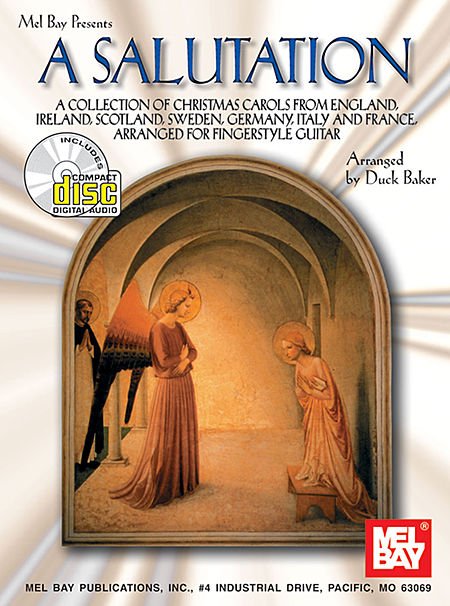
THE SALUTATION Collection Christmas Carols from England Duck Baker CD TABLATURE FINGERSTYLE GUITAR

THE SALUTATION, A Collection of Christmas Carols from England, Ireland, Scotland, Sweden, Germany, Italy and France, ARRANGED FOR FINGERSTYLE GUITAR, Duck Baker. SHEET MUSIC BOOK WITH CD & GUITAR TABLATURE .

LIBRO DI MUSICA FOLK, CON CD .

SPARTITI PER CHITARRA :

PENTAGRAMMA E TABLATURE.


Product Description:
This collection of carols arranged for guitar solo brings together twenty-four melodies that have had broad appeal through the ages. They were a spontaneous expression of musical joy that occurred over much of northern Europe in the fifteenth century, coinciding with the dawning of the modern age and the ending of the long medieval night. The selections include universal favorites, some tunes which are popular in their native lands and reasonably well-known elsewhere, and others which are unfamiliar even in their homelands. Some familiar texts, including "Away in a Manger" and "Angels from the Realms of Glory," have been set to different tunes. Notes on the origin of each tune are included. Written in notation and tablature. The companion CD features performances of all of the tunes, with some grouped into medleys.

Product Number: 99815BCD
Format: Book/CD Set
ISBN: 078662602X
UPC: 796279040402
ISBN13: 9780786626021
Series: Non-Series
Publisher: Mel Bay Publications, Inc.

Contents:
Song Title: Composer/Source:
A Virgin Most Pure arr. Duck Baker
Angelus Ad Virginum arr. Duck Baker
Es Ist Ein' Ros' Entsprungen arr. Duck Baker
Furry Day Carol arr. Duck Baker
Good Christian Men Rejoice arr. Duck Baker
I Saw Three Ships arr. Duck Baker
Il Est Né arr. Duck Baker
In Bethlehem arr. Duck Baker
Let All Earthly Flesh Keep Silent arr. Duck Baker
Noël Nouvelet arr. Duck Baker
O Come, O Come Emmanuel arr. Duck Baker
Patapan arr. Duck Baker
Rorate arr. Duck Baker
The Bagpipers' Carol arr. Duck Baker
The Blessed Virgin's Lullaby arr. Duck Baker
The Boys' Carol arr. Duck Baker
The Holly and the Ivy arr. Duck Baker
The Salutation arr. Duck Baker
The Snow Lay on the Ground arr. Duck Baker
The Wexford Carol arr. Duck Baker
Trettondedagsmarschen arr. Duck Baker
What Is This Fragrance? arr. Duck Baker
While Shepherds Watched Their Flocks arr. Duck Baker

Prezzo: €45,99
€45,99

RENBOURN JOHN FINGERSTYLE GUITAR Folk Blues & Beyond Celtic Melodies & Open Tunings & The Jazz Tinge 3CD TABLATURE

RENBOURN JOHN, FINGERSTYLE GUITAR: Folk, Blues & Beyond; Celtic Melodies & Open Tunings; & The Jazz Tinge. SHEET MUSIC BOOK with 3CD & GUITAR TABLATURE . 


LIBRO DI MUSICA FOLK CON 3 CD.

SPARTITI PER CHITARRA CON GUITAR TABLATURE.

Product Description:
This comprehensive Guitar Workshop Audio Series book/3-CD set brings together a variety of fingerstyle arrangements featured in three of John Renbourn's video lessons. Illustrates unique and exciting fingerstyle techniques in the performance of traditional ballads and other tunes, using standard and several alternate tunings. In notation and tablature. Includes an extensive discussion about the tunes in the collection. 120 PAGES
Format: Book/3-CD Set

... memorized because I'd learnt the tune simply to find out how the parts were worked. So then once I'd got an idea of how you approached the harmonization I found I couldn't resist playing them on the guitar and it fitted OK in D. It probably fits in may other keys as well. And the same thing with Bunyan's Hymn. I tackled that because I liked the melody and the time changes in it and I kind of reharmonized it to fit in open G deliberately.

STEFAN: How about I Saw Three Ships?

JOHN: I Saw Three Ships is also a traditional English tune and a very charming one. It's very simple but it seems to have great appeal. I really like the tune and I know a lot of other people that have a great fondness for it. It seems to me to be a really old tune, I can't say how old but it could easily fit in with the concept of medieval dance tunes that I've come across without very much change and it flows very nicely. It has a little refrain to it and hat also fits very nicely in that same tuning. So I play the two together and I throw in an number of other tradition English tunes in that medley.

STEFAN: How did you find The English Dance?

JOHN: Well I think I must have heard that also a long time ago being played by a man named Francis Bain, who was involved pretty early on in the revival of early music. He was before David Monroe. Before the kind of better, more wide spread groups that specialized in early music. I think I liked The English Dance because it features a repetitive melodic tune in a major key. I think the instrument that Francis Bain played was the fiddelle which was an old type of bowed instrument larger than a violi. The English Dance has a real punch to it when it's played on a bowed instrument because you can get top string drones against the descending patterns and I happen to like that. I found that it fitted nicely on the guitar in the open G tuning.

STEFAN: On stage you joke that it's one of the few English dances from that period of English music.

JOHN; Well, there have been quite a lot of manuscripts supposedly of English music. Lots are lodged in The British Museum but how many of them are actually English manuscripts to start, with I don't know. I think in fact, a great deal of the early dance tunes are probably northern Italian, but I think there is a chance that this one is English. Not that it matters a great deal but there we are you know - there's a certain national pride I suppose.

STEFAN: Let's talk about how you found the open G minor tuning that you use for several Celtic melodies.

JOHN: OK. There were quite a selection of tunings in the Ggroup that were handy. I used to often use a tuning with the second string up to Cwhich meant if I was playing medieval dance tunes - I used to playa tune called Trotto and another titled Salterello that both fitted quite nicely in that tuning - you could play low drones and still keep he melody going. The G minor tuning is just a variation: the second string tuned to the minor third rather than the 4th or the 2nd or whichever you like. I can't remember what I first used it for. I have an arrangement of The Moon Shines Bright which is quite a long elaborate piece. This uses the tuning and later on I used it for Nine Maidens.

STEFAN: Where did you find Owen Roe O'Neill?

JOHN: Owen Roe O'Neill is noted in the O'Neal's collection under the Carolan tunes and I wouldn't be surprised if it in Bunting's as well. In fact, I think it's in Bunting's with a harmonization by Bunting, but I took mine from the op line and harmonized it. It fits pretty nicely on the guitar in the open G minor tuning.

STEFAN: And Mist Covered Mountains Of Home?


JOHN: Mist Covered Mountains Of Home is a tune I learned from a fiddle player who I think got it from Jody Stecher. It's a highland pipe tune and it's an unusual one. Someone some time back sent me a harmony part for a second bagpipe part. I don't know of many tunes that have two bagpipes in close harmony but apparently this one as been arranged that way. I've always imagined that it's was a song but I've never actually heard complete verses s ng to it. ...


Song Title: Composer/Source:

Abide With Me/Great Dreams From Heaven - John Renbourn
Anji - John Renbourn
Buffalo - John Renbourn
Bunyan's Hymn - John Renbourn
Cherry - John Renbourn
I Saw Three Ships - John Renbourn
Judy - John Renbourn
Lament For Owen Roe O'neill - John Renbourn
Lindsay - John Renbourn
Little Niles - John Renbourn
Lord Franklin - John Renbourn
My Dear Boy - John Renbourn
My Sweet Potato - John Renbourn
Sandwood Down To Kyle - John Renbourn
The Blarney Pilgrim - John Renbourn
The English Dance - John Renbourn
The Mist-Covered Mountains Of Home - John Renbourn
The Orphan - John Renbourn
The South Wind - John Renbourn
Tramps And Hawkers - John Renbourn
Transfusion - John Renbourn
Watch The Stars - John Renbourn
White House Blues - John Renbourn

Prezzo: €39,99
€39,99

MARTIN JUAN ANDALUCIAN SUITE NO. 1 LIBRO CD TABLATURE CHITARRA SPARTITI FLAMENCO BULERIAS

MARTIN JUAN, ANDALUCIAN SUITE, NO. 1. CD TABLATURE

Product Description:
Four exciting concert solos for flamenco guitar from Juan Martín’s best-selling album ‘The Andalucian Suites’. This is the first of the four suites on the album. These suites are transcribed into standard notation and flamenco tablature (cifra), with introductory playing notes by Juan Martín. The four solos on the accompanying CD are performed by Juan.

The complementary and contrasting variety of styles and rhythms of the four solos provide a brilliant display of Juan’s artistry and the expressive capabilities of the flamenco guitar. Each solo is complete in itself. A powerfully evocative Zambra Mora is followed by the much-requested rumba ‘La Feria’, then a gently melancholic Milonga and finally a thrilling Bulerías, which combines modern elements with pure gypsy falsetas from Moron del la Frontera. These solos provide an exceptional opportunity to learn and enjoy the music of a master flamenco guitarist, whose two volumes of graded ‘Solos Flamencos’ are already Mel Bay best-sellers.
Format: Book/CD Set 48 pages


ANDALUCIAN SUITE No.1 THE FOUR SOLOS

These four solos are played as a sequence (or suite) to provide an interestingly varied group of pieces which show a range of flamenco guitar styles. Each solo stands as a complete composition which can be played by itself or in any chosen order. La Feria is particularly featured as a much-requested and popular solo.


EVOCACION DE LA INVASION ARABE AD 711

The opening movement of the suite recalls the Moorish invasion of Spain, when a small army arrived from North Mrica in the year 711 A.D. and landed at Gibraltar. The leader of the Moors was Jabal Tariq - 'he of the rock' - from whose name Gibraltar is derived. This small but efficient army, which arrived in Andalucia with its now famous Arab horses and brilliant horsemanship, took over much of Spain, a conquest which was to last nearly eight centuries. Cordoba and, larer, Granada were to become the Islamic capitals, dominating Spain until 1492. The music is based on the form of the Zambra Mora, flamenco's most Moorish dance form. It evokes that original menacing invasion and also reflects the beauty of the Moors' legacy in their art and architecture, with palaces such as the Alhambra in Granada and the great mosque at Cordoba.


Playing Notes

The 6th string is tuned to 0 for this piece, and no cejilfa (flamenco capo) is used. It starts wirh a free form (toque libre) cadenza in the style of the Moorish oud (a lute-shaped instrument with unfretted neck) with passages of ligado in which the nores are sounded by the left hand. The profusion of notes on the page may look daunting at first, bur the music lies quite easily under the fingers. In such a free and expressive passage without a definite rhythmic metre, the timing of the written notes has to be somewhar approximate. Listening to the CD will help to convey rhe correcr phrasing and emphasis. On the second page, the music changes to a regular 2/4 rhythm, which persists to the end of the piece, with later passages of rasgueo (strumming) and alzapua (a rapid three-srroke technique using down- and up-strokes of the thumb). Playets of classical guitars which are not fitted with golpeadores (tapping-plates) can omit the golpe taps. The solo concludes with a passage of continuous rasgueo (see Key to Symbols, following). The golpe on the penultimate beat is made with the middle finger striking the golpeador on the near side of the strings before the finger travels on to sound the strings with a down-stroke. The transcription is dedicated to the distinguished classical guitarist Eleftheria Kotzia, who incorporated the piece into her concert repertoire, as was heard in her virtuoso performance at London's South Bank Centre.


LA FERIA

In the same year, 1492, that Ferdinand and Isabella forced the Moors to leave Spain, Cristobal Colon (Christopher Columbus) sailed from the small port of Palos on the west coast of Andalucia on his voyage of discovery to Ametica. That voyage forged a cultural link with the Americas which has its effect within flamenco music. South American rhythms have returned to Spain with soldiers and musicians and have been absorbed into flamenco, undergoing a change in identity yet retaining an obvious Latin-American aire (atmosphere and feeling). It is clearly evident in this Rumba, an immensely popular style today. The solo is named The Fair, a time of uninhibited celebration.

Playing notes

The 6th string of the guitar is tuned to E. The cejilfa is placed at the second fret. The Rumba starrs with rhythmic strumming, using the characteristic slapping rechniques (see Key). For the first 8 bars the strings are damped with the fingers of the left hand so that they provide a percussive sound without musical vibration. The approximate positions of the left hand fingers as they damp the strings are shown in the music and cifra (flamenco tablature), initially in a chord shape over the lower frets and then over higher frets. The notes of the chord are not sounded, but the change in hand position alters the pitch of the percussive sound made by the damped strings. The piece also includes passages of alzapua, left and right hand apagado damping to cut short the sound of chords and, at the end, a repeated three-stroke rasgueo of thumb up-stroke followed by middle finger and thumb down-strokes. middle finger golpes on the near-side golpeador are used before a final up-stroke with the thumb ends the solo.

Contents:

Biographical Note
The Four Solos, with playing notes
Key to Symbols and Notation
Evocación de la Invasión Árabe AD 711 (Zambra Mora)
La Feria (Rumba)
Alborada (Milonga)
Gitanos (Bulerías)

Prezzo: €25,99
€25,99

60 PROGRESSIVE SOLOS FOR CLASSICAL GUITAR Bach Handel Mozart Beethoven Brahms CD TABLATURE

60 PROGRESSIVE SOLOS FOR CLASSICAL GUITAR, Featuring the Music of the World's Greatest Composers: Bach, Handel, Mozart, Beethoven & Brahms. SHEET MUSIC BOOK WITH CD & GUITAR TABLATURE . 

LIBRO DI MUSICA CLASSICA PER CHITARRA CON CD.

SPARTITI PER CHITARRA CON : PENTAGRAMMA E TABLATURE.


60 PROGRESSIVE SOLOS FOR CLASSICAL GUITAR
Featuring the Music of the World's Greatest Composers: Bach, Handel, Mozart, Beethoven & Brahms
Series: Guitar
Publisher: Cherry Lane Music
Format: Softcover Audio Online – TAB
Arranger: Mark Phillips

Most classical guitar folios feature compositions by the lesser-known “guitar” composers. This collection, however, exclusively features music by the world's most renowned composers. The works of Johann Sebastian Bach and George Frederick Handel represent the culmination of the Baroque era. Wolfgang Amadeus Mozart stands at the summit of the Classical era. Ludwig van Beethoven straddles the Classical and Romantic eras, and Johannes Brahms is the giant of the Romantic era. For educational purposes, the pieces have been organized in order of difficulty within each composer's section. In addition, complete performances of all pieces can be heard on the accompanying audio. Enjoy! Includes: Jesu, Joy of Man's Desiring • The Harmonious Blacksmith • Ode to Joy • Lullaby • and more.

Audio is accessed online using the unique code inside the book and can be streamed or downloaded. The audio files include PLAYBACK+, a multi-functional audio player that allows you to slow down audio without changing pitch, set loop points, change keys, and pan left or right.

Inventory #HL 02500584
ISBN: 9781575606286
UPC: 073999887044
Width: 9.0"
Length: 12.0"
120 pages


Air - Composed by Johann Sebastian Bach

Bourree - Composed by Johann Sebastian Bach

March from the notebook for Anna Magdelena - Composed by Johann Sebastian Bach

Minuet 1 - Composed by Johann Sebastian Bach

Minuet 2 - Composed by Johann Sebastian Bach

Minuet 3 from the notebook for Anna Magdelena - Composed by Johann Sebastian Bach

Minuet 4 - Composed by Johann Sebastian Bach

Minuet 5 from the notebook for Anna Magdelena - Composed by Johann Sebastian Bach

Minuet 6 from the notebook for Anna Magdelena - Composed by Johann Sebastian Bach

Air (Originally Untitled) from the notebook for Anna Magdelena - Composed by Johann Sebastian Bach

A Child Is Born in Bethehem - from Cantata n.65 - Composed by Johann Sebastian Bach

Chorale from the notebook for Anna Magdelena - Composed by Johann Sebastian Bach

Jesu, Joy Of Man's Desiring - Composed by Johann Sebastian Bach

Jesu, Meine Freude (Chorale) - Composed by Johann Sebastian Bach

The Harmonious Blacksmith - Composed by George Frideric Handel

Gavotte - Composed by George Frideric Handel

Sarabande - Composed by George Frideric Handel

Minuet - Composed by George Frideric Handel

Adagio 1 - Composed by George Frideric Handel

Adagio 2 - Composed by George Frideric Handel

Adagio 3 - Composed by George Frideric Handel

Bourree 1 - Composed by George Frideric Handel

Bourree 2 - Composed by George Frideric Handel

Bourree 3 - Composed by George Frideric Handel

Allegro 1 - Composed by George Frideric Handel

Allegro 2 - Composed by George Frideric Handel

Andante - Composed by George Frideric Handel

Theme - Composed by Wolfgang Amadeus Mozart

Minuet 7 - Composed by Wolfgang Amadeus Mozart

Trio 1 - Composed by Wolfgang Amadeus Mozart

Trio 2 - Composed by Wolfgang Amadeus Mozart

Andante 1 - Composed by Wolfgang Amadeus Mozart

Andante 2 (2nd Movement) From Piano Concerto n.20 - Composed by Wolfgang Amadeus Mozart

Andante 3 (2nd Movement) From Piano Concerto n.15 - Composed by Wolfgang Amadeus Mozart

Allegro (1st movement theme) from Piano Concerto n.13 - Composed by Wolfgang Amadeus Mozart

Russian Folk Tune - Composed by Ludwig van Beethoven

Pretty Minka - Composed by Ludwig van Beethoven

German Dance 1 - Composed by Ludwig van Beethoven

German Dance 2 - Composed by Ludwig van Beethoven

Ecossaise - Composed by Ludwig van Beethoven

Country Dance - Composed by Ludwig van Beethoven

Landler (Tyrolean Air) - Composed by Ludwig van Beethoven

Ode to Joy - Composed by Ludwig van Beethoven

Dance - Composed by Ludwig van Beethoven

Bagatelle 1 - Composed by Ludwig van Beethoven

Bagatelle 2 - Composed by Ludwig van Beethoven

Lullaby - Composed by Johannes Brahms

Symphony No. 3 (3rd Movement) - Composed by Johannes Brahms

Waltz 1 (Op. 39, No. 02) - Composed by Johannes Brahms

Waltz 2 (Op. 39, No. 15) - Composed by Johannes Brahms

Like a Melody - Composed by Johannes Brahms


I pezzi di questo libro sono ordinati per difficoltà crescente.

Prezzo: €27,99
€27,99

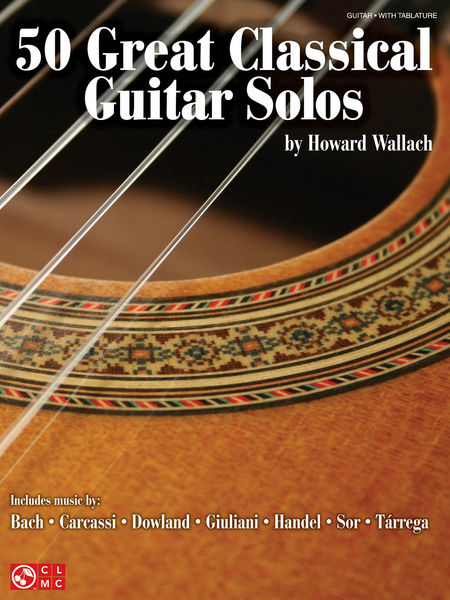
50 GREAT CLASSICAL GUITAR SOLOS Howard Wallach-Carcassi-Dowland-Giuliani-Handel-Sor-Tárrega

50 GREAT CLASSICAL GUITAR SOLOS, Howard Wallach. Bach, Carcassi, Dowland, Giuliani, Handel, Sor, Tárrega, e altri. 114 pagine. TABLATURE

LIBRO DI MUSICA CLASSICA,

SPARTITI PER CHITARRA CON:

PENTAGRAMMA E TABLATURE. 

 
Mauro Giuliani (1781-1829) è il più importante chitarrista compositore italiano dell’Ottocento. Pugliese di origini, si trasferì a Vienna dove la chitarra era già usata da musicisti come Diabelli, Molitor e Matiegka.

Mauro Giuliani. (Bisceglie, 1781 – Napoli, 1829). il più grande chitarrista-compositore italiano del secolo XiX, Mauro giuliani, esponente degnissimo del classicismo musicale, nacque a Bisceglie il 27 luglio 1781. non sappiamo molto dei suoi anni giovanili trascorsi in Italia; non era di famiglia indigente e prima di intraprendere la strada verso Vienna, dove sarebbe diventato famoso, ebbe modo di formarsi una solida preparazione musicale. oltre alla chitarra, suonava il violoncello, ed è comunque evidente, fin dalle prime composizioni date alle stampe nella capitale austriaca, la sua padronanza dell’armonia e delle forme musicali. Come virtuoso, dovette rendersi ben presto conto del fatto che, in patria, la musica da camera era una “cenerentola” e che il favore del pubblico si rivolgeva soprattutto al melodramma. Prese così la strada della capitale dell’impero austriaco: se si trattò di un esilio, fu dei più felici. Vienna – la Vienna turbata dalla minaccia napoleonica ma, dopo Waterloo, rasserenata nella sua imperiale magnificenza – accolse nel 1806 il venticinquenne Mauro giuliani, proveniente dalla Puglia e incline a qualificarsi come napoletano: qualifica non usurpata, poiché la sua regione era allora incorporata al Regno di napoli e probabilmente anche perché a napoli egli aveva studiato. il giovane virtuoso aveva abbandonato l’italia per cercare al nord i favori di un’aristocrazia colta e munifica, di una borghesia amante della musica e di un’editoria occhiuta e sagace. Vienna era per lui la città ideale, e vi giunse nel momento più propizio: la chitarra stava incuriosendo la società viennese, le cui diverse classi sociali si radunavano nei teatri, nelle sale da concerto, nei salotti, per fare e ascoltare musica. in quell’eldorado musicale, la chitarra non era una novità: Anton Diabelli, simon Molitor e Wenzeslaus Matiegka avevano raccolto i rigagnoli di una passione che si stava infervorando e, con le loro composizioni, avevano conferito un

Series: Guitar

Publisher: Cherry Lane Music
Softcover - TAB
Arranger: Howard Wallach

Covering music from the Renaissance, Baroque, Classic and Romantic eras, this fabulous collection includes 50 solos in notes and tab from Bach, Carcassi, Dowland, Giuliani, Handel, Sor, Tárrega and other acclaimed composers. 114 pages


Types of Dances and Pieces

Pavan = A dance of Italian origin popular in the 16 th and 17 th centuries. It was in simple duple time and of stately character.

Villanella = Street song popular in the 16 th Century, also a type of part-song less complex than the madrigal.

Finale = The last movement of a work in several movements.

Chaconna = Originally a dance of 3-in-a-measure rhythms, with the music built on (over) a ground bass. Sometimes there is no actual ground bass, but the music falls into a number of short sections similar to those written over a ground bass.

Bouree = A lively dance in quadruple time beginning with an up beat.

Allemanda = A dance usually in 4/4, but sometimes in duple meter. Often found as the
first dance of a suite. It is serious in character and of moderate speed.

Romanesca = 1) A kind of galliard from Romagna.
2) A certain melody popular in the 17 th Century as a ground bass.

Volta = A quick dance in triple meter; also known as "Lavolta" or ILaVolta,"
similar to the galliard.

Courante = A French dance popular in the 17 th and 18 th centuries and commonly found in the baroque suite. There are two types:
1) The Italian variety: rapid tempo in simple triple time.
2) The French variety: similar to the Italian, but with a different character and in quadruple meter.

Menuet = - A stately court dance of the 17 th and 18 th centuries in triple time. It was an optional movement of the suite and is found later in the classical symphonies of Haydn and Mozart.

Passepied = A lively dance in 3/8 or 6/8 time, which originated amongst French sailors, and later became popular at court.

Sarabande = A slow and stately dance form in triple time. It was a standard movement
of the baroque suite. There had existed an earlier, lively version.

Waltz = A dance in 3/4 time which came into prominence in the last quarter of the 18 th
Century. It rose to tremendous popularity in the 19 th Century, especially in Vienna.

Caprice = A light, quick composition with an improvisational feel, often including
striking or original effects.

Bagatelle = A short unpretentious instrumental composition; a trifle.

Landler = A type of slow waltz originating in northern Austria.

Prelude = A piece of music which precedes something else. In the 19 th and 20 th centuries, a self-contained short instrumental piece which sets a mood.

Mazurka = A traditional Polish country dance in triple time with an accentuation of the second beat of each measure and an ending of the phrases on that beat.


Table of Contents
Signs, Symbols, and Terms .
Found in this Book
Music of the Renaissance
Pavan V Milan .
Pavan VI Milan .
Polish Dance I Anonymous .
Polish Dance II Anonymous .
Villa nella Dlugoraj .
Finale Dlugoraj .
Pa van Byr d .
Mr. Dowland's Midnight Dowland .
My Lord Willoughby's Dowland .
Welcome Home
Music of the Baroque Era
La Chaconna Vallet .
B0urre e Va IIe t .
Allemanda Calvi .
Romanesca Calvi .
Volta Galilei .
Courante Sweelinck .
Menuet de Visee .
B0urre e de Vise e .
Passepied I Le Cocq .
Passepied II Le Cocq .
Menuet Handel '
Oh Sacred Head Now Wounded Bach .
Sarabande Bach .
Bourre e Bach .

Music of the Classic Era
Study in G Major Aguado '
Wa Itz Aguado ,
Andantino Carulli .
Waltz Caru Iii .
Andante Carulli .
Study in A Major Carcassi .
Study in E Minor Carcassi .
Ca price Carcassi .
Allegretto Giuliani .
Andantino Giuliani .
Study in A Minor Giuliani .
Andante Sor .
Study in A Major Sor .
Study in D Major Sor .
Minuet Sor .
Music of the Romantic Era
Bagatelle Schumann .
La nd Ier I Mertz .
Landler II Mertz .
Study in C Major Coste .
Study in A Minor Coste .
Prelude Coste .
Russian Song Tchaikovsky .
Prelude in D Major Tarrega .
Prelude (Endecha) Tarrega .
Prelude in D Minor Tarrega .
Prelude in E Major Tarrega .
Mazurka Tarrega.
 

Prezzo: €19,99
€19,99

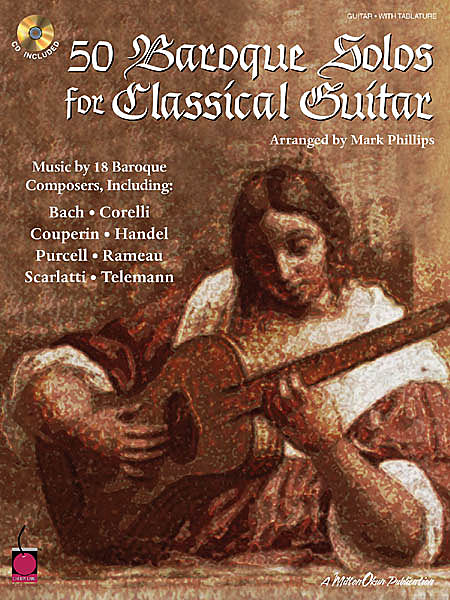
50 BAROQUE SOLOS FOR CLASSICAL GUITAR Mark Phillips LIBRO CD TABLATURE CHITARRA SPARTITI

50 BAROQUE SOLOS FOR CLASSICAL GUITAR, Mark Phillips. Bach, Corelli, Couperin, Handel, Purcell, Rameau, Scarlatti, Telemann e altri. SHEET MUSIC BOOK WITH CD & GUITAR TABLATURE .

LIBRO DI MUSICA CLASSICA CON CD. 

SPARTITI PER CHITARRA : 

PENTAGRAMMA, TABLATURE. 

Series: Guitar
Publisher: Cherry Lane Music
Softcover with CD - TAB
Arranger: Mark Phillips

50 fantastic guitar solos in notes and tab from 18 Baroque composers, including Bach, Corelli, Couperin, Handel, Purcell, Rameau, Scarlatti, Telemann and others. 64 pages

Johann Sebastian Bach

Aria

Be Content

Be Thou with Me

Gavotte (from French Suite No.5)

Minuet 1

Minuet 2

Sheep May Safely Graze

Sinfonia


John Blow

Air


Arcangelo Corelli

Largo

Sarabande 1

Sarabande 2


Francois Couperin

Cuckoos (from French Follies)

The Harvesters

Le Petit Rien

The Thorny One


Louis-Claude Daquin

Noel


Elisabeth-Claude Jacquet de la Guerre

Minuet


Charles Dieupart

Gavotte

Minuet

William Duncombe

Sonatina


Adam Falckenhagen

Minuet


Christopher Graupner

Air en Gavotte


George Frederick Handel

Bourree (from Water Music)

Coro (from Water Music)

Gavotte

March (from Scipio)

Minuet 1

Minuet 2

Minuet 3

Passepied 1

Passepied 2

Sarabande


Henry Purcell

Air

A Farewell (The Queen's Dolour)

Minuet

Rigadoon


Jean Phillippe Rameau

Rigaudon

Rondino


Valentin Rathgeber

Musical Pastime


Domenico Scarlatti

Gigue

Largetto

Minuet 1

Minuet 2


J. S. Scholze

Dance Song


Georg Philipp Telemann

Bourree

Burlesca

Minuet

Scherzino


Wenzel von Radolt

Minuet

Prezzo: €24,99
€24,99
Condividi contenuti