PENTAGRAMMA E TABLATURE - STANDARD NOTATION and TABLATURE

TARREGA FRANCISCO COLLECTION LIBRO CD TABLATURE Adelita-capricho arabe-grand jota TAMBORA

TARREGA FRANCISCO, COLLECTION. SHEET MUSIC BOOK WITH CD AND GUITAR TABLATURE . 

LIBRO DI MUSICA CLASSICA, CON CD.

SPARTITI PER CHITARRA :

PENTAGRAMMA E TABLATURE. 


Paul Henry. Adelita -capricho arabe -gran vals -grand jota (con la tecnica che imita il suono del tamburo, with the tambora, and snare drum effects) -la aldorada -estudio brillante -lagrima -malaguena -Maria -Marita -pavana -prelude -recuerdos de la Alhambra - tango.

Book/CD Pack
Series: Guitar Collection
Softcover with CD - TAB
Artist: Francisco Tárrega

Considered the father of modern classical guitar, Francisco Tárrega revolutionized guitar technique and composed a wealth of music that will be a cornerstone of classical guitar repertoire for centuries to come. This unique book/CD pack features 14 of his most outstanding pieces in standard notation and tab, edited and performed on CD by virtuoso Paul Henry, plus bios of Tárrega and Henry. 64 pages.


FRANCISCO T ARREGA
(b.1852 Villareal, Spain - d.1909 Barcelona, Spain)
The pieces in this collection represent the genius of Francisco Tarrega, the "father" of the modern
classical guitar. Each one of these compositions are classical guitar masterpieces, forming one of
the greatest artistic and technical cornerstones of classical guitar repertoire. They represent the
wide range of style, techniques, musical forms, and timbre that was the mastery of Tarrega. Even
the shorter pieces, such as Lagrima, Pavana, and Prelude, although not technically virtuosic works,
require a thoughtful approach and keen sense of timing to capture the dramatic shadings of the
melodies and accompaniments.
Tarrega's longer pieces, such as Capricho A.rabe, have these same musical challenges yet have
further virtuosic demands. These compositions, as do most of his works, blend traditional Spanish
melodies and rhythms with the Romantic style that was still so popular during Tarrega's time. The
Mazurkas, Maria and Adelita, are reminiscent of the works of Chopin. Besides being a virtuoso
guitarist, Tarrega was also an excellent pianist. Early in his career he often performed half of a
concert on piano and the other half on guitar. This intimacy with the jewels of the piano repertoire
influenced his own work as a composer, and undoubtedly inspired him to transcribe many compositions
for the guitar by composers such as Chopin, Beethoven, Schubert, Mendelssohn, Handel,
Bach, and others. The Maria (Gavota) and Gran Vals are suggestive of some of those composers, in
both spirit and form.
Part of Tarrega's genius was his sophisticated and innovative approach to left hand fingering;
blending melody and accompaniment throughout the fingerboard, thus bringing out the full range
of tone colors and dynamic possibilities of the larger modern day guitar which became popular in
Spain during Tarrega's lifetime.
As with all great composers, the bulk of Tarrega's compositions seem to place musical ideas rather
than technical showmanship in the forefront. However, as exhibited in his Estudio Brillante and La
Alborada (Musicbox), he shows that virtuosity and musical ideas can be best of friends. And, in
the Gran Jota, he takes an extra leap reminiscent of Paganinni by stringing together a collection of
themes and unashamedly displaying nearly every possible guitaristic effect. In perhaps his bestknown
work, Recuerdos de la Alhambra, Tarrega defines his magnificant contribution to classical
guitar repertoire; although using the glimmering tremolo technique, he never allows the technique
itself it to overshadow the absolutely stunning Spanish melody.
Francisco Tarrega - composer, guitarist, pianist, and teacher. He created an artistic legacy that not
only profoundly influenced his contemporaries, but one which has left an indelible mark on each
succeeding generation of guitarists.


PAUL HENRV
Paul Henry is a concert and recording artist based in the Chicago area, and is on the faculty of the Chicago Musical College of Roosevelt University. As a soloist he has concertized throughout the United States and Europe.
His recording credits include The Virtuoso Guitar of Spain and Latin America (Centaur Records), The Romance of Spain, and Dances and Dreams (Cadenza Classics). Among Paul henry's other contributions are his edition and recording of the Twenty-Five Melodic Etudes, Op. 60 by Mateo Carcassi, and his stunning recording of the prestigious Twenty Studies for Guitar by Fernando Sor,Segovia edition (both available as book/CD packages from Hal Leonard Corporation).

TiTLEs : 

Adelita (Mazurka)
Ave Maria
Capricho Arabe
Estudio Brillante
Gran Jota
Gran Vals
La Alborada
Lagrima
Malaguena
Maria
Marieta
Mazurka
Pavana
Recuerdos de la Alhambra
Tango

Prezzo: €24,99
€24,99

TARREGA IN TABLATURE Ben Bolt BOOK CD GUITAR TABLATURE CHITARRA Recuerdoes De La Alhambra

TARREGA, IN TABLATURE. 25 composizioni per chitarra: Marieta! -Rosita -la mariposa -capricho arabe -recuerdos de la Alhambra, Maria. SHEET MUSIC BOOK WITH CD & GUITAR TABLATURE. 

LIBRO METODO DI MUSICA CLASSICA CON CD .
SPARTITI PER CHITARRA CON:
PENTAGRAMMA E TABLATURE.


By Francisco Tarrega (1852-1909), edited by Ben Bolt. Guitar solo book (includes tablature) for guitar. Text language English, Spanish, French, Japanese. 125 pages. With guitar tablature, standard notation and introductory text.

The importance of Francisco Tarrega in the history of the classic guitar is immeasurable. With his original compositions and transcriptions, Tarrega brought the classical guitar to new heights by giving it a repertoire of its own and consequently influencing virtually every modern day classical guitarist. In this volume, Ben Boldt presents 29 pieces by Tarrega in standard notation and tablature. Text in English, Spanish, French, and Japanese. Titles include:

Contents:
Prelude In E
Prelude In A Minor
Lagrima
Prelude In G Major
Prelude In D Major
Prelude In D Minor
Prelude In D
Prelude (Endecha)
Prelude (Lento)
Prelude (Moderato)
Prelude
Prelude
Prelude
Prelude
Prelude In A
Prelude In A Minor
Prelude In A Major
Danza Mora
Marieta! (Mazurca)
Mazurca En Sol
Maria
Minuetto
Adelita (Mazurca)
Pavana
La Alborada
Capricho Arabe (Serenata)
The Butterfly (La Mariposa)
Rosita
Recuerdoes De La Alhambra

Prezzo: €24,99
€24,99

SOR FERNANDO CLASSICAL GUITAR TABLATURE LIBRO SPARTITI CHITARRA-BAGATELLE-FLAUTO MAGICO-TAB

SOR FERNANDO, CLASSICAL GUITAR OF FERNANDO SOR. LIBRO CON TABLATURE.

LIBRO DI MUSICA CLASSICA,
LIBRO DI SPARTITI PER CHITARRA. CON PENTAGRAMMA E TABLATURE.

Variations on a theme from Mozart's the magic flute -waltz in c major op.18 no.6 -minuet in d major op.11 no.5 -minuet in e major op.11 no.10 -divertimento in c major op.13 no.3 -les folies d'espangne op.15 -six airs from the magic flute -fantasia in e minor op.21 -minuet in c major from grand sonata -Petite piece in A major op.45 no.3 -study in d major op.29 no.21 -petite piece in a major op.45 no.5 -minuet i g major -bagatelle in d minor op.43 no.5 -study in e minor op.6 no.11 -lecon in d major op.31 no.10 -lecon in e major op.31 no.23 -petite poece in e major op.32 no.1 -study in b minor op.35 no.22 -Minuet in g major op.2 no.1 -petite piece in a major op.44 no.21 -minuet in a major op.11 no.6. 104 pagine. TAB.

Composer: Fernando Sor
Arranger: Joseph Harris
This book provides guitarists with an essential collection of 22 exquisite pieces by the great Sor, an extensive biography, and playing notes for each piece. Includes: Variations on a Theme from Mozart's "The Magic Flute" o Minuet in D Major, Op. 11, No. 5 o Minuet in E Major, Op. 11, No. 10 o Divertimento in C Major, Op. 13, No. 3 o Les Folies d'Espangne, Op. 15(a) o Bagatelle in D Minor, Op. 43, No. 5 o and more. Includes tablature.

BAGATELLE IN D MINOR OP 43 NO 5 (F SOR)
DIVERTIMENTO IN C MAJOR OP 13 NO 3 (F SOR)
FANTASIA IN E MINOR OP 21 ('LES ADIEUX') (F SOR)
LECON IN D MAJOR OP 31 NO 10 (F. SOR)
LECON IN E MAJOR OP 31 NO 23 (F. SOR)
LES FOLIES D'ESPAGNE OP 15(A) (F SOR)
MAGIC FLUTE, THE OP 19 (SIX AIRS FROM MOZART)
MAGIC FLUTE, THE OP 9 (MOZART) (VARIATIONS ON A THEME FROM)
MINUET IN A MAJOR OP 11 NO 6 (F SOR)
MINUET IN C MAJOR OP 22 (FROM GRAND SONATA) (F SOR)
MINUET IN D MAJOR OP 11 NO 5 (F SOR)
MINUET IN E MAJOR OP 11 NO 10 (F SOR)
MINUET IN G MAJOR (F SOR)
MINUET IN G MAJOR OP 2 NO 1 (F. SOR)
PETITE PIECE IN A MAJOR OP 45 NO 3 (F SOR)
PETITE PIECE IN A MAJOR OP 45 NO 5 (F SOR)
PETITE PIECE IN A MAJOR OP 44 NO 21 (F. SOR)
PETITE PIECE IN E MAJOR OP 32 NO 1 (F. SOR)
STUDY IN B MINOR OP 35 NO 22 (F. SOR)
STUDY IN D MAJOR OP 29 NO 21 (F SOR)
STUDY IN E MINOR OP 6 NO 11 (F SOR)
WALTZ IN C MAJOR OP 18 NO 6 (F SOR)

Prezzo: €17,99
€17,99

RIMSKY-KORSAKOV SHEHERAZADE FOR GUITAR LARRY CORYELL TABLATURE CHITARRA LIBRO SPARTITI

RIMSKY-KORSAKOV : SHEHERAZADE FOR GUITAR, ARRANGED BY Larry Coryell. SHEET MUSIC BOOK WITH STANDARD NOTATION AND GUITAR TABLATURE. 

LIBRO DI MUSICA CLASSICA.

SPARTITI PER CHITARRA CON :

PENTAGRAMMA E TABLATURE.


1ST MOV. - I THE SEA AND SINDBAD'S SHIP. 

2ND MOV. - II THE STORY OF THE CALENDER PRINCE. 

3RD MOV. - III THE YOUNGF PRINCE AND YOUNG PRINCESS

4TH MOV. - IV FESTIVAL AT BAGHDAD - THE SEA - THE SHIPWRECK

Prezzo: €199,99
€199,99

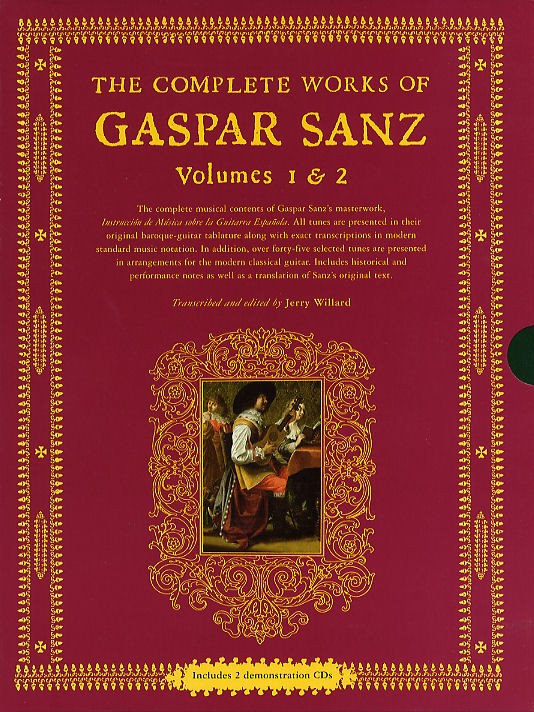
SANZ GASPAR THE COMPLETE WORKS OF Jerry Willard 2 CD TABLATURE LIBRI CHITARRA BAROCCA

SANZ GASPAR, THE COMPLETE WORKS OF. Jerry WILLARD. SHEET MUSIC BOOKS WITH 2CD & GUITAR TABLATURE . 

LIBRI DI MUSICA CLASSICA CON 2 CD.

SPARTITI PER CHITARRA CON : PENTAGRAMMA E TABLATURE.  

Available here is the complete manuscript of Sanz's legacy, which has been translated into English and the tablature arrangements now include standard music notation. Jerry Willard has also included arrangements for the modern guitar and performs selections from this body of work on both the baroque and modern guitar which can be found on the accompanying CDs. 280 pages.

By Gaspar Sanz. Arranged by Jerry Willard. For Guitar TAB. Renaissance, Medieval. Level: Intermediate-Advanced. Sheet Music and Audio CDs. 280 pages.

Gaspar Sanz was one of the most celebrated guitarists and composers of his time. In 1674 he published a method for the baroque guitar. This method has been lauded by guitar aficinados and serves as a significant historic work. Written in Old Spanish with the tablature system of its day, this method has only been available to the few who would meticulously research and decipher its hidden meanings. Available here is the complete manuscript of Sanz's legacy, which has been translated into English and the tablature arrangements now include standard music notation. Jerry Willard has also included arrangements for the modern guitar and performs selections from this body of work on both the baroque and modern guitar which can be found on the accompanying CDs.

Introduction
Biography
On April 4, 1640, Francisco Bartolome Sanz y Celma
was born in the tiny town of Calanda, near Saragossa,
Spain, into an old and well-to-do family. It was later
that he took the name Gaspar. He was educated at the
University of Salamanca, where he studied literature
and music and received a degree in theology. Sanz was
well traveled and spent much time in Italy, where he
studied guitar with Cristoforo Carisani and Lelio
Colista. He also studied the guitar works of Foscarini
and Corbetta. After returning to Spain, Sanz had
acquired such a great reputation as a guitarist and
composer that he was appointed guitar teacher to Don
Juan of Austria.

Baroque Guitar
The baroque guitar was popular primarily in Spain,
France, and Italy, and has a distinguished history
spanning 150 years, with only minor changes in tuning
and technique. Corbetta, Foscarini, and Montesardo in
Italy, de Visee in France, and Gaspar Sanz and Santiago
de Murcia in Spain championed the baroque guitar.

The baroque guitar was smaller than the modern
classical guitar, with more of an oblong shape, and had
wooden tuning pegs and tied-on gut frets. The
movable frets gave the baroque guitarist more
flexibility in tuning and pitch control.
There were many different tunings in vogue during
Sanz's time, the most popular of which is used and
explained in his method. The first string was single,
the second course (a set of multiple strings played as
one) was doubled unisons, the third course wa
doubled unisons, the fourth course was doubled in
octaves with the high octave on the thumb or bass
side, and the fifth course was doubled unisons an
octave higher than standard (modern) tuning. This
type of tuning, with the high octave on the thumb
or what would be the bass side of the strings,
enabled the guitarist to use the thumb as a melodic
finger, often playing high melody notes with the
thumb and achieving bell-like cross-string passage
called eampanellas.

Tablature
Tablature is a schematic that represents the five strings
of the guitar, with the bottom line representing the
highest string.
The frets are then represented by the numbers 1-9,
with 0 being an open string, and X indicating the
tenth fret. (Ed Note-Although indicated as a fret
marking in the original manuscript, an "X" in
conventional notation represents a muted string. This
edition will conform to conventional notation.) The
dots next to the numbers indicate the left-hand
fingering: one dot=index, two dots=middle, three
dots=ring, four dots=the little finger. Juan Carlo
Amat wrote the earliest publication for baroque guitar
and devised the alphabeto, a series of letters indicating
predetermined chords to be strummed during the
composition or dance. In the tablature, only the fretted
notes were indicated-the open strings were assumed.
(Ed Note- The diagram below illustrates the open
strings in this manner. However, conventional openstring
indications will be observed throughout the
remainder of this edition.) 


Contents:
Allemande La Serenissima
Another Ducal
Another French Saraband
Another Granduque
Another Passacaglia
Another Villano
Ballet
Batalla (Battle)
Bugle From the French King's Musketeers
Canarios (Sanz)
Chaconne
Dance of Mantua
Dance of the Axes
Dance of the Torches
Espa–oleta
Folias
Four Voices and Chromatics
French Ballet
French Saraband
Fugue I
Fugue II
Gallarda
Gallardas
Gigue
Gigue in the English Style
Granduque (Great Duke)
Great Duke of Florence
Jacara From The Coast
Jacaras
Labyrinth
Lantururu (Sanz)
Maricapolos
Mariona (Sanz)
Paradetas (Sanz)
Passacaglia
Passacaglia In A Minor
Passacaglia in E Minor
Passacaglia in F
Passacaglia In G Minor
Passacaglias
Passacaglias in B Flat
Passacaglias in D
Passacaglias in D Minor
Passacaglias in E Minor and B Flat Minor
Passage
Pavane
Pavane In A Minor
Prelude and Fantasy
Promenades in C
Rujero Gaspar Sanz
Saltaren
Tarantela
The Catalonian Mi-ena
The Enfachata of Naples
The French Shellfish
The Garzona
The Knights of Naples With Bugles
The Portuguese Minima
The Return
Torneo
Two Passacaglias
Two Trumpets of the Swedish Queen
Villano

Prezzo: €49,99
€49,99

PUMPING NYLON GUITAR TABLATURE 120 STUDI GIULIANI FLAMENCO BACH DOUBLE TENNANT TREMOLO TAB

PUMPING NYLON, IN TAB. THE CLASSICAL GUITARIST'S TECHNIQUE HANDBOOK.

LIBRO DI MUSICA CLASSICA, 

SPARTITI PER CHITARRA CON:

PENTAGRAMMA, TABLATURE.

TECNICA, METODO, CLASSICA FLAMENCO

Manuale completo che comprende: i 120 studi per arpeggio di Giuliani, esercizi per di controllo della velocità, le scale, il tremolo, la tecnica del flamenco, il suono, le unghie della mano destra, con esempi da J.S. Bach. TABLATURE

Scott Tennant, world-class classical guitarist and well-respected guitar eduactor, has brought together the most comprehensive technique handbook for the classical guitarist. It is presented here in both standard music notation and TAB. In addition to technical information not available elsewhere, he has compiled selections from Giuliani's 120 Right-Hand Studies; musical examples by Bach, Turina, Rodrigo and others; Tarrega arpeggio studies; and original compositions by Andrew York and Brian Head. Essential information and a great sense of humor are effectively combined in this best-selling book.


Author Preface

Welcome! This is my little book about guitar technique. I want to make it clear from the start that the material in this book is meant to reflect my own way of doing things on the instrument. The exercises are those that have helped me, some of which I still practice every day.

The goal of Pumping Nylon is to offer ideas that will help solve various technical problems. The idea was to steer clear of assembling anything that resembled a method book. Rather, my intent was to focus only on specific technical issues which I felt had not been clearly explained elsewhere. Generally, the issues dealt with in this book are those that have been brought up time and time again by students in master classes and lessons over the past ten years or so.
The exercises and musical examples have been chosen because of their unique technical challenges. For instance, the Bach DOUBLE was taken from a solo guitar arrangement, stripped of all its bass notes and more comfortable fingerings, and transformed into a very effective string-crossing and scale study.
I don't pretend to have addressed every issue. (There are too many out there for one book!) The reader, however, is strongly encouraged to invent hislher own exercises whenever necessary, since all of our technical needs are so very different.
I hope you find a few answers to some of your questions. Go get 'em!

I would like to thank ...
Nat Gunod, for coaching me through this process for the last two years; Brian Head and Andy York for composing their wonderful "made-to-order" etudes; Billy Arcila for posing for the photos that were used to create the illustrations; Durmel DeLeon for the photography; John Dearman and Matt Greif for their technical assistance; an endless list of friends for their constant encouragement; and the students at the ational Guitar Summer Workshop, San Francisco Conservatory and the University of Southern California for being (not always voluntary) "guinea pigs" for much of the [I1aterial contained herein.
And special thanks to Ron Krown at Alfred Publishing for encouraging us to do this new edition.

Glossary of Signs
This list will help you to interpret the various markings in the music.
1, 2, 3, 4 Left hand fingers, numbered from index (1) to pinky (4).
p, i; m, a, Right hand fIngers: p = thumb, i = index, m = middle, a= ring finger.
The six strings of the guitar, numbered from low E 6 to high E 0.
IV, V, VII etc Roman numerals. Here is a quick review of these symbols: 1=1, 11=2, III=3, IV =4,
V=5, V1=6, VII=7, VIII=8, IX=9, X=IO, XI=11 and XII=12.
BII4 The B indicates a barre. The Roman numeral indicates the fret to be barred, and
the small subscript arabic numeral indicates the number of strings to be barred.
So, this symbol would indicate to barre four strings at the second fret.

-1, -2, -3, -4 A dash in front of a fingering indicates a guide finger shif . A shift is a movement
from one position to another. is a finger that can be used just before
and just after a shift. For instance, if the 4th finger has been used to play G on the
J st string. 3rd fret, and then moves to play A on the 1st string, 5th fret, it will be
marked -4.


Editor Preface
I hope you will enjoy this new edition of Scott's gratifyingly popular book. As a response to public
demand, we are happy to provide a version of the book that includes tablature. Hopefully, this will make the book useful to more guitarists. After all, everyone who plays the guitar has something to gain from learning some c1assical guitar technique, and something to learn from a great teacher.
This book evolved from a warm-up routine and technical regimen that Scott Tennant began teaching and writing about several years ago. It is this daily warm-up that has inspired the whimsical title.
Pumping nylon. But in the following pages Scott has done far more than merely map out an exercise routine.
He has provided a wealth of technical information not readily available elsewhere. He has also compiled a variety of both well- and lesser-known technical exercises such as the 120 Right Hand Studie" of Mauro Giuliani and some arpeggio studies by Francesco Tarrega, and has offered some exercises of his own as well. It is also through Scott Tennant that four great new studies. two by Brian Head and two by Andrew York, have been written and published.

But I think he has done a lot more than even those things.
What students and teachers alike will find inPumping Nylon is a joyful attitude toward problem-solving on the classical guitar. There is an underlying message that says if you are willing and able to look at an issue from a different perspective, and if you can bring the same creative powers that you bring to your music-making to your technical work, you can overcome obstacles. Furthermore. there's no law that says it can't be fun.
Anyone who has studied classical guitar is going to hnd ,lOl/lethùl.9 in this book that directly contradicts what you have been taught-or what you teach-about ,1olllethùl.q. This is inevitable. But ifyou dismiss this work for that reason. you will be missing much. I encourage you to read ono Take a look at ali the ideas presented here by this great player and teacher. You will come away better for it.
I expect that for years to come it will be commonplace to hnd well-worn copies of this book in students' hands. I am sure that for Scott Tennant, as for myself, that will be the biggest reward for this efrort.
Many thanks to the wonderful people at Alfred Publishing-especially the M.I. team-for helping to
make this and many other National Guitar Workshop books a reality.
Nathaniel Gunod Litchheld, Connecticut
July, 1997
How to Read Tablature
4th string,5th fret
An open C chord
T
A
B
An H over a slur - indicates a hammer-on.
A P over a slur - indicates a pull-off.
1st stringo 10th Fret ] __Played together
2nd string, l0th fret

Nathaniel Gunod has edited many guitar books including
Benjamin Verdery's by Howard \Vallach, and Play AIM. co-authored Benjamin Verdery's
instructional directed the video, is the author of Cla. Guitar. A recital·ist on Baroque. Classical period and modern c1assical guitars, he has taught students from ali over the world at the Peabody Conservatory of Music and the National Guitar Workshop. where he is Associate Director.
He is the founder of the NGSW Classical Guitar Seminar and the D'Addario Guitar Concerto Competition. Preface


Inspiration
Inspiration only lasts a relatively brief time. We alI eventually fìnd ourselves experiencing a "dry spell."
We get stuck on something in our practicing and can't seem to improve, and sometimes it may seem that we're getting worse. At times we may even think of just quitting. Have you ever felt that the joy you once had for playing is gone forever?
These are not emotions you're experiencing alone. They visit everyone now and then. OccasionalIy we need to give ourselves a break and put down the guitar for a day, a few days, or however long it takes to feel refreshed again. For those who play for a living and don't always have that luxury, some digging back into one's past might be the key. Why did you want to play the guitar in the fìrst piace? Try to recall the feelings you experienced when you fìrst decided that you really wanted to play. Perhaps recall the joy you felt when you heard that fìrst recording or concert that thrilled you. What qualities about the instrument first drew you to it?
As I have done for several circumstances in my life, it may make you feel better to jot down a few of these positive thoughts on a piece of papero Then, when you hit another rough period, you can read through them.

In Conclusion
Music is the most powerful of ali the arts. It instantly stirs up emotions, conjures visions, and offers
glimpses of other, higher dimensions. It arouses men to battle; kindles amorous passions in lovers; soothes a baby to sleep; comforts us when we grieve. It engages our hearts and our minds, and can bring out the best that we are. One can safely presume that not a single emotion, nor any human or natural event, has been left undocumented by music.
As musicians, our objective is to command the elements of music as best we can in order to tap into that other dimensiono It is our access into heaven, if only for a while. But while we are there we can take aH who are listening ith uso If just one person is uplifted by our playing and walks away feeling better than before he carne, we have made a difference. A healing has taken piace.
I very much hope that you have found at least one thing in this book that has helped you. I also hope that, as you work to improve your technique, you do not lose sight of the larger goals: to be able to express yourself freely on your instrument and to turn every note you play into great music. When you can do those things, you cease to be just a guitar player and become a healer and magician.


Table of Contents

Author' s Preface 
Glossary of Signs 
Editor' s Preface 
How to Read Tablature 
Some Do's and Don'ts 
About the Hands 
About the Body 
About Holding the Guitar- The Triangle 

The Left Hand 

Finger Placement and Accuracy 
Pressure and Release 
Pressure/Release Exercise 
Finger Exchange 
Ascending Slurs (Hammer-ons) 
Descending Slurs (Pull-offs) 
Finger lndependence 
 #3 - Opposing Motion 
#4 - Horizontal Character Builders 
#5 - Odair's Favorite Drill 
#6 - "The Spider" 

The Barre 
Weight vs. Pressure 
Being Selective 
Summing It AlI Up 
Quadrivial quadrary by Andrew York - 

A Four-Voice Study for the Left Hand : 
Fanfare by Brian Head-A Slur Study 

The Right Hand 
Tone Production 
Nail Length and Shape : 
Nail Length 
Nail rypes 
Shaping the Nails 
Angle and Placement 

Rest Stroke (Apoyando) 
Position 
The Movement 
Planting 
Press ure 
Release

Free Stroke (Tirando) 
Right-Hand Finger lndependence 
Walking 
Arpeggios from Tarrega's The Complete TechnicaL Studies 

The Thumb 
Shaping the Nail 
Develop That Thumb! 

Flamenco Techniques .
What Else Can the Thumb Do? .
Sofeare. Falseta ,
Alzapua .
Alzapua Falseta ,
Rasgueados .
Some Practical Applications .
from Turina's Sevillana .
from Turina's Rafaga .
from Rodrigo's Conciato de Aranjuez, 2nd Movement .

Daily Warm-Up Routine .
Left-Hand Walking-#l, #2 & #3 .
Ascending Slurs - #4 .
Descending Slurs - #5 .
Triplets - #6 .
Fixed-Finger Exercises-#7 & #8 .
Right-Hand Walking - #9 .
Two-Finger Rasgueados-#10 .

Tremolo .
Psychological Outlook 
Exercises .
Lopsided Tremolos .
Chant by Brian Head: A Tremolo Study .

Scales: Control and Velocity .
Misconceptions about speed .
Right-Hand Velocity .
Synchronization .
String Crossing .
Piecing Things Together .
Some Other Speed Aids .
Rhythmic Variations .
Speed Bursts .
Problem Solving in Scales .
Marking String Crossings .
Evolution of a Scale .
Scale Study - Double from the Courante, Partita No.1, BWV 1002, Johann Sebastian Bach .

Arpeggios .
Full Planting and Sequential Planting .
Giuliani's 120 Right-Hand Studies .
Practicing Tips .
Didactic Doodle by Andrew York .

Afterword .
Performance Anxiety .
Practice
Inspiration
In Conclusion 

Scott Tennant .
 

Prezzo: €24,99
€24,99

RAVEL MAURICE BOLERO GUITAR SOLO SPARTITO CHITARRA CLASSICA TABLATURE LIBRO FINGERSTYLE

RAVEL MAURICE, BOLERO, GUITAR SOLO. SHEET MUSIC FOR GUITARIST . 

LIBRO DI MUSICA CLASSICA. 

TRASCRIZIONE PER CHITARRA SOLA DEL FAMOSO BOLERO DI RAVEL. 

SPARTITO CON PENTAGRAMMA E TABLATURE. 


Maurice Ravel: Bolero For Classical And Fingerstyle Guitar

Ravel's Bolero for Classical Guitar by Maurice Ravel (1875-1937). Arranged by Jerry George. For guitar solo. Solo. Classical. Sheet Music. Text Language: English; Standard notation and tablature. 4 pages. 
With Text Language: English; Standard notation and tablature. Classical.

Though he was accused of imitating his predecessor Debussy, Maurice Ravel (1875-1937) is seen today as a successor. One critic compared the two saying that where Debussy shimmers, Ravel glitters. This is true. Ravel's clear-cut lines are quite spectacular and set apart from Debussy's hazy contours. Bolero is the perfect example of his uniqueness. As with many masterpiece themes, Ravel's Bolero was brought to life in modern day film as the musical backdrop to the comedic classic "Ten". This award winning film featured the most glamorous model of its day, Bo Derek and co-star Dudley Moore. Guitar players can experience this French composer's brilliant use of percussive Latin nuances by learning this famous piece. This fingerstyle classic published by Santorella Publications transcribed by Jerry George, includes standard notation, tablature and suggested fingerings.

Prezzo: €29,99
€29,99

RENAISSANCE MUSIC FOR FLUTE & GUITAR Allan Alexander Jessica Walsh CD TABLATURE LIBRO CHITARRA FLAUTO

RENAISSANCE MUSIC FOR FLUTE & GUITAR. SHEET MUSIC BOOK with CD & GUITAR TABLATURE .

LIBRO DI MUSICA RINASCIMENTALE PER FLAUTO E CHITARRA CON CD .

SPARTITI PER CHITARRA E FLAUTO : 
PENTAGRAMMA, TABLATURE .


INCLUDING ANCIENT MUSIC FROM IRALAND AND SCOTLAND

Dance of the washerwoman -I serve a worthie ladie -saltarello -a fancy -a merry ronde -a child's ronde -a winter's ronde -ronde -medieval song no.3 -the troubadour song -italiana -medieval song no.1 -the gypsy's lilt -volta no.1 -angelus ad virginem -canaries -blind mary -two medieval dances -adew dundie -the english hunts up -sumer is icumen in -kemp's jig -Out in the meadows -song of the ass, -medieval song no.2, e altre. CD TABLATURE


The Gypsy's Lilt - Anon/Jessica/Allan. This piece is a great example of why you never know what sounds you will find in Renaissance music. The dissonance that the guitar plays over and over is very modem sounding. There is no doubt that this is the chord that was intended, as there are two versions of this piece in the same lute book, and the chord comes up often. It's always written the same way. I love the melody that Jessica wrote for the second section. - Allan

Volta #1- Allan/Jessica. Volta means "turning" in Italian, and this piece reminds me of dancers whirling around. The Volta was actually a very complicated dance which involved a lot of leaping and turning. This tune has the same pedal as the Italiana. - Jessica

Kalenda Maya - Raimbaut de Vaqueiras/Allan • The "Calends of May" is the first of May, or May Day. In Medieval times it was a favorite holiday, filled with flowers, ribbons, and dancing. In Raimbaut's poem "Kalenda Maya" he tells us that none of the beauty of May Day can move him until the lady he loves looks on him also with love. - Jessica

Angelus ad Virginem - Anon/Allan. When I hear this tune I think of the very strident sounds of some of the Medieval wind instruments. The meter changes are especially fun to play and fall very naturally in the piece. - Jessica

Canaries - Skene/Allan. The Skene manuscript is a tremendous source for music of Scottish origin. There are pieces in it for the lute, but the majority of the material is for a smaller, more limited instrument called a mandora. Many of the melodies are delightful though, so I tune one of my instruments as the mandora is tuned, and play through a copy of the manuscript until I find the pieces I want to work with. - Allan

Blind Mary - Carolan/Allan/Jessica. Turlough Carolan lived in Ireland. He, like the girl he wrote about in this tune, was blind. This is a lovely melody - sad and gentle. I think that it is better to let it sing for itself than to say too much about it. - Jessica

Two Medieval Dances - Arbeau/ Allan. I find some of these Renaissance and Medieval melodies very addictive. Because they exist as just one-line melodies, we often have to add many notes to fillthem out, so it can be a surprise to play them for the first time. Often, they sound better when we come back to them, and sometimes we donlt even know how much we will end up liking them. We just have to wait and see. - Allan

Adew Dundie - Skene/Jessica. Dundee (the modem spelling) is a Scottish town that was rarely at peace throughout the Renaissance. It may be that the mandora player who wrote this melody left Dundee becuuse of the beating that his town was taking at the hands of the English. I wonder if he ever saw his home again. - Jessica

Kemp's Jig on lute and Renaissance flute. If you have the CD, you will hear this piece twice. This last time it is played on Renaissance instruments. - Allan & Jessica

Allan Alexander is a guitarist / Lutenist whose love is arranging and composing for both instruments. Allan is continuing to add to the repertoire of both guitar and lute, but is focusing on the flute and guitar repertoire with his performing partner Jessica. He lives in Troy, NY, with his lovely wife, an artist and sculptor. Jessica Walsh is composing, performing, and working on both books and recordings with Allan. She lives in Troy with her husband and their three exuberant children.

"Renaissance Music for Flute & Guitar" by Allan Alexander and Jessica Walsh. There is great music to be found in all times and from all countries. This is what we are always looking for... pieces that surprise us (pleasantly of course), tunes that make us say, "I want to hear that again," and music that we can't stop playing. Allan & Jessica have compiled a tremendous collection of Renaissance and Medieval duos for flute and guitar. If you love playing independent, interesting parts and if you like communicating with your musical partner, this is the book for you.This music captures the feeling of the Medieval and Renaissance times. It comes alive when you play it. During the Renaissance, it was the performers who wrote the music. Often they added variations; they were excited about the melodies. Allan & Jessica bring some of this approach to the music in this book. Good music need not be difficult to play. When doing arrangements, they make sure that the pieces lay well on the instruments. A few of the pieces in this book are composed by Allan & Jessica, because they also love to write. Nothing is more satisfying, nothing gives us greater pleasure than creating a tune that they want to come back to over and over again... and this is truly in the spirit of the Renaissance.

There are almost seventy minutes of music on the CD, and 29 pieces in the book. This book is perfect to take on gigs, or just to play with a friend. The point is, the music is great. You have to play the tunes in this book to appreciate what Allan & Jessica are talking about. The CD will give you insights into the music, and it will be enjoyable to listen to on its own merit.

Songs include Dance of the Washerwoman, I Serve a Worthie Ladie, Saltarello, A Fancy, A Merry Ronde, A Child's Ronde, A Winter's Ronde, Ronde, Medieval Song No. 3, The Troubadour Song, Italiana, Medieval Song No. 1, The English Hunts Up, Sumer is Icumen in, Kemp's Jig, Out in the Meadowe, Song of the Ass, Medieval Song No. 2, Bransle Charlotte, Cantiga de Santa María, Untitled from Rowallan, The Gypsy's Lilt, Volta No. 1, Kalenda Maya, Angelus ad Virginem, Canaries, Blind Mary, Two Medieval Dances, Adew Dundie.

Customer Comment About This Book:
just bought your music issue "Renaissance Music for Flute & Guitar" today. I am a kind of guy that is constantly search for beautiful music, especially guitar, flute, and piano. I have two kids. The older plays guitar and the younger plays flute. They are 14 and 11 but quite good in the instrument. It have been very few times that I bought a tape or book that I felt worth it. Sometimes I even felt waste the money. But this book of yours including the CD is really worth it. I chose 11 songs out of that I like most: Volta No.1, Bransle Charlotte, A Fancy, A Child's Ronde, A Winter's Ronde, Italiana, I serve a Wothie Ladie, Blind Mary, Adew Dundie, Dance of the Washerwoman, and Kemp's Jig. I am training my kids so that someday they will be able to play like you and Jessica. My kid's guitar teacher said guitar & flute make a very good duet. I agree with that. It is beautiful, especially when I listen to your CD. You guys are doing very good.


Author: Allan Alexander and Jessica Walsh

Category: Instrumental Collections

Renaissance Music for Flute and Guitar 


1. Dance of the Washerwoman .
2. I Serve a Worthie Ladie .
3. Saltarello .
4. A Fancy .
5. A Merry Ronde .
6. A Child's Ronde .
7. A Winter's Ronde .
8. Ronde :
9. Medieval Song NO.3 :
10. The Troubadour Song :
11. Italiana 
12. Medieval Song NO.1 
13. The English Hunts Up 
14. Sumer is Icumen in 
15. Kemp's Jig 
16. Out in the Meadowe 
17. Song of the Ass 
18. Medieval Song NO.2 
19. Bransle Charlotte 
20. Cantiga de Santa Maria 
21. Untitled from Rowallan 
22. The Gypsy's Lilt 
23. Volta NO.1 
24. Kalenda Maya 
25. Angelus ad Virginem 
26. Canaries 
27. Blind Mary 
28. Two Medieval Dances
29. Adew Dundie 
Prezzo: €99,99
€99,99

POPULAR CLASSICS OF THE GREAT COMPOSERS VOLUME 2 JASON WALDRON LIBRO CD CHITARRA

POPULAR CLASSICS OF THE GREAT COMPOSERS VOLUME 2. SHEET MUSIC BOOK for GUITAR with CD . 


Con "Humoresque" di Dvorak. 

LIBRO DI MUSICA CLASSICA CON CD.

SPARTITI PER CHITARRA CON: PENTAGRAMMA. 

Contiene: plasir d'amor (Jean Paul Martini) -morning (Peter Gynt) -la danza delle ore di (Ponchielli) -da "Il Trovatore" (Giuseppe Verdi) -the trut (Franz Schubert) -light cavalry (Suppe) -tema dalla sinfonia n. 5 (Beethoven) -ninna nanna (Brahms) -tema da "il lago dei cigni" (Tchaikovsky) -la marcia dal "Guglielmo Tell" di (Rossini) -trumper voluntary (Clark) -tema dal capriccio italiano di (Tchaikovsky) -la canzone del toreador dalla "Carmen" (Bizet) -walzer dal "lago dei cigni" (Tchaikowsky) -tema dal concerto per violino di (Mendelssohn) -pomp an circumstance (Elgar) -la marcia di Radtzky (Strauss) -serenade (Haydn) -you and you -walzer (Strauss) -la paloma (Yradier) -sonata in do (Mozart) -onde del Danubio (Iavanovici) -can-can (Offenbach) -preludio n.7 (Chopin) -valse lente (Delibes) -notturno di (Chopin) -la donna è mobile (G. Verdi) -humoresque (Dvorak) -canzone d'India (Rimsky-Korsakov) -aria (Bach) -stella di Eve (Wagner) -la marsigliese (Rouget de Lisle) -on wings of song (Mendelssohn) -the skaters' waltz (Waldteufel) -canon in re di (Pachelbel). CD


  Contiene:  
  Popular Classics Volume 2   
Song Composer
No.1 Plaisir d'Amour J.P. Martini
No.2 Morning (Peer Gynt) E. Greig
No.3 Dance of the Hours A. Ponchielli
No.4 Anvil Chorus from II Travatore Giuseppe Verdi
No.5 The Trout F. Schubert
No.6 Light Cavalry F. von Suppe
No.7 Theme from Symphony No.5 L. van Beethoven
No.8 Lullaby J. Brahms
No.9 Swan Lake Theme P. Tchaikovsky
No.10 March from William Tell G. Rossini
No.11 Trumpet Voluntary J. Clark
No.12 Theme from Capriccio Italien P. Tchaikovsky
No.13 Toreador Song from Carmen G. Bizet
No.14 Waltz from Swan Lake P. Tchaikovsky
No.15 Theme from Violin Concerto F. Mendelssohn
No.16 Pomp and Circumstance E. Elgar
No.17 Radetzky March J. Strauss
No.18 Serenade J. Haydn
No.19 You and You - Waltz J. Strauss
No.20 La Paloma S. Yradier
No.21 Sonata in C W. Mozart
No.22 Danube Waves J. Ivanovici
No.23 Can - Can J. Offenbach
No.24 Prelude No. 7 F. Chopin
No.25 Valse Lente L. Delibes
No.26 Nocturne F. Chopin
No.27 La Donna e Mobile G. Verdi
No.28 Humoresque A. Dvorak
No.29 Song of India N. Rimsky - Korsakov
No.30 Air on a G string J. S. Bach
No.31 Star of Eve (from Tannhauser) R. Wagner
No.32 La Marsellaise C. Rouget de Lisle
No.33 On Wings of Song F. Mendelssohn
No.34 The Skaters' Waltz E. Waldteufel
No.35 Cannon in D J. Pachelbel
Prezzo: €29,99
€29,99

PAGANINI FOR ACOUSTIC GUITAR Ben Bolt BOOK & CD TABLATURE SPARTITI CHITARRA LIBRO CAPRICCIO

PAGANINI FOR ACOUSTIC GUITAR. Tutti i pezzi tranne i capricci sono sul CD. Caprice in e no.9, caprice in a minor no.24, allegro, 4 andantinos, 3 allegrettos, andante, 4 sonatas, 3 valtzes, andantino in c, allegretto in a, allegretto in a minor, valtz in c, rondo in a minor, rondoncino, valtz in e, sonata in a, sonata in c.

SHEET MUSIC BOOK WITH CD & GUITAR TABLATURE

LIBRO DI MUSICA CLASSICA.
SPARTITI PER CHITARRA CON: PENTAGRAMMA
 

Niccolo Paganini, was born in Genova October 27, 1782, and died in Nice on May 27, 1840, was an Italian violinist, guitarist, and composer. Other instruments he played included the viola and mandolin. He is considered to be the World's gift to the violin and his virtuosity and showmanship are legendary. Being a gambler, he was forced to pawn his violin to pay his debts. Perhaps it was his gambling instinct that led to his technical risk taking when performing Although he owned a Stradivarius, his favorite violin was a Guarnerius. Ironically, his Guarnerius was in fact the property of a wealthy merchant who loaned to him and which Niccolo refused to return. Paganini first performed outside Italy in Vienna and his legend spread throughout Germany, France, and England. Although the exact age he started playing the guitar is uncertain, he composed his first pieces for violin and guitar when he was 12. In later years he associated with the most notable guitarists of his day, including Giuliani, Carulli, and Legnani. Carulli remarked that "It is not generally known that Paganini was an excellent guitarist and that he composed most of his airs on that instrument, arranging and developing them on the violin according to his fancy." Niccolo's brother Carlo was also a guitarist. Niccolo once considered bringing his brother to Milan to play the guitar part for his quartets. Paganini lived during the Golden Age of the Guitar. Listed below are the names of great guitarists of the past, all born within a span of 32 years:
Fernando Carulli 1770-1841
Francisco Molino 1775-1847
Fernando Sor 1778-1839
Mauro Giuliani 1781-1829
Anton Diabelli 1781-1858
Niccolo Paganini 1782-1840
Dionisio Aguado 1784-1849
Luigi Legnani 1790-1877
Matteo Carcassi 1792-1853
Zani Ferranti 1801-1878

The dream of Andres Segovia (1893-1987) was to take the guitar out of the hands of the Spanish folklore
guitarists, who performed mostly in taverns and place it on the concert stage. He decided
that in order to have the guitar receive the respect that he felt it deserved, it would need to
be taught in the colleges, universities, and conservatories. Because of this intense concert
career and his mature years, for his dream to be fulfilled he had to train teachers, who he
called his disciples. Segovia accomplished his dream. Today the guitar has respect and
credibility because of his vision and work. Bravo to the maestro!
While my performing career began in Miami nightclubs, much like the Spanish folklore
guitarist, I went on to study with Segovia, who personally awarded me a scholarship that
he paid for. I have performed on the concert stage with symphonic orchestras, and I am now
a college professor. I have come to understand the significance of his dream.
Ironically, my dream is the complete opposite to that of Segovia. I believe that for the
acoustic classical style to flourish, it must be put back into the hands of the people. My vision
includes all guitarists, regardless of style or background, becoming familiar with the
classical guitar technique and repertoire. To see my dream fulfilled, I have had to make
learning fun and simple, without sacrificing the integrity of the information. By the mid
1980s my vision came to life in the form of a book entitled A Rock Player's Guide to Classical
Guitar. It was the first classical guitar book that included the notation/tablature/tape
format. I chose the rock market because at that time they were the only guitarists who were
genuinely interested and eager to learn" classical" from me. This, of course, didn't surprise
me, since I too began as a rock guitarist. It was obvious that when classical guitar was
accessible to all guitarists, more people would hear and enjoy the beauty of the pure guitar
style. Since my first publication, thousands of new classical guitarists have surfaced.
All of my books come in notation/tablature/CD format. The recordings prove that all of
my arrangements have been tested and do sound guitaristic. All of the great late composers
were fine musicians, as well as composers. They could play the music they composed.
you can also play the great classics! With the tablature and the recording, great music is
closer to your fingertips than you might imagine.

About the Author
Ben Bolt is credited with being the first classical guitarist to introduce thousands of new people to the classical style of guitar through his videos and books, which use a revolutionary format of learning. In the past, guitar students needed to learn to read music at the same time they were learning to play the guitar, which was complicated. Since the publication of Bolt's book/ recording packages, beginners are able to play immediately. The tablature, using lines and numbers to show where the notes are, and the recording, which is rhythmically self explanatory, empowers all students to play. Bolt's work has been mimicked throughout the publishing world. Because of his vision of making classical guitar accessible to all kinds of musicians, the classic guitar is being experienced by the masses.
Andres Segovia, the father of classical guitar, said, "Ben Bolt is an excellent guitarist with fine tone." Segovia personally paid for a scholarship so that Bolt could continue his studies at the Musica en Compostela, which Segovia had founded. During the Spanish Civil War Segovia had been in exile in Montevideo, Uruguay. He was not concertizing in Europe, due to World War ll. Because of extra time he took on one of this most talented students, Abel Carlevaro. Carlevaro took lessons every other day for over ten years in Uruguay. Because of this historic fact, Bolt sought out Carlevaro in order to attain more information about Segovia. In Paris Bolt studied with Maestro Carlevaro, who wanted to continue teaching Bolt in Brazil at the International Guitar Conservatory. There, under full scholarship Bolt was introduced to more Segovia information, but equally important, the Carlevaro school of technique. During the next several years he went on to Montevideo, Carlevaro's home town, and completed his music studies under the direction of Maestro Carlevaro and Guido Santorsola, the great late distinguished Italian composer and conductor. Several Ben Bolt books have appeared on the best seller list. His video, Anyone Can Play the Classic Guitar has been become a reference for college students as the authority on basic fundamentals concerning classical technique. He also appears in Mel Bay's video of the Modern Guitar Method Grade One, a huge commercial success, selling millions of copies. Bolt divides his time between publishing, performing with orchestras, and teaching at the college level. He believes anyone can play the guitar well, provided they have these three ingredients: a good instrument, a knowledgeable teacher, and music that holds the student's interest. Bolt's work is distri1?uted internationally and has been featured at the yearly NAMM show (National Association of Music Merchants) in California, as well as the International NAMM show in Germany. His influences include Mel Bay, Beatles and Segovia. Ben Bolt is available for concert and master classes.

Mel Bay Publications, Inc. has been a driving force in music performance, education and instruction since 1947. Our tradition of quality music, carefully arranged and edited for maximum ease in learning, has received international acclaim. We are dedicated to providing the best in all styles of guitar performance, acoustic instruments such as banjo, mandolin, dulcimer, harp, harmonica, recorder, tinwhistle, and fiddle, as well as keyboard, wind and percussion instruments. We also offer CDs, concert and instructional DVDsof all stylesand instruments. Mel Bay offers an extensive catalog covering most musical styles-from classical to jazz to celtic to bluegrass to blues.

Song Title: Composer/Source:

Allegro
Andantino
Allegretto Paganini Arr: Ben
Allegretto In A Paganini Arr: Ben
Allegretto In A Minor Paganini Arr: Ben
Allegro Paganini Arr: Ben
Sonata
Sonata
Allegro
Andante Paganini Arr: Ben
Andantino Paganini Arr: Ben
Andantino In C Paganini Arr: Ben
Andantino Paganini Arr: Ben
Sonata
Caprice In A Minor, No:24 Paganini Arr: Ben
Caprice In E, n.9 Paganini Arr: Ben
Rondo In A Minor Paganini Arr: Ben
Rondoncino Paganini Arr: Ben
Sonata Paganini Arr: Ben
Sonata In A Paganini Arr: Ben
Sonata In C Paganini Arr: Ben
Valtz Paganini Arr: Ben
Valtz In C Paganini Arr: Ben
Valz In E Paganini Arr: Ben
 

Prezzo: €21,99
€21,99
Condividi contenuti