PENTAGRAMMA E TABLATURE - STANDARD NOTATION and TABLATURE

BACH J.S. IN TABLATURE CD LIBRO CHITARRA-Jesu Joy Of Man's Desiring-BOURRE-PRELUDIO-GAVOTTE

BACH J.S., IN TABLATURE.

LIBRO DI MUSICA CON, SPARTITI PER CHITARRA CON PENTAGRAMMA E TABLATURE. 

Contiene: minuet 1 in G maggiore (dal piccolo libro di note di Anna Magdalena Bach) -musette in D maggiore (dal piccolo libro di note di Anna Magdalena Bach) -minuetto 2 in G minore (dal piccolo libro di note di Anna Magdalena Bach) -bourre in E minore (dalla prima suite per liuto) -invenzione in C minore e invenzione in D minore (per due chitarre) -minuetto in G minore -Jesu, joy of man's desiring (dalla cantata 147) -gavotta (dalla terza suite per liuto) -preludio in D minore (dalla prima suite per liuto). CD TABLATURE

Product Description:
This edition contains 10 of J.S. Bach's finest compositions scored in notation and tablature. Works include: Two Part Invention in C Major; Gavotte, from the 3rd Lute Suite; Prelude in D Minor; Bouree in E Minor, from the 1st Lute Suite; and others. The CD is a stereo listening CD and on it each selection is played at both a slow and performance tempo. All songs from the book are on the CD.
Contents:

Minuet 1 In G Major -- J.S. Bach
Minuet In G Minor -- J.S. Bach
Bouree In E Minor -- J.S. Bach
Gavotte From The 3rd Lute Suite -- J.S. Bach
Musette In D Major -- J.S. Bach
Prelude In D Minor -- J.S. Bach
Minuet 2 In G Major -- J.S. Bach
Two Part Invention In C Major -- J.S. Bach
Two Part Invention In D Minor -- J.S. Bach
Jesu, Joy Of Man's Desiring -- J.S. Bach

Prezzo: €20,99
€20,99

BACH FOR ACOUSTIC GUITAR BEN BOLT LIBRO CD TABLATURE FUGA SARABANDA PRELUDIO GIGUE BOURRE

BACH, FOR ACOUSTIC GUITAR. Ben Bolt. SHEET MUSIC BOOK WITH CD & GUITAR TABLATURE .

LIBRO DI MUSICA CLASSICA CON CD,

SPARTITI PER CHITARRA :

PENTAGRAMMA E TABLATURE .


Product Description:
J. S. Bach is the most sought after composers of all time. He is everybody's favorite! Best selling author Ben Bolt has inked 12 solos for guitar in this book. Included are moderate to advanced solos in notation and tablature. All 12 solos are recorded in order like the book. The recording can easily stand on it's own for your listening pleasure, or can be used as an instructional tool. Professor Bolt also includes a copy of Bach's original manuscript of Partita No. 1 for cross-reference purposes. Includes the following pieces: Sleepers Awake! (from Cantata No. 140), Gavotte, Prelude (from 3rd Cello Suite), Courante (from 3rd Cello Suite), Corrente (from 1st Violin Partita), Bourrée (from 1st Violin Parita), Prelude in D (from 1st Cello Suite), Gigue (from 1st Cello Suite), Sarabande (from 2nd Lute Suite), Gigue (from 2nd Lute Suite), Courante (from 1st Lute Suite) and Fugue.

J. S. Bach was born in Germany in 1685 and died in 1750. His ancestors for over 100 years had been musicians. He was orphaned before he reached the age often and his brother, Johann Christoph Bach, raised him. Johann Christoph had been a pupil of Johann Pachelbel. When Bach was fifteen, he studied under two of the most important organists of that time, J. J. Lowe and Georg Bohm. Bohm has been considered a great influence on Bach's compositions for organ. While still a teenager, Bach began his professional career as a church organist in Amstacht. During that time he made a longjourney to Lubeck on foot to hear the great organist Dietrich Buxtehude. It is speculated that Bach considered applying for the succession to Buxtehude's post. The post, however, carried with it an obligatory marriage to Buxtehude's thirty year old daughter. Many scholars think that this deterred Bach from making the application. In 1708 Bach did accept a position as court composer to the Duke of Saxe-Weimer. While this post began a happy phase of his life, he seems to have been unable to avoid controversy regarding court politics. By 1717 he was again seeking a new appointment as the director of music at the court of Anhalt-Cothen. His release from Weimer was obtained only after persistent demands and a period of imprisonment for insubordination. It was in Cothen that Bach turned from religious music to secular music. This was because religious music did not have a place at the Calvinist Court of Cothen. It was during this period he produced the six Brandenburg Concertos, the six suites for unaccompanied cello, and the three sonatas and three partitas for unaccompanied violin. The complete autographed facsimile ofthe violin partitas have been included in this book. Bach made use of the material of Vivaldi, Corelli, and Frescobaldi in his own compositions. The borrowing of ideas was a common practice at the time. But he was not a mindless mimicker, he took their ideas to new heights, using his own genius. Bach's imagination continues to impress the greatest living composers centuries after his death. In spite of the large number of Bach compositions that exist, scholars believe they represent only about half of what he actually composed. Of the five Passions he wrote, only two are now known. In addition to the 200 cantatas, it is speculated that 100 have been lost. Bach is quoted as saying that anyone who had worked as hard as he had done, could have achieved as much. As we stand in awe of Bach's body of work and realize that he mastered both the intellectual and emotional sides of music, one wonders where his inspiration originated.

Ben Bolt is credited with being the first classical guitarist to introduce thousands of new people to the classical style of guitar through his videos and books, which use a revolutionary fonnat of learning. In the past, guitar students needed to learn to read music at the same time they were learning to play the guitar, which was complicated. Since the publication of Bolt's book/tape packages, beginners are able to play immediately. The tablature, using lines and numbers to show where the notes are, and the recording, which is rhythmically self-explanatory, empowers all students to play. Bolt's work has been mimicked throughout the publishing world. Because of his vision of making classical guitar accessible to all kinds of musicians, the classic guitar is being experienced by the masses. Andres Segovia, the father of classical guitar, said, "Ben Bolt is an excellent guitarist with fine tone." Segovia personally paid for a scholarship so that Bolt could continue his studies at the Musica en Compostela (circa 1987) summer masterclass and music festival, which Segovia had founded. In his zeal to pursue the Segovia technique and interpretive style, Bolt also studied with one of Segovia's most gifted students, Abel Carlevaro, who awarded him the coveted "Premio de Merito". While studying with Carlevaro in Montevideo, Uruguay, he was also the First Place winner of "Concurso International Aemus." His music studies were completed under the direction of Maestro Guido Santorsola, who bestowed him with an original composition for guitar entitled "Seis Bagatelas" as a graduation gift. After returning to the U.S., he became the first guitarist inducted as a National Patron of Delta Omnicron International Music Fraternity. Several Ben Bolt books have consistently appeared on Mel Bay's best seller list. His video Anyone Can Play the Classic Guitar has become a reference for college students as the authority on the fundamentals of classical technique. He also appears on Mel Bay's videos of the complete volumes of Modern Guitar Method, a huge commercial success, selling in the millions of copies. He is endorsed by Takamine Guitars and D' Addario Strings. Bolt divides his time among publishing, performing, and teaching at the college level. He believes anyone can play the guitar well, provided they have these three ingredients: a good instrument, a knowledgeable teacher, and music that holds the student's interest. Bolt's work is distributed internationally and has been featured at the annual NAMM show (National Association of Music Merchants) in California, as well as the International NAMM show in Germany.

Format: Book/CD Set
Contents:

Sleepers Awake! from Cantata No. 140 -- J. S. Bach; Arranged by Ben Bolt
Gavotte -- J. S. Bach; Arranged by Ben Bolt
Prelude from 3rd Cello Suite -- J. S. Bach; Arranged by Ben Bolt
Courante from 3rd Cello Suite -- J. S. Bach; Arranged by Ben Bolt
Corrente from Partita No. 1 for Violin -- J. S. Bach; Arranged by Ben Bolt
Bourree from Partita No. 1 for Violin -- J. S. Bach; Arranged by Ben Bolt
Prelude in D from 1st Cello Suite -- J. S. Bach; Arranged by Ben Bolt
Gigue from 1st Cello Suite -- J. S. Bach; Arranged by Ben Bolt
Sarabande from 2nd Lute Suite -- J. S. Bach; Arranged by Ben Bolt
Gigue from 2nd Lute Suite -- J. S. Bach; Arranged by Ben Bolt
Courante from 1st Lute Suite -- J. S. Bach; Arranged by Ben Bolt
Fugue -- J. S. Bach; Arranged by Ben Bolt

Prezzo: €29,95
€29,95

ALBENIZ ISAAC THE MUSIC OF BOOK & CD GUITAR TABLATURE LIBRO SPARTITI CHITARRA rumores de la caleta

ALBENIZ, CARLOS BARBOSA LIMA.  SHEET MUSIC BOOK WITH CD & GUITAR TABLATURE. 

LIBRO DI MUSICA CLASSICA, CON CD. 

SPARTITI PER CHITARRA : 

ACCORDI, PENTAGRAMMA E TABLATURE. 


Contiene:

- Cuba

- en el mar

- en la playa

- rumores de la caleta

- puerta de tierra. 
 

Di ogni titolo c'è anche una trascrizione solo della linea melodica.

The Music of Albéniz
Isaac Albéniz / arr. John Griggs and Carlos Barbosa-Lima

SERIES: Carlos Barbosa-Lima Guitar Editions
CATEGORY: Classical Guitar Folio
FORMAT: Book & CD


About the Authors

The Brazilian classical guitarist Carlos Barbosa-Lima is acclaimed as one of the leading guitarists in the world. Since his first U.S. tour in 1967, he has been catapulted into international attention, performing as guest soloist, and in recital, with major orchestras and music festivals throughout the world. At the age of 7, Barbosa-Lima started studying the guitar and made his concert debut at age 12 in Sao Paulo, Brazil. His teachers have included Isaias Savio in Brazil and the legendary Andres Segovia in Spain. Barbosa-Lima is on the faculty of Manhattan School of Mllsic and teaches privately in New York, where he is based. He has transcribed for the guitar Scarlatti Sonatas,
and works by Bach and other classical masters. Says Barbosa-Lima, "My greatest inspiration was Johann Sebastian Bach, the greatest transcriber in history." Although his background is in classical music, Barbosa-Lima also gives attention to 20th Century ll1asters, including the great Argentinian composer Alberto Ginastera and composers who have attained great popular appeal.
John Griggs founded the Griggs School of Mlisic in 1957. Since that time, he has taught thousands of pupils to play jazz and classical guitar. Many of his pupils have become teachers and performers. Also, John established the first guitar department at the college level in the state of Virginia. Since then, guitar departments have blossomed
statewide. Currently, John teaches guitar for Old Dominion University, Virginia Wesleyan College, and Tidewater Community College, in addition to his own private teaching. Besides teaching, John performs with The John Griggs Trio. They have performed in concert with such notables as Charlie Byrd and Carlos Barbosa-Lima. For years, John sponsored the Griggs School of Music Concert Series, the most prestigious concert series yet to be presented in the Norfolk/Virginia Beach area of Virginia. The series presented the world's greatest artists in concert: Andres Segovia, Isaac Stern, Beverly Sills, Van Cluburn, Victor Borge, Roberta Peters, Carlos Montoya, Dave Brubeck, Alicia DeLarrocha, Peter Nero, The Houston Basset, Jose Creco, Roger Williams, The Duke Ellington Orchestra, John Williams, and Julian Bream, to name but a few. John also finds time to transcribe, arrange, and compose works for the guitar. He has been published by Mel Bay Pub. and Columbia Music Company. His music has been recorded on Bird Records, Unart Records, and United Artists Records. John was a pupil of Sophocles Papas.


Containing five of Albéniz' most beautiful works, this collection includes both concert solo guitar and lead sheet arrangements of each piece written in standard notation and tablature. Includes a CD of the pieces performed by Carlos Barbosa-Lima. Titles are: Cuba (Notturno) - En el Mar - En la Playa - Rumores de la Caleta - Puerta de Tierra.

Prezzo: €29,99
€29,99

ALBENIZ ISAAC SPANISH CLASSICS GUITAR TABLATURE LIBRO SPARTITI-Rumores De La Caleta-MALLORCA

ALBENIZ, SPANISH CLASSICS FOR GUITAR IN TABLATURE. SHEET MUSIC BOOK WITH GITAR TABLATURE . 

LIBRO DI MUSICA CLASSICA,

SPARTITI PER CHITARRA CON PENTAGRAMMA E TABLATURE. 

Collezione di uno dei maggiori musicisti spagnoli dell'800, Isaac Albeniz (1860-1909). Benché Albeniz abbia composto musica per pianoforte, le celebri trascrizioni per chitarra serbano ed esaltano il senso descrittivo e evocativo delle città iberiche. Le suggestive incisioni dei maggiori interpreti del '900, tra i quali Andres Segovia, John Williams (di cui segnaliamo il disco "Echoes of Spain"), Narciso Yepes, hanno reso queste composizioni "obbligatorie" nel repertorio della chitarra classica. In questo libro di 120 pagine sono contenute le medesime fedeli trascrizioni di Miguel Llobet, Francisco Tarrega, Ernesto Bitetti, usate dai maestri della chitarra moderna. Siamo sicuri che questo volume sarà di aiuto per tutti i chitarristi, anche per quelli che hanno facilità nel leggere la musica. Contiene: Cadiz -Cataluna -Cordoba -Granada -Mallorca -Oriental -Puerta de Tierra -Rumores de la Caleta -Serenata arabe -Sevilla -Tango -Torre bermeja. TABLATURE

Isaac Albeniz (1860-1909), edited by John Zaradin. Guitar tablature songbook for guitar solo. With guitar tablature, standard guitar notation and fingerings. Classical Period.

Twelve classic pieces from one of Spain's most significant composers, Isaac Albeniz. Includes Mallorca, Sevilla, and Serenata Arabe. 120 pages.

Contents:
Cadiz (Seranata Espanola)
Cataluna (Corranda No. 2 de la 'Suite Espanola')
Cordoba (De 'Cantos de Espana')
Granada (Serenata de la 'Suite Espanola')
Mallorca (Barcarola)
Oriental (de 'Cantos de Espana')
Puerta De Tierra (Bolero)
Rumores De La Caleta (Malaguena de 'Recuerdos de Viaje')
Serenata Arabe
Sevilla (Sevillanas de la 'Suite Espanola')
Tango (No. 2 de la Suite 'Espana')
Torre Bermeja (Serenata)

Prezzo: €29,99
€29,99

39 PROGRESSIVE SOLO FOR CLASSICAL GUITAR 2 CD TABLATURE SPARTITI Guardame Las Vacas-Narvaez

39 PROGRESSIVE SOLO FOR CLASSICAL GUITAR 2. Allemande (Bach) -Baxa De Contrapunto (De Narvaez) -Canarios (Sanz G) -Cancion Del Emperador (Narvaez) -Guardame Las Vacas (Narvaez) -Romance -Sarabande -Six Pavans (Milan) -Studio In B Minor (Sor) -Study In C (Sor) -Study In D (Sor) -Tarleton's Riserrectione(Dowland. SHEET MUSIC BOOK WITH CD & GUITAR TABLATURE .

LIBRO DI MUSICA CLASSICA CON CD.

SPARTITI PER CHITARRA:

PENTAGRAMMA E TABLATURE.

39 PROGRESSIVE SOLOS FOR CLASSICAL GUITAR Book 2
Series: Guitar Educational
Publisher: Cherry Lane Music
Softcover with CD - TAB

39 outstanding classical guitar solos arranged with tablature for the first time. Includes, 44 pages

Allemande (Bach)
Baxa De Contrapunto (De Narvaez)
Canarios
Cancion Del Emperador
Guardame Las Vacas (Narvaez)
Romance
Sarabande
Six Pavans (Milan)
Studio In B Minor (Sor)
Study In C (Sor)
Study In D
Tarleton's Riserrectione(Dowland

Prezzo: €25,99
€25,99

ACOUSTIC GUITAR MAGAZINE BOOK CD TABLATURE CHITARRA LIBRO SPARTITI

ACOUSTIC GUITAR MAGAZINE. SHEET MUSIC BOOK WITH CD & GUITAR TABLATURE .

LIBRO DI MUSICA CLASSICA.

SPARTITI PER CHITARRA CON TABLATURE .


Choro n.1, Villa Lobos -preludio n.11, Tarrega -andecy, Andrew York -prelude n.1, Villa Lobos -clavelitos, Valverde -greenslevees, anonimo -Vals Venezolano n.3 Vals criollo, Antonio Lauro -Sarabande, Handel -prelude 1, J.S. Bach -menuet, J.S. Bach -Gavotte, Scarlatti -the song of pearl fischer, Bizet -estudio n.4, Sor -minuet op.11-6, Sor -minuetto op11-5, Sor -serenata espagnola, José Ferrer -traumerei, Schumann -canco del Lladre, Llobet -el noi de la mare, Llobet -habanera, Roch -Shalom -la playa, G. Powell -villancino de navidad, Barrios -variazione, Sor -un sueno en la floresta, Barrios. 


Prezzo: €99,99
€99,99

J.S. BACH FOR MANDOLIN BOOK CD TABLATURE Robert Bancalari LIBRO SPARTITI MANDOLINO

J.S. BACH FOR MANDOLIN. Robert Bancalari. MUSIC SHEET BOOK & CD TABLATURE

LIBRO DI MUSICA CLASSICA CON CD. 

SPARTITI PER MANDOLINO CON:

PENTAGRAMMA, TABLATURE.  


Product Description:
These arrangements of many pieces by J.S. Bach make a great composer's works accessible to the mandolinist. Since the bulk of the music has been adapted from various suites, sonatas, and partitas, the authors provides an explanation of each dance form and other similar pieces. Includes: 'Bauree Angloise' from Partita in A Minor for solo flute; 'Marche' from Anna Magdalena Back Book; 'Fantasie' from Partita No. 3 in A Minor; and more. In notation and tablature. Includes a CD which contains 13 of the 26 solos. 104 pages.

Format: Book/CD Set

Song Title: Composer/Source:
Air (from French Suite No. IV in Eb) Johann Sebastian Bach
Allemande (not on CD) Johann Sebastian Bach
Bourree (from Orchestral Suite No. 3 in D) Johann Sebastian Bach
Bourree Angloise (from Partita in A minor) Johann Sebastian Bach
Bourree I (in G major) Johann Sebastian Bach
Bourree I (Orchestral Suite No. 2 in B minor) Johann Sebastian Bach
Bourree II (not on CD) Johann Sebastian Bach
Bourree II (Orchestral Suite No. 2 in B minor) Johann Sebastian Bach
Ciaccona (Sonata #4 in D minor) (not on CD) Johann Sebastian Bach
Courante (not on CD) Johann Sebastian Bach
Courante (from English Suite No. IV in F) Johann Sebastian Bach
Fantaisie (from Partita No. III in A minor) Johann Sebastian Bach
Gavotta (from Partita No. VI in E minor) Johann Sebastian Bach
Gavotte I (English Suite No. III in G minor) Johann Sebastian Bach
Giga (Sonata #VI in E) (not on CD) Johann Sebastian Bach
Gigue (not on CD) Johann Sebastian Bach
Gigue (French Suite No.VI in E) (not on CD) Johann Sebastian Bach
Marche (in D major) Johann Sebastian Bach
Marche (in G major) Johann Sebastian Bach
Menuet (from Anna Magdalena Book) Johann Sebastian Bach
Passepied I (English Suite No.V) not on CD Johann Sebastian Bach
Sarabande (not on CD) Johann Sebastian Bach
Sarabande (Orchestral Suite No2 in B minor) Johann Sebastian Bach
Sarabande (Sonata #4/D minor) not on CD Johann Sebastian Bach
Suite III (Solo Suites for Cello) (not on CD) Johann Sebastian Bach
Violin Concerto No. I in A minor (not on CD) Johann Sebastian Bach

Prezzo: €27,99
€27,99

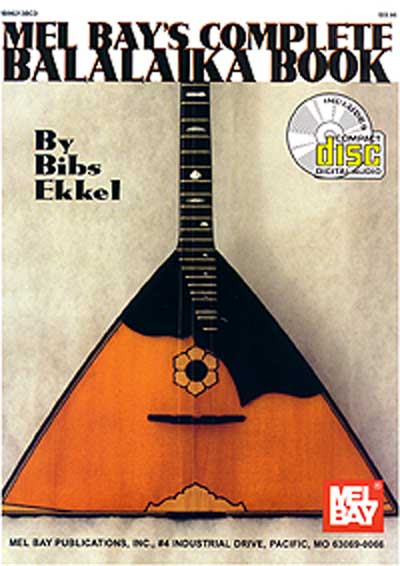
COMPLETE BALALAIKA BOOK Bibs Ekkel CD TABLATURE LIBRO SPARTITI METODO MUSICA PENTAGRAMMA

COMPLETE BALALAIKA BOOK. METHOD SHEET MUSIC BOOK WITH CD & TABLATURE.

LIBRO METODO DI MUSICA PER BALALAIKA, CON CD.

SPARTITI CON ACCORDI, PENTAGRAMMA, TABLATURE. 

TECNICA, FOTOGRAFIE, 

180 PAGINE

La Balalaika è molto spesso associata al Folklore Russo. In questo metodo completo, l'artista che si esibisce nei concerti e ha registrato molti dischi, Bibs Ekkel svela a noi la sua vasta conoscenza di balalaika come viene insegnata in Russia oggigiorno. Questo libro di 160 pagine è diviso in quattro parti: ampia Prefazione, Tutore, A Breve Storia di Balalaika, e parte del Repertorio. Diversamente dagli altri libri di Mel Bay, Metodo Completo di Balalaika non inizia dai rudimenti delle nozioni musicali. La prefazione di 20 pagine offre un panorama generale sulle accordature di tutta la famiglia della balalaika, posizioni delle mani, risorse delle accordature, aggiustamento dello strumento, settaggio della distanza tra le corde e le corde e la tastiera, ottimizzazzione, la forma degli accordi. L'autore descrive anche come fare il pletro per la balalaika bass con il cuoio da scarpe. Tutore o parte delle istruzioni è scritta  per la balalaika 'prima' che correttamente si suona solo con le mani senza usare il pletro. Gli esercizi ed intonazioni variano tra minime, semiminime, crome, biscrome, semi-biscrome, le note puntate occasionali e ritmo sincopato. Probabilmente metà di brani di questa parte è trascritta  con notazioni e tablature. Incluso un glossario dei caratteri musicali e terminologia russo. Una storia breve di Balalaika è ben scritto e illustrato. Rari libri di Mel Bay hanno cosi completo quadro generale dello strumento in questione. La sezione del Repertorio offre dei pezzi preziosi della musica folk dell'Est Europa. Tutti, tranne due selezioni di questa sezione sono scritte con notazioni, e tablature con i suggeriti accordi per la chitarra, ad eccezione di arragiamenti per balalaika e pianoforte e spartito per orchestra di balalaike.   Più che semplice spartiti di accordi melodiche, sono degli arrangiamenti d'autore dei accordi per balalaika solo e orchestra di balalaike. Il CD che contiene dei brani selezionati e eseguiti dal autore, completa questo altamente istruttivo pacchetto.

La Balalaika ha solo 3 corde, e le due più basse sono uguali, Mi, Mi, La. Ma fare le cose fatte bene e suonare meglio degli altri non è mai facile. Si suona con il plettro o con le dita. Questo libro molto completo con tutti i consigli e riferimenti precisi sulle dimensioni e distanze tra i vari modelli e la "sorella" Domra, anche lei a 3 corde, però con 3 note diverse Mi, La, Re. Non mancheranno certo i pezzi della tradizione Russa e quelli di repertorio, come "Slovyev Sedoi", dvie gitary, la csardas di Monti, il volo del calabrone,  tra le tecniche: il vibrato, il tremolo, pizzicato, per finire con la partitura di un pezzo completo per 5 Balalaike e 4 Domre. Molte le fotografie per aiutare meglio a conoscere il mondo di questo strumento.


Like some poor relative, the balalaika is all too often left out of encyclopedias and musical dictionaries and, when included, often dismissed as a "primitive, guitar-like instrument of limited range found in Eastern Europe". Such descriptions do no justice to this unique and very beautiful instrument that can, in the hands of a master, produce a range of sound and wealth of expression unrivalled by any other instrument.

One ofthe greatest problems directly affecting the balalaika's popularity is its almost total confinement to Russia and the non-availability in the West of literature, music, and teachers for the instrument. The purpose of this book is not only to provide the student with a precise description of all the various techniques available to the balalaika player, but also to contradict misconceptions about the instrument and how it is played. (Unfortunately, the lack of balalaika playing traditions and material in the West has led to the publication of some scurrilously inaccurate teaching methods. One widely available book, notwithstanding its superlative-sounding title, has, to the author's personal knowledge, caused more than one budding student to give up learning the instrument altogether. )

The playing methods described and illustrated here conform to standards as taught in Russia today and include minor additions and innovations stemming from the author's own practical experience. As with other instruments, disagreement exists as to certain playing techniques on the balalaika. Russia being the vast country it is, there are geographical differences in accepted playing norms. Passages can usually be played in more than one way and in different styles. Many players, becoming adept at certain styles over the years, find it difficult to accept alternatives to their own preferred style of playing: recognizing their own as being the only correct one. As every hand is slightly different both in shape and size, it is only natural that variations will occur between each hand's comfortable playing position.

One should always remember the immortal guitarist, Django Rheinhardt, who, with two fingers of his left hand missing, necessarily broke countless rules. He not only proved that devotion and determination come first on the list of requirements for becoming an able musician, but showed up many other musicians in the process. The author has endeavoured wherever possible to indicate where acceptable variations in method and style may occur. However, certain contentious issues should be cleared up straight away.


Product Description:

The balalaika is most often associated with Russian folklore. In this comprehensive method book, concert and recording artist Bibs Ekkel shares his extensive knowledge of the balalaika as taught in Russia today. This 160-page book is divided into four sections: an extensive Foreword, the Tutor, A Brief History of the Balalaika, and a Repertoire Section. Unlike many Mel Bay books, the Complete Balalaika Book does not begin with the rudiments of music notation. Rather, the 20-page Foreword offer insights on the tunings of all the instruments in the balalaika family, hand positions, string sources and height adjustment, and chord shapes. The author even describes how to make a bass balalaika pick from shoe leather. The Tutor or instruction segment is written for the 'prima balalaika' which is correctly played with the fingers only rather than with a pick. The Tutor jumps right in with exercises and tunes in quarter, eighth, and sixteenth-note values with occasional dotted notes and syncopation. Perhaps half of the music in this section is shown in both standard notation and tablature. A glossary of musical signs and Russian musical terns is included. A Brief History of the Balalaika is well written and nicely illustrated. Very few Mel Bay books contain such a comprehensive historical overview of the subject instrument. The Repertoire Section offers a valuable resource of Eastern European folk tunes. All but two selections in this section are written in both notation and tab with suggested guitar chords, the exceptions being an arrangement for balalaika and piano, and a balalaika orchestra score. More than simple melody chord leadsheets, these are the author's own arrangements of tunes for solo balalaika and balalaika orchestra. A companion CD with selections performed by the author completes this highly effective instructional package.

Exactly when the balalaika fIrst appeared isn't known. What is certain, however, is that the instrument is

native to Russia and probably stemmed from another, earlier Russian folk instrument - the domra. The round-bodied, two-stringed domra, reputedly the favorite instrument of the "skomorokhi" (the wandering minstrels in the Middle Ages) is believed to have been first brought to Russia from across the steppes in the 13th Century Tartar invasion. The earliest known reference to the balalaika is to be found in a document dated 1688 – an official report on the punishing of two men caught playing the instrument in flagrant defiance of the 1648 edict of Czar Alexei Mikhailovich, which banned the playing of all 'devilish' musical instruments. All instruments were to be confiscated and burned, and transgressors faced a public flogging and banishment to outlying regions of Russia (which is, in fact, where folk instrumental art eventually survived, far from official control). Back then, the instrument had a semi-spherical, oval, or triangular body and a long neck with 5 - 7 movable tied gut frets. Almost all instruments were home-made and their shape, number of strings and tuning tended to vary. However, two or three strings and a triangular body with a back made of four triangular wooden slats seems to have been most common. Balalaikas were played in rural communities, enjoying wide popularity until being superceded by foreign newcomers: first the accordion and then the 7-string guitar in the 19th Century. The balalaika had all but fallen into oblivion when it was "rediscovered" by a nobleman and amateur violinist, Vasili Vasilievich Andreyev, who chanced to hear the playing of a peasant (a certain Antip) on his family estate. Andreyev was eventually to be responsible for repopularizing the instrument, helping it gain respectability and placing it permanently on the concert platform. This tireless champion not only learned to play the balalaika well, but also initiated a number of changes and improvements to the instrument. Apart from permanent chromatically-arranged metal frets and changes in design to improve its acoustic qualities, he had different sizes made, so that when the balalaika reemerged, it was not only as a solo instrument, but as an orchestral one too - gaining immediate popularity for collective playing. Andreyev's first solo public performance in 1886 in St. Petersburg caused a sensation. Soon afterwards he formed a small circle of balalaika enthusiasts, playing the full range of newly improved instruments. Their fIrst public performance was in March 1888. Soon this group was expanded to form a larger ensemble called the Great Russian Imperial Balalaika Orchestra, incorporating the domra and gusli, which by then Andreyev had also redesigned and improved. He also composed several pieces for the balalaika. Of the luthiers Andreyev commissioned to make his redesigned models: Ivanov, Pasyerbsky, and Nalimov, it was with the latter that he formed the most permanent and productive relationship. Nalimov made and repaired instruments in the workshop on Andreyev's estate, producing instruments which were later emulated by all the best makers. At one stage, while money was short, Nalimov and Andreyev removed all the doors and window-sills at ... (continue)


Formato: Libro/CD Set
162 PAGINE

Contenuto:
Foreword
Finding the Right Strings
Tuning & Bridge Position
Bridge
Adjustment of Strings
Tuning of Orchestral Instruments
Strings for the Balalaika Orchestra
Picks for orchestral Instruments
Chord Shapes for Prima (and Alto) Balalaika
Balalaika Diagram

Tutor
Strings
Tuning
Holding The Balalaika
The Balalaika Fingerboard
The Left Hand
Strumming With The Thumb
Left Hand: Using The Thumb
Right Hand: Plucking With The Thumb
Strumming With The Index Finger
Annotation of Strokes
Tremolo
Tremolo on 2nd and 3rd Strings Only
Double Pizzicato
Single Pizzicato
Pizzicato & the Left Hand
Tremolo on One String
Vibrato
Tremolo With Vibrato
Rolls
Syncopation
Left Hand Pizzicato
Glissando
Harmonics
False Harmonics
Triads
"Guitar" Techniques
Guitar Tremolo
Guitar Pizzicato
Forward Guitar Pizzicato
Straight-Fingered Guitar Pizzicato
Guitar Picking
Tricks and Special Effects
Some Extra Difficult Strokes
General Advice on Practicing
Glossary of Musical Signs
Russian Musical Terms
Short Introduction to Timing 

A BRIEF HISTORY OF THE BALALAIKA

 
REPERTOIRE SECTION
 
Baa-Baa Black Sheep .
The Slender Rowan Tree .
God Save the Czar ,
In the Field a Birch Tree Stood .
The Ural Rowan Tree .
It's Not the Wind that Bends the Branch .
Dance, Dance .
Varyag .
Do Not Scold Me .
I Shall Go Down to the River .
I Loved You .
Goin' Home .
I Was in the Garden .
The Post Troika Hastens .
Moonshine .
Akh, Nastasya ,
Under the Apple Tree .
Polosynka .
Go Home You Gossips .
Dark Browed, Dark Eyed Lad .
Two Guitars .
Katiusha .
For Czar, Motherland and Faith .
A Cossack Crossed the Danube .
Leaf from an Album .
Daydreams
Prezzo: €43,99
€43,99

50 SOLOS FOR IRISH TENOR BANJO-Gerry O' Connor & David McNevin-CD TABLATURE LIBRO SPARTITI

50 SOLOS FOR IRISH TENOR BANJO. O' Connor. SHEET MUSIC BOOK WITH CD & TABLATURE
A unique collection for C G D A and G D A E tuning.

LIBRO DI MUSICA IRLANDESE CON CD. 

SPARTITI PER BANJO CON: 

PENTAGRAMMA E TABLATURE.


This collection of fifty jigs, reels and hornpipes is arranged for two types of tuning; the standard C G D A used by Gerry O'Connor, and the traditional G D A E tuning used by David McNevin. The first 25 tunes are played by Gerry O'Connor, whose creative and individual style has earned him the reputation of being one of Ireland's finest banjo players. The remaining 25 tunes are arranged and played by David McNevin, an extremely skillful player in the traditional style, who has received major awards for his achievements on the banjo. As David McNevin's solos are arranged for traditional tuning, the tablature may also be used for the mandolin.

In Irish traditional music playing it is not unusual to start a tune with an introductory note or two which are not part of the tune. It is also quite common to finish a tune with a long note or chord which is not part of the tune. If the tune was played in the middle of a set these notes would not be used. Usually they are not written, but in an effort to have the written music as close as possible to what is played on the companion CD they are included in this book. A finishing flourish is written as a note or chord in a small open-ended bar after the end of the tune. This note or chord does not indicate any specific duration for the finishing note or chord.

Product Description:
This book is the most comprehensive collection of banjo tunes currently available by two of the finest banjo players in Irish traditional music. Contains 50 tunes, featuring jigs, reels, and hornpipes arranged for E,A,D,G and A,D,G,C tunings. CD included.

The early origins of the instrument, now known as the banjo, are obscure. That its precursors came from Africa to America, probably via the West Indies, is by now well established. Yet the multitude of African peoples, languages and music make it very difficult to associate the banjo with any specific African prototype. From various historical references, however, it can be deduced that the banjar, or bangie or banjer, or banza, or banjo was played in early 17th-century America by Africans in slavery, who constructed their instruments from gourds, wood and tanned skins using gut or hemp for strings. This prototype was eventually to lead to the evolution of the modern banjo in the late 18th and early 19th centuries. Until 1800 the banjo remained essentially a black instrument, although, at times, there was considerable interaction between blacks and whites in enjoying music and dance - whites usually participating as observers. What brought the instrument to the attention of the nation, however, was a grotesque representation of black culture by white performers in minstrel shows. The very essence of minstrelcy was black-face caricatures, which became increasingly popular towards the end of the 18th century, leading to fully fledged black-face skits and songs on stages throughout white America by the middle of the 19th century. It was during this time that the banjo, in all probability, was introduced to Ireland, when the Virginia Minstrels toured in England, Ireland and France in 1843, 1844 and 1845. The leader of the Virginia Minstrels was Joel Walker Sweeney, who was born in Buckingham County, Virginia in 1810. Sweeney, whose antecedents came from Co. Mayo, has become one of the most controversial characters in the history of the banjo, having been credited with introducing the 5th string, or chantarelle, to the instrument. In fact, there are early watercolour paintings well before Sweeney's time that show the 5th string in plantation banjos. So Sweeney most certainly did not invent the 5-string banjo. What he did, however, was extend the popularity of the banjo to an enormous audience all over the United States and Europe. This leads to the question of what kind of banjo was initially introduced to Ireland. The overwhelming likelihood is that it was the 5-string banjo of the minstrels 4 and not the earlier 3- or 4-string variety which was common on the plantations. This is supported by a late 19thcentury sketch in Captain Francis O'Neill's Irish Minstrels and Musicians of piper Dick Stevenson and banjoist John Dunne, where the 5th string and peg on Dunne's banjo are clearly visible. By this tilll<' the banjo had undergone several transformations of a technological nature. Instead of tacking the skin head directly to the wooden hoop or gourd body, a thin metal band had been added, which sat on top of the wooden rim over the head by means of hooks and nuts which fastened through 'shows' mounted around the side of the body. The tightness of the skin could be adjusted. Factory-made gut string replaced the old homemade strings and round wooden hoops were used instead of hollow gourds, giving the instrument more durability. The minstrel banjo also lacked frets and as a result, playing above the 5th-string peg position posed a lot of severe intonation problems. It wasn't until 1878 that frets were added to the commercially produced banjo, a development credited to Henry Dobson of New York State. It took three decades of animated controversy for the idea to catch on. So the earliest Irish banjos were, it would appear, definitely fretless. Up to the turn of the 19th century banjos were plucked and strummed by the fingers. So the evidence, though it is circumstantial, would indicate that the banjo was used in Ireland for rudimentary accompaniment of songs and tunes with, perhaps, some of the simpler melodies being plucked out by the fingers. This all changed dramatically at the turn of the century when steel strings were invented. Influenced by the use of the plectrum in mandolin playing, banjo players started experimenting with different plectral playing styles. The idea of tuning the banjo in fifths, just like the mandolin, caught on around this time as well. Many players started to remove the short drone 5th string from the banjo, and before long banjo makers started manufacturing 4-string banjos, originally called plectrum banjos, which were full size 22-fret banjos just like the 5-string banjo, but lacking the 5th string. Then around 1915 the tango, or tenor banjo, was invented, coinciding with the popularity in America of this new dance form imported from Latin America, which was sweeping America at the time. The tenor banjo had 17 or 19 frets, a shorter neck tuned in fifths, just like the mandolin or fiddle, though not necessarily at the same ...


Song Title: Composer/Source:
An tAthair Jack Walsh, An
Bag of Spuds, The
Bill Harte's Jig
Boys of Blue HIll, The
Collins' Reel
Contradiction Reel, The
Crehan's Reel
Eddie Kelly's Reel
Entertainer, The
Fearghaill O'Gara
Finbar Dwyer's Reel
Flogging Reel, The
Flowers of Red Hill, The
Galway Hornpipe, The
Geese in the Bog, The
Glenbeigh Hornpipe
Groves, The
Harding's Jig
Hornpipe in G
Independent Hornpipe, The
Josie McDermott's Reel
Kelly's Reel
King of the Pipers
King's Fancy Jig
Kitty's Wedding
Lark in the Morning, The
McDonagh's Reel
McGann's Reel
McIntyre's Hornpipe
McKenna's Hornpipe
Mist Covered Mountain, The
Moloney's Reel
Moving Cloud, The
O'Dowd's Reel
Paidin O'Rafferty's Jig
Pay rthe Reckoning
Peacock's Feather, The
Peter's Street
Richard Dwyer's Reel
Roche's Reel
Sally Gardens, The
Silver Vale, The
Sonny Brogan's Jig
Star of Munster, The
Strand Jig, The
Swedish Jig, The
Three Sea Captains, The
Tipperary Hornpipe, The
Tom Ginley's Favourite
Tom Ward's Downfall

Prezzo: €39,99
€39,99

GUITAR ARPEGGIO ENCYCLOPEDIA ANDY MARTIN TABLATURE LIBRO SPARTITI CHITARRA PENTAGRAMMA

GUITAR ARPEGGIO ENCYCLOPEDIA, Andy Martin. TABLATURE

Product Description:
Throughout this book you will be exposed to many different types of arpeggios, their families, a horde of fingerings, how to use them and much more. With practice and patience you will be able to have total control on the fingerboard and you will be able to execute arpeggios with fire and finesse like the best players do. By understanding arpeggios it will immensely improve your improvising for song writing and soloing as well as creating majestic melodies and hooks. All of the material is presented in notation and tablature. Throughout my book you will be exposed to many different types of arpeggios, their families, a horde of fingerings, how to use them and much more. First, I would like to define what an arpeggio is in the simplest form. An arpeggio is simply chord tones played seoarately. For instance, if you played an A minor barre chord at the 5th fret with the root note on the sixth string and instead of strumming the chord, try muting the string slightly with your picking hand (rest your picking hand slightly on the bridge of the guitar). Then, pick each note separately and use all down strokes as you ascend and all up strokes as you descend. This is one of the simplest ways to play an arpeggio. You can do this to all the chords you know and you also can experiment with muting the strings or letting the strings ring out as you play them. Arpeggios are also considered as tonal centers. A tonal center tells you what family you belong to and is the center of tonality. For exempIe:

If you take a major scale 1-2-3-4-5-6-7 the tonal center is the 1-3-5-7 and it is colored with 2-4-6.

If you look at a G major scale the notes diatonically are G-A-B-C-D-E-F#. G is the first degree, A is the second degree, B is the third degree, C is the forth degree, D is the fifth degree and so on.

The tonal center in a G major seventh arpeggio is G B D F#. You can play these notes in any order but traditionally they are played in succession with each other 1-3-5-7.

You should also look at arpeggios as the outline of a scale or chord and you can add your colors to enhance them with flavor. The best analogy I can provide you with is to think of an artist with his pallet. He starts his painting or drawing with an outline, our arpeggio and then he puts a splash of red, green, blue, etc, to make his painting more vibrant. We take our outline, the arpeggio and enhance it with our colors, modal degrees, the 2, 4, 6, 9, 11, 13 or altered colors, sharps or flats. This way we can paint a picture with audibles instead of visuals, then we compose a picture, a story with harmonic content. In my book you will learn how to learn and obtain total control of executing arpeggios and why it is important to have a strong bakground in them. By understanding arpeggios it will immensely improve your improvising for song writing and soloing as well as creating majestic melodies and hooks. Arpeggios are very vocal and lyrical so you can create melodic melody lines or use arpeggios with blistering sweeping speed, incorporating them into you solos, compositions or even as pick up lines. A pick up line is a part of a composition that is played in the present and targets the future. For example, if the solo was about to be approached in your composition, you can playa lick, run, or an arpeggio in the measure before the solo starts to enhance or build up to the solo . Many great guitarists use arpeggios in their compositions and in their soloing. With a lot of practice and patience you will be able to have total control on the fingerboard and you will be able to executed arpeggios with fire and finesse like the best players do. You should also listen to all styles of music even if some styles don't appeal to your ears. Just because you don't like a style of music, it does not mean that you won't learn something from just listening to it. Being musicians and learning our language is what makes a difference in players. We must educate our minds and ears to their fullest extremes. Here are some of my favorite guitarists and composers and their works that exhibit their Arpeggio playing techniques.
Steve Vai: Flexible, Eat Em and Smile, Skyscraper, Passion and Warfare, Alien Love Secrets, Fire Garden, Ultra Zone
Frank Gambale Thunder From Down Under, Passages, Noteworker
Shawn Lane Power of Ten, Tritone Fascination (I love this record)
Yngwie Malmsteen Trilogy, Marching Out, Fire and Ice, Facing the Animal. (When I first started to play, I was studying classical guitar and I heard some of Yngwie's work. I was attracted to the way Yngwie exhibited total control of his exotic 
arpeggios and was a major influence in my passion.)
Paul Gilbert Street Lethal, King of Clubs (Paul has an amazing picking technique that was showcased with Racer X)
Johann Sebastian Bach Goldberg Variations, Trio Sonatas, Piano Sonatas, Toccata and Fugue in D minor, Partita NO.2 in D 
minor, Suite for Lute in E Major, (too many to list!)
Ludwig Van Beethoven Fur Elise, Piano Sonatas Nos. I, 2 & 3, Piano Concertos Nos. 2 & 5 "Emperor"


Contents:
1) Acknowledgements
2) Introduction
3) How to Approach This Book
4) Arpeggios Fingerings
5) Arpeggios Families & Interval Formulas
Major Arpeggios
Minor Arpeggios
Diminished
Major 7th
Dominant 7th
Minor 7th
Minor 7th 5
Diminished 7th
Augmented
Major add 9
Minor add 9
Major 6th
Minor 6th
Major sus 4
Minor sus 4
Major 9th
Dominant 9th
Minor 9th
Dominant #9th
Major 7th add #11
Dominant 11th
Minor 11th
Major 13th
Dominant 13th
Minor 13th
Minor/Major 7th
Minor/Major 9th

6) Picking Techniques
7) Superimposing Arpeggios
8) Harmonizing Arpeggios
9) Parallel Harmonies
10) Modal/Diatonic Harmonies
11) Very Violent Riffs and Licks!

Prezzo: €31,99
€31,99
Condividi contenuti