SPARTITI PER CHITARRA DI MUSICA CLASSICA

60 PROGRESSIVE SOLOS FOR CLASSICAL GUITAR Bach Handel Mozart Beethoven Brahms CD TABLATURE

60 PROGRESSIVE SOLOS FOR CLASSICAL GUITAR, Featuring the Music of the World's Greatest Composers: Bach, Handel, Mozart, Beethoven & Brahms. SHEET MUSIC BOOK WITH CD & GUITAR TABLATURE . 

LIBRO DI MUSICA CLASSICA PER CHITARRA CON CD.

SPARTITI PER CHITARRA CON : PENTAGRAMMA E TABLATURE.


60 PROGRESSIVE SOLOS FOR CLASSICAL GUITAR
Featuring the Music of the World's Greatest Composers: Bach, Handel, Mozart, Beethoven & Brahms
Series: Guitar
Publisher: Cherry Lane Music
Format: Softcover Audio Online – TAB
Arranger: Mark Phillips

Most classical guitar folios feature compositions by the lesser-known “guitar” composers. This collection, however, exclusively features music by the world's most renowned composers. The works of Johann Sebastian Bach and George Frederick Handel represent the culmination of the Baroque era. Wolfgang Amadeus Mozart stands at the summit of the Classical era. Ludwig van Beethoven straddles the Classical and Romantic eras, and Johannes Brahms is the giant of the Romantic era. For educational purposes, the pieces have been organized in order of difficulty within each composer's section. In addition, complete performances of all pieces can be heard on the accompanying audio. Enjoy! Includes: Jesu, Joy of Man's Desiring • The Harmonious Blacksmith • Ode to Joy • Lullaby • and more.

Audio is accessed online using the unique code inside the book and can be streamed or downloaded. The audio files include PLAYBACK+, a multi-functional audio player that allows you to slow down audio without changing pitch, set loop points, change keys, and pan left or right.

Inventory #HL 02500584
ISBN: 9781575606286
UPC: 073999887044
Width: 9.0"
Length: 12.0"
120 pages


Air - Composed by Johann Sebastian Bach

Bourree - Composed by Johann Sebastian Bach

March from the notebook for Anna Magdelena - Composed by Johann Sebastian Bach

Minuet 1 - Composed by Johann Sebastian Bach

Minuet 2 - Composed by Johann Sebastian Bach

Minuet 3 from the notebook for Anna Magdelena - Composed by Johann Sebastian Bach

Minuet 4 - Composed by Johann Sebastian Bach

Minuet 5 from the notebook for Anna Magdelena - Composed by Johann Sebastian Bach

Minuet 6 from the notebook for Anna Magdelena - Composed by Johann Sebastian Bach

Air (Originally Untitled) from the notebook for Anna Magdelena - Composed by Johann Sebastian Bach

A Child Is Born in Bethehem - from Cantata n.65 - Composed by Johann Sebastian Bach

Chorale from the notebook for Anna Magdelena - Composed by Johann Sebastian Bach

Jesu, Joy Of Man's Desiring - Composed by Johann Sebastian Bach

Jesu, Meine Freude (Chorale) - Composed by Johann Sebastian Bach

The Harmonious Blacksmith - Composed by George Frideric Handel

Gavotte - Composed by George Frideric Handel

Sarabande - Composed by George Frideric Handel

Minuet - Composed by George Frideric Handel

Adagio 1 - Composed by George Frideric Handel

Adagio 2 - Composed by George Frideric Handel

Adagio 3 - Composed by George Frideric Handel

Bourree 1 - Composed by George Frideric Handel

Bourree 2 - Composed by George Frideric Handel

Bourree 3 - Composed by George Frideric Handel

Allegro 1 - Composed by George Frideric Handel

Allegro 2 - Composed by George Frideric Handel

Andante - Composed by George Frideric Handel

Theme - Composed by Wolfgang Amadeus Mozart

Minuet 7 - Composed by Wolfgang Amadeus Mozart

Trio 1 - Composed by Wolfgang Amadeus Mozart

Trio 2 - Composed by Wolfgang Amadeus Mozart

Andante 1 - Composed by Wolfgang Amadeus Mozart

Andante 2 (2nd Movement) From Piano Concerto n.20 - Composed by Wolfgang Amadeus Mozart

Andante 3 (2nd Movement) From Piano Concerto n.15 - Composed by Wolfgang Amadeus Mozart

Allegro (1st movement theme) from Piano Concerto n.13 - Composed by Wolfgang Amadeus Mozart

Russian Folk Tune - Composed by Ludwig van Beethoven

Pretty Minka - Composed by Ludwig van Beethoven

German Dance 1 - Composed by Ludwig van Beethoven

German Dance 2 - Composed by Ludwig van Beethoven

Ecossaise - Composed by Ludwig van Beethoven

Country Dance - Composed by Ludwig van Beethoven

Landler (Tyrolean Air) - Composed by Ludwig van Beethoven

Ode to Joy - Composed by Ludwig van Beethoven

Dance - Composed by Ludwig van Beethoven

Bagatelle 1 - Composed by Ludwig van Beethoven

Bagatelle 2 - Composed by Ludwig van Beethoven

Lullaby - Composed by Johannes Brahms

Symphony No. 3 (3rd Movement) - Composed by Johannes Brahms

Waltz 1 (Op. 39, No. 02) - Composed by Johannes Brahms

Waltz 2 (Op. 39, No. 15) - Composed by Johannes Brahms

Like a Melody - Composed by Johannes Brahms


I pezzi di questo libro sono ordinati per difficoltà crescente.

Prezzo: €27,99
€27,99

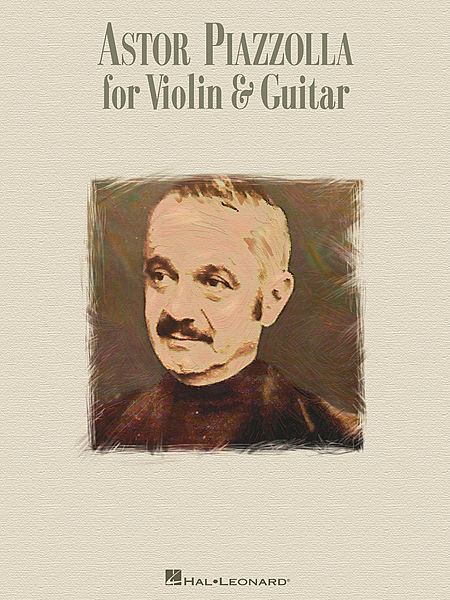
PIAZZOLLA ASTOR FOR VIOLIN & GUITAR HAL LEONARD LIBRO SPARTITI CHITARRA VIOLINO SHEET MUSIC BOOK

PIAZZOLLA ASTOR, FOR VIOLIN & GUITAR. SHEET MUSIC BOOK IN STANDARD NOTATION. 

LIBRO DI MUSICA. 
SPARTITI PER CHITARRA E VIOLINO, IN PENTAGRAMMA. 

Composer: Astor Piazzolla

Astor Piazzolla (1921-1992) was the foremost composer and ambassador of tango music, who carried the signature sound of Argentina to clubs and concert halls around the world. This folio gathers 35 of his finest and arranges them for violin and guitar duets. Includes bio. 80 pages
Titles include:

Astor Piazzolla (1921-1992) was the foremost composer and ambassador of tango
music, who carried the signature sound of Argentina to clubs and concert halls around
the world.
Piazzolla was born in 1921 in Mar del Plata, on the coast south of Buenos Aires, but
lived in New York City from 1924 to 1937. In New York the young Piazzolla tuned into the
vibrant jazz scene and bandleaders such as Duke Ellington and Cab Calloway. At age 12,
he received his first bandoneon, a type of button accordion that is the principal voice
of tango, and began playing music from the classical repertoire. Soon after his family
returned to Argentina in 1937, Piazzolla joined the popular tango orchestra of Anibal
Troilo and-while still a teenager-established himself as a talented bandoneon player
and arranger.
In Argentina, Piazzolla continued to study classical music, too, with the composer
Alberto Ginastera and others. In 1954, Piazzolla's composition "Buenos Aires" won
him a scholarship to study in Paris with Nadia Boulanger, who encouraged him to
find his own voice by tapping into his passion for tango. Back in Argentina in the
late 1950s, Piazzolla did just that, laying the groundwork for what become known as
tango nuevo-new tango.
In 1960 he formed his seminal group Quinteto Tango uevo, featuring bandoneon
alongside violin, guitar, piano, and bass. In the ensuing years Piazzolla's music increasingly
used dissonance, metrical shifts, counterpoint, and other techniques inspired
by modern classical composition and jazz orchestras. In Argentina, where tango is a
source of national pride and identity, some tango purists were incensed by these radical
departures from tradition, and in the late 1960s even Argentina's military government
criticized Piazzolla for being too avant-garde. Piazzolla left behind a huge body of music-more than 750 works-and classic recordings such as Adios Nonino and Tango:
Zero Hour, as well as collaborations with artists as diverse as poet/author Jorge Luis
Borges (El Tango), jazz vibraphonist Gary Burton (The New Tango), and the Kronos
Quartet (Five Tango Sensations). In 1986, Piazzolla's music was featured in the
Broadway hit Tango Argentino. In 2001 Amadeus Press published Astor Piazzolla: A
Memoir, the remarkable life story (as told to journalist Natalio Gorin) of one of the 20th
century's true musical iconoclasts.


1958 - Adios nonino  - Yves Paul Martial Puech, Asto Piazzolla
1957 - Boricua - Astor Piazzolla
1963 - Buenos Aires Hora Cero - Astor Piazzolla
1960 - Calambre - Astor Piazzolla
1960 - Decarisimo - Astor Piazzolla
1958 - Dernier lamento - Roger Auguste, Charles Desbois, Albert Abraham, Ben Soussan, Astor Piazzolla
1957 - Détresse - Astor Piazzolla
1962 - Extasis - Astor Piazzolla
1958 - Fièvre (Fiebre de Tango) - Albert Abraham, Ben Soussan, Albert Noel De Marigny Engeurrand
1963 - Fracanapa - Astor Piazzolla
1958 - Greenwich - Albert Abraham, Ben Soussan, Andre Psieto, Astor Piazzolla
1958 - Gulinay - Astor Piazzolla
1962 - Imàgines 676 - Astor Piazzolla
1963 - racundo - Astor Piazzolla
1960 - La Calle 92 - Astor Piazzolla
1962 - La fin del mundo - Oscar Nicolas Fresedo, Astor Piazzolla
1960 - Las Furias - Astor Piazzolla
1958 - Llueve Sobre Broadway - Raoul Cohzales, Astor Piazzolla
1961 - Los Poseidos -  Yves Paul Martial Puech, Astor Piazzolla
1960 - Made In USA  - Asto Piazzolla
1957 - Mi Exaltacion - Asto Piazzolla
1957 - Misteriosa VidaGuy Favreau, Astor Piazzolla
1957 - Nuevo Mundo - Astor Piazzolla
1957 - Presentania - Astor Piazzolla
1962 - Psicosis - Astor Piazzolla
1960 - Recuerdo New York - Astor Piazzolla
1963 - Revirado - Astor Piazzolla
1957 - Romantico Idilio (Sans ta presence) - Astor Piazzolla Gay Favreau, Albert Abraham, Ben Soussan, 
1964 - Se Termino (C'est fini) - Astor Piazzolla
1957 - Suavidad - Astor Piazzolla
1964 - Tango choc (Doudou) - Astor Piazzolla
1958 - Tanguisimo - Astor Piazzolla
1958 - Te quiero tango - Astor Piazzolla
1962 - Todo Fue - Diana Piazzolla, Astor Piazzolla
1958 - Yo canto un tango - Astor Piazzolla

Prezzo: €25,99
€25,99

PIAZZOLLA ASTOR HISTOIRE DU TANGO LATIN DANCE CLASSICS FOR FLUTE & GUITAR CD BASI

PIAZZOLLA ASTOR, HISTOIRE DU TANGO AND OTHER LATIN DANCE CLASSICS FOR FLUTE & GUITAR. CD

LIBRO DI MUSICA CON CD DI BASI.
SPARTITI PER CHITARRA E FLAUTO, IN PENTAGRAMMA. 
BASI PER FLAUTO

Series: Music Minus One

Publisher: Music Minus One
Medium: Softcover with CD
Composer: Astor Piazzolla
performed by Katarzyna Bury, flute
Accompaniment: Christian Reichert, guitar

Guitar and flute virtuosi Christian Reichert and Katarzyna Bury bring you this album featuring Argentina's most fabled 20th-century tango composer, Astor Piazzolla, who wrote this suite of tango pieces bridging a century of tango styles, drawn in a rich pallette for guitar and flute duet. Alongside this wondrous composition is a quartet of dance classics from such composers as Enrique Granados and Pablo de Sarasate. Sensational music and not to be missed! Includes an authoritative, newly engraved solo part printed on high-quality ivory paper, and a compact disc containing a complete version with soloist; then a second version in digital stereo of the orchestral accompaniment, minus the soloist. 77 pages


ASTOR PIAZZOLLA :

Histoire du tango

Bordel 1900

Café 1930

Nightclub 1960

Concert D'aujourd'hui


ENRIQUE GRANADOS :

Danza Espagnola Op.37

N. 5 Andaluza (Playera)


PABLO DE SARASATE :

Playera

Romanza Andaluza


Histoire du Tango: 1. Bordel 1900 Performed by Astor Piazzolla

Histoire du Tango: 2. Cafe Performed by Astor Piazzolla

Histoire du Tango: 3. Nightclub Performed by Astor Piazzolla

Histoire du Tango: 4. Concert d'aujourd'hui Performed by Astor Piazzolla

Spanish Dances, op. 37, H142: 5. Andaluza (Playera) Performed by Enrique Granados (arr. Reichert & Bury)

Romanza Andaluza Performed by Pablo de Sarasate

Playera Performed by Pablo de Sarasate

Prezzo: €41,99
€41,99

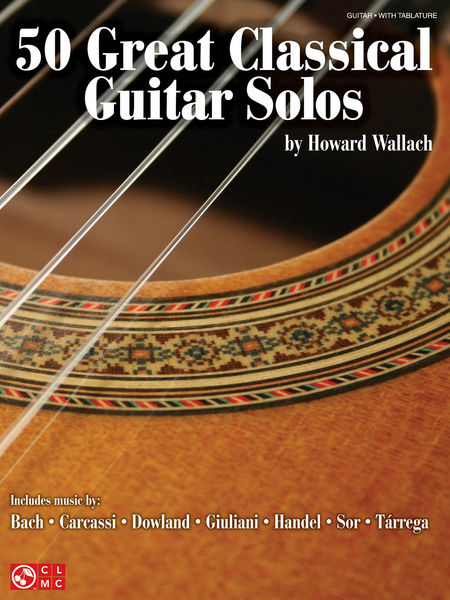
50 GREAT CLASSICAL GUITAR SOLOS Howard Wallach-Carcassi-Dowland-Giuliani-Handel-Sor-Tárrega

50 GREAT CLASSICAL GUITAR SOLOS, Howard Wallach. Bach, Carcassi, Dowland, Giuliani, Handel, Sor, Tárrega, e altri. 114 pagine. TABLATURE

LIBRO DI MUSICA CLASSICA,

SPARTITI PER CHITARRA CON:

PENTAGRAMMA E TABLATURE. 

 
Mauro Giuliani (1781-1829) è il più importante chitarrista compositore italiano dell’Ottocento. Pugliese di origini, si trasferì a Vienna dove la chitarra era già usata da musicisti come Diabelli, Molitor e Matiegka.

Mauro Giuliani. (Bisceglie, 1781 – Napoli, 1829). il più grande chitarrista-compositore italiano del secolo XiX, Mauro giuliani, esponente degnissimo del classicismo musicale, nacque a Bisceglie il 27 luglio 1781. non sappiamo molto dei suoi anni giovanili trascorsi in Italia; non era di famiglia indigente e prima di intraprendere la strada verso Vienna, dove sarebbe diventato famoso, ebbe modo di formarsi una solida preparazione musicale. oltre alla chitarra, suonava il violoncello, ed è comunque evidente, fin dalle prime composizioni date alle stampe nella capitale austriaca, la sua padronanza dell’armonia e delle forme musicali. Come virtuoso, dovette rendersi ben presto conto del fatto che, in patria, la musica da camera era una “cenerentola” e che il favore del pubblico si rivolgeva soprattutto al melodramma. Prese così la strada della capitale dell’impero austriaco: se si trattò di un esilio, fu dei più felici. Vienna – la Vienna turbata dalla minaccia napoleonica ma, dopo Waterloo, rasserenata nella sua imperiale magnificenza – accolse nel 1806 il venticinquenne Mauro giuliani, proveniente dalla Puglia e incline a qualificarsi come napoletano: qualifica non usurpata, poiché la sua regione era allora incorporata al Regno di napoli e probabilmente anche perché a napoli egli aveva studiato. il giovane virtuoso aveva abbandonato l’italia per cercare al nord i favori di un’aristocrazia colta e munifica, di una borghesia amante della musica e di un’editoria occhiuta e sagace. Vienna era per lui la città ideale, e vi giunse nel momento più propizio: la chitarra stava incuriosendo la società viennese, le cui diverse classi sociali si radunavano nei teatri, nelle sale da concerto, nei salotti, per fare e ascoltare musica. in quell’eldorado musicale, la chitarra non era una novità: Anton Diabelli, simon Molitor e Wenzeslaus Matiegka avevano raccolto i rigagnoli di una passione che si stava infervorando e, con le loro composizioni, avevano conferito un

Series: Guitar

Publisher: Cherry Lane Music
Softcover - TAB
Arranger: Howard Wallach

Covering music from the Renaissance, Baroque, Classic and Romantic eras, this fabulous collection includes 50 solos in notes and tab from Bach, Carcassi, Dowland, Giuliani, Handel, Sor, Tárrega and other acclaimed composers. 114 pages


Types of Dances and Pieces

Pavan = A dance of Italian origin popular in the 16 th and 17 th centuries. It was in simple duple time and of stately character.

Villanella = Street song popular in the 16 th Century, also a type of part-song less complex than the madrigal.

Finale = The last movement of a work in several movements.

Chaconna = Originally a dance of 3-in-a-measure rhythms, with the music built on (over) a ground bass. Sometimes there is no actual ground bass, but the music falls into a number of short sections similar to those written over a ground bass.

Bouree = A lively dance in quadruple time beginning with an up beat.

Allemanda = A dance usually in 4/4, but sometimes in duple meter. Often found as the
first dance of a suite. It is serious in character and of moderate speed.

Romanesca = 1) A kind of galliard from Romagna.
2) A certain melody popular in the 17 th Century as a ground bass.

Volta = A quick dance in triple meter; also known as "Lavolta" or ILaVolta,"
similar to the galliard.

Courante = A French dance popular in the 17 th and 18 th centuries and commonly found in the baroque suite. There are two types:
1) The Italian variety: rapid tempo in simple triple time.
2) The French variety: similar to the Italian, but with a different character and in quadruple meter.

Menuet = - A stately court dance of the 17 th and 18 th centuries in triple time. It was an optional movement of the suite and is found later in the classical symphonies of Haydn and Mozart.

Passepied = A lively dance in 3/8 or 6/8 time, which originated amongst French sailors, and later became popular at court.

Sarabande = A slow and stately dance form in triple time. It was a standard movement
of the baroque suite. There had existed an earlier, lively version.

Waltz = A dance in 3/4 time which came into prominence in the last quarter of the 18 th
Century. It rose to tremendous popularity in the 19 th Century, especially in Vienna.

Caprice = A light, quick composition with an improvisational feel, often including
striking or original effects.

Bagatelle = A short unpretentious instrumental composition; a trifle.

Landler = A type of slow waltz originating in northern Austria.

Prelude = A piece of music which precedes something else. In the 19 th and 20 th centuries, a self-contained short instrumental piece which sets a mood.

Mazurka = A traditional Polish country dance in triple time with an accentuation of the second beat of each measure and an ending of the phrases on that beat.


Table of Contents
Signs, Symbols, and Terms .
Found in this Book
Music of the Renaissance
Pavan V Milan .
Pavan VI Milan .
Polish Dance I Anonymous .
Polish Dance II Anonymous .
Villa nella Dlugoraj .
Finale Dlugoraj .
Pa van Byr d .
Mr. Dowland's Midnight Dowland .
My Lord Willoughby's Dowland .
Welcome Home
Music of the Baroque Era
La Chaconna Vallet .
B0urre e Va IIe t .
Allemanda Calvi .
Romanesca Calvi .
Volta Galilei .
Courante Sweelinck .
Menuet de Visee .
B0urre e de Vise e .
Passepied I Le Cocq .
Passepied II Le Cocq .
Menuet Handel '
Oh Sacred Head Now Wounded Bach .
Sarabande Bach .
Bourre e Bach .

Music of the Classic Era
Study in G Major Aguado '
Wa Itz Aguado ,
Andantino Carulli .
Waltz Caru Iii .
Andante Carulli .
Study in A Major Carcassi .
Study in E Minor Carcassi .
Ca price Carcassi .
Allegretto Giuliani .
Andantino Giuliani .
Study in A Minor Giuliani .
Andante Sor .
Study in A Major Sor .
Study in D Major Sor .
Minuet Sor .
Music of the Romantic Era
Bagatelle Schumann .
La nd Ier I Mertz .
Landler II Mertz .
Study in C Major Coste .
Study in A Minor Coste .
Prelude Coste .
Russian Song Tchaikovsky .
Prelude in D Major Tarrega .
Prelude (Endecha) Tarrega .
Prelude in D Minor Tarrega .
Prelude in E Major Tarrega .
Mazurka Tarrega.
 

Prezzo: €19,99
€19,99

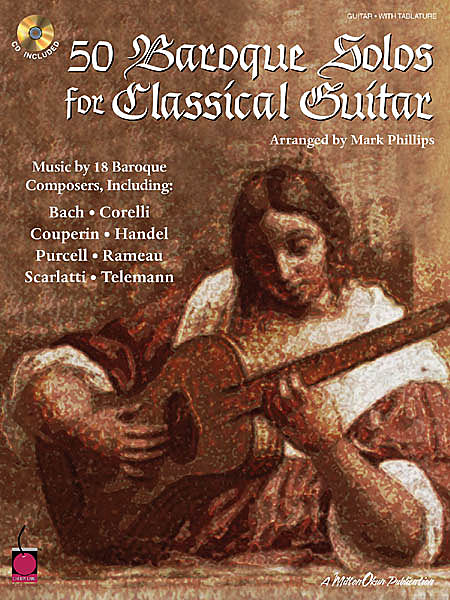
50 BAROQUE SOLOS FOR CLASSICAL GUITAR Mark Phillips LIBRO CD TABLATURE CHITARRA SPARTITI

50 BAROQUE SOLOS FOR CLASSICAL GUITAR, Mark Phillips. Bach, Corelli, Couperin, Handel, Purcell, Rameau, Scarlatti, Telemann e altri. SHEET MUSIC BOOK WITH CD & GUITAR TABLATURE .

LIBRO DI MUSICA CLASSICA CON CD. 

SPARTITI PER CHITARRA : 

PENTAGRAMMA, TABLATURE. 

Series: Guitar
Publisher: Cherry Lane Music
Softcover with CD - TAB
Arranger: Mark Phillips

50 fantastic guitar solos in notes and tab from 18 Baroque composers, including Bach, Corelli, Couperin, Handel, Purcell, Rameau, Scarlatti, Telemann and others. 64 pages

Johann Sebastian Bach

Aria

Be Content

Be Thou with Me

Gavotte (from French Suite No.5)

Minuet 1

Minuet 2

Sheep May Safely Graze

Sinfonia


John Blow

Air


Arcangelo Corelli

Largo

Sarabande 1

Sarabande 2


Francois Couperin

Cuckoos (from French Follies)

The Harvesters

Le Petit Rien

The Thorny One


Louis-Claude Daquin

Noel


Elisabeth-Claude Jacquet de la Guerre

Minuet


Charles Dieupart

Gavotte

Minuet

William Duncombe

Sonatina


Adam Falckenhagen

Minuet


Christopher Graupner

Air en Gavotte


George Frederick Handel

Bourree (from Water Music)

Coro (from Water Music)

Gavotte

March (from Scipio)

Minuet 1

Minuet 2

Minuet 3

Passepied 1

Passepied 2

Sarabande


Henry Purcell

Air

A Farewell (The Queen's Dolour)

Minuet

Rigadoon


Jean Phillippe Rameau

Rigaudon

Rondino


Valentin Rathgeber

Musical Pastime


Domenico Scarlatti

Gigue

Largetto

Minuet 1

Minuet 2


J. S. Scholze

Dance Song


Georg Philipp Telemann

Bourree

Burlesca

Minuet

Scherzino


Wenzel von Radolt

Minuet

Prezzo: €24,99
€24,99

PARKENING CHRISTOPHER DUETS & CONCERTOS 234 Pagine TABLATURE CHITARRA GRANADOS SPARTITI

PARKENING CHRISTOPHER, DUETS & CONCERTOS. 234 Pagine. SHEET MUSIC BOOK WITH GUITAR TABLATURE .

LIBRO DI MUSICA CLASSICA,

SPARTITI PER CHITARRA :

PENTAGRAMMA, TABLATURE .


CHRISTOPHER PARKENING – DUETS & CONCERTOS
Series: Guitar Recorded Versions
Format: Softcover – TAB
Artist: Christopher Parkening

Throughout his career, Christopher Parkening, America's preeminent classical guitarist, has had the opportunity to perform with many of the world's leading artists and orchestras. This folio, Duets and Concertos, contains many selections from those collaborations, and features a wide range of musical pairings which show the guitar at its versatile best: voice and guitar, guitar duets, chamber music, and concertos. All of the pieces included here have been edited and fingered for the guitar by Christopher Parkening, and to quote Christopher himself, “No compromise has been made in requirement of technique. All of these pieces are suitable for performance by the virtuoso guitarist.” This folio contains 35 transcriptions. 


Table of contents :

Berceuse
Canon
Ciranda Bambole
City Called Heaven
Come Again! Sweet Love Doth Now Invite
Con Amores, la mi Madre
Concerto In C Major
Concerto In D Major
Dormi Jesu
Drewries Accordes
Fine Knacks For Ladies
Infant Holy, Infant Lowly
Jesus, The Light Of The World
The King's Hunt
La Maja de Goya
La Rossignol
La Volta
Lamento
Lord, I Couldn't Hear Nobody Pray
Mary And Her Baby Chile
Mary Had A Baby
Methinks I See An Heav'nly Host
Offertorio
An Old Music Box (Ou I'on entend une vieille boite a musique)
Pampano Verde
Quittez Pasteurs
Round The Glory Manger
Sanctify Us By Thy Goodness
Silent Night
Sometimes I Feel Like A Motherless Child
Suo Gan
Trio In C Major
The Virgin Mary Had A Baby Boy (Caribbean Carol)
Watkin's Ale
Wexford Carol
What If I Never Speed?

Inventory #HL 00690938
ISBN: 9781423434757
UPC: 884088217068
Width: 9.0"
Length: 12.0"
232 pages
 

Prezzo: €34,99
€34,99

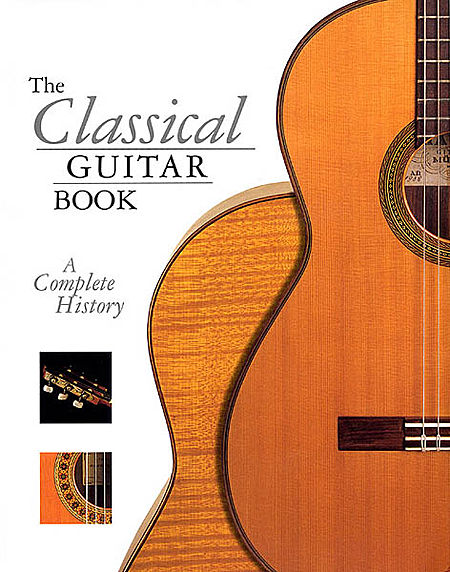
THE CLASSICAL GUITAR BOOK A Complete History by John Morrish LIBRO CHITARRE HAUSER FLETA

THE CLASSICAL GUITAR BOOK, A Complete History. John Morrish.

Serie: Book

Editore: Backbeat Books

Copertina morbida

Autore: John Morrish

The Classical Guitar Book
A Complete History
Series: Book
Publisher: Backbeat Books
Format: Softcover
Author: John Morrish

Inventory #HL 00330989
ISBN: 9780879307257
UPC: 073999309898
Publisher Code: 0879307250
Width: 10.0"
Length: 12.5"
126 pages

Hermann Hauser è considerato il più famoso produttore di chitarre classiche fuori Spagna che ha sviluppato le regole fondamentali della costruzione e design impostate da Torres, applicando a esse “i suoi principi teutonici di ingeneria” come li ha descritto Julian Bream. Ecertamente il fatto che le sue chitarre erano usate da Andres Segovìa più che favorito la reputazione di lutaio tedesco.

Hermann era il figlio di Josef Hauser, un musicista che suonava e faceva le cetre e altri strumenti musicali dall all'età di 18 anni: dal 1905 ha iniziato a produrre le chitarre i liuti. (Herman Hauser è chiamato come Herman I per distinguerlo dal figlio e nipote che anche portano il nome Hermann, anche loro fabricatori di chitarre.) Tutto questo tempo Hauser suonava in un quartetto è oltre a questa attivita, sperimentava nella costruzione delle chitarre alto e chitarre basso. Comunque lui attende il concerto di Miguel Liobet, uno dei più prominenti allievi di Francisco Tárrega, durante il tour del 1913-14. Llobet suonva la chitarra di Torres del 1859 e Hauser ha capito le potenzialità delle chitarre tradizionali di Torres. Così è iniziato il processo della costante ricerca. Secondo la ricerca di Franz Jahnel, pubblicato nel suo “Manuale delle Tecnologie Chitarristiche” del 1981, nel 1920 Hauser ha fatto una serie di conclusioni dopo lo studio degli effetti causate dal posizionamento assimetrico dei listelli. Nello stesso anno Hauser ha brevettato il progetto per il nuovo tipo di cassa armonica. Il top della sua chitarra veniva sostenuto con un listello trasversale e due listelli longitudinali, il listello trasversale sotto il top della corda MI con l'intenzione di rafforzare le note alte. Houser ha incontrato Andrés Segovia nel 1924 durante suo primo tournè in Germania e questo incontro ha aperto le future possibilità per il progresso. Per esempio, Segovia ha invitato il lutaio a esaminare e misurare la sua famosa chitarra di Manuel Ramírez/Santos Hernádez quale il chitarrista ha acuistato nel negozio di Ramírez a Madrid nel 1912 prima del suo debutto. A sua volta Segovia ha seguito il concerto di chitarristi che suonavano le migliori chitarre di Hauser come lui ha ricordato nelle memorie dedicate a Hauser e pubblicate nel 1954 nella revista “Guitar Review”.

Le chitarre erano costruite dal Hauser”, scrive Segovia del concerto. “Le ho esaminato tutte e ho subito capito il potenziale di questo superbo artigiano, se la sua maestria potess essere applicata alla costruzione delle chitarre sui modelli spagnoli immutabilmente impostati da Torres e Ramírez come per il violino erano stabiliti da Stradivarius e Guarnerius.” Da quel momento Hauser ha iniziato a lavorare per crearequello, che Segovia avrebbe chiamato ”la più grandiosa chitarra dell'epoca”. Questo lavoro ha occupato alcuni anni, ma nel 1937 Hauser ha prodotto uno strumento che Segovia ha accettato con grande piacere. Josè Romanillos ha commentato tutta la complessita dello svilupo di Hauser I durante questi anni e l'influenza dei concetti spagnoli dopo il 1924. “Le chitare di Hauser subendo l'influenza spagnola sono divise in due categorie: una che segue il modello di Ramírez e altra che con un tocco ingenioso e innovativo ritorna al modello basilare di Torres. Nelle sue chitarre basate sul modello di Ramírez, si vede la sua influenza nella scelta del design della testa, largo posizionamento dei listelli e nelle dimensioni,” scrive Romanillos nel suo libro dedicato a Torres. “Houser ha provato diversi combinazioni e forme per i suoi strumenti anche dopo che ha prodotto per la Segovia la chitarra 1937. In alcune di queste chitarre intodotto un'amalgama di due maestri: forma arrotondata e e più armoniosa degli strumenti di Manuel Ramírez e alcune detagli che ricordano le forme delle chitarre di Torres come la testa, la lunghezza della scala e le decorazioni.”

Romanillos prosegue dicendo che prima del 1940 le chitarre di Hauser dimostravano ancor più forte affinità con le chitarre di Torres forse anche perchè proprio in questo periodo Hauser aquistò uno suo strumento creato nel 1960. Romanillos conclude che mentre non c'è alcun dubbio che la chitarra di Ramírez apartenente a Segovia ha avuto il ruolo principale nella crescita di questo grande produttore di chitarre....ma il sistema ortodossale di Torres che ha finalmente dato le basi per la costruzione delle chitarre di Segovia”. In questo modo Hauser ha incorporato i migliori elementi del design delle chitarre sviluppato in Spagna durante il dicianovesimo e al inizio del ventesimo secolo.


Libro di alta qualità da mettere in mostra, che propone testi dei più noti esperti del mondo ; il primo lavoro che racconta la storia completa della chitarra classica e del suo repertorio, degli artisti e  produttori  - dalle radici europei del 19 secolo alla moderna interpretazione internazionale. Questo bel libro con la copertina morbida è illustrata con le fotografie grandi delle chitarre classiche prodotte dai migliori lutai del mondo. Un'edizione addizionale parla del uso di chitarra classica nella musica pop, delle tecniche diverse di apprendimento e insegnamento; del mercato di collezionisti e la scienza della chitarra. Fa conoscere i profili di artisti famosi come Andrès Segovia, Julian Bream e John Williams; e in più, la, completa discografia, il glossario, l'indice, la biografia, tabella delle misure . 


Offering essays by the world's top experts in a full-color, coffee-table quality book, this is the first work to tell the complete story of the classical guitar and its repertoire, players and makers - from its 19th century European roots to modern international interpretations. This handsome softcover volume features lavish photography of classical guitars made by the best luthiers in the world. Additional essays cover use of the classical guitar in pop music, different playing and teaching techniques, the collectors' market, and the science of the guitar. It also features profiles of legendary artists such as Andrés Segovia, Julian Bream and John Williams, plus a full discography, a glossary, an index, a bibliography, and a guitar measurement chart. 126 pages.

A more attractively presented pictorial book on the classical guitar I cannot imagine. It measures 32cm by 25cm, has 126 pages and is packed with beautiful colour pictures, with a small number in black and white; the main photographs being the work of Miki Slingsby. Selected guitars are presented on foldout pages, which display them to great effect. Unfortunately, it is a rather fiddly job to release the folded leaf out of the spine of the book as it is a close fit, trimming the page back a centimetre would have been most beneficial.

Based on the Russell Cleveland Collection, the book includes a brief history of the guitar starting with references as far back as Ancient Greece, through to the Renaissance, the Baroque and up to the small-bodied guitars as played by Fernando Sor (1778-1839) and Dionisio Aguado (1784-1849). It was these small-bodied guitars that were the predecessors of the modern guitar, upon which this book is mainly focused. There are also sections devoted to the anatomy of the modern guitar, with examples of various strutting, and a guitar, which is broken down into its constituent parts by the English luthier Paul Fischer, who is also an acting consultant on the book. The volume also covers woods favoured by the different makers, the science involved in construction, the future of the instrument - in fact all the aspects connected to the guitar in this form, are dealt with in a logical and informative way. There are biographies of the principal players and their association with certain makers. It is in this area that we are treated to Graham Wade’s insights into John Williams, and in particular Andrès Segovia, on whom Wade must rank as one of the foremost authorities. There is also a discography of recordings by a wide range of players.

One can tell from the foreword to the book, written by Russell Cleveland himself, that he is engaged in something of a love affair with the guitars in his collection. He describes their individual sounds and characters - the obvious joy of his life. This devotion is maintained throughout the book through the writings of the formidable array of scholars. These include Colin Cooper, editor of the Classic Guitar magazine, Brian Jeffery, author of probably the definitive book on Fernando Sor and Dr Bernard Richardson whose work in the field of the acoustics of stringed instruments is highly regarded, as well as the aforementioned Graham Wade. I name but a few, who have collaborated to impart their knowledge and, in many cases, their findings from lifelong study of the subject.

The core of the book concentrates on what is regarded today as the modern instrument as envisaged by the maker Antonio Torres (1817-1892), a guitar of greater power and projection. In doing this he more or less standardised, for subsequent luthiers, the body’s dimensions and string length. For the most part experimentation by the following generations of makers focused on the strutting of the top of the guitar, some improving on Torres’ original concepts, some not.

Starting with Torres, this book maps the progress of the luthier’s craft through its most significant makers from all over the world, including the family dynasty of Ramírez. It was Manuel Ramírez who in 1912 supplied the great Andrès Segovia with his first proper concert guitar. Also featured are the Hauser family, now into their third generation, as are the Fleta family. Both of these makers also produced guitars played not only by Segovia, but also by many of the other finest guitarists in the world.

The roll-call of great guitars and their makers continues down through the years, Simlicio 1925, Santos Hernánez 1933, Bouchet 1955, Rubio 1966, to mention only five of the thirty-four featured, up to a 1996 José Romanillos guitar. Romanillos made the guitar that Julian Bream used on many of his famous recordings and concerts. Each maker’s work is accompanied by a text outlining his life. Additional photos highlight the details of headstocks, labels, machine heads and rosettes. Also listed are the specifications (dimensions, weight and string lengths, etc) of many guitars.
 

To make a trumpet. said Mahler, you take a hole and you wrap a piece of tin around it. The guitar's construction is scarcely less simple: you take a hole and you build a wooden box around it. Across that box you stretch some strings. under which you attach a strip of wood so that you can press your fingers against the strings and so alter their pitch. Of course the process does not end there. Two highly skilled people are needed before your simple box can give out music. One is the player, who must devote years of study to finding out exactly how to activate those strings so that the sounds the box makes are musical sounds. The other is the builder, the luthier without whose expertise the full potential of the box cannot be realised by the player. The enthusiasm with which the guitar was taken up in the 1960s and 1970s has resulted in a proliferation of mature talent, both in building and playing. Possibly at no time in history have there been so many excellent instruments in existence, with equally excellent musicians to play them. The only drawback- and it is a serious one in economic terms - is that the guitar's audience has largely deserted it. A concert hall that was full for an inelifferent guitarist in 1967 may be. in 1997, only half full to hear a guitarist of acknowledged brilliance. It is possible that this decline in audience numbel's is linked with the gradual trivialisation of music. Music all too easily becomes muzak. a background noise ever present in supermarkets. restaurants and even five-star hotels. We cannot switch it off. but we can at least make no conscious effort to listen to it. That Quickly becomes a habit. and a bad one. so that when occasionally a piece by, say. Mozart comes out of the speakers. it merges almost imperceptibly into the mush that precedes and follows it. If someone should happen to notice the good Stuff among the trivia. the next step could lI'ell be to buy some Mozart and play it at home. But the quantum leap from the hi-fi to the concert hall is something that, given present levels of inertia, seems less and less likely to happen as electronic technology improves. It is ironic tllat the very technology that makes it so easy to listen to music at home should be the same as that which, by making it fully audible in a large hall, could in different circumstances be the guitar'S economic salvation. Without such amplification, the guitar is best suited to the intimate solo recital in a room containing no more listeners than can hear every nuance and every pianissimo, free from the constant fear of losing the musical narrative through a single inconsiderate cough. We call that a small audience. but the uncomfortable truth is that all audiences for classical music are small. When a John WiIIiams plays to 3000 Londoners. where are the other ten million or so? Eren if a Pavarotti sings to 20.000. that is still fewer than two persons in every thousand of the city's population. PR people. alll'ays imaginative. call this a 'mass audience'. All that can be accurately said is that Pararotti's minority audience is bigger than the minority audience of your are rage rirtuoso guitarist. Some have called for a new Segovia, a new Julian Bream, a new figure with the charisma to attract the general musical public. But behind this lie considerations that are more economic than musical. We are given to undrstand that the profile of the guitar will be changed, that people will begin to flock to the concert halls once more, and that all will be well with the guitar for another generation or two. Did not Segovia say: "It is the artist thal the people follow, not the instrument"? There is a lot of truth in that statement. Britten did not compose the Nocturnal for the guitar: he composecl it for Julian Bream. People, by and large, do not go to a guitar recital- if they go at all Jilin order to heal' Britten's Nocturnal: they go to hear Julian Bream play the Nocturnal. Nevertheless. a comparative lack of charismatic figures and the audiences to hear them are not in themselves indicators of terminal decline. The circle of guitar enthusiasts – and it is a very large circle - who keep the guitar going would in any case contradict you with considerable heat over the Question of charisma, pointing to David Russell. Manuel Barrueco, Eliot Fisk. Roberto Aussel and half a dozen other guitarists all capable of holding an informed audience spellbound for a couple of hours. What the critics are perhaps seeking is a guitarist who can hold an uniformed audience spellbound. That, though it would help the guitar's public image, can be termed an accident. Accidents do happen, but they cannot be relied upon. The absence of public charisma is certainly no way to judge the overall health of a musical instrument. Measured by the number of people who buy it and who play it, one would be justified in concluding that the guitar is in a state of mde health. Hundreds of thousands of classical guitars are made and sold erery year: where do they all go? A guitar is not a disposable object: it is not something that you renew every year: The only explanation is that large numbers of people are buying classical guitars - and. though the drop-out rate may be considerable. they surely do not buy them just to hang on the wall. An estimated two to three million people in Japan alone are believeed to play the guitar. They support a monthly magazine of 180 pages.The number of guitarists in China cannot eren be guessed at. The Shanghai guitar society alone is reported to have around 2000 members. In Beijing there is outstaneling guitar talent, with an enviable record of success in international competitions at the very highest level. Russia has a vast reservoir of guitar talent that neeeds only better teaching and better materials. The piano and the violin. with their long traditions. survived the decades of cultural isolation: the modern guitar depended too much on tile visit of Andrés Segovia in 1926. since when the message has become somewhat distorted. As in a game of Chinese whispers. That situation is being remedied. though slowly. In all the Scandinalian countries the guitar enjoys wide popularity. Even Iceland. with a population smaller than that of most cities, has mounted a guitar festival, Central European countries such as Poland, Hungary and the Czech Republic are rich in annual guitar festivals and competitions. Spain and Italy bothhave a number of important international competitions. Germany is particularly well endowed with guitar activity, and so is France. Some brilliant players from the Low Countrie. There is a new moviment to widen the guitar' scope in Turkey, which Venezueta and recently held ...


... dances, and for this they used a "Tist-based motion that involved the entire right hand. rather than a knuckle-based movement of the individual fingers. This simple and robust guitar technique is seldom encountered in the more refined repertoires of either the lute or the vihuela. In Spain, the status of the four-course guitar remained humble (its dubious associations with taverns and barbers' shops were already developing), but it soon began to acquire a serious repertoire in other countries, first in Italy, then more notably in France. The French king Henry II (who was held hostage in Spain from 1526 to 1530) developed a fondness for the instrument, and later employed several guitarists at his court. From 1550 onwards, books of music for the four-course guitar were regularly published in France,most of them by specialist guitar composers such as Guillaume Morlaye and Adrien Le Roy,but some by celebrated lutenists such as Alberto da Rippa,which suggeststhat the four-course guitar had come to be regarded in that country as a serious musical instrument. Several volumes of guitar music also appeared in London in the years around 1570, though these were mostly pirated from French publications. The heyday of the four-course guitar was undoubtedly the 16th century, but the instrument continued to be played throughout the 17th and 18th centuries. In Italy, it was mainly used to provide a strummed chordal accompaniment to popular songs and dances (often notated by means of chord charts similar to those used by today's pop and folk guitarists). and four-course guitars were manufactured in that country until at least the mid-seventeenth century. Indeed, small, strummed, four-course guitars persist to the present day as folk instruments in Spanish and PortugueseculLures (especially in South America). And, if the bordon is removed from the temple nuevos tuning suggested above by Bermudo, we are left with the standard pitches of the modern ukulele. Although the five-course guitar did not supersede the foure course version until well into the 17th century, depictions of fivee course instruments can be found in Italy from c.1500 onwards, while the earliest published music appeared in Spain in 1554, in the Libro se musica para I'ihuela by Miguel de Fuenllana. Many splendid fivee course instruments from the 16th and 17th centuries have survived, giving us a good idea of the typical design and dimensions: a flat peg box with ten tuning pegs inserted from the rear; elaborate inlaid designs on the neck, back. and table, often in ebony and ivory; an ornate rose; a string length of about 650-700 mm; and an overall length of about 900-950 mm. It is interesting to note that, although the guitar has generally been regarded as a quintessentially Spanish instrument, most of the finest extant five-course examples come from Italy, including several by Matteo Sellas of Veniceand two by the great violin-maker Antonio Stradivari of Cremona. The most remarkable feature of the five-course guitar was its 're-entrant' tuning, in which the sequence of open-string pitches does not follow a low-to-high pattern across the neck. To modern guitarists this can seem strange and even confusing. According to 16th century sources, a bordon should be used on each of the two lowest courses,giving a tuning recognisablysimilar to the top five strings of today's instruments (A/a - d/d' - g/g - b/b - e'). However, many 17th century guitarists chose instead to double the octave string and dispense with the bordon altogether, which meant that all five courses were devoted to the treble, and none to the bass (A/a - d'/d' - g/g - b/b - e'). So, where today's guitarists use their right thumb to play bass notes on the lmvest strings. many 17th century performers used their thumb and fingers to play interlocking notes of a scaleon the lower and upper courses (somewhatsimilar to the techniqueof a modern finger-style banjoist). The advantage of this was that players could create a striking bell-like effect (campanella) by letting several melody notes ring out simultaneously on different courses. so long as the music was composed with this technique specifically in mind. The use of tablature ensured that players would understand the composer's intentions, but it also explains why music written for the five-course guitar often sounds unconvincing and incoherent when performed on a modern classical instrument. The instrument was played in Italy at every level of society, and dozens of books containing simple strummed accompaniments to well-known songs and dance tunes were published throughout the 17th century. Many used a system known as alfabeto, in which letters of the alphabet were used to represent strummed chord sequences, encouraging players to think of the music solely as a succession of vertical harmonic progressions. But solo pieces by Italian guitar virtuosos like Francesco Corbetta and Lodovico Roncalli were generally performed using a more varied mixture of plucking and strumming, techniques often referred to as punteado and rasgueado respectively.Theinstrument was also widely played in Spain. perhaps the greatest 17th-century exponent being Gaspar Sanz, many of whose pieces (suitably modified) remain firmly in the repertoire of the modern guitar. Musicians in England and France were, however, initially even more sceptical about the artistic merit of the five-course guitar than they had been about the four-course. The lack of a true bass line offended many aesthetic sensibilities, and even Robert de Visee (the greatest French guitarist of the 17th century) lamented the inevitable deficiencies in the part-writing of his guitar music, weaknesses he never permitted in his more sophisticated lute compositions. He confessed that "the instrument itself is the reason".Nevertheless,it becamea favourite instrument of Louis XIV, who employed Corbetta as his court guitarist (and later de Visee). Charles II of England also became a keen player and patron. Although it was most successful playing solo music, or accompanyingsimple songs. the penetrating sound of the strummed guitar led to its widespread use as a continuo instrument. The popularity of the strummed style of alfabeto accompaniment led to the development of an instrument specifically intended for loud and simple rhythmic music: the chitarra battente. This instrument's origins remain somewhat uncertain (indeed, the name seemsnot to havebeen used until the 19th century), but it is thought to have been developed in Naples during the 1740s, at about the same time as the Neapolitan mandolin, with which it shares many characteristics. There are surviving 17th century chitarre battenti, but they seem to have started life as normal five-course guitars and been modified at a later date. The typical chitarra battente had a slightly rounded back, and five pairs of brass or steel strings, which were played with a plectrum. Metal strings had two principal advantages: they were louder than gut, and they held theil' pitch better when played outdoors in hot sun. But the greater strain that they imposed on the instrument demanded important modifications to the traditional guitar design. Bone or metal frets were used (tied gut frets being easily cut by the wire), and the table of the instrument was bent near ... 


FOREWORD - RUSSEL CLEVELAND
INTRODUCTION - COLIN COOPER
ANATOMY OF MODERN GUITAR - JOHN MORRISH
THE GUITAR BEFORE TORRES - PAUL SPARKS
GUITAR METHODS - BRIAN JEFFERY
TORRES: LIVE & WORK - JOHN MORRISH
"TORRES" GUITAR
JOSÉ RAMIREZ I GUITAR 1897
ARIAS GUITAR 1906
MANUEL RAMIREZ GUITAR 1912
ANDRÉS SEGOVIAS - GRAHAM WADE
THE RAMIREZ BROTIIERS 1912
GARCIA GUITAR 1912
SIMIPLICIO GUITAR 1925
ESTESO GUITAR 1929
SANTOS HERNANDEZ GUITAR 1933
HAUSER I GUITAR 1935 - GRAHAM WADE
THE TRIUMPH OF THE SEGOVIA TECHNIQUE - GRAHAM WADE
GOMEZ RAMIREZ GUITAR 1936
VELAZQUEZ GUITAR – 1955
JOSE' RAMEREZ II GUITAR 1956
BOUCHET GUITAR 1961
ORIBE GUITAR 1965
RUBIO GUITAR 1966 - GRAHAM WADE
JULIAN BREAM
JOSE' RAMIREZ III GUITAR 1967 & 1969
SEGOVIA AND THE GUITAR MAKERS
WOOD AND THE GUITAR MAKER
HAUSER II GUITAR 1971
PENA FERNANDEZ GUITAR 1973
KOHNO GUITAR 1974
FLETA GUITAR 1975
THE FLETA FRATERNITY
RODRIGUEZ GUITAR 1976
RUCK GUITAR 1978
FRIEDERICH GUITAR 1981
CONTRERAS GUITAR 1983
UNCONVENTIONAL GUITARS
HAUSER III GUITAR 1988
BERNABE' GUITAR 1992
THE FUTURE OF THE INSTRUMENT
FLAMENCO: SETTING THE SCENE - BROOK ZERN
FLAMENCO: EVOLUTION OF AN ART FORM - BROOK ZERN
SMALLMAN GUITAR 1992 - TONY BACON
JOHN WILLIAMS
SCIECE AND THE GUITAR MAKER - BERNARD RICHARDSON
HUMPHREY GUITAR 1993
GILBERT GUITAR 1994 - RICHARD JOHNSTON
ROMANILLOS GUITAR 1996
THE MARKET: VISITING SPAIN
THE MARKET: A DEALER'S VIEW
THE MARKET: AUCTION HOUSES
THE MUSIC: COMPOSERS
THE MUSIC: ON THE RECORD - COLIN COOPER
THE MUSIC: IN THE STUDIO - COLIN COOPER
THE MUSIC: CLASSICAL CROSSOVER - PAUL FOWLES
GLOSSARY / INDEX / BIBLlOGRAPHY / ACKNOWLEDGEMENTS .
MEASUREMENTS / SPECIFICATIONS / CONVERSATIOS  

Prezzo: €199,99
€199,99

CLASSICAL GUITAR MUSIC VOLUME I. CD-ROM ROSSINI GRANADOS CHOPIN BACH GIULIANI SOR TARREGA

CLASSICAL GUITAR MUSIC VOLUME I. CD-ROM

OLTRE 1600 PAGINE !!! 

Series: CD Sheet Music
Medium: CD-ROM
Guitar
Composer: Various Composers

CD Sheet Music(TM) is the revolutionary series of masterworks on CD- or DVD-ROM that transforms a PC or MAC computer into a virtual music library. Now you can quickly locate, view and print the great works of the classical repertoire. Compared to traditional printed sheet music or music downloads, it is incredibly inexpensive. Original sources are out-of-copyright standard editions from publishers such as Breitkopf and Härtel, C.F. Peters, G. Schirmer, Carl Fischer, G. Ricordi, Durand and many others. The discs also include biographical and analytical information from Grove's Dictionary of Music and Musicians, 1911 Edition.


Enfant prodige suo malgrado – a soli otto anni dominava perfettamente la chitarra – Giulio Regondi venne cresciuto dal padre, vero o putativo, che lo sottopose ad un feroce regime di studio per farne uno strumento di guadagno ... all’epoca, innalzava virtuosi come Thalberg e Liszt alla celebrità: Regondi fu sì apprezzato, amato e stimato, ma in misura inferiore ai suoi meriti, e ciò avvenne a causa delle circostanze. Anche se le notizie biografiche ci permettono di ricostruire con una certa chiarezza l’itinerario della sua vicenda terrena – con qualche zona di penombra: non sappiamo nemmeno quale fu la sua nazionalità, anche se è certa la sua patria adottiva, da lui eletta nell’inghilterra – alla fine il profilo caratteriale dell’uomo risulta impalpabile: dalle testimonianze che ci sono pervenute, lo si direbbe un angelo sceso nel mondo, dove la sua grazia, la sua gentilezza d’animo, la sua magnanimità, avrebbero dovuto patire l’ingiuria del male fin dall’infanzia più tenera. Assente, nella sua vita, fu la madre, forse morta nel darlo alla luce in quel di ginevra nel 1822 – e da lui più tardi sostituita con la poetessa Felicia Dorothea Hemans Browne, incontrata però troppo tardi, già ammalata e prossima a spegnersi – e presente invece, con la sua incombenza di spietato mentore e aguzzino, fu un padre – non sappiamo se vero o putativo – che lo sottopose a un regime feroce, per farne un enfant prodige. Ci riuscì, il professor Regondi, insegnante di italiano a Lione, grazie al talento davvero prodigioso del piccolo orfano, che egli rinchiudeva a chiave in una stanza, in compagnia della sola chitarra, obbligandolo a una disciplina da caserma, e ci riuscì non per amore del bimbo, ma per fare di lui uno strumento di guadagno, da esibire presso le corti e i salotti d’Europa al fine di trarne profitto per sé: era uno scialacquatore che, poco più tardi, avrebbe derubato il figlio di tutti i suoi averi, abbandonandolo in inghilterra nel rischio di morire di fame. Che non si trattasse di un fenomeno circense, ma della precoce manifestazione di un autentico talento musicale, è provato dal coro di elogi che, nella stampa di Parigi e di Londra, accolse i primi concerti del bambino


This CD, along with its companion CD, Classical Guitar Music Vol. II, contains the largest collection of solo classical guitar music ever assembled! It includes virtually the complete works (methods, studies and pieces) of Guiliani and Sor as well as works by J.S. Bach and Paganini. Volume II features the collected works of Carcassi and Tarrega along with pieces by Arcas, Chopin, Coste, Diabelli, Granados, Mertz, Molino and Regondi. 8 pages

The World's Greatest Sheet Music Library
at a fraction of the cost of regular printed music.
This CD along with its companion CD. Classical Guitar Music Vol. II. contains the
largest collection of solo classical guitar music ever assembled! It includes virtually
the complete works (methods. studies and pieces) of Guiliani and Sor as well as
works by J. S. Bach and Paganini. Volume II features the collected works of Carcassi
and Tarrega along with pieces by Arca-s. Chopin. Coste. Diabelli. Granados.
Mertz. Molino and Regondi.

A MUST-HAVE COLLECTION FOR:
Reference
• Complete or near-complete libraries of major composers
• Incredible vocal and instrumental collections
• Quick navigation with indexes and interactive, tables of contents
• Tens of thousands of pages of music on a few feet of shelf space
Teaching
• Print unlimited copies for personal use
• Teachers/students can mark up music and retain a clean original
• No more lost music or emergencies
Performance
• Festival letter allows use in competitions
• A vast repertoire of well-known and neglected works

SEE INSIDE FOR THE COMPLETE TABLE OF CONTENTS AND ALL TITLES IN THE SERIES

Works on PC or Mac computers
Uses Acrobat Reader® (available for free)
No special software or skill required


Table of Contents:

BACH, JOHANN SEBASTIAN
6 Transcriptions for Guitar
Bourée in E Minor
Prelude in D Minor
Courante in A Major
Gavotte from Violin Sonata No. 6 in E Major
Saraband in E Minor
Saraband in B Minor
GIULIANI, MAURO
18 Progressive Exercises, Op. 51
24 Exercises, Op. 48
6 Progressive Lessons, Op. 139
Etudes Instructives, Op. 100 (Cadences, Caprices, Rondos and Preludes)
Giulianate, Op. 148
No. 1
No. 2
No. 3
No. 4
No. 5
No. 6
No. 7
No. 8
Guitar Works, Group 1
Allegro cantabile from Il Pirata (Bellini), WoO (Version 1)
Allegro cantabile from Il Pirata (Bellini), WoO (Version 2)
Allegro moderato from L'Esule di Roma (Donizetti), WoO
Amusemens, Op. 10
10 Bagatelles, Op. 73
The Barber of Seville (Rossini), Op. 16 (Various pieces from the Ballet)
Guitar Works, Group 10
6 Preludes, Op. 83
6 Progressive Rondos, Op. 14
New Rondo, Op. 5 (Imitating the Bells of Bologna)
Rondongino brillante, WoO
3 Rondos, Op. 3
3 Rondos, Op. 8
3 Rondos, Op. 17
Guitar Works, Group 11
Sonata, Op. 15
3 Sonatinas, Op. 71
Tengo più di trentun' anni, Op. 147b
The Terpsichore of the North, Op. 147
Guitar Works, Group 12
Theme and 8 Variations, Op. 6
Theme with Variations, Op. 9
Variations on a Savoyard Theme, WoO
Variations, Op. posth
6 Variations, Op. 2
6 Variations on Nel cor più non mi sento, Op. 4
6 Variations on a theme from Die feindlichen Volksstämme, Op. 7
6 Variations on an Original Theme, Op. 20
6 Variations, Op. 34
Guitar Works, Group 13
6 Variations on the Aria a Schisserl und a Reindl, Op. 38
6 Variations on Folies d'Espagne, Op. 45
6 Variations on I bin a Kohlbauern Bub, Op. 49
6 Variations on an Original Russian Theme, Op. 60
6 Variations on an Original Theme, Op. 62
6 Variations on Poschaluite Sudarina, Op. 64
8 Variations on a Duet from Jeannot et Colin, Op. 72
Variations on a Theme from Tancredi, Op. 87
Variations on a Theme from La Sentinelle, Op. 91
Variations on Ich bin liederlich - Du bist liederlich, Op. 97
Guitar Works, Group 14
Variations on Deh! Calma, o ciel, Op. 101
Variations on a Favorite Waltz, Op. 103
Variations on a Favorite Theme Partant pour la Syrie, Op. 104
Variations on a Theme from Ruhm und Liebe, Op. 105
Variations on a Theme of Handel, Op. 107
Variations on a March by Cherubini, Op. 110
6 Variations, Op. 112
4 Variations on Oh! Cara memoria, Op. 114
Guitar Works, Group 15
6 Variations, Op. 118
6 Variations on an Irish Narional Air, Op. 125
Variations on a Theme of Pacini, Op. 128
4 Variations and Finale on a Neopolitan Theme, Op. 140
4 Variations and Finale on a Neopolitan Theme, Op. 145, Op. 141
4 Variations and Finale on a Neopolitan Theme, Op. 142
4 Variations and Finale on a Neopolitan Theme, Op. 143
4 Variations and Finale on a Neopolitan Theme, Op. 144
4 Variations and Finale on a Neopolitan Theme, Op. 145
Guitar Works, Group 16
Variations and Finale, Op. 70 (from the Third Guitar Concerto)
Les Variétés Amusantes, Op. 43 (Dépôt de pièces faciles)
Les Variétés Amusantes, Op. 54 (Recueil de pieces faciles)
12 New Wald-Ländler, Op. 23
12 Waltzes, Op. 90, Op. 21
12 Waltzes, Op. 57
12 Waltzes, Op. 90
Guitar Works, Group 2
La Caccia, Op. 109 (Grand Rondo)
Caprice, Op. 11
Cavatina from Il Pirata (Bellini), WoO
Cavatina from L'Esule di Roma (Donizetti), WoO
La Cenerentola, Overture (Rossini), WoO
Guitar Works, Group 3
Divertissements, Op. 29
12 Divertimenti, Op. 37
12 Divertimenti, Op. 40
12 Divertimenti, Op. 56
4 Divertimenti, Op. 78
5 Divertimenti, Op. 106
Guitar Works, Group 4
Easy Pieces, Op. 59
3 Easy Sonatas, Op. 96
6 Easy Variations, Op. 32
12 Easy Variations on the Austrian National Anthem, Op. 47
8 Easy Pieces, Op. 98
12 Ecossaises, Op. 33
Guitar Works, Group 5
2nd Fantasy on Themes of Rossini, Op. 123 (Rossiniana, Part 5)
3 Favorite Themes, WoO
4 Favorite Themes, WoO
Fughetta, Op. 113
Guitar Works, Group 6
Grand Overture, Op. 61
Grand Sonata Eroica, Op. 150
Grand Variations on a Theme from Fanchon, Op. 88
Guitar Works, Group 7
Introduction and Variations on Das ist alles eins, ob wir Geld haben, oder keins, Op. 99
Introduction and Variations on Nume perdonami, se in tal instante, Op. 102
Introduction, 12 Waltzes and Finale,
12 Ländler, Op. 44
6 Ländler, 6 Waltzes and 6 Ecossaises, Op. 58
4 Marches, WoO
3 Marches,
12 Monferrine, Op. 12
Guitar Works, Group 8
14 National Dances, Op. 24
Niaiserie d'Enfant varié, Op. 41
Le Ore d'Apollo, Op. 111
Le Papillon, Op. 50
10 Pieces Named After Flowers, Op. 46 (Le Bouquet Emblématique)
Guitar Works, Group 9
Potpourri No. 1, Op. 18
Potpourri No. 2, Op. 26
Potpourri No. 3, Op. 28
Potpourri No. 4, Op. 42
(Grand) Potpourri No. 3, Op. 31
Potpourri Nazionale Romano, Op. 108
Le Rossiniane
Part 1, Op. 119
Part 2, Op. 120
Part 3, Op. 121
Part 4, Op. 122
Rossiniana, Part 6, Op. 124
6 Scottish Songs, WoO
Semiramide (Rossini), Part I
Overture
Trio: La dal Gange
Quartet: Di tanti regi e popoli
Cavatina: Ah, quel giorno
Duet: Bella immago degli Dei
Bel raggio lusinghier
Duet: Serbami ognor si fido il cor
Semiramide (Rossini), Part II
Seconda Marcia
Quintet and Finale: Giuri ognun
Duet: Se la vita
In si barbara sciagura
Deh ti arresta
Preghiera: Al mio pregar t'arrendi
Trio: L'usato ardir
Chorus: Vieni Arsace
Studio per la Chitarra, Op. 1
Thematic Catalog and Explanation of Symbols
PAGANINI, NICCOLÒ
26 Pieces for the Guitar
Grand Sonata for Guitar and Piano (Guitar/Piano Score)
Guitar/Piano Score
Violin Part
SOR, FERNANDO
24 Easy Studies, Op. 35
24 Progressive Lessons, Op. 31
Complete Method for the Guitar
Introduction
Part I
Part 2
Part 3
Part 4
26 Etudes
Guitar Works, Group 1
Les Adieux, Op. 21
Aria and Variations
6 Bagatelles, Op. 43 (Mes Ennuis)
Le Calme, Op. 50 (Caprice)
La Candeur
Concert Piece, Op. 54
Guitar Works, Group 2
6 Divertimentos, Op. 1
6 Divertimentos, Op. 2
6 Divertimentos, Op. 8
6 Divertimentos, Op. 13
Divertimento No. 5, Op. 23
Est-ce bien ça?, Op. 48 (6 Pieces)
Guitar Works, Group 3
Fantasia No. 1, Op. 4 (for the Spanish Guitar)
Fantasia No. 2, Op. 7
Fantasia No. 3, Op. 10
Fantasia No. 4, Op. 12
Fantasia (No. 7) and Variations, Op. 30
Fantasie villageoise, Op. 52
Fantasia, Op. 58
Fantasie élégiaque, Op. 59
Guitar Works, Group 4
Folies d'Espagne and Minuet, Op. 15a
Grand Solo, Op. 14
Introduction and Variations on Que ne suis-je la fourgère, Op. 26
Introduction and Variations on Gentil Housard, Op. 27
Introduction and Variations on Malbroug, Op. 28
Introduction and Variations on a Scottish Air, Op. 40
6 Little Pieces, Op. 5
8 Little Pieces, Op. 23
6 Little Pieces, Op. 32
6 Little Pieces, Op. 42
Guitar Works, Group 5
24 Little Pieces, Op. 44
6 Little Pieces (Progressive), Op. 47
March from Cinderella
4 Minuets
3 Pièces de Société, Op. 33
3 Pièces de Société, Op. 36
Guitar Works, Group 6
Sérénade, Op. 37
Grand Sonata, Op. 22
Sonata No. 2, Op. 15b
Grand Sonata No. 2, Op. 25
Souvenir d'amitié, Op. 46 (Fantasie)
Guitar Works, Group 7
Souvenirs d'une Soirée , Op. 56
Theme and Variations, Op. 3
Theme and Variations, Op. 15c
Theme and Variations
Theme and Variations, Op. 20
2 Themes, Variations and 12 Minuets, Op. 11
6 Themes from The Magic Flute, Op. 19
Guitar Works, Group 8
Variations on a Theme of Mozart, Op. 9 (from The Magic Flute)
Variations on Nel cor più non mi sento, Op. 16
Voyons si c'est çà, Op. 45 (6 Easy Little Pieces)
6 Waltzes, Op. 17
6 Waltzes, Op. 18
6 Waltzes, Op. 51 (À la bonne heure)
6 Waltzes and a Galop, Op. 57
Introduction to the Etude, Op. 60
Studies
12 Studies, Op. 6
12 Studies, Op. 29  

Prezzo: €23,00
€23,00

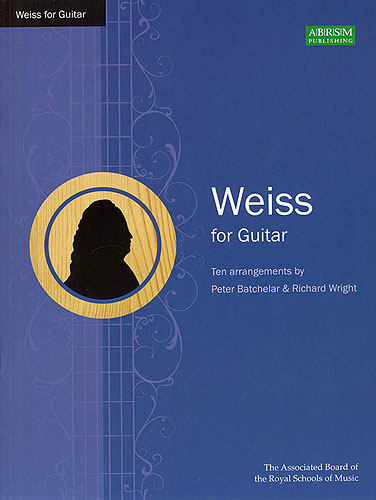
WEISS SILVIUS LEOPOLD, FOR GUITAR.

WEISS SILVIUS LEOPOLD, FOR GUITAR.

An exact contemporary of Bach, Silvius Leopold Weiss (1687-1750) was one of the greatest Lutenists of all time. He was also a prolific and brilliant composer.

This collection of arrangements for solo Guitar is an ideal introduction to Weiss's music. The ten varied pieces were carefully chosen for their musical character and technical suitability. Placed in order of difficulty, they reflect the range of skills required for Baroque repertoire, at intermediate and advanced levels.

Stylish and idiomatic adaptations, preserving the original ornamentation and left-hand slurs.
Core repertoire for Grades 6-8, with pieces on the ABRSM Guitar syllabus.
Carefully considered fingering, both clear and consistent.
Advice on ornaments, including full realizations.

Media: Sheet Music

Language: English

Arrangement: Classical Guitar (GTR)

Arranger: Peter Batchelar; Richard Wright

Bourree S-C 23/3
Courante S-C 21/2
Gavotte S-C 14
Giga S-C 2/7
Menuet S-C 13/5
Menuet S-C 18/5
Paysane S-C 29/7
Prelude S-C 34/1
Rondeau S-C 27/4
Sarabande S-C 2/5

Prezzo: €13,00
€13,00

CLASSICAL FAVORITES FOR GUITAR DUO by Nadal BOOK

CLASSICAL FAVORITES FOR GUITAR DUO, by Nadal. SHEET MUSIC BOOK in standard notation for 2 GUITARS.


LIBRO DI MUSICA CLASSICA.

SPARTITI PER DUE CHITARRE :

PENTAGRAMMA.

Spanning the Renaissance through the twentieth century, this original collection features The Harmonious Blacksmith, selections from Bach's Art of the Fugue and Two-Part Inventions, plus works by Beethoven, Schubert, Granados, and others. Perfect for beginners as well as advanced players, it features several teacher-student duets. Pages 144.

This new collection of duos for classical guitar brings together a wide variety of pieces for beginning, intermediate and advanced players. Musical styles represented include a sampling from the Renaissance, Baroque, Classical, and Romantic periods, as well as arrangements of several popular folk melodies. I have organized the selections into four groups:

Folk and Traditional Music includes many favorites arranged in an easy-to-play format. The majority of the parts are fingered to minimize shifts of the fretting-hand's position. The textures are all straightforward with the melody or soloist in the top part and the accompaniment below.

The Easy Music section consists of some repertoire arranged for the student and teacher as well as music for second- and third-year players. The selections include Elizabethan music (Dowland and Byrd), famous simple dances by Bach, a charming Valse by the great 19th-century guitar composer Fernando Sor, Beethoven's Ode to Joy theme, Schumann's Melodie from Album for the Young, Justin Holland's period arrangement of the theme to Auber's Fra Diavolo, and a simplified arrangement of the ever popular Foster song, My Old Kentucky Home.

Intermediate Music includes increasingly advanced music for third- through sixth-year players. Repertoire includes: Dowland's curious Galliard originally written for two to play on one lute; Bach Inventions and a Bourrt?e from his second English Suite; duos by Sor and Giuliani (the most important guitar composers of the early 19th century); two graceful Schubert Llindler, and an adaptation of his famous Stlindchen; arrangements of piano music by the Spanish nationalists, Albeniz and Granados; and Joplin's ragtime two step, The Entertainer.

Advanced Music contains three virtuosic selections. Handel's Harmonious Blacksmith (a posthumously bestowed nickname for a portion of his Fifth Harpsichord Suite) and Bach's Canon at the Octave from Art of the Fugue will present many challenges to the advanced player, but the rewards well surpass the difficulties. The famous Barber of Seville Overture is my own adaptation of Giuliani's arrangement of Rossini's Elisabetta. Try to seek out the original orchestral version (also published by Dover) to better mimic the orchestral timbres.

It is hoped that this new collection will bring you much joy in your music making. New York City 2005. Dedicated to my students, past and present-especially those who studied with me during the summer of 2005: Bernard Barisic, Michael and Rachel Edery, Matthew Linder, Ronnie Spiewak and my CUNY classes. Table of Contents for Classical Favorites for Guitar Duo Folk and Traditional Music

Amazing Grace - Tradizionale
Aura Lee - Tradizionale
Bill Boy - Tradizionale
Cradle Song - Tradizionale
Danny Boy, Londonderry Air - Tradizionale
Greensleeves - Tradizionale
The Kerry Dance - Tradizionale
The Rose of Tralee - Tradizionale
Remon - Creole Song
Thanksgiving Prayer - Colonial Congregational
The Wayfaring Stranger - Appalachian Lament
Easy Music
Sleep, wayward thoughts from the first booke of songs (John Dowland 1563-1626)
Lesson for Two Lutes from the Dowland lute book (Anonymous late 16th century)
Sellinger's Round from The Fitzwilliam Virginal Book (William Byrd 1542-1623)
Awake, sweet love (John Dowland 1563-1626)
When Phoebus... (John Dowland 1563-1626)
Minuet in G from The Little Notebook for Anna Magdalena Bach (Johann Sebastian Bach 1685-1750)
Bourrée from Suite for Lute, BWV 996 (Johann Sebastian Bach 1685-1750)
Musette in D (J.S. Bach)
Minuet in G from The Little Notebook for Anna Magdalena Bach (Johann Sebastian Bach 1685-1750)
Valse in C N.1 from six Valses puor Deux Guitares, Op. 44 (Fernando Sor 1778-1839)
Ode to Joy from Symphony N.9, Op.125 (Ludwig van Beethoven 1770-1827)
Melodie N.1 from 43 Clavierstucke Fur Die Jugend, Op. 68 (Robert Schumann 1810-1856)
My Old Kentucky Home (Stephen Foster 1826-1864)
Fra Diavolo from Auber's Opera Comique (Justin Holland 1819-1887)
Intermediate Music
My Lord Chamberlin's Galliard "for two to play upon one Lute" from the first Booke of songs (John Dowland 1563-1626)
Invention No. 4 from fifteen two-part inventions (Johann Sebastian Bach 1685-1750)
Invention No. 8 from fifteen two-part inventions (Johann Sebastian Bach 1685-1750)
Invention No. 13 from fifteen two-part inventions (Johann Sebastian Bach 1685-1750)
Bourrée I from English Suite N.2 (Johann Sebastian Bach 1685-1750)
Andante N. 1 from Trois Dous, Op. 55 (Fernando Sor 1778-1839)
Souvenir de Russie Op. 63 (Fernando Sor 1778-1839)
Polonese and Trio N.1 from The Polonesi Concertanti, Op. 37 (Mauro Giuliani 1781-1829)
Ländler N.1 from Eight Ländler, D.378 (Franz Schubert 1797-1828)
Ländler N.8 from Eight Ländler, D.378 (Franz Schubert 1797-1828)
Ständchen from Schwanengesag (Franz Schubert 1797-1828)
Capricho Catalan N.5 from Espagna: 6 Hojas de Album, Op.165 (Isaac Albeniz 1860-1909)
Tango N.2 from Espagna: 6 Hojas de Album, Op.165 (Isaac Albeniz 1860-1909)
Spanish Dance No. 1 from Twelve Danzas Espagnolas (Enrique Granados 1867-1916)
Spanish Dance No. 2 from Twelve Danzas Espagnolas (Enrique Granados 1867-1916)
The Entertainer A Ragtime Two step (Scott Joplin 1868-1917)
Advanced Music
The Harmonious Blacksmith Air and Five Variations from suite in E major, (HG II/i/5) (George Frideric Handel 1685-1759)
Canon at the Octave Contrapunctus XII from The Art of the Fugue (J.S. Bach 1685-1750)
The Barber of Seville - Overture dall'Opera il Barbiere di Sivilia (Gioacchino Rossini 29 febbraio 1792 - 13 Novembre 1868)

Prezzo: €23,99
€23,99
Condividi contenuti