SPARTITI PER CHITARRA DI MUSICA CLASSICA

ACUSTIC GUITAR MAGAZIN, 22 titoli per chitarra classica. CD TABLATURE

ACUSTIC GUITAR MAGAZIN, 22 titoli per chitarra classica. CD TAB.

Prezzo: €69,00
€69,00

ACUSTIC GUITAR MAGAZIN. 23 titoli per chitarra classica. CD TABLATURE

ACUSTIC GUITAR MAGAZIN. 23 titoli per chitarra classica. CD TAB.

Prezzo: €69,00
€69,00

FIVE-FINGER TECHNIQUE FOR THE RIGHT HAND. Postlewate. DVD

FIVE-FINGER TECHNIQUE FOR THE RIGHT HAND. Postlewate. DVD

Product Description:
This two-hour DVD is a presentation of the 19-year project by Charles Postlewate on extending right hand technique for guitar to include the little finger. PART I presents this technique in actual repertoire, including standard guitar repertoire (by Barrios, Sor, Torroba and Villa-Lobos), new arrangements & transcriptions and original compositions. It features complete performances of twelve pieces recorded on Postlewate's Homage to Villa-Lobos CD, in the book by the same name. Each performance is introduced by Postlewate with explanations and demonstrations of how and where the little finger is used in the execution of scales, chords, arpeggios, tremolos and harmonics, with close-up shots of the right hand.

PART II explains the training of the right hand in a five-finger technique, with demonstrations of the above techniques using sample studies from the different chapters of his book, Right-Hand Studies for Five Fingers (MB98710). As in PART I, close-up shots show the viewer precisely how to position the right hand and move the fingers for each study or set of studies. Each set of studies uses a special progression up and down the fingerboard and, like the book, this video demonstrates how to make chromatic variations of these progressions to increase the interest. At the end of PART II Postlewate demonstrates how the guitarist can develop similar studies to fit specific right-hand problems not covered in this book and video.

The video ends with an ENCORE interview of five questions and answers with Charles Postlewate to give some background information on this historic project.

PRODUCT DESCRIPTION - SPANISH
En este DVD de dos horas, Charles Postlewate presenta su proyecto de diecinueve años extendiendo la técnica de la mano derecha de la guitarra para incluir el dedo meñique. La PRIMERA PARTE presenta el uso de esta técnica en el repertorio, incluyendo el repertorio tradicional de la guitarra (por Barrios, Sor, Torroba y Villa-Lobos), nuevos arreglos y transcripciones, y composiciones originales. Se presentan interpretaciones completas de doce piezas grabadas en el CD de Postlewate Homenaje a Villa-Lobos y publicadas en el libro bajo el mismo título. Cada interpretación es presentada por Postlewate con explicaciones y demostraciones de cómo y dónde se usa el meñique en las escalas, los acordes, los arpegios, los trémolos y los armónicos, mostrando la mano derecha en un primer plano.

La SEGUNDA PARTE explica el entrenamiento de la mano derecha en una técnica de cinco dedos, con demostraciones de las técnicas mencionadas anteriormente usando como ejemplos estudios sacados de los diferentes capítulos del libro, Estudios para los cinco dedos de la mano derecha (MB98710). Como en la PRIMERA PARTE, enfocando de cerca la mano derecha se muestra su ubicación exacta y el movimiento de los dedos para cada estudio o grupo de estudios. Cada grupo de estudios usa progresiones especiales ascendiendo y descendiendo por el diapason y, como el libro, este vídeo muestra cómo crear variaciones cromáticas de estas progresiones para aumentar el interés. Al final de la SEGUNDA PARTE Postlewate muestra como el guitarrista puede desarrollar estudios similares para problemas específicos de la mano derecha no discutidos en este vídeo y libro.

Este vídeo termina con una entrevista (ENCORE) compuesta por cinco preguntas y respuestas con Charles Postlewate para dar un trasfondo a este proyecto histórico.

1. PART I - REPERTOIRE
2. Dr. Gradus Ad Parnassum by Claude Debussy
3. La puerta del vino by Claude Debussy
4. Homage to Villa-Lobos by Charles Postlewate
I. Preludio rondo by Charles Postlewate
II. Valsa melancólica
III. Danza
7. Prelude #2 by Heitor Villa-Lobos
8. Study in E Minor by Fernando Sor
9. Study in A Major by Fernando Sor
10. Sonatina in A Major - III. Allegro by Federico Moreno Torroba
11. Una limosna por el amor de Dios by Agustín Barrios
12. Variations on a Theme of Prokofiev by Charles Postlewate
13. Improvisation on Green Dolphin Street by Charles Postlewate
14. PART II - TRAINING THE RIGHT HAND IN A FIVE-FINGER TECHNIQUE
15. Right Hand Position
16. Scales
17. Chords and Arpeggios
18. Thumb and One Finger
19. Thumb and Two Fingers
20. Thumb and Three Fingers
21. Thumb and Four Fingers
22. Tremolos
23. Right Hand Harmonics
24. Developing the Melody Fingers
25. Chromatic Variations of Progressions
26. Preparation Studies for Specific Pieces
27. CONCLUSION
28. ENCORE (questions and answers about this project)
29. CREDITS

Spanish Contents:

1. PRIMERA PARTE - REPERTORIO
2. Dr. Gradus Ad Parnassum por Claude Debussy
3. La puerta del vino por Claude Debussy
4. Homenaje a Villa-Lobos por Charles Postlewate
I. Preludio Rondo
II. Valsa melancólica
III. Danza
7. Preludio II por Heitor Villa-Lobos
8. Estudio en Mi menor por Fernando Sor
9. Estudio en La mayor por Fernando Sor
10. Sonatina en La mayor - III. Allegro por Federico Moreno Torroba
11. Una limosna por el amor de Dios por Agustín Barrios
12. Variaciones sobre un tema de Prokofiev por Charles Postlewate
13. Improvisación sobre la Calle del Delfín Verde por Charles Postlewate
14. SEGUNDA PARTE - EL ENTRENAMIENTO DE LA MANO DERECHA EN UNA TÉCNICA DE CINCO DEDOS
15. La posición de la mano derecha
16. Escalas
17. Estudios de acordes y arpegios
18. El pulgar y un dedo
19. El pulgar y dos dedos
20. El pulgar y tres dedos
21. El pulgar y cuatro dedos
22. Trémolos
23. Armónicos para la mano derecha
24. El desarrollo de la función melódica de los dedos
25. Progresiones en variación cromática
26. Estudios de preparación para piezas específicas
27. CONCLUSION
28. ENCORE (preguntas y respuestas sobre este proyecto)
29. CREDITS (RECONOCIMIENTOS)

Prezzo: €29,00
€29,00

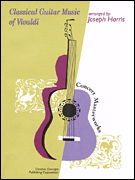
VIVALDI CLASSICAL GUITAR MUSIC OF Joseph Harris TABLATURE GARDELLINO CHITARRA LIBRO SPARTITI

VIVALDI, CLASSICAL GUITAR MUSIC OF.  SHEET MUSIC BOOK WITH GUITAR TABLATURE. 

LIBRO DI MUSICA CLASSICA. 
SPARTITI  PER CHITARRA :
PENTAGRAMMA E TABLATURE.


CONCERT MASTERWORKS

Classical Guitar Music of Vivaldi
Series: Creative Concepts Publishing
Publisher: Creative Concepts TAB
Artist: Antonio Vivaldi
Arranger: Joseph Harris

Features 31 pieces by Antonio Vivaldi arranged for solo guitar with tablature. Includes historical notes, performance suggestions, explanation of ornaments, and more.

Inventory #HL 00315187
ISBN: 9781569221945
UPC: 073999158755
Publisher Code: 074090
Width: 9.0"
Length: 12.0"
80 pages

About Classical Guitar Music Of Vivaldi - Guitar Solo
By Antonio Vivaldi (1678-1741), arranged by Joseph Harris. Guitar tablature songbook for guitar. 80 pages.
With standard guitar notation, guitar tablature, introductory text and instructional text. Baroque. 9x12 inches.

Features 31 pieces by Antonio Vivaldi arranged for solo guitar with tablature. Includes historical notes, performance suggestions, explanation of ornaments, and more.

For many years remembered only for his contribution of hundreds of violin concertos, Antonio Vivaldi is regarded today as a key musical figure of the Italian Baroque. Although his most visible and enduring influence was indeed in the development of the solo concerto, Vivaldi was also admired in his day as a composer of excellent chamber music, a stunning violinist and a popular composer of Italian opera. This composer of "The Four Seasons" was a bold and impetuous individual who managed to focus his musical impulses in a unique voice that was consistent yet expressive. Vivaldi was born in Venice in 1678 and trained for the priesthood, but ended up practicing this vocation for only a brief time. Vivaldi served for nearly forty years (from 1703 until just before his death in 1741) as musical director of the Conservatorio dell'Ospedale della Pieta, one of four girls' orphanages in Venice. The Ospedale provided outstanding musical instruction and under Vivaldi's direction created quite a musical sensation. Vivaldi's tasks at the Ospedale included teaching private lessons, composing music for both concerts and church services, repairing musical instruments and commissioning works from other composers for concerts at the Ospedale. Vivaldi was extremely prolific, composing over 50 operas, 90 sonatas and 450 concertos. Despite the apparent ease with which he could produce a composition (he once boasted he could compose a piece faster than it could be copied), Vivaldi is criticized sometimes for being too predictable. The twentieth century Italian composer Luigi Dallapiccola once asserted that Vivaldi did not compose 450 separate concertos, but wrote the same concerto 450 times. Whereas during the Baroque many musicians believed that the particular intent of a composition (church, chamber or theatre) should dictate its musical language, Vivaldi's style varied little between genres and even between mediums. His vocal music and instrumental music share similar musical characteristics, as do his sacred and secular works. Furthermore, Vivaldi's compositional style remained remarkably consistent throughout his career and evolved very little. The only major variances one finds are in surface details, such as melodic contour, which tended to reflect public tastes. However, it is a tribute to Vivaldi's skill as a composer that within such a limited musical vocabulary he exhibited a virtually inexhaustible variety of invention.

Sonatas for Violin, Op. 2
The 12 Sonatas for Violin, Op. 2 were Vivaldi's first solo sonatas. The Sonatas were published in Italy in 1709 and dedicated to Frederick IV of Denmark on the occasion of his visit to Venice. For the Sonatas, Vivaldi drew upon models of Arcangelo Corelli, a conservative Italian composer whose works are tidily constructed, yet highly expressive. Vivaldi's Sonatas are a composite of church and chamber styles, demonstrating his tendency to blur boundaries between genres. In the Sonatas, dance movements intermingle with abstract movements (those with only tempo designations). Baroque dances of the Italian variety differ considerably from their French or German equivalents. The slight differences in the names of dances (for example, compare the Italian giga to the French gigue) do not signify nationality only, but salient musical traits. Whereas the French gigue is a lively, bouncy dance in an imitative texture, the Italian giga has a more restrained sense of pulse, a less rhythmically active bass line and little or no imitation between voices. The Italian gavotta lacks the characteristic two upbeats and musette-like middle section of the French gavotte. The Italian corrente is faster and more "running" in character than the French courante. Also, the French courante may emphasize dotted rhythms and an alternation between duple and triple meter, while the corrente is more rhythmically consistent and metrically stable.

Sonata No.3
In the Adagio (found on page 7), the bass line should be played with a warm tone, especially in areas where it is exposed (as in the opening and in measure 9). To achieve a warm tone on the guitar, play with the right hand close to the fretboard and strike the string with the side of the thumb, using as much flesh as possible. The Giga (found on page 8) should be played dynamically strong throughout and in a lightning fast tempo.

Sonata No.6
The Preludio (found on page 12) should sound very elegant and graceful. Exaggerate the dotted rhythms by playing the long notes longer and the short notes shorter. The Giga (found on page 16) should be played in a moderately fast tempo. Count two beats per measure, not four, to give the piece a stronger and more stable sense of forward motion

Sonata No.7
The tempo of the Corrente (found on page 19) should be very fast. However, in areas where the bass line becomes more active (especially in mm. 17-21), make sure that neither voice breaks down.

Sonata No.9
The Preludio (found on page 23) is an energetic and dramatic piece. The movement contains elements of a "learned" style, which show off a composer's contrapuntal skills. Be sure to emphasize the points of imitation (as in the first few measures).

Sonata No. 11
The abundance of syncopated rhythms presents an interesting technical problem for the solo performer in the Gavotta (found on page 28). In order toconvey the meter clearly, keep the tempo steady and count two beats per measure. Hold on to notes with the left hand for as long as possible before fingering new notes.

Sonatas for One or Two Violins, Ope 5
The Six Sonatas, Op. 5 were first published in 1716. By this time, Vivaldi had chosen a new publisher, Etienne Roger in Amsterdam. There were at least two significant reasons for the switch: superior printing methods and an increased demand for the music of Vivaldi and other Italians in northern Europe. The Sonatas, Op. 5 were actually engraved and published at Roger's own expense. Such a practice was quite rare in Vivaldi's time and testifies to his immense popularity.

Sonata No. 13
The Sarabanda (found on page 30) lacks the lasciviously strong accent on the second beat characteristic of the Spanish sarabande. Keep the tempo slow, the meter even and play with as much vibrato as possible. Sonata No. 14

For the Gavotta (found on page 32), the left-hand slurs (as in mm. 7-9 and 39-41) may require some extra attention during practice. Isolate each slur and treat it as a trilling exercise. Devote a few minutes each day to these passages until they sound crisp and clear.

Sonata No. 16
In the Preludio (found on page 35), exaggerate the dotted rhythms and apply vibrato liberally. Because of the slow tempo, it will be necessary to think ahead and be aware of the melody's direction and shape. At some point, you may want to do a simple phrase analysis of the Preludio. Break the piece into small phrases, study how they relate to one another and then group them into longer phrases. The longer the phrases you envision, the better the sense of forward motion you will convey.

Sonata No. 18
The Air-Minuet (found on page 38) demonstrates an ambiguity in Vivaldi's choice of titles for movements. The designation "Air" suggests the vocal-like quality of the melody. The piece is also an instrumental dance movement, containing the clear four-bar phrasing and clear cadences typical of a minuet. Overall, the piece should sound stately, yet singing.

II cimento dell'armonia e dell'inventione, Op. 8
The Concertos, Op. 8 were first published in 1725 and dedicated to the Bohemian Count Wenzeslaus von Morzin. The first four concertos are collectively known as "The Four Seasons." A significant feature in each of these concertos is the inclusion of an explanatory sonnet, each line of poetry corresponding to a particular passage in the music.

Il cimento dell'armonia e dell'invenzione, Op. 8
Pubblicati per la prima volta nel 1725, i primi 4 concerti sono conosciuti come "Le quattro stagioni".

TABLE OF CONTENTS: 
Historical Notes & Performance Suggestions
Explanation of Ornaments
Adagio Sonata for Violin, Op. 2, No.3
Giga from Sonata for Violin, Ope 2, No. 3
Preludio from Sonata for Violin, Ope 2, No. 6
Giga from Sonata for Violin, Ope 2, No. 6
Corrente from Sonata for Violin, Ope 2, No. 7
Largo from Concerto for Flute, Op. 10, NO.3 (''il Gardellino") ,
Preludio from Sonata for Violin, Op. 2, No. 9 ,
Gavotta from Sonata for Violin, Ope 2, No. 11
Sarabanda from Sonata for Violin, Ope 5, No. 13
Gavotta from Sonata for Violin, Ope 5, No. 14 .
Preludio from Sonata for Violin, Ope 5, No. 16 .
Air-Menuet from Sonata for Two Violins, Op. 5, No. 18 .
Allegro non molto From the Four Seasons, Op. 8, NO.2 (Summer) .
Largo From The Four Seasons, Op. 8, NO.4 (Winter) .
Affettuoso From Sonata for Flute, RV 48 .
Allegro assai From Sonata for Flute, RV 48 .
Allegro Sonata for Flute, RV48 .
Preludio from Sonata for Flute, RV 49 .
Sarabanda from Sonata for Flute, RV 49 .
Siciliana from Sonata for Flute, RV 49 .
Preludio from Sonata for Recorder, RV 52 .
Allemanda from Sonata for Recorder, RV 52 .
Aria di Giga from Sonata for Recorder, RV 52 .
Largo from Concerto for Lute and Two Violins, RV93 .
Largo from Concerto for Flute and Oboe, RV95 ("La Pastorella") .
Andante from Concerto for Flute, RV429 .
Grave from Concerto for Violin and Organ, RV541 .
Allegro alla Francese Violin and Oboe, RV 543
Largo from Concerto for Oboe and Violin, RV 548 .
Largo from Concerto for Flute, Op. 10, No.4 .
Largo from Sonata for Musette, Vielle, Flute, Oboe or Violin, Op. 13, No.6

Catalog #07- 4090
ISBN# 1-56922-194-4
CREATIVE CONCEPTS PUBLISHING CORPORATION
Creative Concepts Publishing Corp.

Prezzo: €20,99
€20,99

CASTELNUOVO-TEDESCO GUITAR CONCERTO N.1 IN D MAJOR OP.99 BOOK 2 CD CHITARRA SPARTITI BASI LIBRO

CASTELNUOVO TEDESCO, GUITAR CONCERTO N.1 IN D MAJOR, OP.99. with 2CD .

SHEET MUSIC BOOK WITH 2CD , BACKING TRAX .
 
LIBRO DI MUSICA CLASSICA, CON 2 CD. 
 
CD DI BASI PER CHITARRA.
 
SPARTITI  PER CHITARRA CON PENTAGRAMMA.

Performed by Christian Reichert, guitar
Accompaniment : Plovdiv Philharmonic Orchestra
Conductor : Nayden Todorov

This sumptuous guitar concerto, written by the great Castelnuovo-Tedesco on the eve of World War II, quickly became a modern classic, almost approaching the popularity of Rodrigo's 'Concierto de Aranjuez.' Its appreciation has grown with the ensuing years and it is now considered a 20th-century classic. Don't miss this lyrical masterpiece! This deluxe 2CD set includes a slow-tempo practice version to help you get up to speed with the concerto.

Includes an authoritative, newly engraved solo part printed on high-quality ivory paper; a digital stereo compact disc featuring a complete performance of the concerto with orchestra and soloist, and a second performance minus you, the soloist; and a second compact disc containing a full-speed version of the complete version as well as a special -20% slow-tempo version of the accompaniment for practice purposes. The concerto is voluminously indexed for your practice and performance convenience.

Prezzo: €69,99
€69,99

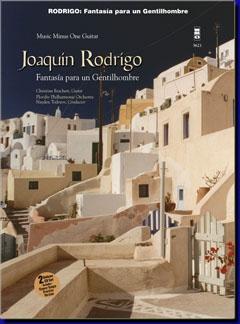
RODRIGO FANTASIA PARA UN GENTILHOMBRE BOOK CD BACKING TRACKS CHITARRA BASI SPARTITI LIBRO

RODRIGO JOAQUIN, FANTASIA PARA UN GENTILHOMBRE. SHEET MUSIC BOOK WITH 2CD BACKING TRAX

LIBRO DI MUSICA CLASSICA, CON 2 CD. 

CD DI BASI ( ORCHESTRALI ) PER CHITARRA.

SPARTITI CON PENTAGRAMMA PER CHITARRA. 

Performed by Christian Reichert, guitar
Accompaniment : Plovdiv Philharmonic Orchestra
Conductor : Nayden Todorov

Second only to the Concierto de Aranjuez in popularity among 20th-century guitar concerti is Rodrigo’s beautiful Fantasia para un Gentilhombre. It remains a requirement for any serious guitarist’s repertory, and couldn’t be more exciting and fun to learn than in the company of this luxurious symphony orchestra! This deluxe 2CD set includes a slow-tempo practice version to help you get up to speed.

Includes the authorized music score printed on high-quality ivory paper, featuring the guitar part with orchestral reduction; plus a separate guitar solo part; a digital stereo compact disc featuring a complete performance of the concerto with orchestra and soloist, and a second performance minus you, the soloist; and a second compact disc containing a full-speed version of the complete version as well as a special -20% slow-tempo version of the accompaniment for practice purposes. The concerto is voluminously indexed for your practice and performance convenience.

Performed by Christian Reichert, guitar
Accompaniment : Plovdiv Philharmonic Orchestra
Conductor : Nayden Todorov

Prezzo: €199,99
€199,99

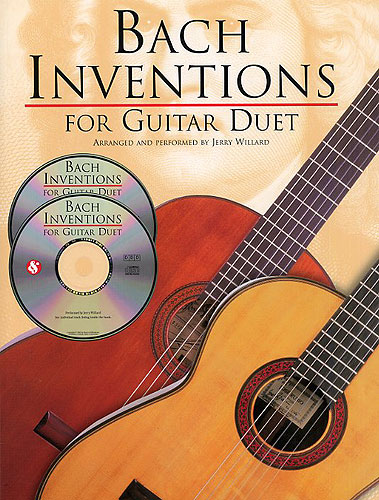
BACH INVENTIONS FOR GUITAR DUET JERRY WILLARD 2CD TABLATURE DUO CHITARRA LIBRO SPARTITI

BACH, INVENTIONS FOR GUITAR. Willard. Per duo. SHEET MUSIC BOOK WITH 2CD & GUITAR TABLATURE. 

LIBRO DI MUSICA CLASSICA CON 2 CD.

SPARTITI PER CHITARRA :

PENTAGRAMMA, TABLATURE. 

BACH INVENTIONS
for Guitar Duet
Series: Music Sales America
Publisher: Music Sales America
Format: Softcover with CD – TAB
Composer: Johann Sebastian Bach
Arranger: Jerry Willard


Since their introduction, Bach's Two-Part Inventions have been an essential resource for developing hand independence and ornamentation technique. Keyboard players have enjoyed these etudes for centuries and now this body of work is available to guitarists in this collection of fifteen pieces. They have been transcribed and arranged for the classical guitar duet by Jerry Willard, and are presented in notation and tab. The title is accompanied by two CDs, the first of which features demonstration recordings of all inventions. The second CD offers single guitar recordings so you can play along.

Inventory #HL 14002913
ISBN: 9780825628290
UPC: 752187978459
Publisher Code: AM978450
Width: 9.0"
Length: 12.0"
64 pages

This collection contains fifteen of Bach's 2-part inventions. These fifteen inventions have been transcribed and arranged for the classical guitar duet by Jerry Willard, and are presented in notation and Tab. The title is accompanied by two CDs, the first of which features demonstration recordings of all inventions. The second CD offers single guitar recordings with which you may play along by means of solo rehearsal.

Johann Sebastian Bach (1685-1750) penned his inventions as a formal method of study, originally for his eldest son Wilhelm Friedemann, and subsequently, refined the collection for his young pupils. These musical gems are the finest examples of music ever written for the sole purpose of instruction, and also serve as preparation for his larger works.

This folio contains all 15 Two Part Inventions arranged for guitar duet by Jerry Willard. Each invention is presented in standard notation and tablature with suggested fingerings and ornamentation. In addition, the accompanying CDs provide the opportunity to study each invention, as well as each part, separately or together. Disc 1 presents each invention played by both guitars while Disc 2 demonstrates each part individually. Disc 2 additionally provides a count-in click giving the student the opportunity to perform the invention with the CD or simply to follow along and study each part individually.

The Editors

Bach Inventions for Guitar Duet is a collection of short pieces penned by Johann
Sebastian Bach for his young pupils. These musical gems are the finest examples of
music ever written for the sole purpose of instruction, and also serve as preparation
for his larger works.
This folio contains all fifteen Two-Part Inventions arranged for guitar duet. It is
believed that Bach's intention was to bring them together as a single work along with
his three-part pieces known as the Sinfonias, confirmed by the way that they are presented
in a manuscript penned in his own hand in 1723.These inventions demonstrate
contrapuntal technique and explore musical expressions while developing motifs in a
logical fashion.
Bach uses the term invention as a play on words. In today's musical parlance, invention
pertains directly to this body of work; however, Bach uses it to describe an idea
that could be used as a compositional theme with the intention that this type of technical
exercise could inspire those who studied these pieces to develop a more musical
approach.
Mr. Willard has arranged these pieces for study and performance as guitar duets.
Each invention is presented in standard notation and tablature with suggested fingerings
and ornamentation. In addition, the accompanying CDs provide the opportunity
to study each invention, as well as each part, separately or together. Disc 1 presents
each invention played by both guitars while Disc 2 has each part performed individually.
Disc 2 additionally provides a count-in click giving the student the opportunity to
perform the invention with the CD or simply to follow along and study each part individually.
Please note that these pieces were performed with minimal ornamentation in order to
provide the student with an accurate representation of the themes. The choices of
embellishments are quite simply too vast to incorporate in this folio and are of a personal
preference left up to the performer.
The following description of Bach's infamous Two-Part Inventions is taken from the
autograph fair copy in the Staatsbibliothek zu Berlin:
Straightforward instruction, in which amateurs of the keyboard, and especially the eager ones, are
shown a clear way not only:
1. of learning to play cleanly in two voices, but also, after further progress,
2. of dealing correctly and satisfactorily with three obbligato parts;
at the same time not only getting good inventions, but developing the same satisfactorily, and above
all arriving at a cantabile manner in playing, all the while acquiring a strong foretaste of composition.
Provided Anno Christi 1723.
By Johann Sebastian Bach:
Capellmeister to his Serene Highness the Prince of Anhalt-Cothen.
 
Jerry Willard was born in Cleveland, Ohio and began studying the guitar with his father Jeff Willard who was a guitarist. The guitar pedagogue Sophocles Papas recognized his talent and invited Mr. Willard to study with him in Washington, D.C. Subsequently Mr. Willard studied with guitarists Richard Lurie and Alirio Diaz. Mr. Willard's performances on guitar and lute range from performances of 16th-century work from the original tabulature to his own transcriptions of music from the 18th, 19th, and 20th centuries. He has appeared in Alice Tully Hall and Carnegie Hall in New York City, and he has concertized extensively throughout Europe and The United States. Well known as an ensemble player, he has performed with the Cleveland Orchestra, The New York Opera Company, The New York Consort of Viols, and The Long Island Baroque Ensemble. He has published many transcriptions for guitar including "The Complete Lute Music of J.S. Bach" available through Music Sales Corp.
 
Invention 1
Invention 2
Invention 3
Invention 4
Invention 5
Invention 6
Invention 7
Invention 8
Invention 9
Invention 10
Invention 11
Invention 12
Invention 13
Invention 14
Invention 15
Prezzo: €29,95
€29,95

YORK ANDREW BEST BOOK & CD GUITAR TABLATURE CHITARRA LIBRO SPARTITI

YORK ANDREW, BEST. SHEET MUSIC BOOK WITH CD & GUITAR TABLATURE.

LIBRO DI MUSICA CONTEMPORANEA CON CD. 

SPARTITI PER CHITARRA CON: 

PENTAGRAMMA, TABLATURE. 

Introduction to Sunburst~Sunburst
Sunday Morning Overcast
Muir Woods
In Sorrow's Wake
Lullaby
Faire
Waiting for Dawn
Marley's Ghost
Reflections
King Lotvin
Numen
Emergence
Chilean Dance

Prezzo: €99,99
€99,99

YORK ANDREW, CONTEMPORARY CLASSIC GUITAR. DVD

YORK ANDREW, CONTEMPORARY CLASSIC GUITAR. DVD

In this video, classic guitarist Andrew York, member of the renowned Los Angeles Guitar Quartet, showcases his compositional and solo guitar performance skills. Andrew plays eight compositions that include seven original works for guitar reflecting an incredibly rich and eclectic assortment of moods and temperaments. A special feature of this video is Andrew York's comment and performance notes concerning each guitar solo. Included are the following Andrew York compositions:

Bagatelle
In Sorrow's Wake
King Lotvin
Marley's Ghost
Numen
Sunburst/Jubilation
Sunday Morning Overcast
Third Cello Suite In C Major J.S. Bach

Prezzo: €23,00
€23,00

VILLA LOBOS HOMAGE TO AND OTHER COMPOSITIONS BOOK & CD SPARTITI CHITARRA LIBRO

VILLA LOBOS, HOMAGE TO AND OTHER COMPOSITIONS. BOOK & CD.
SHEET MUSIC BOOK FOR GUITAR. 

LIBRO DI MUSICA CLASSICA.
SPARTITI PER CHITARRA CON: PENTAGRAMMA
 
 
Product Number: 98711
Format: Book
Skill Level: Intermediate
Pages: 96
Binding: Spiral
Size:9 x 11.75
ISBN:0-7866-5966-1
UPC:796279074858
ISBN13:978-07866-5966-1
Series: None
Publisher: Mel Bay Publications, Inc.
Date Published: 9/28/2001
 
 
This is the first compilation of guitar music for a right hand technique that includes the little finger. The 12 complete compositions include original pieces by Charles Postlewate (Homage to Villa-Lobos, Variations on a Theme of Prokofiev and Improvisation on Green Dolphin Street), transcriptions of piano pieces by Claude Debussy (La puerta del vino and Dr. Gradus ad Parnassum), arrangements of Peruvian popular songs (José María and Virgins of the Sun) and new editions of standard repertoire pieces - two studies by Fernando Sor and the beautiful tremolo study by Agustín Barrios, An Alm for the Love of God. Postlewate also includes excerpts of two other standard repertoire pieces by Federico Moreno Torroba (Sonatina) and Heitor Villa-Lobos (Prelude #2) - which are published elsewhere under copyright restrictions - to show the advantage of using the little finger. These pieces demonstrate new right hand techniques for the classical guitar that use the little finger in the playing of scales, chords, arpeggios, tremolos and harmonics. They also show the advantage of using the little finger for speed, accuracy, strength and balance. This book is a companion to MB 98710 - RIGHT HAND STUDIES FOR FIVE FINGERS using Chords, Arpeggios, Tremolos and Harmonics , also by Charles Postlewate.
 
Spanish Description
 
[Esta es la primera recopilación de música para la guitarra usando una técnica de la mano derecha de cinco dedos que incluye el dedo meñique. Las 12 composiciones completas incluyen piezas originales por Charles Postlewate (Homenaje a Villa-Lobos, Varicaciones sobre un tema de Prokofiev e Improvisación sobre La calle del delfín verde), transcripciones de piezas para piano por Claude Debussy (La puerta del vino y Dr. Gradus ad Parnassum), arreglos de canciones populares peruanas (José María y Vírgenes del sol) y nuevas ediciones de piezas del repertorio tradicional-dos estudios por Fernando Sor y el bello estudio de trémolo por Agustín Barrios, Una limosna por el amor de Dios. Además, Postlewate incluye extractos de otras dos piezas del repertorio tradicional de Federico Moreno Torroba (Sonatina) y de Heitor Villa-Lobos (Prelude #2)-las cuales han sido publicadas y están protegidas bajo derecho de autor-para mostrar la ventaja de usar el dedo meñique. Estas piezas muestran nuevas técnicas de la mano derecha para la guitarra clásica que usan el dedo meñique para tocar escalas, acordes, arpegios, trémolos y arpegios. También muestran la ventaja de usar el dedo meñique para aumentar la velocidad, la exactitud, la fuerza y el equilibrio. Este libro acompaña a MB 98710-RIGHT HAND STUDIES FOR FIVE FINGERS using Chords, Arpeggios, Tremolos and Harmonics (ESTUDIOS PARA LOS CINCO DEDOS DE LA MANO DERECHA usando acordes, arpegios, trémolos y armónicos) también por Charles Postlewate.]
 
Doctor Gradus ad Parnassum       Claude Debussy 
Homage to Villa-Lobos       Charles Postlewate 
Improvisation on Green Dolphin Street       Charles Postlewate 
Jose Maria       Alicia Maguina 
La Puerta Del Vino       Claude Debussy 
Study in A Major, Opus 31 No 19       Fernando Sor 
Study in E Minor, Opus 6 No. 11       Fernando Sor 
Una Limosna por el Amor de Dios       Agustin Barrios Mangore 
Variations on a Theme of Prokofiev       Charles Postlewate 
Virgenes del Sol       Jorge Bravo de Rueda 
Prezzo: €24,99
€24,99
Condividi contenuti