SPARTITI PER CHITARRA DI MUSICA CLASSICA

SCHUBERT FRANZ, ARRANGED FOR GUITAR, Javier Calderon. CD

SCHUBERT FRANZ, ARRANGED FOR GUITAR, Javier Calderon. CD

Product Description:
There have been few previous examples of guitar versions of Schubert' piano music, and practically no attempts to transcribe a complete set of pieces, as Caldern has done here with the six pieces of Schubert's Moments Musicaux. These pieces are superb examples of Schubert's mastery in the miniature form, true "musical moments" of mood and feeling. Two other pieces complete this collection, which also includ notes on the preparation and performance of the pieces in English, German, and Spanish. The music is in standard notation only with a CD of performances of the pieces by the arranger.

Prezzo: €18,00
€18,00

NEW DIMENSIONS IN CLASSICAL GUITAR FOR CHILDREN, by Sonia Michelson. CD

NEW DIMENSIONS IN CLASSICAL GUITAR FOR CHILDREN, by Sonia Michelson. CD

Product Description:
This method is time tested, innovative, and has proven successful in imparting essential concepts of musicianship and classic guitar performance to children. It's realistic approach to early childhood education utilizes important concepts inspired by the writings of both Suzuki and Kodaly. This method stimulates musical imagination and ability through guitar techniques, eurhythmics, and listening and theory games. Students also learn by participating in movement, singing, and guitar performance. 104 PAGES.

Product Number: 94537BCD
Format: Book/CD Set
ISBN: 0786658061
UPC: 796279072410
ISBN13: 9780786658060
Series: Non-Series
Publisher: Mel Bay Publications, Inc.
Date Published: 1/18/2001

Contents:

Introduction
Principles for Successful Study
Overview
Format
Ideas for Teaching Children Effectively
Recommended Reading

First Lessons
Sample Lesson Plans

Imaginative Games, Exercises & Teaching Ideas
Curwen Hand Signals
Rhythm Syllables
Preliminary Exercises
Imaginative Games

Level I
I-1. Cuckoo
I-2. One, Two, Tie My Shoe
I-3. See-Saw
I-4. Star Light, Star Bright
I-5. Snail, Snail
I-6. Mill Wheel
I-7. Rain, Rain
I-8. Ring Around the Rosy
I-9. Strawberry Shortcake

Level II
II-1. Hot Cross Buns
II-2. Bye Bye Baby
II-3. All Around the Buttercup
II-4. Who's That?
II-5. Merrily We Roll Along
II-6. Let Us Chase the Squirrel
II-7. I See the Moon
II-8. Bought Me a Cat
II-9. Rocky Mountain
II-10. Here Comes the Bluebird
II-11. Fais Do Do
II-12. Mama, Buy Me a Chiney Doll
II-13. Twinkle Rhythms

Level III
III-1. Twinkle, Twinkle Little Star
III-2. Aunt Rhody
III-3. Frere Jacques
III-4. Lightly Row
III-5. Hush Little Baby
III-6. Little River Flowing
III-7. Michael, Row the Boat Ashore
III-8. Learning Chords
III-9 Looby Loo
III-10. Song of the Wind
Ill-1l. Lavender Blue
III-12. Cuckoo, Sing in the Spring
III-13. Oh, How Lovely Is the Evening

Level IV
IV-1. May Song
IV-2. Jim Along Josie
IV-3. Come Little Children
IV-4. Simple Gifts
IV-5. Moon Magic
IV-6. Love Somebody
IV-7. Sometimes I Hear a Song
IV-8. English Song

Level V
V-1. I'll Be a King
V-2. Turn Again, Whittington
V-3. Cotton Eye Joe
V-4.Baker's Shop
V-5. Five Hundred Miles
V-6. Round Up Four
V-7. Alabama Girl
V-8. Who Built the Ark
V-9. Green Holm Jig
V-10. Freight Train
V-11. Minuet
V-12. Minuet in G

Prezzo: €20,00
€20,00

TWO TO TANGO AND MILLENNIUM DUET GUITAR DUETS COMPOSED Jorge Morel LIBRO CD SPARTITI

TWO TO TANGO AND MILLENNIUM DUET, COMPOSED by Jorge Morel. CD

LIBRO DI MUSICA CON CD, SPARTITI PER DUE CHITARRE. PENTAGRAMMA . 


Product Description:
These two pieces for classic guitar duo were composed for the Hanser-McClellan Guitar Duo. "Two to Tango" is a tango rhapsody for two guitars using mainly tango rhythm combined with that of the milonga, another Argentinean dance closely related to the tango. The interaction of the two guitars playing single lines at times and then changing roles between the melody and the rhythm makes it more interesting for both players. "Millennium Duet" was written as a homage to Chet Atkins. The piece opens with a brief reflection of country and western rhythmic ideas, with a melody of a different character. It later moves on to other patterns, at times combining some Latin American rhythms with a little touch of jazz harmony. This book includes two separate guitar parts and a combined score written in standard notation only. The companion CD features the premiere recording of the pieces by the Hanser-McClellan Guitar Duo.

Prezzo: €21,99
€21,99

A CHRISTMAS PASTORALE arranged Michael Newman & Laura Oltman CD DUO SPARTITI SILENT NIGHT

A CHRISTMAS PASTORALE, arranged by Michael Newman & Laura Oltman. SHEET MUSIC BOOK WITH CD & STANDARD NOTATION.

LIBRO DI MUSICA CLASSICA CON CD. 

SPARTITI PER DUO DI CHITARRE CON: PENTAGRAMMA.  

MUSICA SACRA, NATALE. 


Product Description:
Celebration of the Christmas holiday includes a rich musical tradition. For this score and accompanying CD, the internationally-renowned Newman & Oltman Guitar Duo presents a ravishing collection of sacred music written for Advent, Christmas, and Epiphany. The duo has chosen music from six centuries in a wide variety of musical styles, including familiar Christmas tunes, little-known gems, and interesting variations on familiar themes written by such composers as Bach, Handel, Pachelbel, Mendelssohn, and Brahms. Selections range from beautiful Renaissance tunes suitable for beginning guitarists to concert repertoire for advanced players.

From Canta No. 147, Jesu, Joy of Man's Desiring -- Johann Sebastian Bach, Arranged by Michael Newman and Laura Oltman
From Cantata No. 140, Wake, Awake -- Philipp Nicolai, Arr. by Michael Newman and Laura Oltman
From Cantat No. 140, Zion Hears the Watchmen Singing -- Johann Sebastian Bach, Arr. by Michael Newman and Laura Oltman
Chorale: Wake, Awake -- Philipp Nicolai, Arr. by Michael Newman and Laura Oltman
The Holly and the Ivy -- Arranged by Michael Newman and Laura Oltman
From William Ballet's Lute Book (Lulla, Lulla) -- Arranged by Michael Newman and Laura Oltman
I am so Glad each Christmas Eve -- Arranged by Michael Newman and Laura Oltman
Chorale: (Lo, how a Rose e'er blooming) -- Arranged by Michael Newman and Laura Oltman
Chorale Prelude: Op. 122 Lo, how a Rose e'er blooming -- Johannes Brahms, arranged by Michael Newman and Laura Oltman
The Son of Mary -- Edited by Michael Newman and Laura Oltman
Chorale: Dearest Emmanuel -- Arranged by Michael Newman and Laura Oltman
Chorale: A Child is born to us -- Johann Sebastian Bach, arranged by Michael Newman and Laura Oltman
From Christmas Concerto - Adagio-Allegro-Adagio -- Arcangelo Corelli, arr. by Michael Newman and Laura Oltman
From Christmas Concerto -- Arcangelo Corelli, Arr. by Michael Newman and Laura Oltman
O Come, O Come, Emmanuel -- Arranged by Michael Newman and Laura Oltman
There is No Rose -- Arranged by Michael Newman and Laura Oltman
Greensleeves (What Child is This?) -- Arranged by Francis Cutting, Trans. by Michael Newman and Laura Oltman
Chorale: A Boy born in Bethlehem -- Johann Sebastian Bach, Arr. by Michael Newman and Laura Oltman
Joy to the World! -- George Frideric Handel, Arr. by Michael Newman and Laura Oltman
Chorale: From Heaven Above -- Martin Luther, Arr. by Michael Newman and Laura Oltman
Chorale Prelude: From Heaven Above -- Johann Pachelbel. Arr. by Michael Newman and Laura Oltman
Hark! The Herald Angels Sing -- Felix Mendelssohn-Bartholdy, Arr. by Michael Newman and Laura Oltman
From Pageant of the Shearmen and Tailors Coventry Carol -- Arranged by Michael Newman and Laura Oltman
Chorale: The Newborn Child -- Melchior Vulpius, Arr. by Michael Newman and Laura Oltman
Chorale: In Sweet Jubilation -- Arr. by Michael Newman and Laura Oltman
Prelude: In Sweet Jubilation -- Arr. by Michael Newman and Laura Oltman
From Cantata No. 208 Sheep May Safely Graze -- Johann Sebastian Bach, Arr. by Michael Newman and Laura Oltman
From Messiah Pifa -- George Frideric Handel, Arr. by Michael Newman and Laura Oltman
Silent Night -- Arr. by Michael Newman and Laura Oltman

Prezzo: €29,99
€29,99

BACH JOHANN SEBASTIAN TRANSCRIPTIONS CLASSIC GUITAR Javier Calderon CD LIBRO SPARTITI

BACH JOHANN SEBASTIAN, TRANSCRIPTIONS FOR CLASSIC GUITAR, transcribed arranged Javier Calderon. LIBRO E CD

LIBRO DI MUSICA CLASSICA, CON CD,

SPARTITI PER CHITARRA CON PENTAGRAMMA.

CONTIENE LA FAMOSA  ''Chaconne in D Minor BWV 1004'' DI BACH. TRASCRITTA PER LA PRIMA VOLTA PER CHITARRA DA SEGOVIA.  


Product Description:
Absolute, universal, and harmonious - Bach's music is as profoundly satisfying and uplifting today as it was in his era. One of the most eloquent and expressive guitarists of our time, Javier Calderon, presents these timeless pieces, expertly arranged and transcribed for the classic guitar. Selections include: Sonata BWV 1001 (Adagio, Fugue, Siciliano, and Presto); Chaconne in D Minor BWV 1004; Prelude in D Minor, Prelude, Fugue, and Allegro BWV 998; Suite for Lute BWV 996 (Prelude, Allemande, Courante, Sarabande, Bourree, and Gigue); Prelude for Lute BWV 999; and Jesu, Joy of Man's Desiring. Written in standard notation only with minimal, unobtrusive left-hand fingering. The attached performance CD presents the author's exquisite rendition of every selection in the book.


Javier Calderon

J.S.BACH Transcriptions for Guitar

It is difficult to imagine how a composer of the stature of Johann Sebastian Bach (1685-1750) could have lived for 65 years, having written some of the world's most universally accessible and beautifully original compositions in every manner and for practically every instrument of the late Baroque period, in relative obscurity. Trained initially by his father and later by his elder brother, Johann Sebastian is now considered the greatest in a long line of noteworthy musicians and composers of the Bach family. Neither tormented by the specter of financial ruin nor obscured by less competent musical pedagogues, Bach was nevertheless no more well known than a host of other reasonably successful musical functionaries of his time. He was often influenced in his composing career more by external circumstances than by any driving internal impulse to create. And yet, the element of genius is indisputable evident in his music, a fact which elevates his work above that of his equally dedicated contemporaries. His music is as profoundly satisfying and uplifting today as it was in his own time, yet he fit in to his world as comfortably and as unremarkably as the average citizen of any era, he was no brooding outcast seeking to shatter the foundations of his own creative medium, an image that so often accompanies the notions of genius and artistry Indeed, what makes Bach's greatness especially recognizable is the extent to which it celebrates and improves upon the very spirit of his age. Absolute, universal, and harmonious, Bach's music reflects back the sum total of its essential parts, devoid of their imperfections. It is as though he had refined or purified the very elements that made up his world and, by doing so, crystallized them into their immortal expression. It is no wonder that, upon listening to his music, one is transported back to an age largely unfamiliar to him and yet simultaneously immersed in an intangible musical realm whose existence is everlasting. Bach, in this way, was not the artistic antithesis of his age but rather its ultimate revelation. If his music still recalls the religiosity of his day, it is no less as the sanctification of itself as the structure of musical perfection.

The Music

The Sonata, (BWV 1001) originally intended for solo violin was composed in 1720 in Coethen . It is well known that this piece was influenced by Bach's experience in composing for the lute, an instrument which, by Bach's time, had already seen its prime. Wistful, even reminiscent of early music, the Adagio begins with a slowness that is, at the same time, resolute - not yet echoing the multi-voiced scenarios that in large part define and punctuate Bach's vast musical repertoire. The Adagio is much more self-contained, without the obvious symmetry so pervasive in other pieces, suggesting a simpler composition.

The Fugue which follows begins the standard cascade of evenly patterned voices, livelier and yet balanced even as it breaks into centrally placed, almost rhapsodic variations that come into blossom throughout the movement. In the Siciliano we are met with an almost folksy, song-like melody, simple without yet being simplistic, sitting in the work itself like an island away from the more serious themes that dominate the prior and proceeding movements. In the final Presto, we encounter once again the lively exuberance of the Fugue. Full of energy and continuing the merriment of the Siciliano with a wilder, less introverted pacing, it is nevertheless neither hurried nor lacking in the synchronization that brings full circle the three prior episodes.

The Chaconne (BWV 1004) from Bach's solo violin Partita in D minor written in Coethen around 1720 and arranged for Lute, is one of the most famous works in this series. According to Donald Grout in A History of Western Music, Bach here "demonstrated his ability to create the illusion of a harmonic and contrapuntal texture by means of multiple stops or single melodic lines which outline or suggest an interplay of independent voices, a technique going back to the Lute composers of the Renaissance and related to the style of the French Lutenists and Clavecinists ofthe middle and late Baroque". The stillness of the full chords which announce this composition suggest the discipline and control which only mastery over this technique could produce. The Chaconne is neither morose nor worldly. In places practically devoid of emotion, removed from either joy or sorrow, it nevertheless breaks again and again into a beauty, haunting in its appeal. While both dramatic and outspoken, the repetition of movement to overtake the ...


Format: Book/CD Set

Contents:

SONATA BWV 1001 - ADAGIO -- J. S. BACH
SONATA BWV 1001 - FUGUE -- J. S. BACH
SONATA BWV 1001 - SICILIANO -- J. S. BACH
SONATA BWV 1001 - PRESTO -- J. S. BACH
CHACONNE IN D MINOR BWV 1004 -- J. S. BACH
PRELUDE IN D MINOR -- J. S. BACH
PRELUDE - FUGUE & ALLEGRO BWV 998 - PRELUDE -- J. S. BACH
PRELUDE - FUGUE & ALLEGRO BWV 998 - FUGUE -- J. S. BACH
PRELUDE - FUGUE & ALLEGRO BWV 998 - ALLEGRO -- J. S. BACH
SUITE FOR LUTE BWV 996 - PRELUDE -- J. S. BACH
SUITE FOR LUTE BWV 996 - ALLEMANDE -- J. S. BACH
SUITE FOR LUTE BWV 996 - PRELUDE -- J. S. BACH
SUITE FOR LUTE BWV 996 - ALLEMANDE -- J. S. BACH
SUITE FOR LUTE BWV 996 - COURANTE -- J. S. BACH
SUITE FOR LUTE BWV 996 - SARABANDE -- J. S. BACH
SUITE FOR LUTE BWV 996 - BOURREE -- J. S. BACH
SUITE FOR LUTE BWV 996 - GIGUE -- J. S. BACH
PRELUDE FOR LUTE BWV 999 -- J. S. BACH
JESU, JOY OF MAN'S DESIRING -- J. S. BACH

Prezzo: €27,99
€27,99

2: 10 DUETS IN THE STYLES OF ROMANTIC-BLUES-BOSSA NOVA-SAMBA-POP-FOLK CD TABLATURE LIBRO SPARTITI

2: 10 DUETS IN THE STYLES OF ROMANTIC, BLUES, BOSSA NOVA, SAMBA, POP, FOLK. Duetti moderni per chitarra classica o acustica, con basi. CD TABLATURE


LIBRO DI MUSICA CON CD.

SPARTITI PER DETTO DI CHITARRE. ACCORDI, PENTAGRAMMA E TABLATURE

Time Away from Home - Jürgen Kumlehn
3/4 Blues - Jürgen Kumlehn
Blues for Two - Jürgen Kumlehn
Green Bossa - Jürgen Kumlehn
The Sun in the West - Jürgen Kumlehn
The Hermit - Jürgen Kumlehn
White & Blue - Jürgen Kumlehn
When the Rain Falls - Jürgen Kumlehn
Hello Little One - Jürgen Kumlehn
Visit to Rio - Jürgen Kumlehn

Product Description:
This book is for all guitarists who are looking for something new to play and who don't want to limit themselves exclusively to the more traditional type of duet music that's available. Stylistically, the pieces range from romantic, blues and bossa nova to samba, pop and folklore. The included CD contains every piece in two different versions as well as a preparatory exercise. First, there's a complete version for listening with an expanded and properly mixed arrangement. In this version, supporting instruments such as percussion, electric piano, strings, or acoustic bass are added in an appropriate manner for the style and mixed in softly without distracting the focus from the two guitars. After every listening version, a "picking pattern" follows: the rhythm guitar performs and stays with this picking pattern throughout the entire piece and it forms the common thread that represents the actual core of each composition. This pattern is also presented on the CD in a slow version of a representative section of each song which you can analyze and play along with. Finally, you'll find the play-along version. This version has been reduced to only the two guitars, with one guitar on the left channel and the other on the right. Written in notation and tablature. Text in English and German.


Hello and welcome to “2 -10 Duets in the styles of…”!

This book is for all guitarists who are looking for something new to play and who don't want to limit themselves exclusively to the more traditional type of duet music that's available.

Stylistically, the pieces range from romantic, blues and bossa nova to samba, pop and folklore. They are all original compositions, three of which you'll find in other books of mine but which are presented here in totally new duet arrangements.

In an ideal situation, you'll have a friend or colleague with whom you can play these duets; that's what they were written for in the first place! And that shouldn't be too much of a problem: it's certainly easier to get two people together rather than a whole band.

If you can't find a partner at the present moment, that's not a problem either. This is where the accompanying CD comes in: it contains every piece in two different versions as well as a preparatory exercise. First there's a complete version for listening with an expanded and properly mixed arrangement. In this version, supporting instruments such as percussion, sometimes electric piano, sometimes a string line or an acoustic bass are added in an appropriate manner for the style and mixed in softly without distracting the focus from the two guitars in any way whatsoever. This version should be fun to listen to and motivate you to want to play the piece yourself.

After every listening version, a so-called "picking pattern" follows: the rhythm guitar performs and stays with this picking pattern throughout the entire piece and it forms the common thread that represents the actual core of each composition. This pattern is also presented on the CD in a slow version of a representative section of each song which you can analyze and play along with.

After that you'll find the play-along version. It's been reduced to only the two guitars without any reverb or echo effect and in the stereo panorama, one guitar can be found on the left channel and the other on the right. Only where I deemed it absolutely necessary have I added a percussion instrument (a shaker) in the center of the stereo field to serve as timing aid. So when you're practicing and playing alone, you can blend out the instrument you don't need with the pan knob on your amplifier or receiver and take over that part yourself. Work with the book and the CD together – that way you'll hear what it's supposed to sound like right away. The pieces aren't presented in any special order of difficulty so you can start any where you'd like.

Finally, I'd like to thank the following people who were very helpful to me during my work on this book: my family, Victoria Heinrich, Mr. Reinhardt (Seagull and Sanchez Guitars), Matthias Haltenhoff from Emagic, Magunia
Music House in Stade and of course my editor, Karin Stuhrmann, and all the other folks at AMA Publishing.

I hope you have a lot of fun with this book!
Jürgen


Preface
Working With This Book

Time Away From Home
CD 1 Listening Version
CD 2 Picking Pattern
CD 3 Play-Along Version

3/4 Blues
CD 4 Listening Version
CD 5 Picking Pattern
CD 6 Play-Along Version

Blues For Two
CD 7 Listening Version
CD 8 Picking Pattern
CD 9 Play-Along Version

Green Bossa
CD 10 Listening Version
CD 11 Picking Pattern
CD 12 Play-Along Version

The Sun In The West
CD 13 Listening Version
CD 14 Picking Pattern
CD 15 Play-Along Version

The Hermit
CD 16 Listening Version
CD 17 Picking Pattern
CD 18 Play-Along Version 

Prezzo: €33,99
€33,99

CLASSICAL & ROMANTIC GUITAR DUETS BOOK 2CD CHITARRA SPARTITI LIBRO CARULLI ALBENIZ FAURé

CLASSICAL & ROMANTIC GUITAR DUETS. SHEET MUSIC BOOK WITH 2CD BACKING TRAX

LIBRO DI MUSICA CLASSICA CON 2 CD. 
CD DI BASI PER CHITARRA.
SPARTITI  PER CHITARRA CON PENTAGRAMMA.
 
 
Performed by Edward Flower, 1st guitar

Accompaniment : David McLellan, 2nd guitar

More beautiful guitar duets prepared by Edward Flower and David McLellan. You decide which part you want to play a great experience for any classical guitarist.

Includes a high-quality printed music score with both primo and secondo guitar parts; and a compact disc containing a complete performance with secondo guitar on the left channel, and primo guitar on the right channel. Either can be easily removed for your performance pleasure.

Composer / Artist Composition / Title

Sor, Fernando Andantino

Sor, Fernando Marche

Sor, Fernando Duo in A major: Andante

Sor, Fernando Duo in A major: Allegretto

Carulli, Ferdinando Study in A major: Andante

Carulli, Ferdinando Duo in E major: Largo

Carulli, Ferdinando Duo in E major: Allegretto

Scheidler, C.G. Sonata in D major: Romanze

Carulli, Ferdinando Duet in F major: Rondo (Allegretto)

Fauré, Gabriel Pelleas et Melisande: Sicilienne: Allegretto molto moderato

Anckermann (arr. Flower, Edward) El Arroyo que Murmura

Granados, Enrique (arr. Flower, Edward) Spanish Dances, op. 37, H142: 2. Oriéntale

Granados, Enrique (arr. Flower, Edward) Spanish Dances, op. 37, H142: 5. Andaluza (Playera)

Albéniz, Isaac (arr. Flower, Edward) Malagueña

Prezzo: €29,99
€29,99

ACOUSTIC GUITAR MAGAZINE, duets in fingerstyle. CD TABLATURE

ACOUSTIC GUITAR MAGAZINE, duets in fingerstyle. CD TAB.

Prezzo: €70,00
€70,00

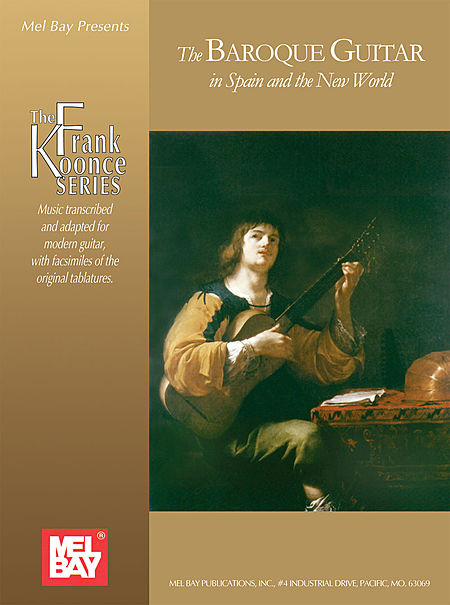
BAROQUE GUITAR IN SPAIN AND THE NEW WORLD BY FRANK KOONCE

THE BAROQUE GUITAR IN SPAIN AND THE NEW WORLD, BY FRANK KOONCE. 170 Pages.

LIBRO DI MUSICA BAROCCA .

SPARTITI PER CHITARRA : PENTAGRAMMA . 


Nel libro c'è anche una parte di storia sull'origine della chitarra ove troverete molte informazioni sulle accordature della vihuela e delle chitarre antiche a 5 corde doppie (non avevano il Mi basso), una guida per la lettura della Tablature italiana del 1500. La Tablature del 1732 di Santiago de Murcia, e quella di Giovanni Paolo Foscarini del 1629, avevano anche l'indicazione degli accordi per l'accompagnamento, lo strumming in giù e in sù, e gli accordi sono gli stessi che si usano nelle canzoni di oggi di Neil Young e Battioni, e poi i trilli e gli abbellimenti. Dopo 500 anni la Tablature italiana, quella che si usa nei libri di oggi, è ancora un sistema valido e immediato per la lettura della musica. Con 40 pagine di facsimile delle tablature originali.

Music transcribed and adapted for modern guitar, with facsimiles of the original tablatures.

Product Description:
A substantial amount of early music for the guitar remains unknown to modern performers and audiences. In recent years, however, musicologists, scholars and performers on period instruments have provided a wealth of accessible new source materials which players can now begin to interpret in convincing and effective ways. Nevertheless, many still feel intimidated by the prospect of sorting through and learning to use these resources for the first time. For the uninitiated, just knowing where to start can be difficult.

A substantial amount of early music for the guitar remains unknown to modem performers and audiences. In recent years, however, many fine musicologists, scholars, and performers of period instruments have provided a wealth of new materials - reprints of original manuscripts, translations of early treatises, scholarly transcriptions of tablatures, and other resources - with which players now can have access this music and begin to interpret it in convincing and effective ways. Nevertheless, many guitarists still may feel intimidated by the prospect of sorting through and learning to use these resources for the first time. For the uninitiated, just knowing where to start can be difficult. Scholarly transcriptions, for the most part, are not designed for easy use by guitarists. For example, many are in double-staff (keyboard) notation and, with regard to Renaissance vihuela and lute music, are not often transposed to guitar pitches. In other words, the open first string is usually written as G, not E. Guitarists who try to play from these editions essentially are faced with the task of transcribing the transcription! Furthermore, these editions sometimes do not offer realistic solutions - from a player's perspective - for voicing, note duration, and other considerations imposed by the technical limitations of an instrument. My idea to develop an anthology came about through my own need for easily accessible resource materials to teach repertoire or history/literature classes at the university level. I also wanted to help bridge the gap between scholarly editions and performance editions by providing a hands-on introduction to tablature transcription and to issues concerning historically informed performance on the modern guitar. I hope that my efforts may be of assistance to other teachers, as well as being simply an attractive collection of music for all to enjoy. The present collection contains representative selections from the publications and manuscripts of four important Spanish Baroque guitarists: Gaspar Sanz, Antonio de Santa Cruz, Francisco Guerau, and Santiago de Murcia. It must be emphasized, however, that this is only a sampling ofthe rich and varied repertoire from this era. The reader is strongly encouraged to seek out other sources, especially the many fine facsimile editions and other scholarly publications that are cited herein. Acknowledgements I am grateful to my friends, colleagues, and family who assisted in the preparation of this anthology: Michael Macmeeken, of Editions Chanterelle, shared images of original tablatures from Murcia's Resumen and Passacalles y obms; Brian Jeffery, of Tecla Editions, shared images from Guerau's Poema harmonico; Michael Lorimer shared images from his facsimile edition ofMurcia's Saldivar Codex No.4; and Richard Savino shared digital photographs of the unpublished Santa Cruz manuscript. James Tyler, Richard Long, Richard Savino, Kay Norton, Richard Troeger, Anthony Bez, Christopher Dorsey, Richard Brune, and Jan-OlofEriksson provided expertise on matters pertaining to the text and music. Babette Burns, Richard Burns, and Anne Loire assisted in translations and international communications. AlAbrams provided photographic services. Bernard Terlay, ofMusee Granet, provided the image for the cover portrait. Sylvain Lemay, of us Productions d'OZ, prepared the music engraving and text formatting, and patiently accommodated my many revisions. Leanne Koonce, my wife and partner, designed the cover, scanned and formatted all of the facsimile images, and provided her abiding love and support as always. Reading Baroque Guitar Tablature

Tablature and Transcription Anyone today who wishes to perform early music originally written for the guitar and other fretted instruments should learn to read tablature because it provides direct access to the original, unaltered, music. Performers also gain access to the vast majority of Renaissance and Baroque pieces that have not yet been transcribed. Those arguments notwithstanding, there are benefits to having tablature transcribed into modern notation: 1) Transcriptions facilitate the playing of music on instruments other than those for which it was written. 2) Modern notation enables performers to see functional aspects of the music such as pitch relationships, voicing, and harmonic structures. 3) Modern notation also provides an introduction to the performance of early music for those not yet accustomed to reading tablature. Nevertheless, the conversion of tablature into modern notation involves making many subjective choices on matters such as note sustain, voicing, and octave selection. Even the most conscientious transcriber cannot avoid imparting personal preferences into this process. The problem is compounded if a transcriber is also trying to take idiomatic differences between a period instrument and a modern instrument into account. Differences in tuning between a Baroque guitar and a modern guitar, for instance, make certain alterations unavoidable. I also must be understood that editors may have perspectives that fall anywhere between two diametric extremes. At one end, an editor may disregard information provided in the tablatures and try to "improve" the music by revising or even re-composing much of it. The result of such a process is a free arrangement, far removed from the original, not a true transcription. At the other end, an editor may try to represent an imagined ideal of performance that goes beyond the realistic technical capabilities of performance on the intended instrument. This often occurs in scholarly editions b musicologists who sometimes do not share the technical concerns of players. 16 In ummary, one must realize that any editorial solution may represent only one of many interpretative possibilities and may therefore may hinder the reader from exploring alternatives that are equally valid - or even more so. Given all of the ambiguities of tablature notation and the subjectivity associated with the transcription process, players should always consult the tablature for the most direct connection to the original music. 3.2. Punteado Notation Reading Italian Tablature, Baroque guitar music from Spain and Italy is written in "Italian" tablature. A five-line staff represents the five courses ofthe guitar, with the bottom line being the first course (the treble E). In this layout, the tablature projects a mirror image of the strings when the music is placed on a table for reading. Numbers placed on or between the lines indicate the frets that are to be stopped on a particular course. The number 0 represents the open course; 1 is for the first fret; 2 is for the second fret, and so on. The Roman numeral X represents the tenth fret instead of the Arabic 10 to avoid it being misread as two notes. Notes above this fret (although rare) (16 For an excellent article on the methods, philosophies, and evolution of transcription, see Matanya Ophee, "The History of Transcriptions of Lute Tablature - 1679 to the Present)

This anthology contains representative selections from the publications and manuscripts of four important Spanish Baroque guitarists: Gaspar Sanz, Antonio de Santa Cruz, Francisco Guerau, and Santiago de Murcia. In addition to being fun and entertaining music for all to enjoy, this collection is intended to help bridge the gap between scholarly editions and performance editions by providing a hands-on introduction to tablature transcription and to issues concerning historically informed performance on the modern guitar.

Contents:

Preface

Acknowledgements

Dedication

1. Evolution of the Five-Course Guitar

1.1. Transition from the Vihuela and Four-Course Guitar

1.2. Dominance of the Five-Course Guitar

2. Tuning of the Five-Course Guitar

2.1. Terms Pertaining to Stringing and Tuning

2.2. Different Tunings for the Baroque Guitar

2.3. Issues and Opinions on Tuning Practices in Spain

2.4. Relevance of Baroque Tuning Practices to Modern Performers

3. Reading Baroque Guitar Tablature

3.1. Tablature and Transcription

3.2. Punteado Notation

3.3. Rasgueado Notation

3.4. Mixed Tablatures

4. Interpretation and Performance

4.1. Octave Selection and Voice Leading

4.2. Punteado Ornaments

4.3. Campanelas

4.4. Meter and Tempo

4.5. Hemiola and Syncopation

4.6. Rasgueado Techniques

4.7. Rasgueado Ornaments

5. Editorial Procedures

5.1. Philosophy and Intent

5.2. The Voicing and Notation of Strummed Chords

5.3. Editorial Notation

6. Gaspar Sanz

6.1–9. La cavalleria de Napoles con dos clarines, Rujero, Paradetas, Folías, Las Hachas, Zarabanda, La Esfachata de Napoles,La Miñona de Cataluña, Canarios

6.10–14. Pavanas, Españoletas, Matachín, Villanos, Passacalles

7. Antonio de Santa Cruz

7.1–3. Jácaras, Villano, Canario

8. Francisco Guerau

8.1–4. Marionas, Villano, Canario, Passacalles in B minor

9. Santiago de Murcia

9.1. Resumen de acompañar

La Guastala, Menuet, Preludio in D minor

9.2. Códice Saldívar No. 4

Marionas, Fandango, Jácaras, Zangarilleja, Cumbées

9.3. Passacalles y obras

Passacalles in G minor, Suite in G Major, Suite in D minor

10. Facsimiles

Selected Bibliography


Music


Gaspar Sanz

La cavalleria de Napoles con dos clarines

Rujero

Paradetas

Folías

Las Hachas

Zarabanda

La Esfachata de Napoles

La Miñona de Cataluña

Canarios

Pavanas

Españoletas

Matachín

Villanos

Passacalles

Antonio de Santa Cruz

Jácaras

Villano

Canario

Francisco Guerau

Marionas

Villano

Canario

Passacalles in B minor

Santiago de Murcia

La Guastala

Menuet(s)

Preludio in D minor

Marionas

Fandango

Jácaras

Zangarilleja

Cumbées

Passacalles in G minor

Suite in G Major

Suite in D minor

Facsimile Reproductions

Gaspar Sanz

Instruccion de musica

Antonio de Santa Cruz

Libro donde se veran pazacalles

Francisco Guerau

Poema harmonico

Santiago de Murcia

Resumen de acompañar

Códice Saldívar No. 4

Passacalles y obras

Prezzo: €34,99
€34,99

DANZAS OF PUERTO RICO FOR TWO GUITARS, ARRANGED BY ELIAS BARREIRO. CD

DANZAS OF PUERTO RICO FOR TWO GUITARS, ARRANGED BY ELIAS BARREIRO. CD

Product Description:
A collection of danzas by five of the most important nineteenth and twentieth century Puerto Rican composers: Juan Morel Campos, Luis R. Miranda, Angel Mislan, Manuel G. Tavarez and Braulio Dueno Colon. All songs are beautifully arranged by Elias Barreiro, with score and first and second guitar pull-out parts; all in standard notation. A companion CD recording of all nine songs is also included.

Contents:

EL TORBELLINO -- JUAN MOREL CAMPOS; ARRANGED BY ELIAS BARREIRO
UN DIALOGO -- JUAN MOREL CAMPOS; ARRANGED BY ELIAS BARREIRO
CARMELITA -- JUAN MOREL CAMPOS; ARRANGED BY ELIAS BARREIRO
CIELO DE ENCANTOS -- JUAN MOREL CAMPOS; ARRANGED BY ELIAS BARREIRO
TEN PIEDAD -- JUAN MOREL CAMPOS; ARRANGED BY ELIAS BARREIRO
IMPROMTU -- LUIS R. MIRANDA; ARRANGED BY ELIAS BARREIRO
SARA -- ANGEL MISLA; ARRANGED BY ELIAS BARREIRO
MARGARITA -- MANUEL G. TAVAREZ; ARRANGED BY ELIAS BARREIRO
TERESA -- BRAULIO DUENO COLON; ARRANGED BY ELIAS BARREIRO

Prezzo: €16,99
€16,99
Condividi contenuti