CHITARRA - GUITAR

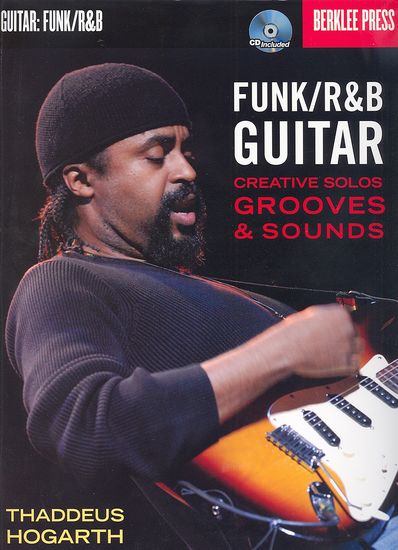
FUNK R&B GUITAR Creative Solos Grooves & Sounds Hogarth Berklee CD TABLATURE SPARTITI LIBRO

FUNK / R&B GUITAR Creative Solos, Grooves & Sounds, THADDEUS HOGARTH Berklee. CD TABLATURE

LIBRO DI MUSICA FUNK CON CD.
SPARTITI PER CHITARRA CON GRAFICO DELLA TASTIERA, ACCORDI, PENTAGRAMMA E TABLATURE.

Creative Solos, Grooves & Sounds
Series: Berklee Guide
Publisher: Berklee Press
Medium: Softcover with CD TAB
Author: Thaddeus Hogarth

Learn deep funk/R&B guitar! These hands-on exercises, licks, and technical discussions will help you play in the style of Kool and the Gang, Prince, James Brown, Sly and the Family Stone, Jimi Hendrix, Curtis Mayfield, Soulive, and other great artists, spanning from old school to contemporary funk/R&B grooves. The CD features demonstration and practice tracks, played by the Boston-based R&B/funk group the Thaddeus Hogarth Band. Guitar tablature, fretboard diagrams, and traditional notation are included. You'll learn how to: play lead lines and build solos; understand and use scales over funk/R&B harmonies; create rhythm-guitar parts that support funk/R&B grooves; bend strings to expand your palette of scales, harmonies, and ornamentation; and much more!

These hands-on exercises, licks, and technical explanations will help you play in the style of Prince, James Brown, Kool and the Gang, Sly and the Family Stone, Jimi Hendrix, Curtis Mayfield, Soulive, and other great artists, spanning from old school to contemporary funk/r&b grooves. The CD features demonstration and practice tracks, played by the Boston-based r&b/funk group, the Thaddeus Hogarth Band. Guitar tablature, fretboard diagrams, and traditional notation are included. You will learn how to:


  • Play lead lines and build solos
  • Understand and use scales over funk/r&b harmonies
  • Create rhythm-guitar parts that support funk/r&b grooves
  • Bend strings to expand your palette of scales, harmonies, and ornamentation
  • Use articulations, such as muting, sliding, plucking, and others
  • Use characteristic funk/r&b amplification and effects such as distortion, wah-wah, envelope filters, chorus, and more
  • Gain facility with all these tools via time-tested exercises

Thaddeus Hogarth is an associate professor of guitar at Berklee College of Music, where he has trained hundreds of guitarists in the art of funk/r&b. He is an active performer and recording artist.

"When I was a young blood, starting out in the Apollo Theater house band, the knowledge the old timers shared with me was invaluable. As I started working through the lessons in this book, it felt like an extension of those glorious soulsters—guiding me like Lewis and Clark, down the trail to Funkland. This will be a priceless tool for the novice, as well as the pro of other disciplines. Bravo."

—Nile Rodgers, Guitarist/Producer/Composer/Arranger (Chic)

"Thaddeus Hogarth has articulated some of the 'secrets of the funk' in an easy to understand, practical manner. It is the only book I've ever seen that approaches funk and r&b with due respect, in its simplicities and complexities. He not only gives great examples but also takes you into the exploratory harmonic possibilities to find your own voice. If you're looking for "That Book" to unlock the inner workings of the groove and what to do on top of it, this is the book to read."

—Billy "Spaceman" Patterson, Guitarist/Composer/Producer/Arranger (James Brown, Sly Stone, Miles Davis, George Clinton)

"A timeless staple of r&b guitar. The format is meticulously detailed, the recorded examples are first rate, and the listening list is a veritable treasure-chest map."

Prezzo: €29,99
€29,99

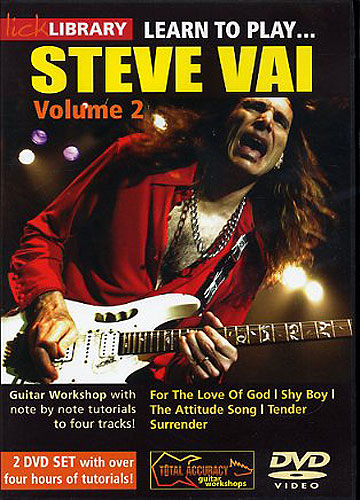
VAI STEVE, LICK LIBRARY LEARN TO PLAY VOLUME 2. Guthrie Govan; Dave Kilminster. 2 DVD

VAI STEVE, LICK LIBRARY LEARN TO PLAY VOLUME 2. 2 DVD

Guthrie Govan; Dave Kilminster

Description
A lick-by-lick guide to even more of Mr. Vai's guitar work which has amazed and confounded guitarists the world over. This special 2-DVD set features over four hours of pure Steve Vai magic, as Guthrie Govan and Dave Kilminster dissect four songs plucked from different stages of the guitar wizard's sparkling career. Discover the secrets of Vai's twisted tones, as well as the compulsory arsenal of techniques, tricks and fretboard pyrotechnics. Songs include The Attitude Song and David Lee Roth's Shy Boy.

For The Love Of God
Shy Boy
Tender Surrender
The Attitude Song

Prezzo: €49,99
€49,99

MONTGOMERY WES Essential Jazz Lines in the Style of LIBRO CD GUITAR TABLATURE Chord Substitution-Mixolydian Bebop

MONTGOMERY WES, Essential Jazz Lines in the Style of. CD TABLATURE

LIBRO DI MUSICA PER CHITARRA CON CD E TABLATURE.

Product Description:
Wes Montgomery took jazz guitar to a new level when he came to the public's attention in the late 1950's. Known for his fluid lines and his big jazz guitar sound, Wes influenced thousands of guitarists in the styles of jazz, blues, and rock. This book will present some of the soloing techniques that Wes used as well has present many melodic ideas (lines) similar to the way he played over the chord progression in many jazz standards. Because the major and minor ii-V-I progression are the most widely used chord progression in jazz standards, the lines in this text will work over these progressions. The accompanying CD contains many play-along tracks (vamps of one chord and vamps around the circle of fourths) that the student should use to practice the material in one key and then master it in all twelve keys. By learning the techniques used by Wes Montgomery, guitarists will add to their own improvising arsenal. As improvising musicians add to their collection of musical ideas, their ability to express themselves completely increases. Have fun studying these ideas and applying them in improvised solos.

Contents:

Wes Montgomery Introduction
Wes Montgomery and Charlie Parker
Guide Tones
Bebop Scales

Mixolydian Bebop
Dorian Bebop
Major Bebop
3 to 9
Fingering Charts
Playing the Upper Structure of Chords
Targeting
Arpeggios

Transposed Arpeggio Examples
Playing Octaves
Block Chords
Chord Substitution
Solo Development
Minor Ideas
Dominant Seventh Ideas
Short ii-V Ideas
Long ii-V Ideas
Major Ideas
Minor ii-V Ideas
Short ii-V-I Progressions
Long ii-V-I Progressions
Minor ii-V-I Progressions
Turnarounds
Chord Progression...

Etude
Similar to "Misty"
B 12 Bar Blues

CD CONTENTS:
Tuning
Minor Chord Vamp
Minor Moving in Fourths
Dominant Seventh Vamp
Dominant Seventh Moving in Fourths
Short ii-V Vamp
Short ii-V Moving in Fourths
Long ii-V
Long ii-V Moving in Fourths
Major Chord Vamp
Major Chords Moving in Fourths
Minor ii-V Vamp
Minor ii-V Moving in Fourths
Short ii-V-I Vamp
Short ii-V-I Moving in Fourths
Long ii-V-I Vamp
Long ii-V-I Moving in Fourths
Minor ii-V-I Vamp
Minor ii-V-I Moving in Fourths
Turnaround Vamp
Turnaround Moving in Fourths
Etude
Progression similar to "Misty"
Blues

Prezzo: €20,99
€20,99

GREEN GRANT Essential Jazz Lines in the Style of for Guitar CD TABLATURE Double-Stops-Dominant Turnarounds

GREEN GRANT, Essential Jazz Lines in the Style of for Guitar. SHEET MUSIC BOOK with CD & GUITAR TABLATURE.

LIBRO DI MUSICA JAZZ CON CD.

SPARTITI PER CHITARRA :  

ACCORDI, DIAGRAMMA DELLA TASTIERA DELLA CHITARRA, PENTAGRAMMA, TABLATURE.


Product Description:
Grant Green was one of the most innovative jazz guitarists of the 1960s. His horn-like lines, original tone, and superb sense of time elevated him to being one of Blue-Note Records first call session players as well as a respected bandleader. This book covers many of the techniques Grant used in his playing and provides many melodic lines in the style of Grant Green for minor, dominant seventh, short and long ii-V, major, and minor ii-V chord progressions. Chapters on double-slurs, double-stops, pentatonic and blues scales as well as chapters on the basics of the jazz language will help guitarists understand and play the music of Grant Green. Presented in standard notation, tab and fretboard diagrams, this book comes with a play-along CD that will assist guitarists in mastering this material.

Contents:

Introuction
Guide Tones
Bebop Scales
3 to 9
Playing the Upper Structure of Chords
Targeting
Double Slurs
Pentatonic and Blues Scales
Double-Stops
Syncopation
Minor Chord Material
Dominant Chord Material
Short ii-V Material
Long ii-V Material
Major Chord Material
Minor ii-V Material
Play-Along Recordings
Short ii-V-I
Long ii-V-I
Minor ii-V-i
Turnarounds
Etude
Progression similar to "Misty"
B 12-Bar Blues
Progression similar to "Solar"
About the Author

Prezzo: €27,99
€27,99

TECHNIQUE EXERCISES FOR GUITAR LIBRO CD TABLATURE Speed Power Jean Marc Belkadi

TECHNIQUE EXERCISES FOR GUITAR, Lessons and Licks for Improving Your Speed, Power & Clarity. Mus. Inst. Jean Marc Belkadi. SHEET MUSIC BOOK WITH CD & GUITAR TABLATURE. 

LIBRO METODO DI MUSICA CON CD.

SPARTITI PER CHITARRA CON:

ACCORDI, PENTAGRAMMA TABLATURE. 

TECNICA, VELOCITà, 

Lessons and Licks for Improving Your Speed, Power & Clarity
Series: Musicians Institute Press
Publisher: Musicians Institute Press
Medium: Softcover with CD
Author: Jean Marc Belkadi

Hone your precision, endurance, dexterity, and synchronization skills with loads of interesting exercises to learn and practice. The accompanying CD contains 81 demonstration tracks of all the exercises in the book. 40 pages.

Prezzo: €16,99
€16,99

A MODERN APPROACH TO JAZZ, ROCK & FUSION GUITAR Jean Marc Belkadi Publisher Mus. Inst. CD TABLATURE

A MODERN APPROACH TO JAZZ, ROCK & FUSION GUITAR. Jean Marc Belkadi, Musicians Institute. Le scale maggiori, i cromatismi, triadi e tapping, arpeggi e sweep picking, fusione di idee. CD TABLATURE


Series: Musicians Institute Press
Publisher: Musicians Institute Press
Format: Softcover with CD - TAB
Composer: Jean Marc Belkadi

Jean Marc Belkadi gives you over 30 great lines using a variety of techniques and melodic ideas. Covers: alternate, sweep, and skip picking; major scale, chromaticism, arpeggios, superimposing triads; legato, wide intervals, alterations; and much more. Includes standard notation and tablature.

Inventory #HL 00695143
ISBN: 9780793573776
UPC: 073999951431
Width: 9.0"
Length: 12.0"
24 pages


A Modern Approach to JAZZ, ROCK, & FUSION GUITAR

Jean Marc Belkadi gives you over 30 great lines using a variety of techniques and melodic ideas

- Major scale, chromaticism, arpeggios, superimposing triads
- Alternate picking, sweep picking, and string skipping
- Legato, wide intervals, alterations
-Standard notation and TABLATURE

HL00695143

MUSICIAN INSTITUTE PRESS
is the official series of Southern California's renowned music school. Musicians Institute
MI instructors, some of the finest musicians in the world, share their vast knowledge and
experience with you nomatter what your current level.
Whether your instrument is guitar, bass, drums, vocals, or keyboards, MI PRESS
offers the finest music curriculum for higher learning through a variety of series:

Essential Concepts – designed from MI core curriculum program

Master Class - designed from MI elective courses

Private Lessons - tackle avariety of topics "one-on-one" with MI faculty instructors

Pocket Guide - handy reference to the basics

Video - in-depth lessons with many of Ml's well-known instructors

Workshops - transcribed scores of music's greatest songs, designed from Ml's performance workshop classes.

HAL LEONARD


by Jean Marc Belkadi

Contents

Dedication
About the Author
Introduction
Introduction to the Recording
Tuning
Chapter 1: The Major Scale and Chromatism
Chapter 2: Triads
Chapter 3: Arpeggios
Chapter 4: Additional Ideas
Closing
Guitar Notation Legend

ISBN 0-7935-7377-7
HAL-LEONARD


DEDICATION
This book is dedicated to Marie Christine Belkadi, my brother Patrick, and my
parents whose love, strength, and faith has been a source of inspiration and
growth.
Special thanks to:
Karen Segal for transcribing, copying, editing, and for all your positive
suggestions.
Vasso Dimitriou for producing, recording, and for your supportive attitude.
Ted Green for editing and positive advice.
Thanks to Frank Gambale, Michael Komitchisk, Francois and Fred from LAG
guitars and Steve Butcher from Dimarzio pick-ups.

ABOUT THE AUTHOR
Jean Marc Belkadi started playing guitar at age 14. He graduated from the
Toulouse Music Conservatory in his hometown. In 1984,he left France for the
u.s. to learn at the Musicians Institute of Technology in Los Angeles where he
received the Best Guitar of the Year Award.
In 1989 and 1992he was awarded third and second prize at the Billboard Song
Contest. For three years he was musical director of the Johnny Hune TV show.
He has written two guitar method books addressing Jazz, Fusion and Rock
soloists and recorded one solo album.

INTRODUCTION
The purpose of this book is not to be a guitar method book with a captalIM."
Rather, it is intended as a source of inspiration to help you develop your own
ideas. The three key areas that I focus on and encourage you to explore are:

Melody
In any style of music you are into, the melodic direction, sound, and phrasing
are the first and most important things to consider. For this reason-and to
develop the connection between your ear and fingers-I recommend that you
sing all the lines (slowly at first).

Harmony
All of the lines are performed against a certain chordal background. However,
they can also be used with other chords and will sound different in each context.
I encourage you to experiment by playing them in different chordal contexts using
a tape recorder, a synthesized background, a friend, or whatever you may have
available.

Technique
This book is geared for guitar players and makes use of various techniques that
are unique to the guitar, including alterna te, sweep, and skip picking, hammer-ons,
pull-offs, and tapping. Play the lines very slowly and accurately at first and
gradually speed up. Don't forget that the melody should sound natural to you at
any tempo. The harmony should be implicit, your phrasing clean, and timing
perfect.
Let's begin now! I hope you will enjoy this as much as l do ...

Editor's notes:
Follow the audio icons in the book to keep your spot on the CD.
A short "introductory" solo portion may sometimes precede the main lick of each
figure, to give it a better sense of context. However, only the main lick itself
appears transcribed in each case.
 

Prezzo: €17,99
€17,99

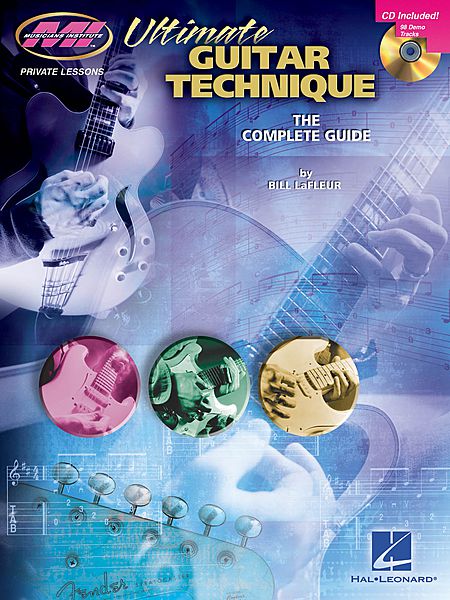
ULTIMATE GUITAR TECHNIQUE-Bill LaFleur-Musicians Institute CD TABLATURE CHITARRA TECNICA

ULTIMATE GUITAR TECHNIQUE, THE COMPLETE GUIDE. Bill LaFleur. Musicians Institute - PRIVATE LESSONS. SHEET MUSIC BOOK WITH CD & GUITAR TABLATURE

LIBRO DI MUSICA, ROCK, CLASSICAL, LATIN, FOLK, METAL, JAZZ, 

METODO DI TECNICA PER CHITARRA. 

SPARTITI PER CHITARRA CON: 

ACCORDI, PENTAGRAMMA, TABLATURE. 

Publisher: Musicians Institute Press

From bends and picking styles to multi-finger tapping and animal sounds, this book/CD pack contains loads of guitar techniques to learn and master. Hone your skills with chop-building exercises, and use the demonstration CD to master every technique in the book. Includes: chop-building exercises - tremolo bar, tapping, harmonics - bends, slurs, slides - picking styles, rakes - fret-hand techniques - pick-hand techniques - lead and rhythm guitar - rock, classical, Latin, folk, metal, jazz and more - tricks and sound effects - standard notation and TABLATURE

Prezzo: €25,99
€25,99

LATIN GUITAR Musicians Institute Bruce Buckingham CD TABLATURE SPARTITI CHITARRA METODO

Latin Guitar The Essential Guide to Brazilian and Afro-Cuban Rhythms. SHEET MUSIC BOOK WITH CD & GUITAR TABLATURE. 

LIBRO METODO DI MUSICA LATINA CON CD. 

SPARTITI PER CHITARRA CON : 

ACCORDI, PENTAGRAMMA, TABLATURE. 


INDICE:

Bossa Nova

Samba

Partido Alto

Baião

Bolero

Cha Cha

Mambo

Nanigo 6/8


Bruce Buckingham

Publisher: Musicians Institute Press

MASTER CLASS

Pro musician and G.I.T. instructor Bruce Buckingham covers all the basics guitarists need to know in this book/CD pack designed from MI elective courses. Rhythms covered include: bossa nova, samba, partido alto, baião, bolero, cha cha, mambo, nanigo 6/8 and more. The accompanying CD includes 79 demo tracks.


PART I: BRAZILIAN RHYTHMS

Bossa Nova - The One-Bar Pattern

Bossa Nova - Two-Bar Patterns And Beyond

Samba

Variations - Partido Alto, Baião, and 3/4 Bossa Nova


PART II: AFRO-CUBAN RHYTHMS

Bolero

Cha Cha

Mambo

Nanigo 6/8


MUSICIANS INSTITUTE PRESS

is the official series of southern California's renowned music school, musicians Institute.

MI instructors, some of the finest musicians in the world, share their vast knowledge and experience with you no matter what your current level.

Whether your instrument is guitar, bass, drums, vocals, or keyboards, MI PRESS offers the finest music curriculum for higher learning through a variety of series: 


ESSENTIAL CONCEPTS -designed from Mi core curriculum programs


MASTER CLASS - designed from MI elective courses


PRIVATE LESSONS -tackle a variety of topics "one-on-one" with MI faculty instructors

Prezzo: €25,99
€25,99

JAZZ-ROCK TRIAD IMPROVISING FOR GUITAR Jean Marc Belkadi CD TABLATURE 50 LICKS-Substitution-

JAZZ-ROCK TRIAD IMPROVISING FOR GUITAR, Jean Marc Belkadi. Mus. Inst. 50 LICKS AND LESSONS FOR CREATING RED HOT LEAD PHRASES

SHEET MUSIC BOOK CD WITH GUITAR TABLATURE.

LIBRO METODO DI MUSICA CON CD.

SPARTITI PER CHITARRA CON: 

ACCORDI, PENTAGRAMMA, TABLATURE. 


Jazz-Rock Triad Improvising for Guitar
Series: Musicians Institute Press
Publisher: Musicians Institute Press
Format: Softcover with CD - TAB
Composer: Jean Marc Belkadi

In this “private lesson,” MI instructor Jean Marc Belkadi reveals the secrets to creating interesting, over-the-top, red-hot licks and lead phrases! He covers: modal and tonal usage, triad substitution and superimposition techniques, and much more. The book is in standard notation and tab, and the CD features 50 full-band tracks.

Inventory #HL 00695361
ISBN: 9780634001581
UPC: 073999953619
Width: 9.0"
Length: 12.0"
24 pages

PRIVATE LESSONS

JAZZ-ROCK TRIAD IMPROVISING for Guitar
50 LICKS AND LESSONS FOR CREATING RED HOT LEAD PHRASES

Jean Marc Belkadi reveals the secrets to creating interesting, over-the-top phrases.

- CD Includes 50 Full-Band Tracks
- Modal and Tonal Usage
- Triad Substitution and Superimposition Techniques
- Standard Notation and Tablature

ISBN 0-634-00158-2


Introduction
In contemporary music, the use of triads is an important element in improvisation and composition.
They are as prevalent as scales, modes, arpeggios, rhythms, and intervallic ideas.
Like scales and modes, triads can be substituted in tonal and modal music. They can also be
superimposed, creating bitonality or polytonality. Superimposed triads give us synthetic scales
such as hexatonic (6 note scales = 2 triads), or nonatonic scales (9 note scales = 3 triads).
What Is a Triad?
A triad is a three-note chord made up of a root, third, and fifth. There are four triad families:
Major triad: 1-3-5
Minor triad: 1-b3-5
Diminished triad: 1-b3-b5
Augmented tri ad: 1-3-# 5
Of course, in everyday applications triads are played with different inversions:
Root position
1-3-5

Inversion possibilities
3-5-1, 5-1-3, 3-1-5, etc.

Sometimes triads are played with one degree dispersed an octave higher:

regular triads
open triads

This dispersement procedure creates what is referred to as an open triad, and can be applied
to minor, diminished, and augmented triads, as well as major.

Triad Substitution
Triad substitution is where one triad is substituted in place of another. One of the most common
is flat-five-or tri-tone substitution. This is when a triad a flat-fifth degree (tri-tone) away is
substituted for a chord. For example: instead of playing a G major triad over a G7 chord, a Db
major triad (Db is a flat-fifth away from G) is "substituted."

Triad Superimposition
Triad superimposition is where two or more triads are played one after the other, creating a
"dispersed scale" effect of bitonality or polytonality. Of course all triads can be substituted or superimposed
in both tonal and modal music, either using the single-note approach or voiced in chord form.
 

About this Book
The purpose of this book is to help you to create your own ideas using triad concepts. It is
divided into two parts: tonal music (II-V-I chord progressions, Chapters 1 and 2) and modal
music (Chapters 3 and 4). Keep in mind that the examples do not follow a specific order
of difficulty; you can jump in anywhere and work with the licks you like best. You also might want
to listen to the CD first to locate the examples that appeal to you the most.

About the Audio
Throughout this book, the numbers in the audio symbols (+) indicate the CD track number
where each example will be found on the accompanying CD.
Each example is played at full tempo, and most are repeated at half speed. In addition, short
introductory phrases (which are not transcribed in the examples) are sometimes included to provide
a better sense of context and to maintain an improvisational feel.


Acknowledgments
I wish to give special thanks to Marie-Christine Belkadi, Kevin Holmes for editing assistance, all at Hal Leonard Corporation, Frank Gambale and Mike Stern for their support, Keith Wyatt from Musicians Institution, Steve Blutcher from DiMarzio, HHHrrernst Homeyer for his good advice, Marco Biasella and Pierre Pichon for letting me use their equipment, Alain Lasseube-Le frere
Gagarine, Olivier Hermitant for his friendship, and Chris Jero of Yamaha.
This book is dedicated to my dear Grandma, Georgette Bach.

About the Author
Jean-Marc Belkadi started playing guitar at age 14. He graduated from the Toulouse Music
Conservatory in his hometown. In 1984, he left France for the U.S. to study at Musicians
Institute in Los Angeles where he received the Best Guitarist of the Year award.
In 1989 and 1992, he was awarded third and second prize at the Billboard Song Contest.
For three years, he was musical director of the Johnny Hune TV show. He has written three guitar
method books-A Modern Approach to Jazz, Rock, & Fusion Guitar, The Diminished Scale for
Guitar, and Advanced Scale Concepts and Licks for Guitar-and has recorded one solo album.


Table of Contents
About this Book
About the Audio
Introduction

Chapter 1: Substitution and Superimposition Techniques in Tonal Music
Major Key II-V-I Progressions Using Substitution 
Major Key II-V-I Progressions Using Superimposition 
Minor Key II-V-I Progressions Using Substitution 
Minor Key II-V-I Progressions Using Superimposition 
Major Key IImi7b5-V-1 Progressions Using Substitution 
Major Key IImin5-V-1 Progressions Using Superimposition 
Major Key 117-V-1Progressions Using Substitution 
Major Key 117-V-1Progressions Using Superimposition 

Chapter 2: Open Triad Techniques in Tonal Music
Major Key II-V-I Progression Using Open Triads .
Minor Key II-V-I Progression Using Open Triads 
Major Key Ilmi7b5-V-1 Progression Using Open Triads 
Major Key II7-V-1Progression Using Open Triads 

Chapter 3: Substitution and Superimposition Techniques in Modal Music
Ma7 Chord Examples 
Ma7#11 Chord Examples 
Mi7 Chord Examples 
Mi(ma7) Chord Examples
Dominant7 Chord Examples 

Chapter 4: Open Triad Techniques in Modal Music
Ma7 Chord Examples 
Mi7 Chord Examples 
Mi(ma7) Chord Examples 
Mi6 Chord Examples 
Dominant7 and Altered Dominant7 Chord Examples 
Acknowledgments
About the Author
Guitar Notation Legend
Note: Track to tune up.
 

Prezzo: €17,99
€17,99

GIBSON LES PAUL 50 YEARS OF THE Half a Century of the Greatest Electric Guitars Tony Bacon BOOK LIBRO

50 YEARS OF THE GIBSON LES PAUL, Half a Century of the Greatest Electric Guitars. Tony Bacon. 160 pagine.

LIBRO ILLUSTRATO


Series: Book
Publisher: Backbeat Books
Medium: Softcover
Author: Tony Bacon

This exciting book documents the complete decade-by-decade story of one of the world's most important and influential electric guitars. The Gibson Les Paul turned 50 years old in 2002, and since its invention, its sweet, urgent sound has been used by a host of major rock players - from Eric Clapton in Cream to Steve Jones of The Sex Pistols, from Joe Walsh in The Eagles to Slash of Guns N'Roses. Unique color photographs feature a multitude of luscious Les Paul models and highlight great players in action with their Les Paul guitars. Meticulous listings for the collector document every model produced from 1952 to the present day. 50 Years of the Gibson Les Paul is a beautiful, detailed examination of six decades of great guitars and the fine musicians inspired to play them. 160 pages.


FIFTY YEARS OF THE GIBSON LES PAUL

Les Paul created on record a magical orchestra of massed guitars playing catchy instrumental tunes, and his first multi-guitar single was a big hit.


Les Paul is not just the name on a guitar headstock. The man himself was born Lester William Polfus in Waukesha, Wisconsin, in the mid 1910s, and started professional life as a talented, teenage guitarist. By age 17 he was broadcasting on local radio stations, playing country as Rhubarb Red and adding jazz to his expanding repertoire. The kid had an apparently natural technical ability, which he applied to music as well as to making his own bits and pieces of instrumental and electrical gadgetry. Like a number of performers in the 1930s, the young Lester soon became interested in amplifying his guitar. He recalled later that in his early teens he'd managed to create a pickup out of a telephone mouthpiece and an amplifier from his parents' radio, allowing him to bring his guitar to the attention of the audience at a local roadhouse gig. Around this time companies such as Rickenbacker, National and others began to sell the first commercial electric guitars, instruments with electric pickups and controls built into regular archtop acoustic guitars. By the middle of the 1930s the Gibson company had got into this market with an "Electric Spanish" guitar and amplifier, as had their biggest competitor, Epiphone of New York City. Meanwhile, Lester Polfus had permanently adopted a suitably shortened version of his name - Les Paul - and for three years from 1938 led a jazz-based trio broadcasting out of New York on the Fred Waring show. It was at this time that he moved from an acoustic archtop model to one of Gibson's first electric guitars, the ES-300. Later he would visit the empty Epiphone factory at weekends to experiment with an instrument he called his "log". The nickname came from a four-by-four solid block of pine that he inserted between the sawn halves of a dismembered Epiphone body, with a Gibson neck and Larson Bros fingerboard, adding his own vibrato and pickups. He didn't play this one much - it was more of a testbed. A little later Paul modified a second and third Epiphone, which he named his "clunkers", and he and vocal/guitar partner Mary Ford would use these semi-solid guitars regularly on stage and in recording studios through the early 1950s. Other explorations into solidbody electric guitars were being made elsewhere in America at this time, not least by Rickenbacker, National, Bigsby and Fender, all in California. A solidbody electric was appealing to manufacturers because it would be easier to construct than an acoustic guitar, using a body or body-section made of solid wood to support the strings and pickups. For the player, it would cut down the annoying feedback produced by amplified acoustic guitars. A solidbody guitar reduced the effect that the body had on the instrument's overall tone – something that players of electric hollowbody guitars criticise - but the solid body had the benefit of more accurately reproducing and sustaining the sound of the strings. Paul knew that Gibson was the biggest in the guitar business in the 1940s. After all, he'd appeared in the company's catalogues and ads as a famous player, both as Rhubarb Red and as Les Paul, and he'd played various Gibson guitars, including L-50, L-5 and Super 400 models (all acoustics) and that electric ES-300. So now he decided to try to interest them in his "log". Gibson was big, and ...


LES BEFORE THE PAUL

THE 50'S

THE 60'S

THE 70'S

THE 80'S

THE 90'S

THE NOUGHTIES

REFERENCE SECTION

INDEX

ACKNOWLEDGEMTES

Prezzo: €199,99
€199,99
Condividi contenuti