CHITARRA - GUITAR

BATTEN JENNIFER TWO-HAND ROCK FOR GUITAR CD TABLATURE CHITARRA LIBRO SPARTITI TECNICA TAPPING

BATTEN JENNIFER, TWO-HAND ROCK FOR GUITAR. SHEET MUSIC BOOK WITH CD & GUITAR TABLATURE . 

Scritto e suonato dalla chitarrista di Michael Jackson.

LIBRO DI MUSICA ROCK, CON CD. 

SPARTITI PER CHITARRA : TABLATURE . 

TECNICA TAPPING, MANUALE


Music, Tablature and analysis

Bends, hammer-ons, pull-offs and slide

adjacent string phrases

String Skipping

Position Changing

Reverse Bends

Harmonic Taps


Cover Photo: Neil Zlozower

Executed all on the B string and involves bending the string up whole steps with the left hand while the right hand hammers a series of notes within the bends in the key of C. Each time the right hand is to hammer a note, release the bend a half step. When the right hand contacts the string re-bend the str ing back to a whole step. Whenever you hammer on a string which has been bent, you must account for the interval you have bent (ie. if you've bent the note G on the B string up a whole step, and then hammered on the 12th fret, the resulting note would be CII). If you hadn't bent the string, the 12th fret would be a B. If you had bent the string up only a half step, the resulting note would be a C. So make sure you anticipate the pitch change. after you've made the initial bend from 0 up to E, keep the string bent while hammering the right hand notes. Every time the Eb grace note comes up, drop the whole step bend a half step to attain the Eb note, then return the bend to E natural. The last 3 triplets are sounded by slowly dropping the left hand bend while hammering with the right hand.

Prezzo: €89,99
€89,99

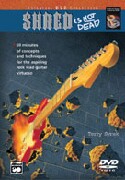
SHRED IS NOT DEAD by TERRY SYREK VIDEO DVD GUITAR TABLATURE

SHRED IS NOT DEAD, WITH TERRY SYREK. Un'ora di splettrante sminuzzamento. GUITAR TABLATURE VIDEO DVD.

Shred Is Not Dead

Concepts and Techniques for the Aspiring Rock Lead Guitar Virtuoso

By Terry Syrek
Item: 00-21936
UPC: 038081205199
ISBN 10: 0739030191
ISBN 13: 9780739030196
Category: Guitar Method or Supplement
Format: Book & DVD
DVD format: Region 0 for use in all regions. 
Instrument: Guitar

Shred Is Not Dead
Concepts and Techniques for the Aspiring Rock Lead Guitar Virtuoso
By Terry Syrek
Guitar DVD
Item: 00-21914

Information
Author: Terry Syrek
Instrument: Guitar
Format: DVD
Item Number: 00-21914
ISBN 10: 0-7390-2827-8
ISBN 13: 978-0-7390-2827-8
UPC: 038081204116

Master shredder Terry Syrek makes it easy to become a rock lead-guitar virtuoso. Discover monster chop-building exercises and the secret to mind-bending, super-fast, sweep-picking licks. Plus, make creative use of the pentatonic scale and other scales you wouldn't necessarily think of using. 48 pages. DVD running time: 60 minutes. 

This booklet will help prepare you to get the most out of your video.
It will introduce the guitar fingerboard, the basics of reading standard
music notation, guitar tablature, chord diagrams and guitar neck
diagrams.  All of us at the National Guitar Workshop and Alfred wish
you lots of fun and fulfillment as you learn to play guitar.
 
The Guitar Fingerboard
Half Steps and Whole Steps
Our first order of business is to understand how the guitar fingerboard
works and to learn how to find or name all of these notes on the neck.
This is easy if we know about half steps and whole steps.
A half step is the distance from one fret to the next on the guitar.  For
instance, the distance from the 1st fret to the 2nd is one half step.  This
is the smallest interval (distance between two notes).  Two half steps equal
one whole step, which is a distance of two frets on the guitar.  For
example, the distance from the 1st fret to the 3rd fret is a whole step.
The arrangement of whole steps and half steps in the musical alphabet
is as follows:
Here is where all of the notes in the musical alphabet—the natural notes—
are found on the guitar.
A B  C D E  F  G A
W H  W W H  W W
 
W= Whole step
H= Half step
 
G A  B C  D  E
C D  E F  G  A
A B C D E
Whole Step
Half Step
1 2 3 4 5 6 7 8 9 10 11 12
1st string
6th string
Open Frets
Strings2 3
& w
G
G line
Treble clef
Staff
Note
 
You have probably noticed the blank, unnamed frets on the fingerboard in
the diagram on page 1.  These are filled with sharp and flat notes, also
called accidentals or chromatic tones.  When a sharp 

 is placed in front of
a note, the note is raised one half step (one fret).  For example, F

 is one
fret higher than F.  When a flat  is placed in front of a note, the note is
lowered one half step (one fret).  For example, G
 is one fret lower than
G.  Notice that F

 and G
 fall on the same fret.  Two notes which sound
the same (played on the same fret) but have different letter names are
termed enharmonic equivalents.  Every sharped or flatted note has an
enharmonic equivalent.
 
Notes
Music is written by placing notes on a staff.
Notes appear in various ways.
Music Notation: Pitch
 
The Staff and Clef
The staff, which is read from left to right,
has five lines and four spaces.  At the
beginning of the staff is a clef.  The clef
dictates what pitch (exact degree of
highness or lowness) corresponds to a
particular line or space on the staff.  Guitar
music is written in treble clef , which is sometimes called the G clef.
The ending curl of the clef circles the G line on the staff.
Here are the notes on the staff using the G clef:
Ledger Lines
The higher a note appears on the staff, the higher it sounds.  When a note
is too high or too low to be written on the staff, ledger lines are used.
Guitar music actually sounds one octave lower than it is written.  We
write music an octave (12 half steps) higher than it sounds strictly for
reasons of convenience and easy reading.
Music Notation: Time
Measures and Bar Lines
The staff is divided by vertical lines called bar lines.  The space between
two bar lines is called a measure.  Measures divide music into groups of
beats.  A beat is an equal division of time.  Beats are the basic pulse behind
music.  A double bar marks the end of a section or example.
 
Time signature
One measure or bar
Bar lines
Double bar
E F G A B C A B C D E
Ledger lines
Ledger lines
Note heads
Stems Flag Beams
& w w w w w w w w w
D G A  B  C  D  E  F
F G A  B C  D  E
Whole Step
Half Step
Enharmonic 
Equivalents
1 2 3 4 5 6 7 8 9 10 11 12
1st string
6th string
Open Frets
Strings4 5
Half Rests = 2 beats
Quarter Rests = 1 beat
Eighth Rests
Sixteenth Rests
= ½ beat
= ¼ beat
Whole Rest  = 4 beats
Ties
When notes are tied, the second note is not
struck.  Rather, its value is added to that of the
first note.  So, a half note tied to a quarter note
equals three beats.
Notice the numbers under
the staff in these examples.
They indicate how to count.
Both of these examples are
in  time, so we count four
beats in each measure.
When there are eighth
notes, which are only half a
beat, we count “&” (“and”)
to show the division of the
beats into two parts.  When
a counting number is in
parentheses, a note is being
held rather than struck.
Ties are a convenient way to notate notes that begin off the beat (on
an “&”).
Half Notes = 2 beats
h h
Quarter Notes = 1 beat
q q q q
Eighth Notes
Sixteenth Notes
= ½ beat
= ¼ beat
Whole Note = 4 beats
Note Values
As you know, the location of a note relative to the staff tells us its
pitch (how high or how low it is).  The duration, or value, is indicated
by its shape.
 
Time Signatures
Every piece of music has a pair of numbers at the beginning, called
time signatures, that tell us how to count time.  The top number
represents the number of beats per measure.  The bottom number
represents the type of note receiving one count.
 
Dots
A dot increases the length of
a note by one half of its
original value.  For instance, a
half note equals two beats.
Half of its value is one beat (a quarter note).  So, a dotted half note
equals three beats (2 + 1 = 3).  A dotted half note is equal to a half
note tied to a quarter note.
Dotted notes are especially
important when the time
signature is  , because the
longest note value that will fit in a measure is a dotted half note.
Also, dotted notes are very important in  time, because not only is
a dotted half note the longest possible note value, but a dotted
quarter note is exactly half of a measure (counted 1 & a 2 & a).
In some cases, consecutive eighth notes are beamed together.
Sometimes a 
 is written in place of  time.  is often called
common time.
= Four beats per measure
= A quarter note      equals one beat

= Three beats per measure
= A quarter note      equals one beat

= Six beats per measure
= An eighth note      equals one beat

Rest Values
Every note value has a corresponding rest.  A rest indicates silence.  A
whole rest indicates four beats of silence, a half rest is two beats of
silence, etc.6 7
Beaming
Notes that are less than one beat in duration are often beamed
together.  Notice the couting numbers: since there are four sixteenth
notes in a beat, they are counted “1 e & a, 2 e & a,” etc.
Rhythmic Notation
Rhythmic notation is common in guitar music.  It is a system of slash
marks with stems and beams that notate specific rhythms without
specific pitches.  Rhythmic notation is usually used to show a rhythm
guitar part.
 
TAB
Tablature is a system of notation that graphically represents the strings
and frets of the guitar fingerboard.  Each note is indicated by placing a
number, which indicates the fret to play, on the appropriate string.
Reading TAB, Scale and Chord Diagrams
Scale Diagrams
The top line of a scale diagram represents the 1st (highest) string of
the guitar, and the bottom line the 6th.  The vertical lines represent
frets, which are numbered.
Chord Diagrams
Chord diagrams are similar to scale diagrams, except they are oriented
vertically instead of horizontally.  Vertical lines represent strings, and
horizontal lines represent frets.
Beamed sixteenth notes Beamed quarter notes
 
Chord name
Play open string
Indicates a
barre chord
Fingered
notes
5 4  3  2  1 Strings
Left-hand
fingering
Fret numbers
Mute or don’t play this string
 
T
A
B
 
4th string, 5th fret
Open G chord
1st string, 10th fret
2nd string, 10th fret
String
numbers
Count:
Whole note (4 beats)
Half notes (2 beats)
Quarter notes (1 beat)
2 3 4  2  4 1 2  3 4
Eighth notes (½ beat)
1 &  2 &  3 &  4 &
Frets Left hand fingering
Root
6th string
Fret numbers
Scale tones
7 8 9 10
1st string
Roman Numerals
Here is a review of Roman numerals and their Arabic equivalents.
I or i................1
II or ii.............2
III or iii...........3
IV or iv..........4
V or v.............5
VI or vi...........6
VII or vii........7
VIII or viii.....8
IX or ix...........9
X or x...........10
XI or xi.........11
XII or xii.......12
XIII or xiii....13
XIV or xiv....14
XV or xv.......15
XVI or xvi....16
XVII or xvii..17
XVIII or xviii..188
Some Terms and Signs
Repeat.  Return to the beginning or the nearest        and
play again.
Half Step.  A distance of one fret on the guitar.
Whole Step.  Equals two half steps, distance of two frets on
the guitar.
Flat.  Lower the note one half step (one fret).
Sharp.  Raise the note one half step (one fret).
Natural.  Cancels a sharp or flat.
Prezzo: €24,99
€24,99

SLAP & POP TECHNIQUE FOR GUITAR 52 LICKS AND LESSONS Musicians Institute by Jean Marc Belkadi CD TAB

SLAP & POP TECHNIQUE FOR GUITAR. 52 LICKS AND LESSONS Musicians Institute. Jean Marc Belkadi. SHEET MUSIC BOOK with CD & GUITAR TABLATURE .


LIBRO METODO PER CHITARRA, CON CD :

ACCORDI, PENTAGRAMMA, TABLATURE .


Series: Musicians Institute Press
Publisher: Musicians Institute Press
Softcover with CD - TAB
Composer: Jean Marc Belkadi

This one-on-one lesson with MI instructor Jean Marc Belkadi applies the slap bass techniques popularized by Louis Johnson, Marcus Miller, Victor Wooten and others to the guitar. Covers basic slap and pop techniques in funk, rock, R&B, Latin and reggae styles. The book includes standard notation and tab, and the accompanying CD features 52 full-band demo tracks. 24 pages .


Introduction


The purpose of this book is to provide a fresh perspective on the subject of funk guitar. For years, I played funk the way most guitarist do-with a pick. This sound is certainly a staple of funk music and a must-learn for all serious funk guitarists. After becoming increasingly interested in funk bass players and the techniques they used, however, I began experimenting with slap and pop techniques (commonly used with bass) in my guitar playing. Influenced by players such as Louis Johnson, Yanic Top, Marcus Miller, Stanley Clarke, Victor Wooten, and Kevin Eubanks, I began imitating the sounds I heard from them on my guitar. Years later, I've found that, although funk is an obvious choice, this technique can be applied to many styles. Throughout this book, we'll also see it applied to R&B, Motown, Reggae, and Latin styles. We'll also cover odd meters and straight-ahead funk-rock grooves. When it's all done, you'll have a new vocabulary of techniques to incorporate into your own playing.


Technical Performance Notes

In order to best digest the information in this book, it's probably necessary to discuss a few techniques

that aren't commonly found in guitar notation. Below is a list of abbreviations and explanations

that pertain to the musical figures found in this book. You may recognize many of these from

conventional bass notation.

T - Strike or "slap" the string with the right-hand thumb.

P - Snap or "pop" the string by pulling upwards with the index finger of your right hand and quickly

releasing it.

L - Slap the strings on the fretboard with your left-hand fingers laid flat, creating a muted percussive

effect.

I - Strum with your right-hand index finger (downstroke) as if it were a pick.

$- Hammer or "tap" the fret indicated with one of the fret-hand fingers.

F - Strum with the nail of your right-hand thumb (upstroke).

Though the "slap" technique is very familiar to most bass players, guitar players have usually not experimented

with this before. Try different positions along the string to ensure that you are not producing a

harmonic with your slap. Also, try to keep your right arm parallel to the strings.


About the Audio

Throughout this book, the numbers in the audio symbols ( • ) indicate the CD track number

where each figure will be found on the accompanying CD.


Table of the Contents:

Page CD Tracks

Introduction

Technical Performance Notes

About the Audio

Chapter 1:Funk Figures

Chapter 2:Funk-Rock Figures

Chapter 3:R&B and Motown Figures

Chapter 4:Latin and Reggae Figures

Chapter 5:Technical Exercises

Acknowledgments

About the Author


Note: Use Track 53 to tune up.

Prezzo: €59,99
€59,99

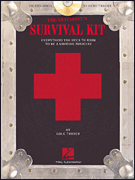
THE GUITARIST'S SURVIVAL KIT DALE TURNER CD TABLATURE ACCORDI SPARTITI LIBRO METODO

THE GUITARIST'S SURVIVAL KIT. DALE TURNER. LIBRO CD TABLATURE


LIBRO DI MUSICA ROCK CON CD.

SPARTITI PER CHITARRA. ACCORDI, PENTAGRAMMA E TABLATURE.

Composer: Dale Turner. From repertoire to accompaniment patterns to licks, this book is fully stocked to give you the confidence knowing you can "get by" and survive, regardless of the situation. The book covers: songs and set lists; gear; rhythm riffs in styles from blues to funk to rock to metal; lead licks in blues, country, jazz & rock styles; transposition and more. The CD features 99 demonstration tracks, and the book includes standard notation and tab. 48 pages.

Prezzo: €21,99
€21,99

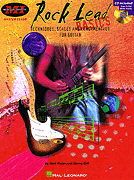
CHITARRA ROCK BASICS Nick Nolan Danny Gill Musicians Institute CD TABLATURE TECNICHE SOLISTE

CHITARRA ROCK BASICS, TECNICHE FONDAMENTALI PER CHITARRA ROCK SOLISTA. LIBRO E CD .

LIBRO METODO IN ITALIANO DI MUSICA ROCK, CON CD. 

SPARTITI PER CHITARRA CON :

ACCORDI, PENTAGRAMMA, TABLATURE. 

MANUALE, TECNICA,


ROCK LEAD BASICS, Nick Nolan and Danny Gill. Musicians Institute CD TABLATURE. 

Publisher: Musicians Institute Press

Rock Lead Basics

Techniques, Scales and Fundamentals for Guitar
Series: Musicians Institute Press
Publisher: Musicians Institute Press
Format: Softcover with CD - TAB
Composer: Danny Gill
Composer: Nick Nolan

A method exploring the techniques, scales and fundamentals used by the greatest legends of rock guitar. CD includes over 75 full demonstration tracks. Covers pentatonic and diatonic scales, bending, vibrato, lead licks, and more. Includes standard notation and TABLATURE.

Inventory #HL 00695144
ISBN: 9780793573783
UPC: 073999951448
Width: 9.0"
Length: 12.0"
40 pages
 

Tecniche fondamentali per chitarra solista rock. Master Class

Un metodo che esplora le tecniche, le scale e le regole fondamentali usate dalle più grandi leggende della chitarra rock. Il CD include oltre 75 tracce dimostrative complete. Scale pentatoniche diatoniche. Bending, vibrato e licks essenziali. Notazione standard e tablatura.
Prezzo: €25,99
€25,99

ROCK LEAD TECHNIQUE Musicians Institute CD TABLATURE licks scales soloing concepts for guitar

ROCK LEAD TECHNIQUE. Musicians Institute.

SHEET MUSIC BOOK METHOD WITH CD & GUITAR TABLATURE.  


LIBRO METODO DI MUSICA ROCK, CON CD . 

SPARTITI PER CHITARRA CON : 

ACCORDI, PENTAGRAMMA, TABLATURE. 


licks, scales, soloing concepts for guitar

Picking technique, string skipping, sweep picking, armonici. CD TABLATURE

Rock Lead Techniques

Techniques, Scales and Fundamentals for Guitar
Series:  Press
Publisher: Musicians Institute Press
Format: Softcover with CD - TAB
Composer: Danny Gill
Composer: Nick Nolan

Jam along with Danny Gill and Nick Nolan as they present material from this MI elective course. Covers: licks, scales, soloing concepts, picking technique, three-note-per-string scales, sweep picking, string skipping, harmonics and more. The CD includes 97 full-demo tracks.

Inventory #HL 00695146
ISBN: 9780793573806
UPC: 073999951462
Width: 9.0"
Length: 12.0"
40 pages
 

Prezzo: €19,99
€19,99

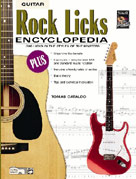
ROCK LICKS ENCYCLOPEDIA CD CATALDO LIBRO SPARTITI METODO STUDIO MUSICA CHITARRA TABLATURE

ROCK LICKS ENCYCLOPEDIA. T. CATALDO. LIBRO CON CD E  TABLATURE

LIBRO METODO DI MUSICA ROCK, CON CD. 

SPARTITI PER CHITARRA CON: 

ACCORDI, PENTAGRAMMA, NOTE, E TABLATURE. 


CONTIENE ESEMPI PRESI DA: 

50's i primi: Chuck Berry, Bo Diddley, Scottie Moore, Muddy Waters. 60's eroi: Eric Clapton, Steve Cropper, Dick Dale, Buddy Guy, George Harrison, Jimi Hendrix, Keith Richards, Pete Towshend. 70's l' esposione del rock: Martin Barre, Jeff Beck, Dickie Betts, Ritchie Blackmore, Larry Carlton, Don Felder, Ace Frehley, David Gilmour, Steve Howe, Tony Iommi, Ed King, Mark Knopfler, Alex Lifeson, Kerry Livgren, Brian May, Jimmy Page, Joe Perry, Carlos Santana, Joe Walsh, Angus Young. 80's i virtuosi: Paul Gilbert, Van Halen, Yngwie Malmsteen, Gary Moore, Randy Rhoads, Joe Satriani, Summers, Steve Vai. 90's grunge e altro: Trey Anastasio, Dimebag Darrell, Kirk Hammett, Eric Johnson, Mike McCready, John Petrucci, Rich Robinson & Jeff Cease, Brian Setzer, Ty Tabor. Scale maggiori e minori, pentatoniche, scale blues, modi maggiori e minori, armonica e melodica minore, diminuite. 294 fraseggi della lunghezza di una, due, tre battute l'uno. 

Prezzo: €26,99
€26,99

SHRED GUITAR Paul Hanson LIBRO CD TABLATURE CHITARRA METODO SPARTITI MANUALE TECNICA

SHRED GUITAR, a complete system for rock improviser, Paul Hanson. Studio e estensione Rock per "fare a brandelli" modi, scale, pentatoniche, progressioni 12-bar blues e 16-bar blues, e "tagliuzzare" con affilati arpeggi al sweep picking, lama con doppio arpeggio, lama tonda per gli arpeggi circolari, bending, scale armonizzate, enigmatiche e gypsy. Come fare a striscie la propria compagna amata, e adorarla con rinnovati power chords, blues scale e pentatoniche orientali. Con 10 prove di taglio tutte per voi. CD TABLATURE

LIBRO METODO DI MUSICA CON CD.

SPARTITI PER CHITARRA CON: 

DISEGNO DELLA TASTIERA, ACCORDI, PENTAGRAMMA E TABLATURE. 

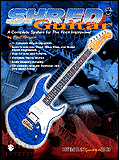
Shred Guitar: A Complete System for the Rock Guitar Improviser By Paul Hanson
SERIES: Contemporary Guitar Series
CATEGORY: Guitar Method or Supplement
FORMAT: Book & CD

A carefully planned and systematic approach to fretboard mastery, Shred Guitar is actually two books in one. The first half of the book, "Shred Guitar," is based around 10 popular rock chord progressions with full play-along tracks included on the accompanying CD. The second half of the book, "The Practical Guide to Harmony and Theory," is a guitar theory reference that contains 17 units of detailed information that will be useful to all guitarists.

Prezzo: €29,99
€29,99

I MAESTRI DELLA CHITARRA ROCK LIBRO CD TABLATURE Clapton Mark Knopfler Santana SATRIANI

I Maestri della Chitarra Rock. 

MASTERS OF ROCK GUITAR, Peter Fischer. IN ITALIANO. CD TABLATURE

LIBRO METODO DI MUSICA ROCK, CON CD.

SPARTITI PER CHITARRA, CON :

ACCORDI, PENTAGRAMMA E TABLATURE.

Mezzo secolo di musica rock, solo 20 uomini. 250 esempi di fraseggi, brevi e medio brevi di: Chuck Berry, B.B. King, Albert King, Jeff Beck, Jimi Hendrix, Eric Clapton, Jimmy Page, Ritchie Blackmore, Santana, Summers, Mark Knopfler, Steve Morse, Van Halen, Roads, Gary Moore, Yngwie Malmsteen, Lukather, Joe Satriani, Paul Gilbert, Steve Vai. Informazioni sul suono e la strumentazione. Tecniche usate: alternate picking, i legati, sweep picking o economy picking, tapping, tecnica a due mani, bending e vibrato, dive bomb, effetti armonici, wrench slide, mouse trap, harmonic dive (horse), cat purr, talk/off-pitch, whammy bar. 159 pagine. 


Dall'autore del metodo di successo Rock Guitar Secrets arriva I Maestri della Chitarra Rock un libro, in notazione e tablatura, che coniuga con grande efficacia gli aspetti teorici e applicativi per il genere musicale rock/metal. Il metodo contiene anche 250 licks nello stile di Jeff Beck, Eric Clapton, Jimi Hendrix, B. B. King, Mark Knopfler, Steve Lukather, Gary Moore, Steve morse, Carlos Santana, Joe Satriani, Steve Vai, Eddie Van Halen e molti altri. Traduzione italiana di Lelio Padovani e Alex Stornello.


Benvenuti a i Maestri della Chitarra Rock
Considerando la varietà stilistica dei passati decenni, il compito di documentare lo sviluppo della chitarra rock
sembra più che difficile.
I problemi iniziano nella scelta dei chitarristi. Innumerevoli chitarristi che potrebbero essere considerati i più
importanti dovranno essereesclusi. Indubbiamente mancherà qualche chitarrista che secondo voi è il maestro
assoluto della chitarra rock.
AI fine di mantenere una chiara prospettiva, ho visto che era necessario Iimitarmi a venti guitar heroes. Persino
in questo libro lo spazio è limitato, quindi ho cercato di scegliere solo quei chitarristi autorevoli che siano stati
protagonisti nello sviluppo delle tecniche chitarristiche.
E' stato quindi necessario lasciare fuori chitarristi quali Frank Zappa, Steve Howe, John McLaughlin, Pete
Townshend, George Lynch ed altri, così come i chitarristi di gruppi quali The Beatles e The Rolling Stones.
Sebbene il loro stile sia inseparabilmente legato alle loro rivoluzionarie composizioni, da un punto di vista
tecnico non sono rivoluzionari od innovativi come il resto del "c1ub", quelli il cui stile è stato un'influenza su
un gran numero di altri chitarristi. I nomi di coloro che ho scelto richiamano certi suoni, concetti e tecniche
esecutive che sono spesso richieste a musicisti ed insegnanti. ("Suonalo come Hendrix / Van Halen / Knopfler / Lukather ... " o "Suona qualcuno di quegli accordi alla Police..."). Raramente ci viene chiesto di suonare un solo nello stile dei Beatles.
Le selezioni sono state fatte per venire incontro a queste esigenze e servire come lavoro di riferimento per chi
stia cercando materiale che suoni autentico. Naturalmente il pericolo di questo tipo di operazione è il ridurre
il concetto del libro ad una semplice raccolta di Iick chitarristici: capire lo stile di un chitarrista richiede più che
imparare alcuni Iicks. Senza le essenzionali informazioni di base come influenze personali, elementi distintivi,
materiale armonico, suono e discografia, i quali, insieme ai licks, danno un'immagine completa di ciascun
chitarrista, non si può rendere giustizia ai Maestri della Chitarra Rock.
Non che stia promuovendo un culto delle star. Quattro decenni di storia del rock sono personificate da questi
venti "chitarristi scelti", col cui aiuto lo sviluppo stilisticamente variabile della chitarra rock può essere visto
chiaramente. Perquesta ragione il nostro breve viaggio nella storia del rock inizierà coi rappresentanti principali
della chitarra blues, B.B.King ed Albert King, il cui stile ha ancora molto da offrire all'attuale generazione di
chitarristi. Equesto, sebbene per molti giovani chitarristi (anche nella mia fasciad'età, tra l'altro) l'Eradella Chitarra
Elettrica inizi con Eddie Van Halen, e nomi come Jimi Hendrix e Jimmy Page spesso hanno come reazione poco
più di un'alzata di spalle.
Naturalmente il livello di difficoltà tecnica aumenta parallelamente alla sequenza cronologica. Così "1Maestri
della Chitarra Rock" non serve solamente come lavoro di riferimento, ma può anche - come extra, per così dire
- essereusato come un aiuto metodico per chitarristi principianti ed avanzati.
Il Cd allegato dura più di settanta minuti. Non solo vi aiuterà a suonare i licks, ma ha anche il grande vantaggio
rispetto ad altre registrazioni che ogni chitarrista può essereselezionato individualmente.
Comunque scegliate di usare questo libro, spero vi divertirete un sacco leggendo, suonando, ascoltando e
lavorando.


Come lavorare con questo libro
Prima di iniziare il nostro viaggio nella storia della chitarra rock ecco alcuni consigli e idee su come lavorare con questo libro:

Suonate ciascun lick non solo sull'accordo col quale compare, ma anche sulle estensioni armoniche. (Ad esempio, se è indicato DO7, suonatelo anche su DO9 e DO11; se è indicato Dom, suonatelo anche su Dom7, Dom9, Dom11, ecc.). Provateli anche sugli accordi diatonici alla tonalità. I licks suonano alquanto differenti su ciascun accordo (a volte meglio, a volte peggio), e vedrete che in questo modo avrete sette volte il materiale che avreste usandoli solo sull'accordo suggerito.

Usate le mie istruzioni sull'esecuzione (legato ascendente, legato discendente, glissato, ecc.) come suggerimenti. giocate coi lick e vedete come trovarli al meglio sotto le dita. Stessa cosa col ritmo, la scelta delle ottave ed il suono.

Ho scoperto che si deve ascoltare (nel senso profondo del termine) ciascun chitarrista per poter sviluppare una vera comprensione del suo stile. Per capire lo stile di Jimi Hendrix, ad esempio, dovete ascoltare molto. I Iick sul CD sono solo un'inizio. Mi dispiace, non c'è modo di evitare l'ascolto dell'originale. La discografia vi aiuterà ad orientarvi.

Ci sono sostanzialmente due modi per fare progressi con questo libro. Uno è quello di andare dritti dall'inizio alla fine, facendo così esperienza dei differenti stadi di sviluppo nella musica. L'altra possibilità è quella di scegliere i vostri eroi in qualunque ordine vogliate. Comunque lo facciate, divertitevi!

Ho registrato di proposito i Iicks di questo libro con delle basi relativamente neutrali, cosicché le etichette stilistiche "metal" o "fusion" o qualunque cosa non ci saranno stampate sopra. Dovrete mescolare e combinare stili se volete sviluppare la vostra creatività e trovare il vostro stile.

non esitate ad usare lick che avete appena imparato in quello che suonate. Questo è l'unico sistema per farli diventare parte del vostro repertorio. E in tema di "io non copio nessuno!", ho trovato una bella citazione da Steve Lukather: "Secopi un solo chitarrista, è rubare. Ma se ne copi un sacco, è una scienza. Tra l'altro io suono quasi asclusivamente licks "presi a prestito"!"

con questo a mente, DIAMOCI DA FARE!

Nato nel 1966, Peter FlSCher è il prindpale autore tedesco di libri didattici come
"MASTERS OF ROCK GUITAR' "ROCK GUITAR SECRETS'' ''TOTAL GUITAR TECHNIQUE'
"BLUES GUITARRULES" e del video "MODERN ROCK CONCEPTS'' ed ha contribuito con le sue rubriche a diversi giornali musicali europei.
Diplomato del Guitar Institute of Technology GIT a Los Angeles, è attivamente impegnato dal vivo ed in studio.
E' stato menzionato da Mike Varney nella rubrica Spotlight sul numero di Novembre 1989 di "Guitar Player'
 

INDICE DEI CONTENUTI
Indice de
 Introduzione
 Come lavorare con questo libro

TRUCCHI E CONSIGLI
 Esercizi preliminari
 Pennata alternata
 Legato (Ascendente e discendente)
 Pennata Sweep o Economy
 Tapping a due mani
 Bending e vibrato

BLUES E PERIODO INIZIALE DEL ROCK
 B.B.King -IL RE DEL BLUES
 Albert King - NATO SOTTO UNA CATTIVA STELLA?
 Chuck Berry -IL PADRE DEL ROCK 'N ROLL

IL PERIODO CLASSICO DEL ROCK
 Jimi Hendrix - L'INVENTORE DELLA MODERNA CHITARRA ROCK
 Eric Clapton -INQUIETO MANOLENTA
 Jeff Beck -IL TIPO CON LA STRAT
 Jimmy Page -IL PADRE FONDATORE DEL ROCK PESANTE - LED ZEPPELIN
 Ritchie Blackmore - L'HARD ROCK SI DA' ALLA CLASSICA - DEEP PURPLE
 Carlos Santana - SPIRITUALITA' LATINA E BLUES

CLASSICI MODERNI
 Andy Summers - LA MUSICA HA BISOGNO DI SPAZIO PER RESPIRARE
 Mark Knopfler -IL SULTANO DELLO SWING - DIRE STRAITS
 Steve Morse - SIGNOR VERSATILE
 Eddie Van Halen -IL DIO DEL TAPPING
 Randy Rhoads - LICK CARATTERISTICI DA METAL E CLASSICA

IL NUOVO CLUB O GLI INFINITI GUITAR HEROES

 Yngwie Malmsteen - METAL NEOCLASSICO CON PROBLEMI DI EGO?
 Gary Moore - HO ANCORA IL BLUES
 Steve lukather - ESTASI CONTROLLATA
 Joe Satriani - VALEVA LA PENA ADENDERE
 Steve Vai - SUA ALTEZZA TENEBROSA
 Paul Gilbert - DAL MI MINORE ALLA SCALA HIP


Welcome to the Masters of Rock Guitar
Foreword
Taking a look at the stylistic variety of the preceding decades, the task of documenting the development of rock guitar playing seems more than difficult. The problems begin with choosing the guitarists. Countless players will have to be left out who could be considered most important.
Undoubtedly you'll miss one guitarist or another who in your opinion is an absolute master of the rock guitar.
In order to maintain a clear perspective, I've found it necessary to restrict myself to twenty guitar heroes. Even in this book, space is limited, so I've tried to select only those really influential guitarists who've been primary forces in the development of guitar techniques. So it's been necessary to leave out guitarists like Frank Zappa, Steve Howe, John Mclaughlin, Pete Townshend, George Lynch, and others, as well as the guitarists from important groups like The Beatles and The Rolling Stones. Although their playing is inseparably linked to their groundbreaking compositions, from a technical standpoint, they're not as revolutionary or innovative as the rest of the "club", those whose playing has been an influence on a large number of other guitarists. The names of the ones I've chosen call to mind certain sounds, concepts and performing techniques that are often demanded of musicians and teachers.
(" Play it like Hendrix / van Halen / Knopfler/ Lukather ... " or "Play some of those Police chords ... ") One is seldom asked to playa solo in a Beatles style. The selections here have been made to meet these demands and to serve as a reference work for anyone who is looking for some authentic sounding material. Of course the danger in this sort of undertaking lies in reducing the concept of the book down to a mere compilation of guitar licks. Comprehending a guitarist's style takes more than just having a few licks down. Without the essential background information, such as personal influences, identifiable elements, harmonic material, sound and discography, all of which, along with the licks, give a well-rounded picture of each individual guitarist, you can't do justice to the Masters of the Rock Guitar.
Not that I'm promoting a star cult. Four decades of rock history are personified by these twenty" chosen players", with whose help the stylistically variable development of rock guitar playing can be seen in a clear light. For this reason our brief tour of rock history will begin with those definitive representatives of the blues guitar, B.B,King and Albert King, whose playing still has a lot to offer to the current generation of guitarists. And this, although for many young guitarists (my own age group, by the way) the Era of the Electric Guitar began with Eddie van Halen, and names like Jimi Hendrix and Jimmy Page often bring little more response than a shrug of the shoulders. Of course the level of technical difficulty increases parallel to the chronological sequence. So "Masters of Rock Guitar" not only serves as a reference work, but can also - as an extra, so to speak - be used as a methodically constructed learning aid for beginning and advanced players. The accompanying CD is over seventy minutes in length. It will not only help you to play the licks, but has also the major advantage over other recordings that each of the guitarists can be selected individually. However you choose to use this book, I do hope you'll have a lot of fun reading, playing, listening and working.

Product Description:
The aim of this book and CD is to document the development of rock guitar playing by thoroughly investigating the styles of twenty distinctive and influential guitar greats, including Chuck Berry, Jeff Beck, Jimi Hendrix, Mark Knopfler, Gary Moore, Eddie van Halen, Joe Satriani, Steve Vai and others. The more than 250 licks selected for inclusion here serve as a reference for anyone in search of authentic sounding material. This book is more than a mere compilation of licks. By presenting detailed information about personal influences, identifiable elements, harmonic material, sound (preferred instruments, amps, effects, etc.) and discographies, the book provides the reader with a well-rounded picture of each individual guitarist. In addition, the level of technical difficulty increases parallel to the chronological sequence, so the book can also be used as a methodically constructed learning aid for beginning to advanced players. The accompanying CD is over 70 minutes in length. It will not only help readers play the licks, but gives them the ability to select each profiled guitarist's music individually. In notation and tablature. Format: Book/CD Set

On working with this book
Tips & Tricks
Before we begin our tour through the history of rock guitar playing here are a few hints and ideas how to work with this book: Play each lick not only over the chord it appears with, but also over the harmonic extensions. (For example, if C 7 is indicated, play also over C 9 and C 11; if Cm is indicated, play also over Cm7, Cm9, Cm11, etc.) Try them over the diatonic chords of the key, as well. The licks sound somewhat different over every chord (sometimes better, sometimes worse), and you'll find that this way you have seven times as much material as you would have if you only practiced over the suggested chord. Look at my instructions for execution (hammer-ons, pull-offs, slides, etc.) as suggestions. Play around with the licks and see how they sit best under your fingers. Same thing for the rhythm, the choice of octaves and the sound. I've found that you really have to listen (in the deeper sense of the word) to each guitarist before you can develop a true feeling for his style. To really get the feeling for Jimi Hendrix's style, for example, you've got to listen quite a bit. The licks on the CD are just a beginning. Sorry, but there's no way around listening to the original. The discography should help you get your bearings. There are basically two ways to make progress with this book. One way is to go straight through from beginning to end, thereby experiencing the different stages of development in the music. The other possibility is to pick out your heroes in whichever order you want. However you do it, have fun! I have purposely recorded the licks on the CD with relatively neutral backgrounds, so that the stylistic labels IImetal II or IIfusion II, or whatever, won't be stamped on them. You'll have to combine and mix styles if you want to develop your own creativity and find your own style. Don't hesitate to use freshly learned licks in your playing. This is the only way to make them a part of your own repertoire. As to the subject of III don't copy anyone! II, I found a good quotation from Steve lukather: "If you copy only one guitarist, it's stealing. But if you copy a lot of them, it's a science. I play, by the way, almost exclusively 'borrowed' licks.!" With this in mind: LET'S GET BUSY!


Contents:

Foreword
On working with this book

TIPS & TRICKS
Preparatory exercises
Alternate picking
Legato technique (Hammer-Ons and Pull-Offs)
Sweep or economy picking
Two hand tapping
String bending and vibrato

BLUES AND EARLY ROCK PERIOD
B. B. King - THE KING OF BLUES
Albert King - BORN UNDER A BAD SIGN?
Chuck Berry -THE FATHER OF ROCK 'N ROLL

THE CLASSIC ROCK PERIOD
Jimi Hendrix - THE INVENTOR OF MODERN ROCK GUITAR
Eric Clapton - RESTLESS SLOWHAND
Jeff Beck - THE STRAT CAT
Jimmy Page -THE FOUNDING FATHER OF HEAVY ROCK
Ritchie Blackmore - HARD ROCK GOES CLASSICAL
Carlos Santana - SPIRITUAL LATIN BLUES

MODERN CLASSICS
Andy Summers - MUSIC NEEDS ROOM TO BREATHE
Mark Knopfler - THE SULTAN OF SWING
Steve Morse - MISTER VERSATILITY
Eddie van Halen - THE TAPPING GOD
Randy Roads - TRADEMARK LICKS FROM METAL AND CLASSICAL

THE NEW GUILD
OR GUITAR HEROES WITHOUT END
Yngwie Malmsteen - NEO-CLASSICAL METAL WITH EGO PROBLEMS?
Gary Moore - STILL GOT THE BLUES
Steve Lukather - CONTROLLED ECSTASY
Joe Satriani - WORTH WAITING FOR
Steve Vai - HIS ROYAL DARKNESS
Paul Gilbert - FROM THE E MINOR TO THE HIP SCALE

Prezzo: €26,99
€26,99

REAL ROCK GUITAR Kenn CHIPKIN CD TABLATURE LIBRO SPARTITI ACCORDI CHITARRA ELETTRICA

REAL ROCK GUITAR. Kenn Chipkin. CD TALATURE


LIBRO DI MUSICA ROCK CON CD.

SPARTITI PER CHITARRA. ACCORDI, PENTAGRAMMA E TABLATURE.

Facciamo un paragone! L'accento americano e quello Britannico. 74 esempi, 120 pagine, migliaia di note a raffronto, comparazione di riffs, i solo di Chuck Berry, Doors, Beatles, Jethro Tull, Santana, Eric Clapton, Rolling Stones, Jimmy Page, Jimi Hendrix, S.R.V, Blackmore, Jeff Beck, e molti altri. 58 esempi di riff, 10 di double-stops e scale; presi dagli anni '60 e '70, con 8 esempi di rock lead guitar completi. 

Prezzo: €28,99
€28,99
Condividi contenuti