CHITARRA - GUITAR

SULTAN KENNY GUITAR BLUES CD TABLATURE LIBRO SPARTITI CHITARRA ACUSTICA Honky Tonk METODO

SULTAN KENNY, GUITAR BLUES. SHEET MUSIC BOOK WITH CD & GUITAR TABLATURE .

LIBRO METODO DI MUSICA BLUES CON CD.

SPARTITI PER CHITARRA CON: 

ACCORDI, PENTAGRAMMA, TABLATURE. 

CONTIENE: 

Cascade Rag
Funky Butt
Honky Tonk
If the Shoe Fits
Lightnin' Strikes Read 'Em and Weep
The Sick Boogie
Slippin' and Drippin'
Suspcious Strut
West Coast Blues

Acoustic Masterclass Series: Kenny Sultan, Guitar Blues
By Kenny Sultan

SERIES: Acoustic Masterclass
CATEGORY: Guitar Method or Supplement
FORMAT: Book & CD

Guitar arrangements transcribed by the artists themselves, in standard notation and tab. Each edition includes a masterclass-style CD in which the artist walks you through the key aspects and techniques for each arrangement. This book is an encyclopedia of vital blues licks and patterns.

This book is an encyclopedia of vital blues licks and patterns. Includes: Cascade Rag * Funky Butt * Honky Tonk * If the Shoe Fits * Lightenin' Strikes * Read 'Em and Weep * The Sick Boogie * Slippin' and Drippin' * West Coast Blues * Suspicious Strut. 


Additional Information
Series: Acoustic Masterclass
Artist: Kenny Sultan
Instrument: Guitar
Format: Book & CD
Page Count: 72
Item Number: 00-SAIR006
ISBN 10: 0-7579-1712-7
ISBN 13: 978-0-7579-1712-7
UPC: 654979068280

Prezzo: €129,99
€129,99

PETTEWAY AL CELTIC BLUES BEYOND CD GUITAR TABLATURE DADGAD Tuning DADDAD DGCFAD CHITARRA

PETTEWAY AL, CELTIC, BLUES AND BEYOND. CD TABLATURE

LIBRO PER CHITARRA CON CD E TABLATURE

After Dark
Alphonso Brown is Back
The Darkest Hour
E Funk
Lightning Rod
Meant to Be
Meant to Be
She Moved Through the Faire Slinky Soozie
Smoky Mountain Morning
Spindrift
St. Clair's Rag
Station to Station
The West Wind
Tony's Rag

Acoustic Masterclass Series: Al Petteway -- Celtic, Blues, and Beyond
SERIES: Acoustic Masterclass
CATEGORY: Guitar Method or Supplement
VERSION: Guitar TAB
FORMAT: Book & CD
--------------------------------------------------------------------------------
Guitar arrangements transcribed by the artists themselves, in standard notation and tab. Each edition includes a masterclass-style CD in which the artist walks you through the key aspects and techniques for each arrangement.

Al Petteway has a unique solo guitar style that mixes varied influences, from folk and Celtic music, to R&B and blues. Includes: After Dark * Alphonso Brown Is Back in Town * The Darkest Hour * E Funk * Eureka Hotel * Lightning Rod * Meant to Be * Requiem * She Moved Through the Faire * Slinky Soozie * Smoky Mountain Morning * Spindrift * St. Clair's Rag * Station to Station * The West Wind * Tony's Rag.


ACOUSTIC MASTERCLASS

16 SOLO GUITAR MASTERPIECES
DAZZLING CONTEMPORARY FINGERSTYLE GUITAR
MASTERCLASS CD INCLUDED


Acknowledgments
Thanks to all the folks who helped make this project a reality.
Years ago, after hearing a tune on one of my early albums, James Jensen of Solid Air Records
had the idea for me to do a blues-oriented recording. The resulting solo guitar project, Shades
of Blue, would not have happened without him.
Aaron Stang of Warner Bros. Publications has been a great inspiration during this project and
its sister DVD. His kind patience and knowledge of guitar were instrumental in making it all
come together.
Frank LaRouche helped immensely by transcribing my music so that the folks at Warner Bros.
Publications would have something from which to work.
And finally, my wife, Amy White, helped every step of the way by being my best ~usical editor
and my best friend.

TRANSCRIBED BY: FRANCOIS LaROUCHE

Introduction
A number of varied techniques are represented in this book. Some come directly from my
blueslrock guitar past and others from playing lute in the university madrigal group or playing
funk bass with a top-40 dance band during the '70s. My acoustic guitar career began with some
serious flatpicking of bluegrass, newgrass, and swing during the '80s and eventually led to writing
and interpreting Celtic music for fingerstyle guitar in the '90s. I'm always amazed at how much of
each style stays with me when I sit down to write or arrange a tune for fingerstyle guitar.
Playing Celtic music in DADGAD tuning taught me new ways to approach the guitar and brought
me full circle to the blues and rock styles of my youth. I was struck with how easy it was to play
these styles on an acoustic guitar when three of the strings are tuned down a whole step and the
bottom two strings make an open fifth. Suddenly, I could bend notes as I did on electric guitars,
and with a bit of practice, I could even add bass and drum parts to accompany myself. A whole new
world opened to me.
Most of the tunes in this book are from my Shades of Blue album on Solid Air Records. I let the spirit
of improvisation carry me many times during the recording of that album, and most of the tunes
are played a bit differently each time I revisit them. In addition, there are three pieces that are more
from the Celtic side of the spectrum and are also included on the DVD Celtic, Blues and Beyond.
These tunes also differ somewhat from my original recordings. The important thing is to get the
melody and the feeling in each of the tunes. The rest is up for grabs. I think it's always best for each
guitarist to reinterpret the tune to fit his or her style and showcase his or her own strong points.
In every case, however, it is important to set up a hierarchy within the parts of an arrangement. The
melody is always played loudest, the bass line a bit softer, and the chord flll notes softer yet. This
approach helps separate the different parts and make everything clearer and easier to listen to.
Ballad tunes should be played as if they were being sung. The music should breathe and not feel
restricted by the meter.
The next few pages contain specific notes about each of the tunes included in this collection. I hope
you enjoy everyone of them.
AI Petteway


The Compositions

After Dark
This one is a relatively straightforward jazzy blues built from a melody and bass line. Note that the
first section is played with a swing feel as if the tune were in 12/8. The second part is played straight
and a bit faster. The transition back to the swing feel happens over a few measures and should be
gradual and smooth.

Alphonso Brown Is Back in Town
My name really is Alphonso Brown Petteway. I always fancied Alphonso Brown as my funk bass playing alias. The primary techniques used in this tune combine a funk bass sensibility with blues licks.
The hardest part (and the most satisfying) is keeping that downbeat happening at all times. The
intro and the funky rhythmic patterns that occur throughout the piece use a technique I came up
with to imitate bass and drums playing together. My right hand maintains a constant slap on the
strings by playing notes on the downbeat with the back of my nails and by pulling the string away
from the fingerboard with the flesh of my finger for any notes on the upbeat. With the addition of
hammer-ons and pull-offs, this technique can result in an incredible groove. You can teach yourself
this technique by playing simple melodies on one string while maintaining the downbeat hit on the
strings. It's not easy, but once you get it, you'll be able to improvise easily. During the main section
of the tune, I use a pretty straightforward technique of muting the bass string with my right-hand
palm while playing blues licks with my fingers. There's lots of bending and snapping going on.

The Darkest Hour
This one is a total improvisation. I used the trick of tuning the entire guitar down a step so that I
could bend the strings further and with more expression.

E Funk
Again the hierarchy of melody, bass, and chords comes into play. The "x" represents a rhythmic hit
on the strings. You can execute the funky bass lines by pulling the string away from the fingerboard
and letting it slap down for the note to sound. This technique takes very little effort but results in a
nice loud slap sound.

Eureka Hotel
Here's a great use for DADGAD tuning: Play the melody in parallel octaves on
three pairs of strings. The repeating bass notes on the downbeat keep this tune
rolling along, and the melody comes right out of the chords. Many times, my
fingers are holding down the entire chord even when I play only one or two notes
of it. That way, I'm safe if I hit one of the other strings by accident or if I want to
fill out the chord a bit more.

Lightning Rod
This tune evolved from an exercise I wrote for my students to teach them how
to jam with themselves. Learning to playa repeating quarter note on the low
E string while improvising on top can lead to hours of fun.


Meant to Be
In DADGAD, the key of Am lends itself nicely to blues styles. On this tune, I set up a rhythmic
pattern with my right hand hitting the strings on beats 2 and 4 rather than on every beat. This
creates a nice backbeat to play the melody over. The same technique is used as in "Alphonso
Brown," where any notes that fall on 2 or 4 must be played with the back of the nails to maintain
the rhythmic pattern. Many times I'll stretch notes up without releasing them or start
notes at the top of a stretch and bring them down. Both of these techniques sound great on
acoustic guitar.

She Moved Through the Faire
Traditionally sung a cappella, this melody in the Mixolydian mode falls nicely under the fingers
without having to change positions. Remember to breathe and let the tempo relax at the ends of
phrases. These kinds of tunes just don't sound right if they are played with a metronomic feel. In
measure 23, the triplet can be played by alternating the thumb and first finger or using all three
fingers on the right hand in quick succession on the one note.

Requiem
This tune needs lots of space as well. The ornaments are very Celtic, but the chord structure is not.

Slinky Soozie
I cheated on this one by tuning the entire guitar down a whole step. Many of my favorite blues
techniques involve stretching pairs of strings. On an electric, it's easy, but with a wound mediumgauge
third string on an acoustic, it's nearly impossible unless you tune down. Since I wanted
to play in standard tuning, this meant tuning down all six strings. It really feels slinky when
you do this.

Smoky Mountain Morning
This Celtic-sounding piece evolves into more of a mountain tune complete with the sound of
a frailing banjo. DAD GAD tuning is wonderful {or these kinds of things because of its modal
character. The melody in the frailing section is played with the thumb while the backs of the first
and second fingernails are used to strum in a down-up pattern creating a banjo-like drone.

Spindrift
The right-hand arpeggio in measures 3 and 7 is played T 1 2 3 2 1 T. Practice this
move slowly until it becomes relaxed and flows easily from the tips of your fingers.
I used this arpeggio to relax my right hand when warming up since it's almost
impossible to do when the muscles in your hand are tensed.

St. Clair's Rag
Simple alternating bass lines drive this Am rag.


Station to Station
The technique used here is the same as the one in the second half of "Smoky Mountain
Morning:' The melody is played in octaves, and the chords are strummed with the fingertips
using a down-up pattern. The intent is to imitate a train speeding up to full speed before pulling
into the next station. The rhythm should be kept even as it speeds up and then slows down. On
some of the double-stops, use vibrato to emulate a slide guitar.

Tony's Rag
This one is just a fun rag based on thousands of similar rags I've heard. The time signature says
4/4, but it feels more like it is in 2/4 when played up to speed. If you tap your foot, tap on beats
1 and 3 instead of all four to get this feel. Pay close attention to the cascading line that appears in
measures 43 and 44. It's a tricky one since some of the higher notes are played on the lower
strings. Using open strings in conjunction with fingered notes can be really effective, especially
in fast passages like this one.

The West Wind
Better known as an Irish tune called "The South Wind," this old Celtic piece is claimed under
different names by all of the Celtic nations. Since I learned it from a piping record, it had a
decidedly Scottish flavor. One of the typical musical figures in Scottish music is the "Scottish
Snap." Typically written as a 16th-dotted-eighth-note pattern, it appears here as a 32nd-dotted16th-
note figure due to the tune being transcribed in 6/8 rather than 3/4. It still sounds exactly
the same.

Outro
DADGAD Tuning Track
DADDAD Tuning Track
DGCFAD Tuning Track
Standard Tuning Track

Introduction :
Performance Notes
After Dark
Alphonso Brown Is Back in Town
The Darkest Hour
E Funk
Eureka Hotel
Lightning Rod
Meant to Be
She Moved Through the Faire
Requiem
Slinky Soozie
Smoky Mountain Morning
Spindrift
St. Clair's Rag
Station to Station
Tony's Rag
The West Wind
Title
Contents
Page CD Track


AI Petteway
The Guitarist
AI Petteway has played music professionally since he was 12 years old, performing nearly
every type of popular, folk, and classical music. Though his primary instrument has always
been the guitar, he has also studied lute, string bass, percussion, and music composition. His
compositions for acoustic fingerstyle guitar are strongly influenced by his love of Celtic
music and his own roots in folk, rock, and blues. His recordings, music books, and instructional
videotapes have helped to win him international acclaim and appearances on National
Public Radio. Before relocating from Takoma Park, Maryland, to the mountains of western
North Carolina, AI was awarded 45 Wammies by the Washington Area Music Association,
including the top honors of Artist of the Year and Musician of the Year. He was the recipient
of two Maryland State Arts Council Individual Artist Awards for Music Composition and has
performed at the Vice President's Residence and the White House. His playing is featured on
more than 60 recordings by some of the world's best-known folk and Celtic musicians, and
his music is heard daily between segments on NPR. He performs extensively with his wife,
Amy White. He teaches private lessons and records acoustic music in their home studio in
Fairview, North Carolina. He is also the Guitar Week coordinator for the world-famous
Swannanoa Gathering music camp at Warren Wilson College near Asheville, North Carolina. 

Prezzo: €39,99
€39,99

LEARN TO PLAY FLAMENCO GUITAR AARON GILMARTIN 2DVD TABLATURE Tangos-Alegrias-Soleares-Bulerias

LEARN TO PLAY FLAMENCO GUITAR, TAUGHT BY AARON GILMARTIN. 2DVD TABLATURE

2 DVD DI MUSICA, LEZIONE PER CHITARRA CON SPARTITI E TABLATURE. 

Combined time: Three hours, thirty minutes DVD 1: Tangos and Alegrias. DVD 2: Soleares and Bulerias Level 3

Two-DVD Set
Series: Homespun Tapes
Publisher: Homespun
Medium: DVD
Author: Aaron Gilmartin

Aaron Gilmartin's intro to flamenco will get anyone started playing this passionate music. Along with flamenco history and terminology, Aaron teaches four of the most important forms: Tangos and Alegrias (on DVD 1) and Bulerias and Soleares (on DVD 2) -along with the strumming and picking techniques that make flamenco so exciting to players and listeners alike. 3-1/2 HOURS TOTAL INCLUDES MUSIC + TAB

Prezzo: €59,99
€59,99

DOWLING MIKE UPTOWN BLUES American Roots Guitar CD TABLATURE SPARTITI CHITARRA LIBRO

DOWLING MIKE, UPTOWN BLUES (American Roots Guitar). 16 titoli. SHEET MUSIC BOOK WITH CD & GUITAR TABLATURE. 

LIBRO DI MUSICA BLUES / TRADIZIONAL CON CD. 

SPARTITI PER CHITARRA CON: 

ACCORDI, PENTAGRAMMA, TABLATURE. 


TITOLI:


Amazing Grace
Jan's Song
Swamp Dog Blues
Minor Thing
Nitpickin'
Bottleneck March
Johnson City Rag
Rosalie Rocky Road
Backslidin'
Bottomlands
Siboney
String Crazy
Fishin' in the Wind
Wild 'Bout It
Shufflin

SERIES: Acoustic Masterclass
CATEGORY: Guitar Method or Supplement
FORMAT: Book & CD
--------------------------------------------------------------------------------
Guitar arrangements transcribed by the artists themselves, in standard notation and tab. Each edition includes a masterclass-style CD in which the artist walks you through the key aspects and techniques for each arrangement.

Roots expert Mike Dowling performs a unique blend of blues, ragtime, swing, and roots music.
--------------------------------------------------------------------------------
Includes the Following Selection:
Title Composer
AMAZING GRACE , MIKE DOWLING
BACKSLIDIN' , MIKE DOWLING
BOTTLENECK MARCH , MIKE DOWLING
BOTTOMLANDS , MIKE DOWLING
FISHIN' IN THE WIND , MIKE DOWLING
JAN'S SONG , MIKE DOWLING
JOHNSON CITY RAG , JAMES JENSEN
MINOR THING , MIKE DOWLING
NITPICKIN' , MIKE DOWLING
ROCKY ROAD , MIKE DOWLING
ROSALIE , MIKE DOWLING
SHUFFLIN , MIKE DOWLING
SIBONEY PRINT (C) , ERNESTO LECUONA, DOLLY MORSE
STRING CRAZY , MIKE DOWLING
SWAMP DOG BLUES , MIKE DOWLING
WILD ABOUT , MIKE DOWLING

Prezzo: €99,99
€99,99

ELLINGTON DUKE GREAT JAZZ STANDARDS LIBRO CD TABLATURE CHITARRA CARAVAN-SATIN DOLL-SOLITUDE

ELLINGTON DUKE, GREAT JAZZ STANDARDS, FRED SOKOLOW. SHEET MUSIC BOOK WITH CD & GUITAR TABLATURE .

LIBRO DI MUSICA JAZZ CON CD .

SPARTITI PER CHITARRA :

ACCORDI, PENTAGRAMMA E TABLATURE. 

Caravan -do nothin' till you hear from me -don't get around much anymore -I got it bad (and that ain't good) -In a sentimental mood -it don't mean a thing (if it ain't got that swing) -moon indigo -prelude to a kiss -satin doll -solitude -sophisticated lady. CD TABLATURE

Great Jazz Standards of Duke Ellington
Duke Ellington / arr. Fred Sokolow

SERIES: Jazz Masters Series
CATEGORY: Guitar Personality
FORMAT: Book & CD

Solid, clear, and accessible solo arrangements for eleven memorable jazz standards. Every song is presented with the guitar part, written in standard notation and tablature, combined with the lead sheet for analysis. All arrangements are demonstrated on the included CD. Titles are:

Includes the Following Selections:
Title Composer
CARAVAN - IRVING MILLS, DUKE ELLINGTON, JUAN TIZOL
DO NOTHIN' TILL YOU HEAR FROM ME - DUKE ELLINGTON; BOB RUSSELL
DON'T GET AROUND MUCH ANYMORE - ELLINGTON DUKE/L: RUSSELL, BOB
I GOT IT BAD {PRINT (C) - DUKE ELLINGTON; PAUL WEBSTER
IN A SENTIMENTAL MOOD (PRINT ONLY) - DUKE ELLINGTON , I. MILLS & M. KURTZ
IT DON'T MEAN A THING (IF IT AIN'T GOT THAT SWING) - ELLINGTON DUKE/L: MILLS, IRVING
MOOD INDIGO - ELLINGTON DUKE/MILLS, IRVING/BIGARD, ALBANY
PRELUDE TO A KISS (PRINT (C) - DUKE ELLINGTON, I MILLS, I GORDON
SATIN DOLL (INSTRUMENTAL) - STRAYHORN, BILLY/ELLINGTON, DUKE
SOLITUDE - ELLINGTON DUKE/L: DELANGE, EDDIE/L: MILLS, IRVING
SOPHISTICATED LADY {PRINT (C) - DUKE ELLINGTON, I. MILLS, M. PARISH

SERIES: Jazz Masters Series
CATEGORY: Guitar Personality
FORMAT: Book & CD

Solid, clear, and accessible solo arrangements for eleven memorable jazz standards. Every song is presented with the guitar part, written in standard notation and tablature, combined with the lead sheet for analysis. All arrangements are demonstrated on the included CD.

Prezzo: €29,99
€29,99

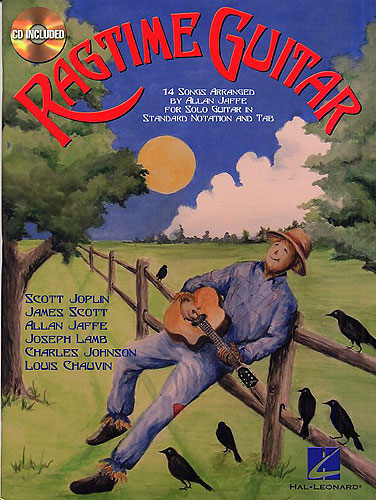
RAGTIME GUITAR 14 Songs Arranged for Solo-Entertainer CD LIBRO TABLATURE SPARTITI CHITARRA

RAGTIME GUITAR, 14 Songs Arranged for Solo Guitar. Allan Jaffe. BOOK WITH CD & TABLATURE

LIBRO DI MUSICA RAGTIME CON CD.

SPARTITI PER CHITARRA CON:

ACCORDI, PENTAGRAMMA E TABLATURE. 

14 Songs Arranged for Solo Guitar

Series: Guitar Solo
Softcover with CD - TAB
Arranger: Allan Jaffe

14 of Jaffe's fingerstyle arrangements of ragtime favorites and originals in standard notation and tablature with accompanying CD, 80 pages

"As a musical entity ragtime was, and is an instrumental work in 2/4 time composed for the piano that combines a syncopated series of melodies accompanied by an even, steady rhythm."-David A. Jasen and Trebor J. Tichener, Rags and Ragtime. In the first twenty years of the 20th century, an unprecedented phenomenon erupted into the world of Western music. For the first time, a form of popular music which was a true fusion of African-American and Western European musical traditions emerged. Although it began as an oral form played by pianists in the bars and brothels of several major American cities, thanks to the publishing houses, it quickly spread through the United States and eventually Europe. Unlike any other music up until then, this music was completely biracial. Everyone called it "ragtime." In an era before the age of radio and recording, the only way for music to reach the public, aside from the concert hall, was through sheet music. Many homes in the United States had their own pianos, and at least one family member was able to play this instrument, albeit often in a rudimentary fashion. Apart from the classical repertoire, most pianists favored versions of popular songs of the day, notated with a very simple accompaniment. Although ragtime challenged the skill levels of the average amateur pianist, Americans quickly succumbed to the new and unusual syncopations. The music became so popular that schools sprouted up around the country specifically for the purpose of teaching the lay-person how to play this strange and seductive music. The original creators and developers of ragtime were the great ragtime pianists and composers of the period, the three acknowledged masters of the classic rag being Scott Joplin, James Scott, and Joseph Lamb. Eventually the Tin Pan Alley composers, the pop songwriters of the day, recognized the commercial potential of this form and began cranking out ragtime pieces by the score. By the end of the 1920s, over five thousand ragtime works had been published. Possibly due to this rampant commercialization, the quality of the music degenerated and eventually ragtime disappeared from public favor until it was revived as a repertoire form years later. During the twenty or so years of ragtime's heyday, many wonderful pieces of music were born from the pens of its finest composers. Along with the works of the above-mentioned masters, one can find a wonderful assortment of music by other great ragtime artists, such as Tom Turpin, Charlie Hunter, Charles Johnson, and Artie Matthews, among others. Ragtime displayed great melodic, harmonic, and rhythmic invention; each piece possessed its own clear emotional impact. When I was asked by Hal Leonard Publications to do a book of rags for the guitar, comprising eleven arrangements of classic rags and three of my own, I had little idea of the rich musical world I was about to enter. Over the past ten years I had been writing my own guitar rags, originally inspired by the work of the three great blues guitarists, Mississippi John Hurt, Reverend Gary Davis, and Arthur "Blind" Blake. However, apart from Scott Joplin's compositions, I was unaware of the richness of this musical period. Thanks to two excellent literary sources, Rags and Ragtime by David A. Jasen and Trebor J. Tichener and They All Played Ragtime by Rudi Blesh and Harriet Janis, plus the multitude of websites dedicated to ragtime, I steeped myself in this music. Eventually, I chose eleven pieces which I felt were some of the best and most important works of ragtime's great composers. As the statement quoted at the beginning of this intro shows, ragtime has always been associated with the solo piano. In talking with people about this project I often heard the same response, "I have never heard ragtime played on the guitar." Indeed, most of the guitar music that has been called "ragtime" comes from the blues and is associated with the works of blues, folk, or country artists such as Gary Davis, Doc Watson, or Dave Van Ronk. On the surface, this seems to be a far cry from the classical-sounding solo piano compositions of Joplin or Lamb. But in fact, the music produced by these artists all share a syncopated melodic line superimposed on a steady bassaccompaniment figure. I found that with the appropriate key changes this music adapted well to the guitar. The rhythmic, melodic, and multi-timbral nature of the guitar makes it an excellent medium for ragtime. Of course there are challenges. Since this music was developed by pianists for pianists-with thick chords, big octave leaps, and bass lines moving in contrary motion to the melodies-there are few major inherent technical difficulties when played on the piano. This is a different story on the guitar. However, through a process of distillation, careful key selection, register changes, and liberal use of open strings, I was able to create versions of these pieces that retain the lyrical, harmonic, and rhythmic richness of the originals, while acquiring through the translation process a character of their own. The result, I believe, is guitar pieces that are a joy to learn and play.

The Entertainer - Scott Joplin (1902)

Marvin Hamlisch's adaptation of this rag for the movie, The Sting in 1976, was responsible for bringing the music of Scott Joplin and ragtime back to the attention of the public. It was originally dedicated to the vaudeville entertainer, James Brown, and, although I was unable to get any information about this person, in arranging it I had in mind an elegant "soft-shoe" performer. In order to bring out the beautiful melodies I have decided on a slower tempo for this tune.

Maple Leaf Rag - Scott Joplin (1899)

A fitting end to one century and beginning to the next, the publication of "Maple Leaf Rag" by publisher John Stark marks the emergence of ragtime as a popular musical form. By 1909 it had sold over a half-million copies. To the aspiring ragtime composer "Maple Leaf" became the model for this relatively new form of music. My version diverges from Joplin's original in two ways: 1. I have chosen to swing it, and 2. I have left out the standard repetition of the A section after the B section.

Heliotrope Bouquet - Scott Joplin and Louis Chauvin (1907)

This beautifully lyrical piece was a collaboration between Joplin and the legendary genius Louis Chauvin. As Chauvin's music had not previously appeared in print, Joplin suggested that in order for him to get his first publication, they should collaborate on this one. The A and B sections were written by Chauvin, the last two by Joplin. One can get some insight into Chauvin's unusual harmonic sense from the haunting A section.

Frog Legs Rag - James Scott (1906)

Scott is the forgotten genius of ragtime. This tune was his first publication and it was an immediate success. Although the B section is reminiscent of "Maple Leaf," we become aware of Scott's considerable originality throughout. The entire piece dances and is, I believe, an imaginative depiction of the movement of the appendages for which it is named. The D section, with James Scott's characteristic "octave echo," is a challenge technically on the guitar, but I have suggested a fingering which makes it a joy to play.

Grace and Beauty - James Scott (1909)

For me, this is the most lyrical and unusual of the James Scott rags. Scott was known to be the most adept pianist of the major three rag composers, and this is one of his most pianistic, using his characteristic octave leaps and arpeggiated "rips." Consequently, in order to make my arrangement "guitaristic" I have taken some liberties with the melody and bass lines.

Sunburst Rag - James Scott (1909)

This is a joyful and exuberant statement by Scott. Scott's rhythmic clarity and variety is apparent in this composition from one section to the next. The C section, which I find to be a wonderful workout for the left hand, seems to have been echoed, whether consciously or unconsciously, about sixty years later in Herb Alpert's "Spanish Flea." This work is beautifully structured, with the B section reappearing at the end, transformed by its modulation up a fourth.

American Beauty Rag - Joseph Lamb (1913)

This is one of the two rags I have arranged in "dropped D" tuning and is a beautiful, and at the same time, revolutionary work. The first two sections here are yet another example of Lamb's extraordinary lyricism and gift for long, arching melodies. Yet midway through this composition, beginning with the transition between Band C, Lamb takes quite a different direction. Suddenly the focus is on rhythm. The C section is remarkable in that, unlike any of the rags of this period, it seems to incorporate the "swing" rhythmic approach of jazz. Lamb notates the "swing" as a dotted eighth and sixteenth note rhythm and effectively alternates it with a straighteighth rhythm. Also unusual in this rag is the increasing intensity of the piece, beginning with the C section and continuing until the end.


1988 - Al's Slow Rag [Jaffe, Allan] 

1913 - American Beauty Rag [Lamb, Joseph] 

1911 - Barber Pole Rag [Johnson, Charles] 

1986 - Delta Rag [Jaffe, Allan] 

1906 - Dill Pickles [Johnson, Charles] 

1906 - Frog Legs Rag [Scott, James] 

1909  - Grace And Beauty [Scott, James] 

1907 - Heliotrope Bouquet [Joplin, Scott] [Chauvin, Louis] 

1990 - Joplin Rag [Jaffe, Allan] 

1899 - Maple Leaf Rag [Joplin, Scott] 

1915 - Ragtime Nightingale [Lamb, Joseph] 

1909 - Sunburst Rag [Scott, James] 

1902 - The Entertainer [Joplin, Scott] 

1916 - Top Liner Rag [Lamb, Joseph]

Prezzo: €32,99
€32,99

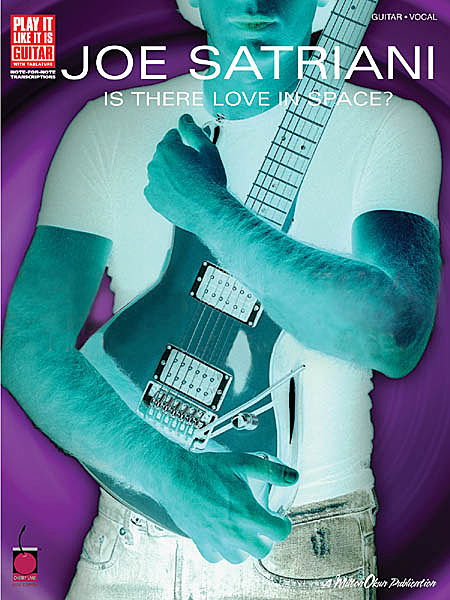
SATRIANI JOE IS THERE LOVE IN SPACE? Play It Like It Is-Cherry Lane Music GUITAR TABLATURE SPARTITI

SATRIANI JOE, IS THERE LOVE IN SPACE? 

SHEET MUSIC BOOK WITH GUITAR TABLATURE. 

LIBRO DI MUSICA ROCK.
SPARTITI PER VOCE E CHITARRA CON :
ACCORDI, PENTAGRAMMA, TABLATURE.


Matching Folio with Note for Note Transcriptions and Tablature for Joe Satriani's Is There Love in Space. Includes the songs: Gnaahh -Up in Flames -Hands in the Air -Lifestyle -Is There Love in Space? -If I Could Fly -The Souls of Distortion -Just Look Up -I Like the Rain -Searching -Bamboo. GUITAR TABLATURE

fotografie di Greg Watermann

Play it Like it is GUITAR TAB
Series: Play It Like It Is
Publisher: Cherry Lane Music TAB
Artist: Joe Satriani
 
Product Details

Inventory: #HL 02500733
ISBN: 9781575607603
UPC: 073999825640
Width: 9.0"
Length: 12.0"
Page Count: 112 Pages
Prices and availability subject to change without notice.

Since his guitar skills often sound like they come from another planet, it's no wonder that Joe Satriani seems the ideal person to ponder Is there Love in Space? Joining such Satriani classics as Not of This earth and Surfing with the Alien, his latest Epic Records endeavor further explores his extra-terrestrial mastery of the instrument-albeit while working in a more comfortably grounded environment. People have heard my bluesy side, my metal side, and my techno side," he says. "I guess this is my rockin' side."

the 11 diverse cuts on Is There Love in Space? range from the pulsating, brash opener, "Gnaahh," to the seven-string menace of "Hands in the Air," to the poignant ballad "Just Look Up." Yet all the tracks are unified by Satriani's love of old-school hard rock.

“I've taken a lot of my cues recently from live performance more than anything else," he says of solo tours and those shared with fellow virtuosos in the evolving project G3. "Standing on stage has made me feel freer to explore some places I've been before and to look for some avenues I haven't."

One of those avenues that is rather novel to Satriani is vocal duties. Is There Love in Space? includes two compositions that feature the instrumentalist taking command of the mic. "I usually try to find a character to sing through as a method of creating a vibe on the song," he explains.

Over the hammering riff of "Lifestyle," Satriani summons the same style he adopted when covering Neil Young during the G3 tour, while on the swamprocker "I Like the Rain," he dons a ZZ Top hat "like a junior Billy Gibbons." “My fans know I'm just using the vocals as an effect to create an interesting song,” he says. "Just like if I'm playing slide guitar, they know I'm not a dedicated slide player. I'm not going to make it part of my signature. What we arrive at is somewhat cathartic for someone who doesn't sing." “I Like the Rain” also features the album's most eccentric moment, when the engine revving of a Harley Davidson becomes an integral part of the song. ("It's a little synchronicity combined with serendipity," Satriani says of the circumstances that spawned the recording.) Apparently, while waiting for a guitar tech to return to the studio with a piece of gear, the band could hear his motorcycle's rumble signaling the arrival. The crew ran some cables out the control room doors and into the street to pop the sound onto tape. "It was perfect because it went with the attitude of the vocals," Satriani says. Another notable guest appearance involves the musician's young son, who turns up on the moody-and downright spacey-closer, "Bamboo." "I coaxed him into lying on the floor with an electric bass and playing a couple notes with his violin bow," he remembers. "It turned out to be great. It was the first thing that we had really done together that I knew would wind up on a record, so it was exciting for me. Obviously, he couldn't care less."

Is There Love in Space? is produced by Satriani, recorded by longtime collaborator John Cuniberti, and mixed by Mike Fraser. The album features the performer's core trio of Matt Bissonette on bass and Jeff Campitelli behind the drums. With this release, the New York native now boasts 11 solo albums to his credit-and a staggering 13 Grammy nominations to go along with them. His records have sold over 10 million copies worldwide. In fact, his sophomore effort, Surfing With the Alien, became the first instrumental guitar album to crack the Top 40. His Live in San Francisco DVD hit the gold mark, and the first G3 Live in Concert DVD went platinum. In addition to his own material, Satriani has recorded and toured with such artists as Mick Jagger, Deep Purple, Alice Cooper, and even Spinal Tap. Even before his 1986 debut Not of This Earth, Satriani had become something of a cult legend as the guitar teacher to such future stars as Steve Vai, Metallica's Kirk Hammett, Counting Crows' David Bryson, and jazz artist Charlie Hunter. Satriani has also become a hometown hero in the Bay Area, where he resides. He has been recruited to render the national anthem before San Francisco 4gers and Giants games, as well as for acrossthe- bridge neighbors, the Oakland As. It's no wonder he is listed at NO.8 in Guitar Player magazine's "Top 50 Greatest Guitarists Poll." "My ultimate goal is to continue playing forever," Satriani says. "I hope to never be tired of it and to always be searching to express the life I lead by taking those experiences and turning them into music. Hopefully, the guitar "II be my ongoing ment of expression."  


Searching (7-STRING low B)

Bamboo

Gnaahh

Hands In The Air (6 & 7-STRING low B)

I Like The Rain

If I Could Fly (6 & 12 string)

Is There Love In Space?

Just Look Up

Lifestyle  (6 & 7-STRING low B)

The Souls Of Distortion (6 & 7-STRING low B)

Up In Flames (DROP D TUNING: D-A-D-G-B-E)


The All Music Guide says that Satriani has "explored many directions, mashing together rock, blues, jazz, and pure technical proficiency in a dizzying blend that bears his unique signature." This matching folio to his 9th album, released in 2004, includes 11 tracks, 112 pages.

Titoli:

Searching

Bamboo

Gnaahh

Hands In The Air

I Like The Rain

If I Could Fly

Is There Love In Space?

Just Look Up

Lifestyle

The Souls Of Distortion

Up In Flames

Prezzo: €99,99
€99,99

MANCINI HENRY-ACOUSTIC MASTERCLASS SERIES-PINK GUITAR-CD TABLATURE LIBRO SPARTITI

MANCINI HENRY, ACOUSTIC MASTERCLASS SERIES PINK GUITAR. CD TABLATURE

LIBRO DI MUSICA CON CD.

SPARTITI PER CHITARRA CON:

ACCORDI, PENTAGRAMMA E TABLATURE. 

Pink Panther Theme - Laurence Juber
Moon River - Ed Gerhard (from the movie "Breakfast at Tiffany's")
Days of Wine and Roses - David Cullen
It's Easy to Say - Doug Smith (from the movie "10")
Peter Gunn - Pat Donohue
The Thornbirds Theme - Al Petteway
The Sweetheart Tree - Mark Hanson (from the movie "The Great Race")
What's Happening - Mike Dowling
Charade - Aaron Stang
Dear Heart - Wayne Johnson
Baby Elephant Walk - William Coulter (from the movie "Hatari")
Two for the Road - Amrit Sond


Twelve classic Henry Mancini tracks arranged for solo guitar by 12 master guitarists. This album-matching folio comes with a "masterclass" CD on which the artists describe the critical elements of their arrangements. Titles and arrangers include: Baby Elephant Walk/William Coulter; Charade/Aaron Stang; The Days of Wine and Roses/David Cullen; Dear Heart/Wayne Johnson; It's Easy to Say/ Doug Smith; Moon River/Ed Gerhard; Peter Gunn/Pat Donohue; The Pink Panther/Laurence Juber; Session at Pete's Pad/Mike Dowling; The Sweetheart Tree/Mark Hanson; Theme from the Thorn Birds/Al Petteway; Two for the Road/Amrit Sond. CD TABLATURE

About the Arrangements

The Pink Panther
"The Pink Panther" starts in E minor, which, in theory, should make it an easy fit on guitar. However, the characteristic chromatic walkup from C# to E would put the arrangement an octave too high in standard tuning. CGDGAD allows me to not only capture that signature run, but it also provides the open C and the open G bass notes, which are essential for the harmonic structure of the composition. I have attempted to remain true to the elements of the original arrangement, maintaining the essence of the bass part and of Plas Johnson's improvised tenor sax solo. My guide for this work is an image of a group of LA's finest studio musicians performing in tight ensemble under Mr. Mancini's baton; this must have been one breathtaking session! -Laurence Juber

Moon River
Although "Moon River" is in 3/4, I don't emphasize the waltz feel in my arrangement. In myopinion, de.-emphasizing the waltz feel contributes to the dreamlike quality of the tune. Let the melody notes ring out as long as possible (a little bit of subtle vibrato will help the melody stand out). This arrangement should be very easy to play, so savor every note. Good luck. -Ed Gerhard

The Days of Wine and Roses
I enjoyed putting together this solo guitar arrangement of "The Days of Wine and Roses:' It includes the same modulation that is popular among jazz pianists. The great Bill Evans does this same modulation in his rendition. I hope you enjoy the bossa nova rhythmic feel in the introduction. I think it sets the mood for the tune. Thank you, Mr. Mancini, for all the memorable melodies. -David Cullen

PeterGunn
Arranging the "Peter Gunn" theme came down to a matter of synchronizing the famous bass line and melody by way of dozens of one-beat finger mechanisms that occur frequently. Until the very end, the only chord in the "Peter Gunn" theme is E7. The challenge was to take it through a few times in different ways. In the A section, I play one time through with a single-note melody and then one time through with a harmonized melody, all against the recurring bass line. Letter B is a bridge of sorts. The C section is the harmonized melody again. The D section is another bridge I composed myself using a combination of diminished and major chord triad shapes. In the E section, there is a technique that simultaneously uses tremolo and bass line in the right hand: the right-hand fingers move up and down rapidly against the first three strings while the right-hand thumb pounds out that familiar bass melody. This arrangement has been extremely exciting and challenging. Don't call me at home with questions! I can't help you. I'll be in therapy. -Pat Donohue

Two for the Road
Technically, this is a pretty simple and straightforward piece to play. Care and attention should be devoted to the right-hand fretting-sustain each melody and chord voicing for as long as possible to allow for smooth transitions throughout. Also, dynamics will really help to bring out the emotional aspect, so experiment with softer and louder right-hand picking-bearing in mind that the melody needs to be up front at all times, and in certain instances I have even chosen to drag the time for effect. The bass counterpart is critical in its role as harmony, so ensure that you pay as much attention to keeping it nice and smooth against the melody. The run that occurs at bar 47 is played with just downstrokes (with the right-hand thumb), slightly speeding up toward the end and then returning to the slower tempo. All harmonics are natural, played at the 12th fret. -Amrit Sond

About Pink Guitar. As owner of Solid Air Records, I would love to take credit for this collection of arrangements, but like most owners, I am luckier than I am smart. Aaron Stang, our partner in print publishing at Warner Bros. Publications, came up with the concept; I can take credit only for agreeing that it could be fun. Of course, asking a dozen artists to find time to pick out a favorite Mancini tune, work up a creative arrangement, record it, transcribe it, and then record a lesson-all in just a few weeks' time-is asking a lot! Fortunately for me, the artists on our label are all up for such challenges and delivered the goods-as they say in the entertainment biz. At this 10th anniversary of the passing of the legendary composer Henry Mancini and the 40th anniversary of the Pink Panther, there are many products in stores honoring his memory: everything from repackages of older recordings to new and exciting versions of his tunes from jazz ensembles to pop stars. Our collection marks the first time a group of guitarists has tackled his compositions; it's a tribute to the strength of his melodies that even played as solos they retain all of their power, beauty, and playfulness. I won't go into detail about each tune since the artists themselves have done a better job than I could, but I would like to say that 2004 marks our own lOth anniversary. We could think of no better way to start this collection than with Laurence Juber, the artist with whom we launched our label. It was obvious to us that the challenging job of turning "The Pink Panther" theme into a solo guitar arrangement had to go to this Grammy-winning musician-and the results speak for themselves. Finally, my sincere thanks to you for purchasing this collection of arrangements. I hope you'll check out the other CDs, books, and DVDs by these wonderful musicians. They're all extremely talented composers in their own rights. Until we meet again and the case is solved. -James Jensen


WAYNE ]OHNSON
After joining the Manhattan Transfer in 1977, Wayne has taken plenty of time off from the gig to keep his solo interests alive. With eight solo CDs to his credit (both trio and solo), Wayne has also recorded and performed with an eclectic variety of other artists in addition to the Manhattan Transfer including Rickie Lee Jones, John Tesh, Akiko Yano, and Lee Oskar ofWar. At home, Wayne does studio work, produces, and is a guest instructor at the Musicians Institute and Los Angeles Music Academy. Look for his new solo acoustic release on Solid Air Records entitled One Guitar.

LAURENCE JUBER
Laurence Juber grew up in North London, where he was inspired by the explosive British pop scene of the early' 60's. Laurence became a highly in-demand studio player, contributing to many recordings ranging from the Alan Parsons Project and Rosemary Clooney to playing lead guitar on the Academy Award-nominated soundtrack to The Spy who Loved Me. In 1978 Paul McCartney asked Laurence to become the lead guitarist for his band Wings. After McCartney folded Wings in 1981, Laurence moved to the U.S., where he concentrated on raising a family while resuming his studio career. He played on such classic '80s TV shows as "Happy Days" and "Family Ties." In 1990 Laurence released his first solo album, Solo Flight, which first showcased his fingerstyle guitar work. His next CD, Naked Guitar, solidified his reputation among guitar fans, and he began touring internationally as a solo concert performer. His solo fingerstyle CDs include Winter Guitar, Mosaic, Altered Reality, Different Times, Guitarist, and the best-selling LJ Plays the Beatles.

AL PETTEWAY
AI Petteway has had an illustrious career as a guitarist, composer, and producer. He has been featured on more than 60 nationally released recordings, including 14 ofhis own. His original compositions have been used in movie sound-tracks and for programs on NPR and PBS, including Ken Burns' film Mark Twain. His trademark musical style, mixing Celtic and American themes, has won him more than 50 Music Association awards, including the Indie award for Gratitude, a duo guitar project with his wife and musical partner, Amy White. Al is the coordinator for the World-renowned Swannanoa Gathering's Guitar Week and is Artist-in-Residence at Warren Wilson College near Asheville, North Carolina. When they aren't touring as a duo, he and An1y work together, recording music and photographing nature at their home high in the mountains of western North Carolina.

DOUGSMITH
Doug Smith's originai instrumental compositions combine folk, classical, jazz, and contemporary forms with virtuoso guitar technique to create a unique, flowing, and highly melodie fingerpicking style. His music has been heard on radio and TV stations throughout the world, including CNN, ESPN, E!, The Discovery Channel, and Encore; his playing has been heard on the soundtracks to movies such as Twister and Moll Flanders; and he has performed on the nationally syndicated radio programs "Echoes," "West Coast Live:' and "River City Folk" as well as local radio and TV shows around the country.

AMRITSOND
Arnrit's unique contemporary instrumental music draws on elements of jazz, classical, folk, world music, and newacoustic techniques, which are ali honed into a highly refined and melodically driven compositional approach. Amrit has graced the same billing as the world's most renowned guitarists, including Dominic Miller (Sting , Hugh Burns (George Michael), Ronnie Johnson (Van Morrison), Doyle Dykes, Jaques Stotzem, and Preston Reed. Affili records for Solid Air Records.

AARON STANG
Aaron Stang is the author of Warner Bros. Publications' 21st Century Guitar Method. One of the most popular guitar methods published, the 21st Century Guitar Method has become the standard text used by many guitar teachers throughout the country and has been translated into Spanish, French, German, and Japanese. Aaron is managing editor of fretted instruments at Warner Bros. Publications, where he has overseen the publication of hundreds of guitar books and videos. Aaron performs solo and with his group, Relative Viewpoint, in concerts and folk festivals throughout south Florida. Currently, Aaron is the lead author of Guitar Expressions, the first comprehensive guitar curriculum designed for middle and high school students.


Acoustic Masterclass Series: Henry Mancini, Pink Guitar
the music of Henry Mancini

SERIES: Acoustic Masterclass
CATEGORY: Guitar Method or Supplement
FORMAT: Book & CD
--------------------------------------------------------------------------------
Guitar arrangements transcribed by the artists themselves, in standard notation and tab. Each edition includes a masterclass-style CD in which the artist walks you through the key aspects and techniques for each arrangement.

Twelve classic Henry Mancini tracks arranged for solo guitar by twelve master guitarists. This album-matching folio comes with a "masterclass" CD on which the artists walk through the key aspects and techniques for each arrangement. Titles and arrangers are: Baby Elephant Walk (William Coulter) * Charade (Aaron Stang) * The Days of Wine and Roses (David Cullen) * Dear Heart (Wayne Johnson) * It's Easy to Say (Doug Smith) * Moon River (Ed Gerhard) * Peter Gunn (Pat Donohue) * The Pink Panther (Laurence Juber) * What's Happening (Mike Dowling) * The Sweetheart Tree (Mark Hanson) * Theme from "The Thorn Birds" (Al Petteway) * Two for the Road (Amrit Sond).
--------------------------------------------------------------------------------
Includes the Following Selection:
Title Composer

BABY ELEPHANT WALK FAMOUS MUSIC
HENRY MANCINI

CHARADE (FROM "CHARADE")
MANCINI HENRY/L: MERCER, JOHNNY

DEAR HEART (FROM "DEAR HEART")
MANCINI, HENRY/EVANS, RAY/L: LIVINGSTON, JAY

IT'S EASY TO SAY
HENRY MANCINI, ROBERT WELLS

MOON RIVER (INSTRUMENTAL)
MANCINI, HENRY

PETER GUNN (FROM "PETER GUNN")
MANCINI HENRY

THE DAYS OF WINE AND ROSES
L: MERCER, JOHNNY/MANCINI, HENRY

THE PINK PANTHER (FROM "THE PINK PANTHER")
MANCINI, HENRY

THE SWEETHEART TREE (FROM "THE GREAT RACE")
L: MERCER, JOHNNY/MANCINI, HENRY

THE THORN BIRDS (MAIN THEME)
MANCINI, HENRY

TWO FOR THE ROAD (FROM "TWO FOR THE ROAD")
L: BRICUSSE, LESLIE/MANCINI, HENRY

WHAT'S HAPPENING!!
HENRY MANCINI

Prezzo: €31,99
€31,99

HAYNES WARREN GUIDE TO SLIDE GUITAR BOOK CD TABLATURE LIBRO SPARTITI CHITARRA MUSICA

HAYNES WARREN, GUIDE TO SLIDE GUITAR. SHEET MUSIC BOOK WITH CD & GUITAR TABLATURE .

LIBRO DI MUSICA ROCK BLUES, CON CD.

SPARTITI PER CHITARRA CON :

ACCORDI, PENTAGRAMMA E TABLATURE. 


CD FEATURES FULL BAND TRACKS BOTH WITH AND WITHOUT GUITAR, PLUS JAM TRACKS . 

Learn the slide guitar stylings of Warren Haynes from the man himself! The legendary guitarist of Gov't Mule, Phil Lesh and Friends, the Grateful Dead, and the Allman Brothers Band offers instructions on choosing a slide, perfecting left- and right-hand techniques, playing rhythm, and blues soloing-on electric and acoustic. The Warren Haynes Guide to Slide Guitar will give you the most in-depth and personal lessons ever on how to play slide guitar in the style of Warren Haynes. Also includes a split-channel CD of the exercises, played by Warren himself with a full band. Listen to the master or solo along to the backing tracks! 48 pages

WRITTEN BY WARREN HAYNES

WITH MIKE LEVINE 


Description

A unique book and CD from the hands of a true slide guitar legend - Warren Haynes. As guitarist with The Allman Brothers Band and The Grateful Dead, Haynes has forged himself a reputation as one of the greatest slide players in rock history, and you can now get a candid guide to his style from the man himself!

Haynes covers every part of your development as a slide guitarist, from choosing the best slide for you and perfecting the basic techniques to playing rhythm parts and blues soloing. A CD is included that features split-channel recordings of Warren performing all examples with a full band... either listen to the master at work, or solo along to the backing track and get your slide licks really cookin'. 48 pages

Acoustic Slide
Advanced Soloing
Approaching The Neck
Beyond The I-IV-V
Getting Started
Playing The Blues

... them, all of which paved the way for the new in-concert set. "I think we've always wanted to do a live album since we got together," says Haynes. "We're just happier in a concert situation, though it wasn't intentional that we'd do two studio discs first, just like the original ABBdid before Fillmore East. But just like then, our songs sound better in concert and, in fact, the Allman Brothers are and will always be a live band. We even cut our studio albums live, with everybody set up in the room and playing all at once. Most of the guitar solos that Dickey and I cut in the studio are live on the tape as they went down, which is very unusual. Of course, we go for that same spontaneity live and instead of just trading straight solos, sometimes we just bob and weave, leaving spaces for the other to fill in with harmonies, unison bits or counterpoint - it's all unplanned and experimental, like Miles Davis and John Coltrane improvising together or 'Trane and Cannonball Adderly. And we leave the mistakes and mishaps in while recording live, too. Like when I'm soloing in the first half of 'Blue Sky,' I start playing straight lead and then you can hear where I switch to slide and finish the lead playing bottleneck. The funny thing is that there's about a five or six beat pause in between them because the slide got kinda stuck in my vest pocket and it took a while to get the darn thing on my finger!" Given his broad listening tastes and keen melodic intuition, it shouldn't be surprising that Haynes also has a wealth of good advice to impart to younger players. As proof, just sample this tidbit of universal guitar wisdom, one which cuts to the heart of the matter just as fast as one of his always inventive solos: "Awhile back, I used to play country music for a living with David Allan Coe and, while I don't think I'd be happy playing country every day, I learned a lot from the experience because whenever you step outside your genre, you're bound to expand your horizons. When I used to read interviews with some of the truly great players, there was always one influence they'd mention that was a complete surprise, like B.B. King saying he dug jazzers like Django Reinhardt and Charlie Christian, which in turn gave him his own special voice as a blues player. In my mind, whether you're into blues or heavy metal, listening to and also playing other styles of music can only make you a better guitar player." 

Prezzo: €27,99
€27,99

ATKINS CHET IN THREE DIMENSIONS VOLUME 2 TABLATURE CHITARRA SPARTITI LIBRO FINGERPICKING

ATKINS CHET, IN THREE DIMENSIONS VOLUME 2. GUITAR TABLATURE

LIBRO DI MUSICA FINGERSTYLE.
SPARTITI PER CHITARRA.
ACCORDI, PENTAGRAMMA E TABLATURE

CON FOTOGRAFIE DI CHET ATKINS INSIEME AL PRESIDENTE DEGLI STATI UNITI D'AMERICA JIMMY CARTER, MARK KNOPFLER, PAUL YANDELL, JERRY REED, E ALTRI, COME RITA PAVONE. 

Rare photographs. Presents the much-anticipated second book in the highly acclaimed series that showcases personal insights into the life and music of "Mr. Guitar." Chet Atkins was a man of many layers: producer, record executive, friend and one of the greatest all-round guitarist in music history. This book is dedicated to the musicians and songwriters that meant so much to him. Interviews include: Dolly Parton, Steve Wariner, John D. Loudermilk, Mark Knopfler, Paul Yandell, Jerry Byrd, Janis Ian, Boots Randolph, Wayne Carson and many more of Chet's closest friends. As in Volume 1, Chet Atkins in Three Dimensions, Volume 2 provides definitive transcriptions (many for the first time) of 26 of Chet's greatest solos and duets such as "Gallopin' on the Guitar," "Liza," "Muskrat Ramble," "Frankie and Johnny," "Mister Sandman," "Smile," "Sweet Georgia Brown," "The Early Dawn," "The Entertainer," "Stump Water," "Dark Eyes," "Winter Walkin'," "Embraceable You," the tour de force piece- Jerry Reed's "Lightning Rod" (a work recorded by Jerry Reed and produced by Chet Atkins) and many other great pieces . Rare photographs, loving tributes and great music are the heart of this wonderful volume-a must for all fans of the guitar.
Song Title: Alice Blue Gown -Autumn Leaves, Joseph Kosma -Black Mountain Rag -Cancion del Viento "Song Of The Wind", arr. by Jorge Morel -Canned Heat, Chet Atkins -Dark Eyes -Embraceable You, George and Ira Gershwin -Estudio Brillante, Francisco Tarrega -Flop Eared Mule (and Other Classics) -Frankie and Johnny -Gallopin' On The Guitar, Chet Atkins -La Madrugada (The Early Dawn), Jerry Hubbard -Levee Walking, Jerry Reed and Henry Strzelecki -Lightning Rod, Jerry Hubbard -Little Music Box "La Alborada", Francisco Tarrega -Liza, George Gershwin -Long Long Ago, Thomas Bayly -Mister Sandman, Pat BallardMuskrat Ramble, Edward "Kid" Ory -Rainbow -Smile, Charles Chaplin -Stump Water, Jerry Reed -Sweet Georgia Brown, Ben Bernie, Kenneth Casey, and Maceo Pinkard -The Entertainer, Scott Joplin (arranged by John Knowles) -Winter Walkin', Jerry Reed. 375 pages. TAB.

By John McClellan and Deyan Bratic. For Guitar (Fingerpicking). Transcribed solos. Country. Book. Level: Advanced. The much-anticipated second book in the highly acclaimed series that showcases personal insights into the life and music of 'Mr. Guitar.' Chet Atkins was a man of many layers: producer, record executive, friend and one of the greatest all-round guitarist in music history. This book is dedicated to the musicians and songwriters that meant so much to him. Interviews include: Dolly Parton, Steve Wariner, John D. Loudermilk, Mark Knopfler, Paul Yandell, Jerry Byrd, Janis Ian, Boots Randolph, Wayne Carson and many more of Chet!s closest friends. As in Volume 1, Chet Atkins in Three Dimensions, Volume 2 provides definitive transcriptions (many for the first time) of 26 of Chet!s greatest solos and duets such as Gallopin on the Guitar, Liza, Muskrat Ramble, Frankie and Johnny, Mister Sandman, Smile, Sweet Georgia Brown, The Early Dawn, The Entertainer, Stump Water, Dark Eyes, Winter Walkin, Embraceable You, the tour de force piece- Jerry Reed's Lightning Rod (a work recorded by Jerry Reed and produced by Chet Atkins) and many other great pieces . Rare photographs, loving tributes and great music are the heart of this wonderful volume-a must for all fans of the guitar.

Song Title: Composer/Source:
Alice Blue Gown
Autumn Leaves Joseph Kosma
Black Mountain Rag
Cancion del Viento "Song Of The Wind" arr. by Jorge Morel
Canned Heat Chet Atkins
Dark Eyes
Embraceable You George and Ira Gershwin
Estudio Brillante Francisco Tarrega
Flop Eared Mule (and Other Classics)
Frankie and Johnny
Gallopin' On The Guitar Chet Atkins
La Madrugada (The Early Dawn) Jerry Hubbard
Levee Walking Jerry Reed and Henry Strzelecki
Lightning Rod Jerry Hubbard
Little Music Box "La Alborada" Francisco Tarrega
Liza George Gershwin
Long Long Ago Thomas Bayly
Mister Sandman Pat Ballard
Muskrat Ramble Edward "Kid" Ory
Rainbow
Smile Charles Chaplin
Stump Water Jerry Reed
Sweet Georgia Brown Ben Bernie, Kenneth Casey, and Maceo Pinkard
The Entertainer Scott Joplin (arranged by John Knowles)
Winter Walkin' Jerry Reed

Prezzo: €58,99
€58,99
Condividi contenuti