LIBRO CON CD

B.B. KING-BLUES LEGEND A Step-by-Step Guitar Styles and Techniques CD TABLATURE CHITARRA SPARTITI

B.B. KING, BLUES LEGEND. A Step-by-Step Breakdown of His Guitar Styles and Techniques. CD TABLATURE

LIBRO DI MUSICA BLUES CON CD.

SPARTITI PER VOCE E CHITARRA CON :

ACCORDI, PENTAGRAMMA, TABLATURE.  

TECNICA, 


B.B.'s Boogie
Blue Shadows
Everyday I Have The Blues
Help The Poor
How Blue Can You Get
It's My Own Fault Darlin'
Just Like A Woman
Lucille
Please Accept My Love
Shake It Up And Go
So Excited
Woke Up This Morning


B.B. King - Legenda del Blues

L'analisi passo per passo del suo stile e della sua tecnica chitarristica.

Serie: Signature Licks Guitar
Formato: Softcover with CD - TAB
Artista: B.B. King
Autore: Dave Rubin

Impara i guitar licks che hanno fatto di B.B. il Re indiscutibile del Blues! David Rubin ti insegna 12 assoli autentici di B.B King: Boogie • Blue Shadows • Everyday I Have the Blues • Help the Poor • How Blue Can You Get • It's My Own Fault Darlin' • Just like a Woman • Lucille • Please Accept My Love • Shake It Up and Go • So Excited • Woke Up This Morning.

Largezza: 9.0"
Lunghezza: 12.0"
48 pagine
 

Prezzo: €29,99
€29,99

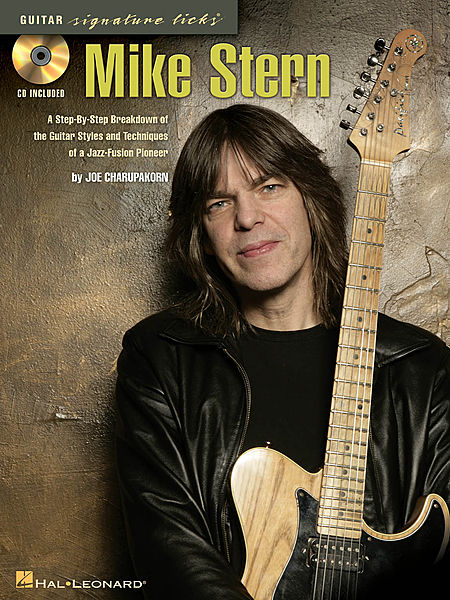
STERN MIKE Guitar Styles & Techniques of a Jazz-Fusion Signature Licks CD TABLATURE SPARTITI

Mike Stern, A Step-By-Step Breakdown of the Guitar Styles & Techniques of a Jazz-Fusion Pioneer. SHEET MUSIC BOOK WITH CD & GUITAR TABLATURE .

LIBRO METODO DI MUSICA FUSION CON CD. 

SPARTITI PER CHITARRA CON: 

ACCORDI, PENTAGRAMMA, TABLATURE. 


MIKE STERN
A Step-By-Step Breakdown of the Guitar Styles & Techniques of a Jazz-Fusion Pioneer
Series: Signature Licks GUITAR
Format: Softcover Audio Online – TAB
Serie: Signature Licks Guitar
Autore: Joe Charupakorn
Artista: Mike Stern

Scopri la magia di un asso di chitarra Mike Stern con l'edizione speciale di Assoli d'Autore che includono le interviste e le lezioni con Stern, informazini esclusive sull'attrezzatura, l'analisi approfondita di 14 titoli e in più un CD audio con tutti  gli esempi musicali del libro. Le canzoni sono: After You • Jigsaw • Like Someone in Love • One Liners • Play •Sunnyside • Swunk • There Is No Greater Love • Tipatina's • Wing and a Prayer • e altre.

Inventory #HL 00695800
ISBN: 9780634068010
UPC: 073999813074
Larghezza: 9.0"
Lunghezza: 12.0"
128 pagine


Discover the magic of guitar wizard Mike Stern with this special edition of Signature Licks that includes an interview and lesson with Stern, exclusive gear info, in-depth analysis of 14 songs, plus recordings of demos for all the music examples in the book! Songs include: After You • Jigsaw • Like Someone in Love • One Liners • Play • Sunnyside • Swunk • There Is No Greater Love • Tipatina's • Wing and a Prayer • and more. The audio is accessed online using the unique code inside each book and can be streamed or downloaded. The audio files include PLAYBACK+, a multi-functional audio player that allows you to slow down audio without changing pitch, set loop points, change keys, and pan left or right. 


After Blood, Sweat & Tears, Stern returned to Boston and played with saxophonist

Jerry Bergonzi (who he met through his teacher, the late Charlie Banacos). He also took

over Bill Frisell's spot in trumpeter Tiger Okoshi's Tiger's Baku, a band that Frisell helped

put together. In 1979, Stern landed his next big gig, with drummer Billy Cobham. During

a gig with Cobham at the now-defunct Bottom Line in New York City, Miles Davis (at the

suggestion of saxophonist Bill Evans) came to check out Stern. He liked what he heard

and Stern got the ultra high-profile gig for Davis's 1981 comeback tour. It was a major

milestone in Stern's career, and one that catapulted him into jazz stardom.

Stern played on three Miles Davis albums: The Man With the Horn, which featured a

burning solo on the first cut "Fat Time" (named in Stern's honor for both his great timefeel

and his at-the-time, corpulent physique); We Want Miles, a great live album; and Star

People, which also featured guitarist John Scofield, who was recruited as a second guitarist

because of Stern's then drug and alcohol problem. Having gradually become unreliable,

Davis ultimately let Stern go, to sober up.

During this time, Stern reconnected with Jaco Pastorius, playing in his Word of Mouth

band. They also played together nonstop when Stern lived above 55 Grand Street, a New

York City jazz club they played at since its inception (not to be confused with the 55 Bar

on Christopher Street, where Stern currently plays twice a week when he's in town). Jaco

wound up crashing at Stern's pad and the two were inseparable, playing at all hours of

the day and blowing lines over changes. Alas, they were also doing "white lines" to the

point of losing control. Stern checked into rehab, and in 1985, the cleaned-up guitarist

rejoined the Miles Davis band. Pastorius, however, never cleaned up. The drugs and alcohol

had severely impacted his mental state and behavior for the worse, and in 1987, during

an altercation with a bouncer outside a nightclub in Florida, he was tragically beaten

to death.

Since his tenure with Miles Davis, Stern has gone on to perform and record with

Michael Brecker, the Brecker Brothers, Bob Berg (with whom he co-led the Mike Stern/

Bob Berg band), Jaco Pastorius's Word of Mouth band, Steps Ahead, David Sanborn, Joe

Henderson, George Coleman, Ron Carter, Jim Hall, and Pat Martino, among others.

Stern has also recorded numerous solo albums-the first being Neesh, in 1983, which

was recorded for Trio (a Japanese label), right after Stern first left Miles Davis's band. It

was recently re-released, but only in Japan (on Absord Music Japan). In 1986, Stern

signed a deal with Atlantic Records and recorded Upside Downside. This marked the

beginning of a 15-year association with Atlantic Records that spawned ten albums and

three Grammy nominations. In 2004, with the demise of the jazz department at Atlantic

Records, Stern recorded his first album for ESC Records, These Times (now available on

BHM Records). In 2006 Stern moved to Heads Up International Records for his release

Who Let the Cats Out?, which garnered Stern a fourth Grammy nomination. A live DVD,

Live-New Morning The Paris Concert was also released in 2006, by independent

German label, lnakustik. This DVD featured Richard Bona, Dennis Chambers, and Bob

Franceschini. In 2009, a sequel to Live-New Morning The Paris Concert was released

and features Tom Kennedy, Dave Weckl, and Bob Franceschini. Big Neighborhood,

Stern's most explosive guitar album to date, was also released in 2009 and featured virtuoso

guitarists Steve Vai and Eric Johnson, among others. Stern's earlier Atlantic recordings,

with the exception of Play and Voices (which are still available through Warner

Music), are now distributed by Wounded Bird Records, a CD-only re-issue label.

Despite Stern's enormous status as a world-renowned jazz-fusion guitar virtuoso, his

prodigious technical abilities (which he seamlessly combines with a heartfelt lyricism),

and his impressive history onstage with countless jazz legends, Stern is a humble and

grounded musician whose sole mission is to constantly grow as a player. "The more I

know, the less I know" is one of Stern's favorite quotes, and it is indicative of his approach

to music, as a neverending quest.

For this Signature Licks edition we have enlisted Mike Stern as a consultant. He offers

not only unique analytical and historical insight for each selection but also a special private

lesson, to help you understand the theory behind his burnin' lines. And indirectly,

large portions of the information in this book have been gathered over the years, during

my studies with Stem and om itnessing countless live shows.


ONE ON ONE WITH MIKE STERN

What was the first jazz solo that had an impact on you?

Well that's a hard question because my mom used to playa lot of jazz records so I always

heard jazz around the house. I started playing when I was 12, but I was 17 when I started

getting more into jazz. I guess it was something off a Miles Davis record. One of the

first records I used to scope was Herbie Hancock's Maiden Voyage. That was one of the

first albums that I checked out and tried to play along with. At the time, I was listening to

more blues, rock, and Motown, and playing along by ear.

When you played along with Maiden Voyage, were you soloing over it or were you

trying to play the actual parts?

I was doing a little bit of both-the actual parts and the solos.

Do you remember the first solo you transcribed?

Yeah, it was a Joe Pass solo. I picked a blues because it's an easy form and Joe's solo

had a lot of inside bebop. It was a medium swing, not a real fast tempo.

Did he playa lot of sixteenth notes in the solo?

He was playing a lot of eighth notes, just a lot of really cool bebop lines. Joe was a very

clear, inside player in a lot of ways. He didn't go outside the key too much, and it was very

clear what he did when he did go out, the way he outlined it. He was amazing like that.

There was a lot of bebop vocabulary; he used to play with Oscar Peterson. It took me

about three weeks to transcribe the solo. I had to slow the record player down, which

almost ruined the record. Finally I taped it and finished the rest. Later on I showed it to

some people and they said most of it was wrong [laughs]. But doing it myself was amazingly

helpful.

After you learned the solo did you take licks from it and use them in your own playing?

A little bit, and some of the phrasing, too. It's like when you read a book or short storyyou

don't memorize every word; you just take certain things away from it and then enough

of the remaining information goes unconsciously into your brain, or in the case of music,

into your ear. Over time, if you take from enough different solos from different people, you

don't sound like just one guy.

For a long time now, I've been more into copping piano and saxophone solos. But

when I was first transcribing, it was guitar because it was my own instrument-and that

was hard enough. But like I said, transcribing lines for myself was really helpful; I got a lot

more out of it that way than from reading it from a book.

Were you writing out the solos?

Yeah, I wrote them down. Then I'd read through it, not so much to cop licks but more like

reading a magazine or a short book, where you might remember a couple of phrases and

quote from it-you don't memorize every word. Some people go too far and memorize the

whole solo, but the idea is to learn how to phrase unconsciously and then twist it around

your own way, as a kind of springboard for your own ideas. That way you get a vocabulary

in a certain style; for instance, if you want to work on your bebop vocabulary, you do

a lot of bebop players. I did a bunch of guitar players at first-Joe Pass, Jim Hall, Wes

Montgomery, George Benson-and then I got into horn players.

INTRODUCTION
DISCOGRAPHY
THE RECORDING
ABOUT THE AUTHOR
MIKE STERN'S GEAR
ONE ON ONE WITH MIKE STERN
BOP 'N ROLL: A LESSONS WITH MIKE STERN

After You - Mike Stern - 1986
Jigsaw - Mike Stern - 1989
Like Someone In Love - Words: Johnny Burke, Music: Jimmy Van Heusen - 1944
Odds Or Evens - Mike Stern - 1991
One Liners - Mike Stern - 1997
Play - Mike Stern - 1999
Showbiz - Mike Stern - 1996
Sunnyside - Mike Stern - 1996
Swunk - Mike Stern - 1994
That's What You Think - Mike Stern - 1997
There Is No Greater Love - Words: Marty Symes, Music: Isham Jones - 1936
Tipatina's - Mike Stern - 1999
Upside Downside - Mike Stern - 1986
Wing And A Prayer - Mike Stern - 1996

Prezzo: €32,99
€32,99

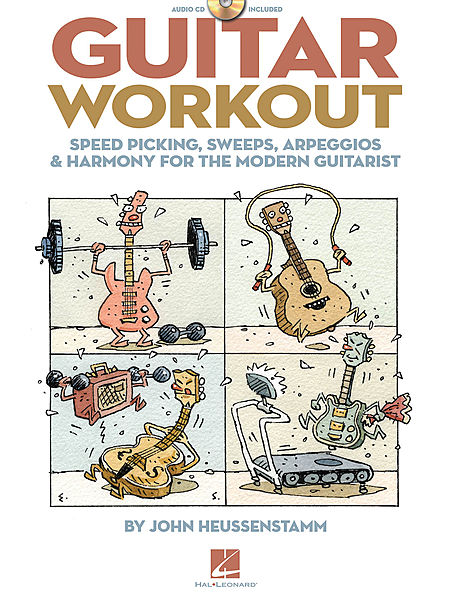
GUITAR WORKOUT, SPEED PICKING, SWEEPS, ARPEGGIOS HARMONY, John Heussenstam. CD TABLATURE

GUITAR WORKOUT, SPEED PICKING, SWEEPS, ARPEGGIOS AND HARMONY For The Modern Guitarist, John Heussenstam. CD TABLATURE

Guitar Workout

Speed Picking, Sweeps, Arpeggios & Harmony for the Modern Guitarist
Serie: Guitar Educational
Formato: Softcover with CD - TAB
Autore: John Heussenstamm

Guitar Workout è un programma intensivo e completo che aumenterà la tua velocità, agilità e creatività. Questo è  un libro di esercizi fondamentali per i chitarristi che vogliono accellerare e articolare lo speed picking. Preparazione professionale insieme alla migliore comprensione delle scale maggiori diatoniche, armonia delle scale, la tecnica del picking che richiede unione di riff e assoli superveloci con l'intelligenza e creatività melodica. Il chitarrista di fama internazionale John Heussenstamm vi dimostrerà gli esercizi di riscaldamento a note singole, esercizi per aumentare la velocità, schemi di ditteggiatura, sweeps, arpeggi, costruzione melodica.

Larghezza: 9.0"
Altezza: 12.0"
154 pagine


ABOUT THE AUTHOR

I come from a musical family.My great grandfather and grandmother Erica had a music conservatorium in Germany. Mygrandmother fled Germany soon after World WarIand settled in Hollywood, California, where she raised four children and taught classical piano and voice lessons. My uncle George taught advanced music theory at the college level and beyond. I started learning piano at the age of four, but that didn't last long! Like most kids, I found playing football on the street with my brothers much more to my liking. I fought with my grandmother about practicing the piano. She claimed that I did all my exercises correctly and had my parents excited about my potential as a pianist. Not long after that, I heard my uncle Peter practicing Flamenco guitar, and that was the sound that inspired me to learn. It was Peter that gave me my first guitar lesson when I was eight years old. In elementary school, they didn't offer guitar, so I was given a cornet from my uncle Sonny on my mother's side of the family. I played that horn for four years in the school band but eventually traded it for a Gibson EBOelectric bass. Around that time, my aunt Barbara, who was married to famous saxophonist George Weidler of the Stan Kenton Band, gave me an old Fender Precision bass and a Standel amp. I used to load that gear on my red wagon, haul it around the neighborhood, and jam for hours with kids in local surf bands. Back in the early sixties, there weren't many bassists, so I was in demand and constantly working in groups until I left high school. After graduating, I traveled to Mexico in a VWcamper on a three-month surfing trip with my brother Paul. I brought along an old Gibson L12 archtop jazz guitar and constantly practiced the entire tripwhenever my brother was driving, I would sit in the back of the vehicle and practice. By the end of the journey, I was ready to start playing in bands. When I turned 21, I hit the road and started touring. Through a friend, I got an audition with a group out of New Orleans called Lovera. That job introduced me to rhythm and blues, and that influence has remained with me. I try to instill in all my students the feeling of that music-a music that we should be proud of.My first jazz teacher, Tito at WestLAMusic, used to say to me, "You should be proud of the great jazz and blues that comes out of America." I also had private lessons with some great guitarists: Joe Pass, Ted Greene, and Bob Conti. I auditioned for a gig with the great soul singer Deniece Williams and got the job playing funky soul music. I was the only white guy in the band. Because of my experience with Lovera, I was familiar with that style. Deniece later went on to win two Grammy Awards, and I am proud to have been a small part of her career. While visiting my brother, Mark, in West Australia, I met my future wife, Julie. After returning to California, I briefly studied Indian music with Ali Akbar in San Rafael, California. We eventually returned to Australia and settled in Perth. From 1980 to 1990, I taught guitar and toured around Australia in my own bands. I've always had a burning desire to play music, and that has led me back to America where it all started. John Heussenstamm John is currently living in Laguna Beach, California, and teaches at The Guitar Shoppe in Laguna.  


CONTENTS:

TITLE

Foreword

Introduction

Section I: The Major Scale

Chapter 1 - Basic Major-Scale Theory

Chapter 2 - Picking

Chapter 3 - Positions and Fingerings

Chapter 4 - The Three-Octave System

Chapter 5 - Three-Note Exercises

Chapter 6 - Two-String Fingering Patterns

Chapter 7 - Concept Review

Section II: Arpeggios

Chapter 8 - Three-Note Arpeggios

Chapter 9 - Four-Note Arpeggios

Chapter 10 - Transferring Melodies

Chapter 11- Modern Inventions

Chapter 12 - Advanced Arpeggios

Chapter 13 - A Note on Musicianship

Chapter 14- Melodic Invention

Section III: Modes and Other Scales

Chapter 15- Modes

Chapter 16- Scale Treatment

Chapter 17 - The Harmonic Minor Scale

Chapter 18 - The Melodic Minor Scale

Chapter 19- The Diminished Scale

Chapter 20 - The Whole Tone Scale

Section IV: Pentatonic Scales

Chapter 21 - The Minor Pentatonic Scale

Chapter 22 - The Major Pentatonic Scale

Chapter 23 - The Minor Pentatonic 6th Scale

Chapter 24 - The Eastern Pentatonic Scale

Section V: Special Guitar Techniques

Chapter 25 - The Ornaments (Colorations)

Chapter 26 - Tapping

Chapter 27 - Monster Licks

Appendix

Harmonic Description (in the key of C)

Changing Keys

Understanding Keys

About the Author

Guitar Notation Legend

Prezzo: €25,99
€25,99

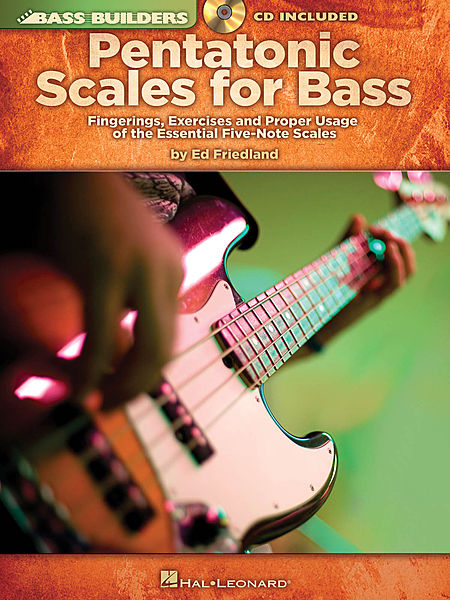
PENTATONIC SCALES FOR BASS, FINGERINGS, EXERCISES FIVE-NOTE SCALES. Ed Friedland. CD TABLATURE

PENTATONIC SCALES FOR BASS, FINGERINGS, EXERCISES AND PROPER USAGE OF THE ESSENTIAL FIVE-NOTE SCALES. Ed Friedland. CD TABLATURE

Ogni scala è mostrata in 3 modi: I posizione, a posizione fissa, in movimento.

Pentatonic Scales for Bass

Fingerings, Exercises and Proper Usage of the Essential Five-Note Scales
Series: Bass Builders
Format: Softcover with CD - TAB
Author: Ed Friedland

The pentatonic is one of the most widely used scales in music. This book teaches fingerings for these essential five-note scales all over the neck, and how to use them to create solid, functional bass lines. The CD contains 56 tracks and features full-band demonstration examples. Covers: major and minor pentatonic scales; one- and two-octave scale patterns; pentatonic modes and their applications; soloing with pentatonic scales; and much more ! 64 pages

By definition, a pentatonic scale is simply a group of five consecutive notes within the
range of an octave. With this loose framework, there can be many variations of five-note

patterns that fit this description. Throughout this book, we will focus on the two most

common variations: the major pentatonic (1-2-3-5-6-S) and minor pentatonic (1-h3-4-

5-~7-S). These pentatonic scales are undoubtedly the most commonly used musical

elements in the world. Cultures as far-flung as Africa, Europe, Asia, the South Pacific,

and the North and South Americas use these five-note patterns as the basis of their

musical traditions, and their influence on contemporary music is just as far-reaching. As

the primary building blocks of the rock and roll musical vocabulary, the pentatonic scale

can be traced directly to West Africa, Ireland, and Scotland. When African captives were

brought to the Western world, they carried with them a deep musical tradition whose

rhythmic basis morphed over time into shuffle and swing feels. Melodically, the minor

pentatonic scale (1-h3-4-5-h7-S) was at the core of their music-eventually evolving into

the blues scale (1-h3-4-#4-5-h7-S), the melodic foundation of the blues. The journey from

the blues to rock and roll has been well-documented.

But the pentatonic scale's influence on popular music can also be traced back to the music of

Ireland and Scotland. As Celtic people settled in the New World, they brought their

songs, reels, jigs, and sea shantys-many of which were based on the pentatonic scale.

This music became the seed of the Appalachian folk tradition, which over the years

evolved into Old Timey, Bluegrass, and Country. Between the late 1940sand 1950s,these

styles crossbred with the emerging "boogie" genre to create rockabilly as well as rock

and roll. When you look at this crosscurrent of influence, the differences between artists

like Muddy Waters and Hank Williams seem less significant.

The pentatonic scale (in its major form) is simply a major scale without scale degrees 4

and 7. The interval created between the 4th and 7th scale degrees is known as the tritone, and it

is the principle source of dissonance in Western music. By removing these two degrees,

we have a scale that is void of any potential dissonance. German composer Carl Orff

(best known as the composer of Carmina Burana) devised a system of music education

for children based on the use of pentatonic scales for this very reason. Since there are no

"bad" notes, children can improvise freely on pentatonic-based instruments to develop

their creativity. It has been said that in medieval times, the use of the tritone in musical composition

was banned due to its disharmonious quality. It is documented that the tritone was once

referred to as Diablo en Musica, or the "Devil in Music," and considering most music of the

time was composed for use in church, it is not hard to see why the pentatonic scale might

have been favored.


Introduction

 Using the CD

 Learning the Pentatonic Scale
 Minor Pentatonic

 Major Pentatonic

 Two-Octave Pentatonic Scales

 Technical Exercises

 Pentatonic Modes
  - Using Pentatonic Modes

 Common Out-of-Scale Chords

 Other Chord Movements

 Soloing with Pentatonic Scales
 - Major 7th Chords
 - Minor 7th Chords
 - Dominant 7th Chords

 In Closing

Prezzo: €20,99
€20,99

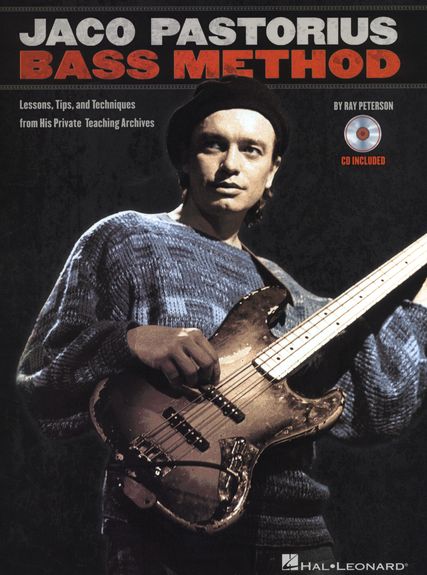
PASTORIUS JACO BASS METHOD BOOK CD TABLATURE SPARTITI BASSO LIBRO METODO FUSION

PASTORIUS JACO, BASS METHOD. SHEET MUSIC BOOK WITH CD & TABLATURE. 

LIBRO METODO DI MUSICA FUSION CON CD. 

SPARTITI PER BASSO CON: 

ACCORDI, PENTAGRAMMA, TABLATURE. 

Jaco Pastorius Bass Method
Lessons, Tips, and Techniques from His Private Teaching Archives
Series: Bass Instruction
Format: Softcover with CD - TAB
Artist: Jaco Pastorius
Author: Ray Peterson

Hailed as the “greatest bass player who ever lived,” Jaco Pastorius (1951-1987) lives on through his groundbreaking legacy of musical brilliance. And now for the first time, one of Jaco's private students imparts the wisdom gained from one-on-one lessons with the bass genius himself. Complete with songs, solos, techniques, theory, and personal experiences with Jaco, this one-of-a-kind book/CD is finally here to give the world what it craves – bass guitar lessons with Jaco Pastorius. We've even included a few scans of actual pages of Jaco's personal practice book – in his own handwriting – for the ultimate personal Jaco experience. The song list includes: Chromatic Fantasy • Continuum • Donna Lee • Havona • Opus Pocus • Portrait of Tracy • Teen Town • and more. The accompanying CD includes audio tracks of all the examples in the book.


Chromatic Fantasy
Come On, Come Over
Continuum
Donna Lee
Havona
I Can Dig It Baby
Kuru
Liberty City
Okonkole Y Trompa
Opus Pocus
Portrait Of Tracy
Teen Town
(Used To Be A) Cha Cha
 

Width: 9.0"
Length: 12.0"
80 pages
 

Prezzo: €26,99
€26,99

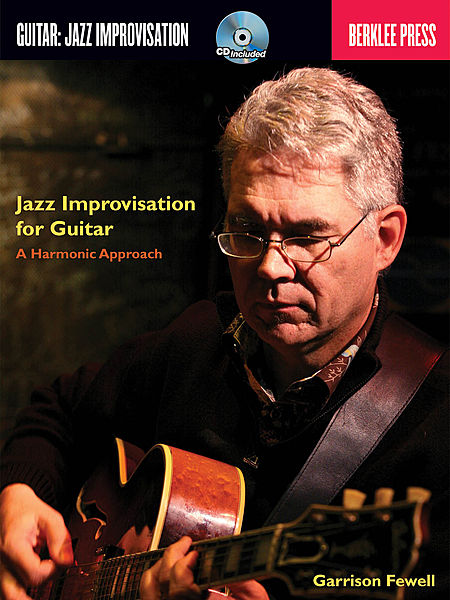
GARRISON FEWELL-JAZZ IMPROVISATION FOR GUITAR A Harmonic Approach CD TABLATURE LIBRO

GARRISON FEWELL, JAZZ IMPROVISATION FOR GUITAR A Harmonic Approach. CD TABLATURE

LIBRO METODO DI MUSICA JAZZ, PER L'IMPROVVISAZIONE.

SPARTITI PER CHITARRA CON:

ACCORDI, PENTAGRAMMA  E TABLATURE. 

Jazz Improvisation for Guitar
A Harmonic Approach
Series: Berklee Guide
Publisher: Berklee Press
Format: Softcover with CD
Author: Garrison Fewell

The purpose of this book is to explore the relationship between jazz harmony and improvisation by studying the vertical structures of chords and their function in a progression, and the horizontal or linear application of harmony to melodic improvisation. Each topic is accompanied by musical examples that are designed to help you hear the connection between harmony and melody and to develop a more melodic and creative way of thinking about improvising over chord progressions.
Width: 9.0"
Length: 12.0"
110 pages


Use jazz harmony to play more intelligent, imaginative, and creative solos. Recognize appropriate note choices and alternatives, whether improvising over easy or complex harmonic progressions. See analysis and melodies created using each concept, "bringing the blackboard to the fretboard." Traditional notation and tab included.

You will learn to:

  • Improvise using a rich harmonic palette, over many types of chord changes
  • Enrich your harmonic context for improvisation using characteristic diatonic substitutions and upper-structure triads
  • Reharmonize melodies using diatonic, hybrid, and polychord voicings
  • Use other non-diatonic chords, such as altered, bII7, and diminished chords
  • Use parallel modes and dominant substitution as sources for new harmonic colors
  • Explore a variety of scale types, including minor scales, symmetrical-diminished scales, and ways of finding new harmonies, such as four-tonic systems
  • Create expressive solos with all these tools, applying these rich harmonic contexts within a framework of traditional counterpoint and compositional practice

Garrison Fewell has taught thousands of guitarists since the 1970s at Berklee College of Music and around the world. He has played on dozens of recordings, both as a leader and with artists such as Herbie Hancock, Slide Hampton, Tal Farlow, Benny Golson, and many others. This book is a companion to his first book, Jazz Improvisation for Guitar: A Melodic Approach (Berklee Press).

"Garrison Fewell has long been a hero to the jazz guitar community. Read this book and you will find out why."

—Jim Hall, Acclaimed Jazz Guitarist, Composer, Arranger

"This book contains the answers to many of the questions I have been getting from my students throughout my 35 years of private teaching. The chapter on Melodic Counterpoint is wonderful and probably the only guitar book I know of that explains counterpoint so concisely."

—Vic Juris, Author, Composer, Guitarist with Dave Liebman, Lee Konitz, Mel Tormé, Gary Peacock

"Jazz Improvisation for Guitar is a must for any jazz guitarist who wants to know the secrets of advanced improvising. Professor Fewell uses his many years of teaching experience (he taught my son Julian when he was at Berklee) plus his prodigious musical talent, to lay out the exact tools for cracking the advanced harmony in modern jazz. I learned some ideas I hadn't thought of from this book, and anyone who takes Garrison's rich and comprehensive journey into the non-diatonic aspect of playing will be well rewarded."

—Larry Coryell, Pioneer Fusion Guitarist, Recorded with Charles Mingus, Gary Burton, Chick Corea, and John McLaughlin

"Very ambitious endeavor by guitarist/author Garrison Fewell. Many topics are included with much care and organized beautifully. This could almost be a dictionary or a thesaurus of musical study. Lots of great examples, and nicely engraved as well. Should be in every musician's library. I for one will do some study here!"

—Jack Wilkins, Author and Guitarist with Chet Baker, Sarah Vaughan, Bob Brookmeyer, Buddy Rich

"For the musician wanting a better understanding of improvisation, this book is a must have. While the main focus of the book is for guitar, it really works for anyone wanting to know more about improvising. Garrison has put together information explaining the harmonic variables that help create interesting improvised solos. The written examples are easy to understand and even have fingering charts to show the best way to execute them. Improvisation is a never-ending study to develop a musical vocabulary to implement your ideas. With the help of this book, you can begin this journey."

—Steve LaSpina, SteepleChase Recording Artist, Composer, Educator, Recorded with Jim Hall, Pat Martino, Stan Getz, Randy Brecker

"This book is a treasure chest of advanced concepts presented in a very accessible and enjoyable way. The "tip" boxes alone could be a go-to for countless hours of repeat practice sessions for players of any level."

—Liberty Ellman, Guitarist, Composer, Pi Recording Artist, Member of Henry Threadgill's ZOOID

Prezzo: €31,99
€31,99

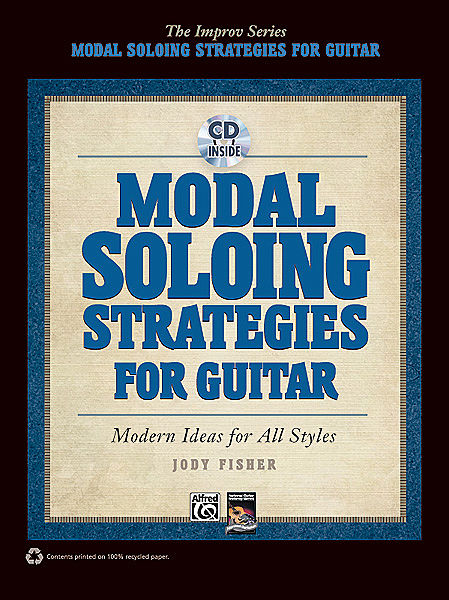
MODAL SOLOING STRATEGIES FOR GUITAR-MODERN IDEAS FOR ALL STYLES-JODY FISHER CD TABLATURE LIBRO

MODAL SOLOING STRATEGIES FOR GUITAR, Modern Ideas for All Styles. BOOK WITH CD & TABLATURE

LIBRO METODO DI MUSICA CON CD. 

SPARTITI PER CHITARRA CON:

ACCORDI, DISEGNO DELLA TASTIERA, PENTAGRAMMA, TABLATURE

SOLISTA, ARMONIA, STUDIO, MANUALE, 

By Jody Fisher
Item: 00-35461
UPC: 038081396576
ISBN 10: 0739071629
ISBN 13: 9780739071625

Series: The Improv Series
Category: Guitar Method or Supplement
Format: Book & CD
Instrument: Guitar

Modal Soloing Strategies for Guitar is a comprehensive, multi-faceted study of the seven major-scale modes. Start applying and understanding the modes through sample licks, extended solos, and play-along tracks. In addition, you'll play each mode in all 12 keys, learn different types of fingerings, and even learn the formula for each mode and its relationship to the diatonic chord. Soon, you'll be harmonizing the modes and deriving them by altering other scales. A CD with play-along tracks and demonstrations of all the examples in the book is included. 

FEATURES
• Each mode of the major scale in all 12 keys, examined from five different perspectives
• Harmonized modes with suggested voicings
• Open, closed, and single-string fingerings
• Licks and play-along tracks for every mode
• Extended solos showcasing the modes in various combinations
• Examples in TAB and standard music notation

ALSO AVAILABLE
Pentatonic Soloing Strategies for Guitar (35302)

The Improv Series
MODAL SOLOING STRATEGIES FOR GUITAR
Modern Ideas for All Styles
JODY FISHER

ISBN-10: 0-7390-7162-9 (Book & CD)
ISBN-13: 978-0-7390-7162-5 (Book & CD)
Alfred Music Publishing Co., Inc.

This book was acquired, edited, and produced by Workshop Arts, Inc., the publishing arm of the National Guitar Workshop.
Nathaniel Gunod, acquisitions, managing editor Burgess Speed, acquisitions, senior editor
Timothy Phelps, interior design Ante Gelo, .music typesetter

CD tracks 1, 4, 7, 10, 13, 16, 19, and 22 recorded by Robert Brown at Workshop
Sounds Studio, Cranford, NJ; tracks 2,3,5,6,11, 12, 14, 15, 17, and 18 recorded at
Studio Blue, Derry Hill, TX; tracks 8 and 9 recorded by Glenn Riley; tracks 20 and 21
recorded by Steve Robertson at Standing Room Only Studios, Fontana, CA

Alfred, the leader in educational publishing,
and the National Guitar Workshop,
one of America's finest guitar schools, have joined
forces to bring you the best, most progressive
educational toolspossible. We hope you will enjoy
this book and encourageyou to lookfor
other fine products from Alfred and the
National Guitar Workshop.

Cares. Contents printed on recycled paper.


INTRODUCTION

Welcome to Modal Soloing Strategies for Guitar, the only book about the modes
you may ever need. This book is for intermediate to advanced guitarists desiring
a thorough understanding of modes and their applications for improvising. For
those unfamiliar with the basics of notation and music theory, there is a review
starting on the next page. If you are already familiar with these basics, you can
skip the review and jump ahead to page 20.
The modes have been in existence for centuries as compositional tools for classical,
folk, and ethnic musicians, as improvisational devices for jazz musicians, and a
source of "new" sounds for rock, pop, and country artists. But, unfortunately,
the subject has been shrouded in mystery, causing many guitar students a lot of
confusion. The confusion may be due to an incomplete overview of the subject.
There are many ways of looking at modes and each one has an important place
in understanding and applying the modes to improvising, composition, or both.
Although modes can be derived from both major and minor scales, this book deals
only with the modes of the major scale. Each chapter is devoted to a particular
mode and will include:
• A notated list of the mode in twelve keys
• Perspective #1: The modal formula, a look at where the half steps occur in
the scale and how it relates horizontally to the fretboard
• Perspective #2: The mode's relationship to the diatonic harmony
• Perspective #3: The mode created by altering another scale
• Perspective #4: The mode's intervallic distance from the "parent" key,
measuring from the root of a chord
• Perspective #5: Deducing a mode's key signature
• Six closed-position fingerings
• Open-position fingerings in every key
• The harmonized mode, with sample chord voicings
• Mode usage
• Practice suggestions
• Licks
• Melodic patterns
• Backing track to practice soloing
Also, sample solos utilizing most of the modes in various combinations have been
included at the end of the book.
One way this book is different from many others is that three fingering options are
covered. The first is the horizontal approach along the single string. The second
is the use of "locked" fingerings or scales that are played in a fixed position. The
third fingering option is the "open" position. When any musical concept is explored
on the guitar, a more complete understanding is accomplished by examining all
three fingering options.
It should be noted here that, while a clear understanding of the modes is important,
it represents only a part of what is needed to become an accomplished improviser.
Modes, in conjunction with other scales, arpeggios, and licks, are only part of the
picture. Improvisation is a lifetime study. Try to keep this in mind.
Each chapter of this book is complete so it's all right to skip around. You can also
move straight through from beginning to end for a very comprehensive study. To
get the most out of this book, you need to transpose all exercises and fingerings in
all twelve keys. At first this may seem like a hassle, but in time it will get easier
and payoff in the form of greater fluency.
 

ABOUT THE AUTHOR
Jody Fisher has worked professionally in virtually all
styles of music during his career, from straight-ahead
and contemporary jazz to rock 'n' roll, country, and
pop. For several years, he was a director of the National
Guitar Workshop. He also taught guitar and jazz studies
at both the University of Redlands and Idyllwild School
of Music and the Arts (ISOMA TA). He is an active
performer in the Southern California area, where he
maintains a busy private teaching practice as well.

Acknowledgements
One does not survive in the music business without
help and support from a large network of family and
friends. I would like to thank my wife, Julie; my son,
Josh; Shauna Perry; and my parents, Howard and Edith
Fisher. Also, thanks to my brother, Rich; my uncle, Sid;
David Smolover, Nat Gunod, Ted Greene, Joe Diorio,
George Stanley, Bob Scarano; and the entire gang at
Caleb's Guitar.

Other Instructional Materials by Jody Fisher
3D-Day Guitar Workout (AlfredlNational Guitar Workshop-Book #17867)
Ear Trainingfor the Contemporary Guitarist (AlfredlNational Guitar Workshop-Book & CD #19370)
Jazz Skills (National Guitar Workshop-Book & CD #07-1012)
Rhythm Guitar Encyclopedia (AlfredlNational Guitar Workshop-Book & 2 CDs #14838)
Stand Alone Tracks: Smooth Jazz (AlfredlNational Guitar Workshop-Book & CD #17808)
The Complete Jazz Method:
Beginning Jazz Guitar (AlfredlNational Guitar Workshop-Book & CD #14120)
Intermediate Jazz Guitar (AlfredlNational Guitar Workshop-Book & CD #14123)
Mastering Jazz Guitar: Chord/Melody (AlfredlNational Guitar Workshop-Book & CD #14126)
Mastering Jazz Guitar: Improvisation (AlfredlNational Guitar Workshop-Book & CD #14129)
Jazz Guitar Harmony (AlfredlNational Guitar Workshop-Book & CD #20440)
Teaching Guitar (AlfredlNational Guitar Workshop-Book & CD #22916)
Jazz Licks Encyclopedia (AlfredlNational Guitar Workshop-Book & CD #19420)

A compact disc is included with this book. Use the CD to help ensure you're capturing the feel
of the examples and interpreting the rhythms correctly. The symbol shown at the left appears
next to every example that is on the CD. The track number below the symbol corresponds
directly to the example you want to hear. Track 1 provides tuning notes for your guitar.
0001 Soloing Strategies for Guitar


CONTENTS
About the Author
Introduction
otation and Theory Review 5
Tablature (TAB)
Scale Diagrams
Chord Diagrams
Reading Roman Numerals
Left-Hand Techniques
The Chromatic Scale
The Major Scale
Key Signatures
Intervals
Minor Scales

The Ionian Mode
In Every Key on Single Strings
Perspective #1: Finding the Half Steps
Perspective #2: Thinking in a Parent Key
Perspective #3: Altering a Scale
Perspective #4: In Relation to a Chord's Root...
Perspective #5: Adjusting Key Signatures
Fingerings: The Mode in Six Closed Positions
Open Position Fingerings: In Every Key
Harmonizing the Mode: Chord Voicings
Using the Mode: Improvisation
Melodic Patterns: For Practice
C Ionian Backing Track

The Dorian Mode
In Every Key on Single Strings
Perspective #1: Finding the Half Steps
Perspective #2: Thinking in a Parent Key
Perspective #3: Altering a Scale
Perspective #4: In Relation to a Chord's Root...
Perspective #5: Adjusting Key Signatures
Fingerings: The Mode in Six Closed Positions
Open Position Fingerings: In Every Key
Harmonizing the Mode: Chord Voicings
Using the Mode: Improvisation
Melodic Patterns: For Practice
D Dorian Backing Track

The Phrygian Mode
In Every Key on Single Strings
Perspective #1: Finding the Half Steps
Perspective #2: Thinking in a Parent Key
Perspective #3: Altering a Scale .
Perspective #4: In Relation to a Chord's Root...
Perspective #5: Adjusting Key Signatures .
Fingerings: The Mode in Six Closed Positions .
Open Position Fingerings: In Every Key .
Harmonizing the Mode: Chord Voicings ; .
Using the Mode: Improvisation .
Melodic Patterns: For Practice .
E Phrygian Backing Track .

The Lydian Mode .
In Every Key on Single Strings .
Perspective #1: Finding the Half Steps .
Perspective #2: Thinking in a Parent Key .
Perspective #3: Altering a Scale .
Perspective #4: In Relation to a Chord's Root... .
Perspective #5: Adjusting Key Signatures .
Fingerings: The Mode in Six Closed Positions .
Open Position Fingerings: In Every Key .
Harmonizing the Mode: Chord Voicings .
Using the Mode: Improvisation .
Melodic Patterns: For Practice .
F Lydian Backing Track .

The Mixolydian Mode .
In Every Key on Single Strings .
Perspective #1: Finding the Half Steps .
Perspective #2: Thinking in a Parent Key .
Perspective #3: Altering a Scale ,
Perspective #4: In Relation to a Chord's Root... .
Perspective #5: Adjusting Key Signatures .
Fingerings: The Mode in Six Closed Positions .
Open Position Fingerings: In Every Key .
Harmonizing the Mode: Chord Voicings .
Using the Mode: Improvisation .
Melodic Patterns: For Practice .
G Mixolydian Backing Track .

The Aeolian Mode .
In Every Key on Single Strings .
Perspective #1: Finding the Half Steps .
Perspective #2: Thinking in a Parent Key .
Perspective #3: Altering a Scale .
Perspective #4: In Relation to a Chord's Root... .
Perspective #5: Adjusting Key Signatures .
Fingerings: The Mode in Six Closed Positions .
Open Position fingerings: in every Key .
Harmonizing the Mode: Chord Voicings .
Using the Mode: Improvisation .
Melodic Patterns: For Practice .
A Aeolian Backing Track .

The Locrian Mode .
In Every Key on Single Strings .
Perspective #1: Finding the Half Steps .
Perspective #2: Thinking in a Parent Key .
Perspective #3: Altering a Scale .
Perspective #4: In Relation to a Chord's Root... .
Perspective #5: Adjusting Key Signatures .
Fingerings: The Mode in Six Closed Positions .
Open Position Fingerings: In Every Key .
Harmonizing the Mode: Chord Voicings .
Using the Mode: Improvisation .
Melodic Patterns: For Practice .
B Locrian Backing Track .

Concluding Solos .
Ionian/Dorian .
Ionian/Dorian/Phrygian .
Lydian/Dorian .
Mixolydian .
Aeolian/Mixolydian .
Locrian/Mixolydian/ Aeolian .

Modal Soloing Strategies for Guitar 


NOTATION AND THEORY REVIEW

Tablature (TAB)
Tablature (TAB) is a system of notation that graphically represents the strings and frets of the guitar fingerboard. Each note is indicated by placing a number, which indicates the fret to play, on the appropriate string.

Scale Diagrams
This book is loaded with scale diagrams. The top line represents the first string of the guitar, and the bottom line the sixth. The vertical lines represent frets, which are numbered with Roman numerals.

The root Scale tones First string
Frets Fret numbers

Chord Diagrams
Chord diagrams are similar to scale diagrams, except they are oriented vertically instead of horizontally. Vertical lines represent strings, and horizontal lines represent frets. Roman numerals are used to number the frets.

Chord Name First String -C7
Barre + Fret number
Frets Sixth String

Reading Roman Numerals
Roman Numeral Review
Here is a review of Roman numerals and their Arabic equivalents.
I or 1
II or 2
III or 3
IV or 4
V or 5
VI or 6
VII or 7

Left-Hand Techniques
SL= Slide
H = Hammer-on
P= Pull-off
Bend and Release
Whole-Step Bend
Half-Step Bend
Left-hand fingering
 

Prezzo: €27,99
€27,99

25 GREAT CLASSIC ROCK GUITAR SOLOS-Dave Rubin-Santana-Gilmour-May LIBRO CD TABLATURE

25 GREAT CLASSIC ROCK GUITAR SOLOS. Dave Rubin. BOOK WITH CD & TABLATURE

LIBRO METODO DI MUSICA ROCK, CON CD. 

SPARTITI PER CHITARRA CON: 

ACCORDI, PENTAGRAMMA E TABLATURE. 

Featuring legends of lead guitar, including Jimmy Page, Eric Clapton, Eddie Van Halen, Jeff Beck, Carlos Santana, Duane Allman, Tony Iommi, David Gilmour, and many mire.

Transcriptions · Lessons · Bios · Photos
Series: Guitar Book
Format: Softcover with CD - TAB
Author : Dave Rubin

From Eric Clapton and George Harrison to Brian May and Eddie Van Halen, take an inside look at the genesis of classic rock guitar. This book/CD pack provides solo transcriptions in standard notation and tab, lessons on how to play them, guitarist bios, equipment, photos, history, and much more. The accompanying CD contains full-band demonstrations of every guitar solo in the book. It's playable on any CD player, and is also enhanced so Mac and PC users can adjust the recording to any tempo without changing the pitch! Songs include: Louie, Louie - Mississippi Queen - Money - Paranoid - Radar Love - Reeling in the Years - Smoke on the Water - Sweet Home Alabama - Tush - We Will Rock You - White Room , and more.

Rock guitar solos have evolved significantly over time. In the "stone age" of the fifties, they often served merely as an "instrumental break" from the vocals; by the "stoned age" of the sixties, however, they sometimes seemed the whole point of the exercise. Even back then, however, the difference was always in the songs with the closest lineage to the blues. Beginning with Chuck Berry and the raucous, howling highway sound of his grinding solo on "Maybellene" in 1955, a freedom to improvise and express joy, anger, lust, menace, or just sheer rebellion for the hell of it became the province of those players willing to test their mettle (metal?) and chops. It's a fairly straight shot from Chuck to the Kingsmen in the Northwest in the early sixties and their primal, iconic garage rock version of "Louie Louie" (1963) featuring lead guitarist Mike Mitchell. In England, Jeff Beck was helping to create psychedelic music in the Yardbirds by filtering the blues through Les Paul and rockabilly music, and his wildly creative chops produced the swinging and humorous "Jeff's Boogie" in 1966. His predecessor in the 'birds, Eric Clapton, would advance the cause of heavy blues rock in Cream during the late sixties with dramatic blues rock like the monolithic "White Room" in 1968. A year later in the U.S., a band from northern California led by the exceptionally talented singer/songwriter/guitarist John Fogerty combined country blues with country, folk, and rockabilly music to create a dazzling string of hit singles. "Born on the Bayou," the flips ide of the future wedding band staple "Proud Mary," captured a Southern ambience not present in British blues rock. Also in 1969, Mexico-born Carlos Santana in the San Francisco area found yet another way to combine the blues with a new genre in the celebratory Latin rock of "Soul Sacrifice" that he had performed that summer at the landmark Woodstock festival in upstate New York. John Lennon likely thought himself the "bluesiest" of the Beatles, that most eclectic and imaginative of sixties bands, but George Harrison and Paul McCartney joined him in trading funky blues rock solos during their crunching jam on 'The End" in 1969 that actually marked the "end" for the Beatles with Abbey Road. Led Zeppelin, their polar opposites led by the brilliant tone king Jimmy Page, gave a nod to a passel of blues classics with their original composition "The Lemon Song" on their second release in 1969. That same watershed year, an authentic American blues group from the South, the Allman Brothers Band featuring Duane Allman and Dicky Betts, included the ultimate encore tune of "Whipping Post" on their debut album. The seventies started off showing no let up in creativity regarding blues influenced rock. Mountain, with the physically "mountainous" lead guitarist Leslie West, paid props to the "Mississippi Queen" in 1970. Across the "big pond," heavy metal avatars Black Sabbath with guitarist Tony Iommi were feeling rather "Paranoid" in 1971, while Deep Purple with the "Dark Knight" Richie Blackmore smoldered with "Smoke on the Water" in 1972. At the same time stateside, the jazz-bopping Steely Dan, with a rotating cast of top session guitarists, recorded the fast shuffling "Reeling in the Years" with studio cat Elliot Randall spinning fluid lines. David Gilmour and the second incarnation of Pink Floyd used "Money" in 1973 to make a major musical statement in England, while the pride of Ohio,

Song List:

YEAR - TITOLO - CHITARRISTA - BAND - ALBUM

1977 - Black Betty - Bill Bartlett - RAM JAM - Ram Jam
1969 - Born On The Bayou - John Fogerty - CREEDENCE CLEARWATER REVIVAL - Bayou Country
1969 - The End - Paul McCartney, George Harrison, John Lennon - The BEATLES - Abbey Road
1966 - Jeff's Boogie - Jeff Beck - YARDBIRDS - Over under sideways Down  
1969 - The Lemon Song - Jimmy Page - LED ZEPPELIN II
1977 - Lights Out - Michael Schenker - UFO - lights out 
1976 - Long Time - Tom Scholz - BOSTON - Long time
1963 - Louie, Louie - Mike Mitchell - The KINGSMEN - The Kingsmen in person
1970 - Mississippi Queen - Leslie West - MOUNTAIN - Climbing!
1973 - Money - David Gilmour - PINK FLOYD - dark side of the moon
1971 - Paranoid - Tony Iommi - BLACK SABBATH - Paranoid
1973 - Radar Love - George Kooymans - GOLDEN EARRING - Moontan
1972 - Reeling In The Years - Elliot Randall - STEELY DAN - Can't buy a thrill
1973 - Rock And Roll Hoochie Koo - Rick Derringer - all american boy
1973 - Rocky Mountain Way - Joe Walsh - the smoker you drink, the player you get
1972 - Smoke On The Water - Ritchie Blackmore - DEEP PURPLE - Machine Head 
1980 - Snortin' Whiskey - Pat Travers e Pat Thrall - PAT TRAVERS BAND - crash and burn
1969 - Soul Sacrifice - Carlos Santana - SANTANA 
1974 - Sweet Home Alabama - Ed King - LYNYRD SKYNYRD - Second helping
1974 - Train Kept A-Rollin' - Steve "the deacon" Hunter - AEROSMITH - Get your wings
1975 - Tush - Billy Gibbons - ZZ TOP - Fandango
1977 - We Will Rock You - QUEEN - news of the world
1969 - Whipping Post - Duane Allman - The ALLMAN BROTHERS BAND 
1968 - White Room - Eric Clapton - CREAM - Wheels of fire
1978 - You Really Got Me - Eddie Van Halen - VAN HALEN - Van Halen

106 pagine

Prezzo: €26,99
€26,99

ROLLING STONES ULTIMATE BASS PLAY-ALONG BOOK & CD BASS TABLATURE

ROLLING STONES, ULTIMATE BASS PLAY-ALONG. SHEET MUSIC BOOK with CD & BASS TABLATURE .

Series: Ultimate Play-Along
Category: Bass Guitar Method or Supplement
Format: Book & CD
Instrument: Bass Guitar
Version: Authentic Bass TAB

Eight classic Stones songs with full bass TAB. The CD contains a complete version and a play-along version (without bass) of each song. Embedded software allows you to slow down, loop, and even transpose keys on your computer. Matching guitar and drum editions are available! Titles:


TITLE COMPOSER
Jumpin' Jack Flash Mick Jagger (composer); Keith Richards (composer)
Let It Bleed Mick Jagger (composer); Keith Richards (composer)
Gimme Shelter Mick Jagger (composer); Keith Richards (composer)
Honky Tonk Women Mick Jagger (composer); Keith Richards (composer)
You Can't Always Get What You Want Mick Jagger (composer); Keith Richards (composer)
Paint It, Black Mick Jagger (composer); Keith Richards (composer)
(I Can't Get No) Satisfaction Mick Jagger (composer); Keith Richards (composer)
Brown Sugar Mick Jagger (composer); Keith Richards (composer)
Prezzo: €29,99
€29,99

RENAISSANCE MUSIC FOR GUITAR VOL.2 Ancient Music Ireland Scotland Allan Alexander CD TABLATURE

RENAISSANCE MUSIC FOR GUITAR VOL.II, Including Ancient Music from Ireland and Scotland. Allan Alexander. SHEET MUSIC BOOK WITH CD & GUITAR TABLATURE.

LIBRO DI MUSICA RINASCIMENTALE CON CD. 

SPARTITI PER CHITARRA CON: 

PENTAGRAMMA E TABLATURE. 


Renaissance Music for Guitar Vol II
contains 32 pieces
Cantiga - Anon/Allan There are over 400 of these songs written in praise of Mary in a book put together by king Alphonso X of Castile. This is a perfect example of a tune that sounds more complex than it is. The open basses make it easier.

Almain - Richard Allison/Allan The music notes from this piece are straight from the tablature. I have not changed a thing. Even though the lute is tuned slightly differently, this piece translates very well. Of course the lute is tuned a minor third higher than the guitar, so if you really want to hear this piece, or any in the book, at the right pitch, simply put a capo on the third fret of the guitar.

Come With Me My Giselle - Adam de la Halle/Allan I love this little troubadour song so much that I wrote a variation for it. This piece was written back in the 13th century. It's really wonderful to bring music like this alive again. Just think, people seven hundred years ago heard this melody.

Douce Dame Jolie - Guillaume de Machaut/Allan The syncopation will be the first thing you will notice in this dance. It may take a little time to get the feel of it, but then it's a lot of fun to play. The variations that I wrote for it maintain the syncopation and make the piece a better length for performance.

Benjamin's Song - Allan I am amazed at this little tune; I keep expecting to get tired of it, but I keep having fun with it. It's not too hard to play, and it also gives a nice introduction into playing in higher positions if you are learning them now. If you are an intermediate player, this tune should be easy.

The Gypsy's Lilt - Anon/Allan Music from the Renaissance can be quite surprising. This tune is note for note from a Scottish lute book. The dissonance in the piece is slightly disturbing at first, but then, once it becomes familiar, it's very appealing. There is no doubt of the notes, as there are two versions in the book, and they both have the dissonance. It's a beautiful and melancholy piece.

Cast a Bell - Playford/Allan This piece is from "The Dancing Master" by John Playford - at least the first eight measures are. The rest of the measures are filled with variations that I wrote for the tune. It's an appealing melody. The Playford books were published slightly later than the Renaissance, but many of the pieces in them are melodies that date back to the 16th century and earlier.

Blind Mary - Turlough Carolan/Allan Turlough Carolan also lived in the Baroque period (when the Playford books were published), and perhaps he heard many of the dances in that book. Many of his tunes sound like they were written in the Renaissance, and I thought it would be fun to include this moving piece.

Indescribable Beauty - Anon/Allan This is a very beautiful piece from an Italian manuscript. The actual manuscript was lost, but Oscar Chilesotti transcribed the tablature into notation and put the pieces into a collection, which saved them. Other versions of this particular piece do exist for the lute.

Lady Cassille's Lilt - Skene/Allan The Skene Manuscript is a huge source of early music from Scotland. It contains music for both lute and mandora. This is a lovely, haunting piece. I wrote the variation for the second half. It should be accessible to beginners.

The English Hunts Up - Thomas Whitfield/Allan This lively little tune is a great addition to any repertoire. It has some nice syncopations. I don't remember hearing any other piece from the Renaissance that sounds quite like this one.

Ich Klag den Tag - Hans Neusidler/Allan This is a fairly easy, but powerful tune. It has a simplicity that can be found in many Renaissance tunes, and at the same time, it has some very nice surprises in the phrasing. This piece stands up very well in a concert or a recording.

Italiana - Anon/Allan This is another tune found in the Chilesotti book. It's easy in the sense that most of the basses are open, but it goes rather quickly, so it does take some time to learn. Because the basses repeat all through the piece, you want to make sure not to play them too loudly. If you do, they could become annoying to a listener.

Kalenda Maya - Raimbaut de Vaqueiras/Allan The "Calends of May" is the first of May, or May Day. In Medieval times it was a favorite holiday, filled with flowers, ribbons, and dancing. In Raimbaut's poem "Kalenda Maya" he tells us that none of the beauty of May Day can move him until the lady he loves looks on him also with love. - This description thanks to Jessica

The Maid's in Constrite - Anon/Allan It was a common practice to do variations on melodies in the Renaissance, but in many of the lute pieces, the variations no longer exist. In this case, someone wrote some of them down. The first eight measures are the piece, and the rest of them are the variations.

Out in the Meadowe - Anon/Allan I love this tune and have done a few different versions of it. I like this one the best; it's haunting, and the variation gives another dimension to it. It really has an aura all its own. This music has a very ancient feeling.

Guardame las Vacas - Luys de Naravaez/Allan I tend to look for material that has not been published to use for my books, but sometimes there are tunes that are just so good that I want to include them. I used a well-known Mudarra Fantasia with some reluctance in the first Renaissance book, and did get some feedback on it which really made me glad that I did. The person had heard it before, and may have had the music, but he was used to hearing it played quickly. He found the slower version that I play to be much more to his liking, and the tune then also became playable for him. Guardame las Vacas is just a great tune. There is nothing else quite like it in the Renaissance. The title means "Guard My Cows."

Medieval Dance - Thomas Arbeau/Allan This piece works well when coupled with the Medieval Dance in the first "Renaissance Music for Guitar" book available from ADG. It can stand on its own though, and the variations are fun and a good way to get used to playing some of the notes in higher positions.

Medieval Song No. 1 - Colin Muset/Allan This song has a very nice feel to it. The melody is so simple that it is easy to overlook how wonderful this piece is. To think that the melody is from the 13th century and has lasted this long makes me dizzy.

Villancico - Luys Milan/Allan Many people know the pavans or perhaps the fantasias that Milan wrote. This piece is less familiar, and I have not seen it in a book for guitar. It's short but has a sound all its own.

Tarleton's Resurrection - John Dowland/Allan Dowland was probably the most prolific composer for the lute in the Renaissance. In addition to all of his solos, he wrote many collections of songs for lute and voice. Much of his music was published in the Renaissance. He traveled extensively and was well known as both a composer and performer.

Medieval Song No. 2 - Edi beo Thu Hevene Quene - Anon/Allan The gentle rocking of this melody reminds me of night. The title means, "Blessed be You, Queen of Heaven," and the rest of the words are dreamy. My favorite line is, "My Lady, bring us to your bower". - This description thanks to Jessica

Allemande - Hermann Schein/Allan I love the music of Hermann Schein. The things I have seen have been for an ensemble of five melody instruments. I found this tune so attractive that I had to make arrangements of it for both guitar and lute. The second section is a variation that I wrote for it. When you have a chance, go to the early music section of a large record store and see if you can find some recordings with his music. You won't be disappointed.

Medieval Song No. 3 - Allan Often I will write something because there is a particular type of piece that I really like the sound of, and I can't find another. The other two Medieval Songs on this CD were very appealing to me, and that was the inspiration for writing this piece. I wrote it for my lovely wife. Again, I was looking for the Magic. Because I wrote this tune on the lute, it is much easier to play with the third string of the guitar tuned down to the F#. If it's difficult to read the notation, please just make the adjustment in tuning and read the tablature.

Untitled - Anon/Allan Only the first twelve measures in this tune are the original; the rest are filled with variations that I wrote. I hear this as a melancholy tune, and I find the entire piece and the variations very dreamy. Of course there are no tempo markings on any of the old lute pieces, and the way they are played is entirely up to the performer.

My Heart is Entrusted to You - Orlando de Lasso/Allan It is surprising to me that a tune with a sound like this is from the Renaissance, but then that is what I like about that period. It continually surprises me. This is a very sweet piece and not too difficult to play for an intermediate player.

Song of the Ass - Anon/Allan/Jessica This tune has changed a bit since Medieval times. It is now usually played in a 3/4 meter. I am playing the old version, in 4/4, but the notes are the same. You may know it as "The Friendly Beasts". I prefer it this way - This description thanks to Jessica

A Winter's Ronde - Allan Many of these pieces started out as lute solos, and this one is no different. I did write it, but it was written on the lute. It is special to me, because it's the first piece with this particular sound that I created. This was the piece that gave birth to other pieces, such as "The Ronde for Spring" and "The Child's Ronde."

Passo Mezzo di Diomedes - Diomedes/Allan This literally means Passo Mezzo by Diomedes. He wrote many pieces for the lute. Often, there will be several versions of a piece that have survived. This one was from a collection by Chilesotti.

Pavane - Allan The rhythm is the trickiest part of this because it's quite syncopated. But other than that, it should be playable by a beginner. It doesn't go too quickly, and I find it enjoyable to play.

Alman - Robert Johnson/Allan Robert Johnson was a well-known lutenist in the Renaissance. He was not nearly as prolific as John Dowland, but he did write some beautiful pieces. This is not too hard to play, and with it you can make sweet music.

The Wildflower - Allan This is the last piece that I wrote in 1999, and I wrote it for my musical partner and friend Jessica Walsh. She liked it right from the beginning and encouraged me to complete it. This is one of those magical pieces for me that I just can't stop playing. I don't know where it came from. I just know that I waited and waited, and then the piece mostly just wrote itself, nudging me where it wanted to go.

Presented in both Tablature and Music Notation
The music is presented in both music notation and guitar TAB (for people that do not read music). The music notation is clear and crisp. It contains complete clear fingerings for the guitar. These will help you to learn the tunes quickly whether you depend on the tablature or the music.

Comes With a Compact Disc of the Pieces Performed by Allan Alexander
The CD, played by Allan Alexander, gives the musician the advantage of being able to hear how these songs can be played and will make the learning process easier. This is a high quality Digital recording (DDD). In addition to helping the player become familiar with the music, it will also be a source of listening pleasure. The CD is almost 70 minutes in length.

A High Quality Collection of Music The Renaissance and Medieval Times including Ancient Music from Ireland and Scotland.
It took me a long time to figure it out... exactly what it was in music that attracted me. It appeared to have nothing to do with the complexity, the tempo, the period or the country of origin. There was an indefinable essence that made me want to come back and play it or hear it again. These were the tunes that I would play until my hand was sore, these were the tracks on an album that I would play over and over again and then go searching for the music so I could play it too. There were certain periods that attracted me more than others, and I found the music of some countries very appealing... but then something would come out of the blue and blow me away. The piece was simple and fit none of my accumulated criteria, but it was great. And that is when I figured it out. It was magic. That's what was in the music that I loved. I started to look for it. It didn't matter if the music was easy or difficult, complex or simple, as long as it had the magic. The Renaissance was a very good source. I remember seeing Julian Bream in concert and hearing his recordings. I was stunned to find how simple some of the beautiful lute pieces were.

In Renaissance music I found many dances, fantasias, and songs that had the magic. The majority of them were easier than most of the guitar pieces I was familiar with. Maybe that is because, in the Renaissance, the people who played the instruments wrote the tunes for them... or maybe it was because they were just looking for the magic too. In any event, it's interesting that you rarely find a lute piece that was not written by a lutenist.

Sometimes I would have periods when I couldn't find a tune... then I would try and write one. Every once in a while, I felt I nailed it. Then I suddenly would have another piece that I could play over and over again. It never occurred to me that others would like my pieces too, but I discovered that they did... and eventually I figured out a simple but telling "Magic Test" for a tune. If I have to ask myself if the magic is there... it's not.

The last tune in this book is a free bonus; it's not "Renaissance", but it's loaded with magic. It's one of mine, and I really love it. It's a little more difficult than most of the tunes in this book, but it lays well on the fingerboard.

There are 65 minutes of music on the CD and 32 pieces in the book. This book is perfect to take on gigs or just to play for yourself. The music is great. The CD will give you insights into the music, and it will be enjoyable to listen to on its own merit.

Prezzo: €40,95
€40,95
Condividi contenuti