LIBRO CON CD

DOBRO WORKBOOK DAVID HAMBURGER techniques lap-style resophonic slide guitar CD TABLATURE

the DOBRO WORKBOOK, DAVID HAMBURGER. 98 Esempi per lap-style, slide, fotografie di tecnica. CD TABLATURE

Tutti gli esempi di questo libro sono suonati in accordatura SOL: SOL - SI - RE - SOL - SI - RE 

LIBRO METODO MUSICA CON CD. 


Teaches licks, techniques and improvisation for lap-style resophonic slide guitar. Covers: scales, licks, songs and examples; hammer-ons, pull-offs, slides, picking techniques; syncopations, rolls, double stops, playing in different keys; and more. The book is in standard notation and tab, and the CD features 98 full-demo tracks. 80 pages.  

The Technical Lowdown and a Note about the Recording All of the examples on the accompanying CD were played by the author using a 1996 Dobro Model 27DX strung with John Pearse phosphor bronze resophonic guitar strings (.016-.059) and played with National metal fingerpicks, a National metal thumbpick, and a Shubb bar. The short examples are played slowly, accompanied by a click track for reference. The longer examples are played up to tempo with a rhythm section. On the longer examples, you can use the balance control on your stereo to pan hard right, to hear just the example itself, or hard left, in order to play along with the rhythm track. +All of the examples in this book are to be played in the standard High G tuning, G-B-D-G-B-D, low to high. The first track on the CD provides a series of notes to which you can tune up.

Unless someone mistakenly gave you this book for your birthday instead of bringing a dozen roses or sending you to Nazareth, Pennsylvania on an all-expenses-paid tour of, oh, I don't know, some guitar factory, you're probably reading this right now because you want to improve your lap-style resophonic slide playing. Have you come to the right place? Well, let's start with what I can't show you. I can't teach you patience and determination, two relatively important ingredients in the sometimes difficult but generally enjoyable journey towards becoming a better musician. And inspiration-that impulse to take a weird left turn in your break, or to put two and two together and come up with thirtyseven- well, you're on your own in that regard, too. I can't even really show you some of the more tangible things like how to learn off of records or how to make discoveries by observing another musician perform or play at a jam. I might suggest ways to go about that, but I can't get inside your head to show you how that part of the learning process feels. Finally, I won't be showing you anyone's note-far-note solos, because I happen not to have the publishing rights to anything like that just lying around. But that's OK, because there are other places you can get that sort of thing. So what can I show you? Well, I can show you some notes. To be more specific, I can show you which notes you might play, how you might play them, and when you might play which ones. Put another way, I can show you various materials, techniques, and concepts. Materials are more or less the facts of music-the scales musicians choose from, the tunes they play on. From these bedrock materials come more subjective, creative things like phrases, licks, and breaks. Techniques are essentially the mechanics of playing a particular instrument. How to execute slides, rolls, hammer-ons and pull-offs, melodic style patterns, right-hand fingerings, and bar moves-these are all technical concerns. You, yourself, have to ultimately train your hands to respond the way you want them to, to create the sounds you seek, but I can give you particular things to practice that will help you focus your brain and your muscles on one thing at a time. Finally, concepts are just that-ideas about music. You need to know what you're trying to do in order to work on it and get better at it. A concept can be very specific, like using call-and-response phrasing to create a break, or using syncopation to create a new roll. Or it can be something more general, like an approach to practicing more effectively. The book is based on the demands of playing bluegrass-you can play any kind of music on the resophonic slide guitar, and I hope you take some of the ideas here and use them towards your own musical ends, bluegrass or otherwise, but bluegrass happens to be both technically demanding and possessed of a rich history of lap-style playing, which makes it a good point of departure for anyone interested in playing this instrument. I have tried to provide material that will work "in the real world," i.e., things that you could actually incorporate into your playing and really use. So while this is not a book of tunes per se, I have included arrangements of a handful of tunes from the the bluegrass repertoire, and many of the exercises are essentially sample breaks on those tunes. Some of the other exercises are really more like studies, designed to show you an idea, illuminate a concept, or give you a real workout executing a particular kind of move or pattern. These exercises are the musical equivalent of swinging two baseball bats while on deck before stepping up to the plate with just one-if you can get comfortable with a particularly difficult, demanding passage while practicing, the simpler things will come that much easier when you're on stage or in an impromptu jam. Each chapter builds upon what has come before, technically and conceptually, as it introduces the next round of material. While I have tried to keep the theory to the necessary minimum, it will help if you have a basic understanding of major, minor, and blues scales as well as of major and minor chords. 

Table of Contents :

Introduction .

A Word about "the Dobro" .

Some Essentials for Playing Lap-Style Resophonic Slide Guitar .

Holding the resophonic guitar

The bar

picks

capos

strings


Chapter 1 Basic Techniques in Open Position-Hammer-Ons, Pull-Offs, Slides, and Picking

The G Major Scale;

Hammer-Ons;

Pull-Offs;

Blues Notes in G;

Combining Major and Blues Sounds;

Combining Hammer-Ons and Pull-Offs;

Slides 


Chapter 2 Building Licks and Starting to Improvise

Creating Your Own Vocabulary;

Four-Note Units;

Combining Units to Create Licks;

Unison Slides;

Double Stops;

Call and Response;

"New River Train";

A la "Nine Pound Hammer" .


Chapter 3 Syncopations and Rolls

Syncopated Rolls in G;

Syncopated Rolls over C;

Syncopated Licks in the Closed Position;

"Gowanus Valley Blues #2";

Playing over C in Open Position;

"Bill Cheatham"


Chapter 4 The Melodic Style

G Scales, Melodic Style;

From Open Position to Melodic Style and Back;

Creating Licks in the Melodic Style;

"Sally Goodin"


Chapter 5 Playing over C and F

C Scales and Licks;

Applications;

"Bill Cheatham" Revisited;

F Scales and Licks;

Applications;

"Red-Haired Boy"


Chapter 6 Playing in the Key of D, Open Position

D Scales;

Four-Note Units;

Combining Units to Create Licks;

Applications;

"New River Train";

Syncopations in D;

Double Stops in D;

"Reuben"


Chapter 7 Playing in D, Melodic Style

D Scales and Licks;

"Reuben" Revisited;

"Little Maggie";

Playing over A (in D);

"Soldier's Joy";

"Whiskey Before Breakfast"


Chapter 8 A and E

A Minor Scales and Licks;

A Major Scales and Licks;

"Old Joe Clark";

E Minor Scales and Licks;

E Major Scales and Licks;

"Salty Dog" .

Appendix-Finding the Notes on the Fingerboard .


Afterword.

Prezzo: €22,99
€22,99

ELECTRIC SLIDE GUITAR KEITH WAYTT BOOK WITH CD TABLATURE SPARTITI METODO CHITARR

ELECTRIC SLIDE GUITAR, Keith Waytt. CD TABLATURE.

LIBRO METODO DI MUSICA BLUES ROCK, CON CD.

SPARTITI PER CHITARRA CON: 

ACCORDI, PENTAGRAMMA, TABLATURE. 

Beyond Basics: Electric Slide Guitar
By Keith Wyatt
SERIES: Beyond Basics
CATEGORY: Guitar Method or Supplement
FORMAT: Book & CD
Topics covered include choosing the right slide, open "blues" tunings, stylistic licks and patterns, standard tuning techniques and more. The book contains a full-color photo section showing all types of slides, and it includes 32 music examples in standard notation and tablature.

Prezzo: €16,99
€16,99

ELECTRIC SLIDE GUITAR David Hamburger LIBRO CD TABLATURE TUNINGS-Ry Cooder-MUDDY WATERS-ELMORE JAMES

ELECTRIC SLIDE GUITAR. Hamburger.

LIBRO DI MUSICA PER CHITARRA SLIDE CON CD E TABLATURE

This book/audio method explores the basic fundamentals of slide guitar: from selecting a slide and proper setup of the guitar, to open and standard tuning. Plenty of music examples are presented showing sample licks as well as backup/rhythm slide work. Each section also examines techniques and solos in the style of the best slide guitarists, including Duane Allman, Dave Hole, Ry Cooder, Bonnie Raitt, Muddy Waters, Johnny Winter and Elmore James. CD TABLATURE

Series: Guitar Educational
Softcover with CD - TAB
Author: David Hamburger

This book/audio method explores the basic fundamentals of slide guitar: from selecting a slide and proper setup of the guitar, to open and standard tuning. Plenty of music examples are presented showing sample licks as well as backup/rhythm slide work. Each section also examines techniques and solos in the style of the best slide guitarists, including Duane Allman, Dave Hole, Ry Cooder, Bonnie Raitt, Muddy Waters, Johnny Winter and Elmore James. 80 pages


INTRODUCTION
The aim of this book is to present you with the essential techniques required to play electric
slide guitar, while providing a hands-on understanding of the variety of slide styles that exist within
the blues idiom. The book begins with the open G tuning, proceeds to open E tuning, and concludes
with playing in standard tuning. While there is material at a variety of levels throughout the book,
important matters of technique are introduced chapter by chapter. E tuning is not "harder" than G tuning,
or vice versa, but as the chapters on open E tuning come later in the book, that is the point at
which more advanced techniques are discussed, whereas basics of right and left hand technique are
covered in the earlier chapters on G tuning.
A Note About the Tunings
There are four tunings that are considered standard for the electric slide guitar: open G, open
D, open A, and open E. Open G and open A offer essentially the same sound as one another, a whole
step apart (open G= D, G, D, G, B, D; open A= E, A, E, A, C#, E, low to high). Open D and open E
likewise offer essentially the same sound as one another, a whole step apart (open D= D, A, D, F#, A,
D, open E= E, B, E, G#, B, E, low to high). For this book, I have chosen to present all of the examples
(except for those in standard tuning) in either open G or open E tuning, rather than distinguish
between various artists' use of G or A tuning, and D or E tuning. I have done this for two reasons. The
first is to enable you to compare examples from different styles of playing within a given chapter
quickly and easily, without having to retune or capo by a whole step, or transpose in your head. The
second reason is that G and E tunings share some familiar fret positions and bar chord locations with
standard tuning. This makes orientation to each of these open tunings a little easier. More importantly,
it makes it much easier to translate what you have learned in open tunings back into standard tuning,
should you wish to play without t::hanging to an open tuning-for instance, if you use a slide for just
part of a song.
Electric slide guitar is at the heart of electric blues, from the pioneering postwar recordings of
Muddy Waters and Elmore James to the blues-rock of Duane Allman, Johnny Winter and Lowell
George, from timeless, genre-busting originals like Earl Hooker and Ry Cooder to contemporary
artists like Bonnie Raitt, Roy Rodgers and Dave Hole. The diversity among slide players is remarkable.
Far from being limited to the generic sound stereotyped in every bar band's version of "Dust My
Broom," the world of electric slide guitar is as broad, deep, and eclectic as the blues itself.


CONTENTS
Introduction

Chapter 1 Slide Essentials
Choosing a Slide .
Guitar Set-Up .
Left Hand Damping .
Left Hand Exercises .
Right Hand Muting .
Fingerstyle .
Right Hand Exercises .
More Right Hand Practice .
Playing with a Pick .
Vibrato .

Chapter 2 Open G TIming
Tuning Up .
The Fretboard in Open G Tuning .
Scales .
Damping/Muting Exercises on One String .
Major and Minor Pentatonic Licks .
Call and Response .
Combining Major and Minor Pentatonic Scales .
The Blues Form .

Chapter 3 Improvising in Closed Position
Closed Position Scales in G .
Precision Exercises .
Blues Vocabulary .
Transposing: Blues in G .
Combining Open and Closed Positions, ala Muddy Waters .
The Upper Extension: Adding Notes above the 12th Fret .
Transposing the Upper Extension: Blues in C .
The Dorian Mode

Chapter 4 Backup in Open G
The Style of Muddy Waters .
Changing Keys-Using a Capo .
The Style of Bonnie Raitt .
The Style of Ry Cooder .
The Style of Johnny Winter .
The Style of Dave Hole .

Chapter 5 Open E TIming
Tuning Up .
The Fretboard in Open E Tuning .
Scales .
Exercises .
The Style of Ry Cooder .
The Style of Johnny Winter .

Chapter 6 Broom Dusters, House Rockers, and the Closed Position
Scales .
The Style of Elmore James .
The Style of Hound Dog Taylor .
The Style of Duane Allman .
Pulldowns, Escape Notes, and Gradual Slides .
Duane's World .
High Energy Blues/Rock: the Styles of Johnny Winter and Dave Hole

Chapter 7 Backup in Open E
The Style of Elmore James-Elmore's Shuffle .
The Style of Hound Dog Taylor .
The Style of Ry Cooder .
Beyond the Key of E .
Stop Time Boogie .
Double Stops .

Chapter 8 Standard TIming
Translating Open G Tuning to Standard Tuning .
Translating Open E Tuning to Standard Tuning .
Standard Tuning .
Adapting Classic Open Tuning Licks to Standard Tuning .
Combining the Open and Closed Positions in Standard Tuning .
The Style of Robert Nighthawk .
The Style of Earl Hooker .
Standard Tuning Licks .

Chapter 9 What to Do Next .
A Selected Discography
About the Author .
Notation Legend .
 

Prezzo: €20,99
€20,99

FAST FORWARD SLIDE GUITAR LIBRO CD TABLATURE SPARTITI-Elmore James-Muddy Waters-Ry Cooder

FAST FORWARD, SLIDE GUITAR. LIBRO CON CD E TABLATURE

LIBRO METODO DI MUSICA ROCK BLUES CON CD.

SPARTITI PER CHITARRA.
ACCORDI, PENTAGRAMMA E TABLATURE. 

Fast Forward – Slide Guitar

Riffs & Tricks You Can Learn Today!
Series: Music Sales America
Publisher: Music Sales America
Format: Softcover with CD - TAB
Author: Rikky Rooksby

This exciting series of instrumental instruction books includes complete music plus easy-to-follow instructions, tips and advice. The accompanying CDs allow you to listen and play along to the matching audio tracks. These user-friendly book/CD packs provide riffs, licks, chords & tricks you can learn now, and easily incorporate into your own playing style!

A comprehensive guide to slide guitar playing – learn how to play slide guitar in the styles of Elmore James, Muddy Waters, Ry Cooder, Bonnie Raitt and other top musicians. Apply slide techniques to blues, rock and other playing styles. Learn how to use tunings, string damping and vibrato, and play single note melodies and chords.
64 pages

Prezzo: €21,99
€21,99

LEARN TO PLAY BOTTLENECK GUITAR Fred Sokolow LIBRO CD TABLATURE OPEN D G TUNING Fred McDowell-Robert Johnson

LEARN TO PLAY BOTTLENECK GUITAR. Fred Sokolow. CD TABLATURE

LIBRO DI MUSICA PER CHITARRA CON CD E TABLATURE

A popular and easy to understand book which teaches and explores the many aspects of bottleneck/slide guitar techniques developed nearly a century ago and made famous through the recordings of legendary blues greats like Robert Johnson, Mississippi Fred McDowell and Muddy Waters. Much of the book is dedicated to teaching you how to use these assorted techniques to make original improvised solos. You will learn to play bottleneck guitar in open D tuning, open E tuning, open A tuning, and standard tuning. Written in notation and tablature.


In blues, rock, or country, the gutsy, gritty whine of a slide guitar brings any piece of
music down to earth; it has an unmistakably down-home, "back-to-the-roots" flavor. That's
because slide guitarists today use techniques developed nearly a century ago in the
Mississippi Delta and popularized by the recordings of legendary blues greats like Robert
Johnson, Mississippi Fred McDowell and Muddy Waters.
To play acoustic or electric bottleneck, whether the context is Southern rock, Chicago
blues, country, or heavy metal, you need to look to this source and study the techniques and
sound of the old Delta blues masters.
In this book, you'll learn many of those techniques and how to use them to make up your
own solos. The emphasis is on improvisation. You'll learn back-up and lead styles in several
open tunings and standard tuning, and how to express a melody in bottleneck style. Along
the way you'll pick up lots of wonderfullicks-of-the-masters that will give your playing that
"back-to-the-roots" sound.
P.S.: The recording that accompanies this book is an invaluable teaching aid. All the
written solo and slide techniques discussed in the book are played just as written. Listen
before, during, and after reading the music and/or tablature.
 

Guitars & Strings
You can play slide on any guitar (acoustic or electric, steel or nylon strings), but most
of the old blues players used steel-string acoustic guitars (6 or 12 strings). Many of them
favored the metal-body National with its loud volume and sustain.
Heavy-gauge strings and "high action" make bottleneck playing easier (though they
make normal fretting more difficult). "Action" is the height of the strings from the fretboard.
It's adjustable on many electric guitars. Consult your local music store to see if your guitar's
action can be raised (sometimes this is an easy bridge modification) or if your guitar can
stand heavy-gauge strings.
Bottlenecks & Slides
Many of the original slide players used a broken glass bottleneck, a jackknife, or a
sawed-off piece of metal tubing as a slide. Today you can buy a variety of shapes and sizes
of glass and metal slides, as well as carefully smoothed glass bottlenecks. Here are a
few guidelines:
• Slides versus bottlenecks: Most glass bottlenecks (cut from a real bottle) are slightly
curved. This is helpful if your fingerboard is also curved. If it's perfectly straight, a
straight slide will be easier to use.
• Glass versus metal: This is strictly a matter of personal choice, so try both types on your
guitar to see which you prefer for feel and sound.
• Long versus short: Some slides cover most of your finger and span all 6 (or 12) guitar
strings; others, intended for a more precise single-string playing style, cover only 1 or 2
strings. To begin withthe basics, get a long slide. You'll need itto play 5- or6-string chords.
• Fat versus skinny: Most players wear the slide on their pinkies or ring fingers; this frees
the rest of the left hand for playing chords. Find a slide that fits comfortably on your pinky.


LISTENING GUIDE
If you've learned the material in this book/CD set, you have a strong foundation in slide
playing. The next step is twofold:
1. Listen to the masters (recorded or live) and try to imitate what you hear.
2. Make up your own licks, accompaniment, and solos based on the ideas you've
learned.
Learning from Recorded Music
There's a lot to be gained by watching a live performer that records can't duplicate. Go
to live performances by slide players whenever possible, or watch them on TV; more and
more music videos are becoming available. In the meantime, listen to slide guitar
recordings. First, listen for the pleasure of listening and to get acquainted with the styles of
the great players. It's fun and amazing to discoverthe moods and sounds ofthe best players,
past and present. Be sure your listening includes:
Tampa Red
Son House
Robert Nighthawk
Duane Allman
Johnny Winter
George Harrison
Acoustic Players
Robert Johnson Blind Willie Johnson
Bukka White Kokomo Arnold
Electric Players
Earl Hooker Muddy Waters
Ron Wood Joe Walsh
Ry Cooder David Lindley
Fred McDowell
Charley Patton
Elmore James
Eric Clapton
Bonnie Raitt
Next comes listening analytically, with guitar in hand, learning licks and tunes from
recordings. Here are a few pointers:
• Find the tuning: Unless there's a lot of fancy chording, assume that the guitar is in an open
tuning (especially with the acoustic players). Start with your guitar in open G. Find the key
of the song you're analyzing. It's usually the chord that begins and ends every chorus; but,
if your song is the exception to that rule, it's the chord that "resolves" the tune, the chord
that makes the tune feel "finished." This will not be a problem with many of the old-time
players who stayed on one chord throughout a whole tune!
Once you feel sure you can hearthe "tonic" chord (the "key" chord), try to rnatch your open
G chord to it; if it doesn't match, barre across all 6 strings with your index finger and try
to match the G#, A, Bb, B, C, or C# (going up 1 fret at a time to the 6th fret) to that tonic
chord. If one of these matches, place a capo where your barring index finger was and you
are ready to play along with the record. (Consult the capo chart in this book to determine
what key you're in.)
If none of your barred chords matched the recording, retune your guitar to open 0 tuning
and repeat the same process. Eventually you will find the key and be set up to play with
the record.
 

Contents:

Introduction

How To Read Tablature
Equipment
Guitars & Strings
Bottlenecks & Slides
Picks
Open D Tuning
"String-to-String" Tuning
Tuning Down form Standard Tuning
Sliding on the Strings-Preliminaries
Barred Chords
Fretted Chords
Boogie-bass Accompaniment
The D Major Scale
Higher D Major Scale
Emphasizing Open-String Notes
Lower D Major Scale
Turnarounds
The 12th Fret D Major Scale

Open E Tuning
Tuning Up From Standard Tuning
It's the Same as D Tuning

Open G Tuning
"String-to-String" Tuning
Tuning Down form Standard Tuning
Barred Chords
I-IV-V Relationships
Similarities Between D and G Tunings
The G Major Scale
Emphasizing "Open-String" Notes
A Lower G Major Scale
The 12th Fret G Major Scale

Open A Tuning
Tuning Up from Standard Tuning
It's the Same as G Tuning
7th Chords

Slide In Standard Tuning
"String-to-String" Tuning
Playing in the Key of E
E Chord Positions
A Chord Positions
B Chord Positions
9th chord licks
Slide in the Key of A

Play in Any Key You Like - Using a Capo
Conclusion and Listening Guide
Learning From Recorded Music 


If you've learned the material in this book/CD set, you have a strong foundation in slide
playing. The next step is twofold:
1. Listen to the masters (recorded or live) and try to imitate what you hear.
2. Make up your own licks, accompaniment, and solos based on the ideas you've
learned.

Learning from Recorded Music
There's a lot to be gained by watching a live performer that records can't duplicate. Go
to live performances by slide players whenever possible, or watch them on TV; more and
more music videos are becoming available. In the meantime, listen to slide guitar
recordings. First, listen for the pleasure of listening and to get acquainted with the styles of
the great players. It's fun and amazing to discoverthe moods and sounds ofthe best players,
past and present. Be sure your listening includes:
Tampa Red
Son House
Robert Nighthawk
Duane Allman
Johnny Winter
George Harrison
Acoustic Players
Robert Johnson Blind Willie Johnson
Bukka White Kokomo Arnold
Electric Players
Earl Hooker Muddy Waters
Ron Wood Joe Walsh
Ry Cooder David Lindley
Fred McDowell
Charley Patton
Elmore James
Eric Clapton
Bonnie Raitt
Next comes listening analytically, with guitar in hand, learning licks and tunes from
recordings. Here are a few pointers:

- Find the tuning: Unless there's a lot of fancy chording, assume that the guitar is in an open
tuning (especially with the acoustic players). Start with your guitar in open G. Find the key
of the song you're analyzing. It's usually the chord that begins and ends every chorus; but,
if your song is the exception to that rule, it's the chord that "resolves" the tune, the chord
that makes the tune feel "finished." This will not be a problem with many of the old-time
players who stayed on one chord throughout a whole tune!
Once you feel sure you can hearthe "tonic" chord (the "key" chord), try to match your open
G chord to it; if it doesn't match, barre across all 6 strings with your index finger and try
to match the G#, A, Bb, B, C, or C# (going up 1 fret at a time to the 6th fret) to that tonic
chord. If one of these matches, place a capo where your barring index finger was and you
are ready to play along with the record. (Consult the capo chart in this book to determine
what key you're in.)
If none of your barred chords matched the recording, retune your guitar to open 0 tuning
and repeat the same process. Eventually you will find the key and be set up to play with
the record.

Prezzo: €20,99
€20,99

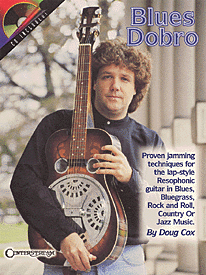
BLUES DOBRO Doug Cox LIBRO CD TABLATURE lap-style Resophonic guitar Bluegrass Rock and Roll

BLUES DOBRO, Doug Cox. SHEET MUSIC BOOK WITH CD & GUITAR TABLATURE. 

LIBRO DI Musica Blues, bluegrass, ROCK AND ROLL, jazz, country, CON CD. 

SPARTITI PER DOBRO CON :

ACCORDI, PENTAGRAMMA, TABLATURE.

TECNICA, 

Comodamente seduti con la chitarra distesa sulle gambe, a suonare in Lap-style,  CD TABLATURE


Series: Guitar
Medium: Softcover with CD
Author: Doug Cox
Blues Dobro gives you proven jamming techniques for lap-style Resophonic guitar in Blues, Bluegrass, Rock and Roll, Country, and Jazz. Companion CD allows you to hear how exercises should sound.


Proven jamming techniques for the lap-style Resophonic guitar in Blues,
Bluegrass, Rock and Roll, Country Or Jazz Music.
By Doug Cox


Table of Contents
CD Tracks .
About the Author .
Introduction .
Tuning .
Intro to Basic Dobro Techniques .
Exercise 1
Blues Rhythm .
Exercises
Holding the Bar .
Exercises
Understanding 12 Bar Blues .
Rolling patterns .
Exercises
Blues scales, Major scales, Hammer ons, Pull offs .
Exercises
Ripping .
Exercise
Harmonic exercises '
Exercises
Slanting Scales ,
Exercises
Basic Blues in G .
Exercises
Musta Notta Gotta Lotta .
Exercise
Minor blues .
Exercises
Bm blues .
Exercise
Am blues .
Blues in A
Conclusion. 

Prezzo: €21,99
€21,99

BOTTLENECK BLUES GUITAR BOB BROZMAN acoustic Masters CD TABLATURE SPARTITI METODO CHITARRA

BOTTLENECK BLUES GUITAR, BOB BROZMAN. SHEET MUSIC BOOK WITH CD & GUITAR TABLATURE. 

LIBRO METODO DI MUSICA SLIDE, CON CD.

SPARTITI PER CHITARRA CON: 

ACCORDI, PENTAGRAMMA, TABLATURE. 

TECNICA CHITARRISTICA SLIDE, 


Acoustic Masters Series: Bob Brozman's Bottleneck Blues Guitar
By Bob Brozman
SERIES: Acoustic Masters Series
CATEGORY: Guitar Method or Supplement
FORMAT: Book & CD

E' d'obbligo l'accordatura SOL APERTO (OPEN G TUNING dalle corde basse verso le alte: RE, SOL, RE, SOL, SI, RE.), per poter suonare degli accordi con il bottleneck. La seconda, la terza e la quarta corda rimangono in accordatura standard. 

Quelle che Brozman chiama le "Buddy note" sono le famose "Blue note", note che non appartengo né all'armonia minore, né maggiore. L'intervallo di terza maggiore del Sol è il Si, e quello di terza minore è il Sib, la Blue note sta tra il Sib e il Si. Con la chitarra possiamo tirare la corda di un quarto di tono, terza corda terzo tasto, dal Sib andiamo un poco in su per fare una nota "stonata" un Si calante, il piangente del classico lamento blues.

Charlie Patton quelli del Delta, e gli Hawaiiani usano la dissonanza suonando contemporaneamente due note vicine come Si e Sib. 

Esercizi sul Vibrato, lo staccato, "strike and slide", trillo, le corde stoppate. Un'altro effetto ritmico alla Robert Johnson consiste nel suonare con l'indice e con il medio le ultime 4 corde verso l'alto, e poi con il pollice verso il basso, tutto molto velocemente e con le corde stoppate.

L'accompagnamento di Willie Brown e gli armonici con il bottleneck il pollice e il palmo della mano. 


Per imparare i turnarounds, la tecnica bottleneck, blue notes, open G tuning, tecnica della mano destra, blues licks and phrases, authentic blues rhythms, harmonics, e altro. Incluse complete trascrizioni di "Terraplane Blues," parole e musica di Robert Johnson,  "Moon Goin' Down," and "Rhythm in the Blues."

• CD Included
• Turnarounds

• Bottleneck Techniques
• Blue Notes
• Open G Tuning
• Right Hand Techniques
• Blues Licks and Phrases
• Authentic Blues Rhythms
• Harmonics
• Robert Johnson, Willie Brown and Son House Styles
• "Terraplane Blues"
• "Moon Goin' Down"
• "Rhythm In The Blues"
• Standard Notation and Tablature
Bob Brozman performs the music examples on the included CD.
Tutta la musica è scritta in notazione standard e tablature.


Introduction

Notation Guide

Getting Started

Tuning

Turnarounds

Exs.2a - 2f

Exs.2g - 2j

Bottleneck Techniques

Exs.3a & 3b

Exs.3c - 3e

Exs.3f - 3g

Ex. 3h

Exs,3i - 3k

The "Buddy" (Blues) Note

Exs.4a - 4g

Right Hand Techniques

Exs.5a - 5e

Exs.5f - 5h

Review Of Picking Techniques

Exs.5i - 5j

Speciality Strokes

Exs.6a - 6e

Ex.6f

Creating Blues Verses

EX.7a

Analytical Breakdown, Ex. 7b

Ex,7c

Exs,7d - 71

Exs,7j - 7k

Exs,71- 7m

EX.7n

Exs.70 - 7q

Rhythmic Exercises

2 Against 3 Rhythm

3 Against 2 Rhythm

3 Against 4 Rhythm

Chords

Wrong Notes & Right Notes

(Exs, lOa - 109 Not Recorded)

Intro To Terraplane Blues

Terraplane Blues

Ex. 10j

G Down The Staff

Exs. 11a - 11d

Ex, 11e: Moon Gain' Down

Exs. llf - 11j: Analysis

Ex. 11 k

Exs. 11l- 11o

Harmonics

Exs. 12a - 12c

Palm Harmonics: Exs. 12d - 12g

Coda: Putting It All Together

Rhythm In The Blues

Prezzo: €29,99
€29,99

SLIDE GUITAR AND OPEN TUNINGS Doug Cox CENTERSTREAM LIBRO CD TABLATURE explore the basics of open tunings and slide licks chords songs

SLIDE GUITAR AND OPEN TUNINGS. CD TABLATURE

LIBRO DI MUSICA PER CHITARRA CON CD TABLATURE

Slide Guitar and Open Tunings

Series: Fretted
Publisher: Centerstream Publications
Format: Softcover with CD - TAB
Composer: Doug Cox

This book/CD pack for the intermediate player explores the basics of open tunings and slide guitar, covering licks, chords, songs and patterns. This is not just a repertoire book, but rather an approach for guitarists to jam with others, invent their own songs, and understand how to find their way around open tunings with and without a slide. The accompanying CD features 37 tracks.

Inventory #HL 00000243
ISBN: 9781574240689
UPC: 073999929607
Width: 9.0"
Length: 12.0"
56 pages


Slide Guitar and Open Tunings

For the intermediate guitar player to explore the basics of open tunings and slide guitar with licks, chords, songs, and patterns, plus jamming with others. by Doug Cox

Doug uses John Pearse Strings.
Recording for this project was engineered by Mark Wing for Mark's Music in Courtenay, Be.
Cover photo by Steve Halliday - Hand photos by Lawrence McLagen
The author wishes to thank all the photographers who contributed photos/rom their archives:
Dorothea Funk, Arnie Dyker, Allison Green, Neil Russell, Ken Hamm, David Walford, Johnny Hasenovic, Chris Banner.
Cover art: Shawn Brown

Music notation, pasteup and layout. Kenneth Warfield
Production· Ron Middlebrook

SAN 683-8022
ISBN 1-57424-068-4
CENTER STREAM Publishing - Anaheim Hills, CA 92807
 

About the Author:
Doug is a Canadian musician who has recorded and performed with a who's who of fellow Canadian and International musicians. He has toured in North America and Europe extensively as both a sideman and a frontman. A busy teacher, with his own instructional video series, Doug teaches guitar and Dobro at workshops across North America and has developed his own voice on his instruments. He appears on over 100 CDs as a sideman and has two solo recordings; "Canadian Borderline", and "Bone Bottle Brass or Steel", with a new release in the works! Doug hosts his own weekly TV music show in Canada called "Sittin' in with Doug Cox." His Dobro is heard daily across Canada playing the popular adaptation of CBC National Radios' "Discdrive" theme "Fanfarinette" .

Conclusion
Playing in Open Tunings with and without a slide will add many new dimensions to your musical path. I hope the areas we have explored in this book will open new doors in your playing and understanding of music and the guitar. I would also like to emphasize my belief that everything I teach in this book simply reflects the way I approach the guitar and should not be taken as the right or wrong way to do things. I believe that aside from doing anything that causes you physical damage, there is no right or wrong way to play music. Do what you like and what works for you. I also encourage any music student to study with as many teachers as possible and learn what you can from every musical encounter you have. Thank you for studying with me and I hope to see you down the road! Doug Cox

Table of contents:

About The Author.
CD Tracks.
Open E and D Tuning .
D Scale # 1 .
1st Position .
2nd Position .
Practice Patterns In 3s .
Practice Patterns In 4s .
Arpeggio Pattern .
St. Anne's Reel # 1 .
Melodic Major Scale .
St. Anne's Reel #2 .
Colored Aristocracy .
Further Along .
Dadgad Tuning
Wake Up Lisa .
Mary Greig .
Changing Open D to Dm Tuning .
Major/Minor Chord Construction .
D Minor Tuning .
Buffalo Skinners .
Basic Slide Techniques .
Choosing A Slide .
Damping .
Right hand exercise # 1 .
Right hand exercise #2 .
Elmore James Lick Part 1 and 2 .
Elmore James Full Lick .
The 5 Commandments in The Church Of Slide .
Blues Scale Without / With Slide .
12 Bar Blues Rhythm Patterns .
Don't Bring Me Water.
Black Girl / In the Pines .
Hats Off To Ry .
Crossroads Lick .
Death Letter Lick .
Movable Scales, Chords And Licks .
Harmonized Major Scale Patterns .
Conclusion . 

Prezzo: €18,99
€18,99

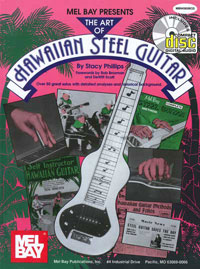
HAWAIIAN STEEL GUITAR THE ART OF LIBRO CD TABLATURE SPARTITI CHITARRA LIBRO METODO

HAWAIIAN STEEL GUITAR, THE ART OF. Numerose fotografie sulla storia della musica Hawaiiana, 60 pezzi tradizionali e recenti. CD TABLATURE

LIBRO, METODO DI MUSICA HAWAIIANA CON CD, PER STEEL GUITAR.
SPARTITI CON ACCORDI E TABLATURE CON NOTAZIONE DELLA DURATA RITMICA.

Product Description:
This book is an excellent study of the history and unique musical stylings of the Hawaiian guitar. Stacy Phillips successfully pinpoints the characteristics of Hawaiian guitar solos. A special feature is the inclusion of a superb historical survey of Hawaiian music. Written in tablature only, G tuning. DeWitt Scott comments: "There are two types of Hawaiian music, the 'authentic' style and the 'tourist' style. Stacy is presenting the 'authentic' style and this is much needed to keep the Hawaiian music alive."

Song Title: Composer/Source:
Alekoki
Aloha Oe
Cunha Medley
E Mame E
Hanohano-E
He Aloha Noa Honolulu #1
He Aloha Noa Honolulu #2
Hilo E
Hilo March #1
Hilo March #2
Honolulu Bound #1
Honolulu Bound #2
Honolulu Stomp
Hue Hue
Hula Blues #1 Johnny Noble And Sonny Cunha
Hula Blues #2 Johnny Noble And Sonny Cunha
Hula Blues #3 Johnny Noble And Sonny Cunha
Hula Medley #1
Hula Medley #2
Indiana March
Kaua I Ka Huahua'i #1
Kaua I Ka Huahua'i #2
Kaui Kahio
Ke Ahi Kuu Ipo
Kewalo Chimes
Kiho' Alu
Kilima Waltz
Kohala March
La Rosita
Lehua
Lei Ana Ika Makihana
Lei Lehua
Little Heaven Of The South Seas #1
Little Heaven Of The South Seas #2
Little Heaven Of The South Seas #3
Mai Kai No Kauai
Mai Poina Oe Ia'u
Maui Chimes #1
Maui Chimes #2
Moana Chimes
Moani Ke Ala
Na Ali'i
Na Lei O Hawaii
Na Moku Eha
Na Pua O Hawaii
Opihi Moemoe
Pa' Au' Au Waltz C. E. King And I. U. Iosepa
Paahana #1 C. E. King And I. U. Iosepa
Paahana #2 C. E. King And I. U. Iosepa
Patches C. E. King And I. U. Iosepa
Pauoha C. E. King And I. U. Iosepa
Pupu O 'Ewa C. E. King And I. U. Iosepa
Sol Hoopuu Hot Solo C. E. King And I. U. Iosepa
Sweet Lei Lehua C. E. King And I. U. Iosepa
Tickling The Strings #1 C. E. King And I. U. Iosepa
Tickling The Strings #2 C. E. King And I. U. Iosepa
Tomi Tomi #1 C. E. King And I. U. Iosepa
Tomi Tomi #2 C. E. King And I. U. Iosepa
Ua Like No A Like C. E. King And I. U. Iosepa

Prezzo: €32,99
€32,99

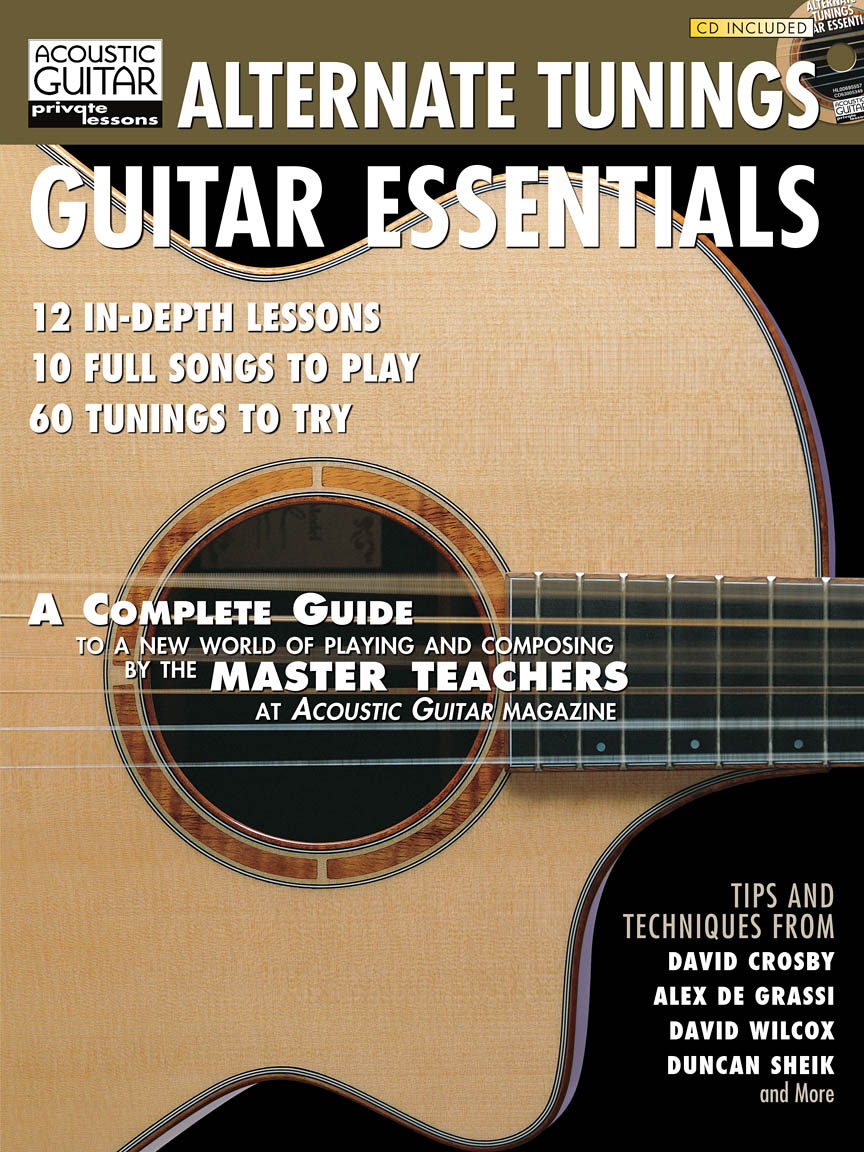
Acoustic Guitar Magazine ALTERNATE TUNINGS ESSENTIALS CD TABLATURE LIBRO METODO CHITARRA

Acoustic Guitar Magazine. ALTERNATE TUNINGS GUITAR ESSENTIALS. SHEET MUSIC BOOK with CD & GUITAR TABLATURE .

LIBRO METODO DI MUSICA SULLE ACCORDATURE APERTE, CON CD.

SPARTITI PER CHITARRA CON:

ACCORDI PENTAGRAMMA, NOTE, TABLATURE. 

STUDIO, MANUALE, TECNICA, TEORIA, 


Dylan Schorer-Riverside, Prelude From Cello Suite No.1; David Hamburger-Banks Of The Ohio, I Am A Pilgrim; Steve James-Sebastopol, Spanish Fandango; Steve Baughman-Robert's Serenade; Al Petteway-She Moved Through The Faire, Morrison's Jig; Scott Nygaard-Rovin' On A Winter's Night. 

Alternate Tunings Guitar Essentials

Series: Guitar Educational
Publisher: String Letter Publishing
Format: Softcover with CD - TAB
Author: Various Authors

Unlock the secrets of playing and composing in alternate tunings with this unique, comprehensive book/CD pack! Includes an introduction to alternate tunings and the players who have pioneered them (including tips from David Wilcox, David Crosby, Alex de Grassi, Duncan Sheik and more), 12 in-depth lessons in 11 tunings, 10 full songs to play, a special section on how to create your own tunings, an extensive list of 60 tunings to try – with artist songs and examples, and accessible arrangements in standard notation and tab. The complete guide to a new world of playing by the master teachers at Acoustic Guitar magazine!

Prezzo: €29,99
€29,99
Condividi contenuti