LIBRO CON CD

ELLINGTON DUKE GREAT JAZZ STANDARDS LIBRO CD TABLATURE CHITARRA CARAVAN-SATIN DOLL-SOLITUDE

ELLINGTON DUKE, GREAT JAZZ STANDARDS, FRED SOKOLOW. SHEET MUSIC BOOK WITH CD & GUITAR TABLATURE .

LIBRO DI MUSICA JAZZ CON CD .

SPARTITI PER CHITARRA :

ACCORDI, PENTAGRAMMA E TABLATURE. 

Caravan -do nothin' till you hear from me -don't get around much anymore -I got it bad (and that ain't good) -In a sentimental mood -it don't mean a thing (if it ain't got that swing) -moon indigo -prelude to a kiss -satin doll -solitude -sophisticated lady. CD TABLATURE

Great Jazz Standards of Duke Ellington
Duke Ellington / arr. Fred Sokolow

SERIES: Jazz Masters Series
CATEGORY: Guitar Personality
FORMAT: Book & CD

Solid, clear, and accessible solo arrangements for eleven memorable jazz standards. Every song is presented with the guitar part, written in standard notation and tablature, combined with the lead sheet for analysis. All arrangements are demonstrated on the included CD. Titles are:

Includes the Following Selections:
Title Composer
CARAVAN - IRVING MILLS, DUKE ELLINGTON, JUAN TIZOL
DO NOTHIN' TILL YOU HEAR FROM ME - DUKE ELLINGTON; BOB RUSSELL
DON'T GET AROUND MUCH ANYMORE - ELLINGTON DUKE/L: RUSSELL, BOB
I GOT IT BAD {PRINT (C) - DUKE ELLINGTON; PAUL WEBSTER
IN A SENTIMENTAL MOOD (PRINT ONLY) - DUKE ELLINGTON , I. MILLS & M. KURTZ
IT DON'T MEAN A THING (IF IT AIN'T GOT THAT SWING) - ELLINGTON DUKE/L: MILLS, IRVING
MOOD INDIGO - ELLINGTON DUKE/MILLS, IRVING/BIGARD, ALBANY
PRELUDE TO A KISS (PRINT (C) - DUKE ELLINGTON, I MILLS, I GORDON
SATIN DOLL (INSTRUMENTAL) - STRAYHORN, BILLY/ELLINGTON, DUKE
SOLITUDE - ELLINGTON DUKE/L: DELANGE, EDDIE/L: MILLS, IRVING
SOPHISTICATED LADY {PRINT (C) - DUKE ELLINGTON, I. MILLS, M. PARISH

SERIES: Jazz Masters Series
CATEGORY: Guitar Personality
FORMAT: Book & CD

Solid, clear, and accessible solo arrangements for eleven memorable jazz standards. Every song is presented with the guitar part, written in standard notation and tablature, combined with the lead sheet for analysis. All arrangements are demonstrated on the included CD.

Prezzo: €29,99
€29,99

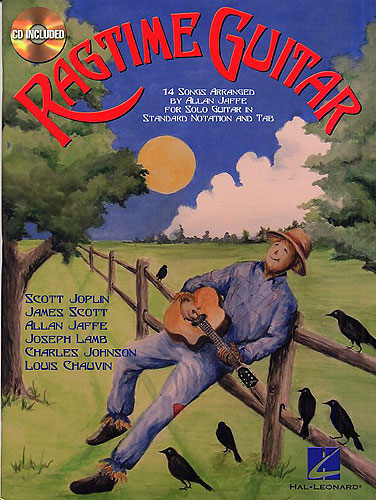
RAGTIME GUITAR 14 Songs Arranged for Solo-Entertainer CD LIBRO TABLATURE SPARTITI CHITARRA

RAGTIME GUITAR, 14 Songs Arranged for Solo Guitar. Allan Jaffe. BOOK WITH CD & TABLATURE

LIBRO DI MUSICA RAGTIME CON CD.

SPARTITI PER CHITARRA CON:

ACCORDI, PENTAGRAMMA E TABLATURE. 

14 Songs Arranged for Solo Guitar

Series: Guitar Solo
Softcover with CD - TAB
Arranger: Allan Jaffe

14 of Jaffe's fingerstyle arrangements of ragtime favorites and originals in standard notation and tablature with accompanying CD, 80 pages

"As a musical entity ragtime was, and is an instrumental work in 2/4 time composed for the piano that combines a syncopated series of melodies accompanied by an even, steady rhythm."-David A. Jasen and Trebor J. Tichener, Rags and Ragtime. In the first twenty years of the 20th century, an unprecedented phenomenon erupted into the world of Western music. For the first time, a form of popular music which was a true fusion of African-American and Western European musical traditions emerged. Although it began as an oral form played by pianists in the bars and brothels of several major American cities, thanks to the publishing houses, it quickly spread through the United States and eventually Europe. Unlike any other music up until then, this music was completely biracial. Everyone called it "ragtime." In an era before the age of radio and recording, the only way for music to reach the public, aside from the concert hall, was through sheet music. Many homes in the United States had their own pianos, and at least one family member was able to play this instrument, albeit often in a rudimentary fashion. Apart from the classical repertoire, most pianists favored versions of popular songs of the day, notated with a very simple accompaniment. Although ragtime challenged the skill levels of the average amateur pianist, Americans quickly succumbed to the new and unusual syncopations. The music became so popular that schools sprouted up around the country specifically for the purpose of teaching the lay-person how to play this strange and seductive music. The original creators and developers of ragtime were the great ragtime pianists and composers of the period, the three acknowledged masters of the classic rag being Scott Joplin, James Scott, and Joseph Lamb. Eventually the Tin Pan Alley composers, the pop songwriters of the day, recognized the commercial potential of this form and began cranking out ragtime pieces by the score. By the end of the 1920s, over five thousand ragtime works had been published. Possibly due to this rampant commercialization, the quality of the music degenerated and eventually ragtime disappeared from public favor until it was revived as a repertoire form years later. During the twenty or so years of ragtime's heyday, many wonderful pieces of music were born from the pens of its finest composers. Along with the works of the above-mentioned masters, one can find a wonderful assortment of music by other great ragtime artists, such as Tom Turpin, Charlie Hunter, Charles Johnson, and Artie Matthews, among others. Ragtime displayed great melodic, harmonic, and rhythmic invention; each piece possessed its own clear emotional impact. When I was asked by Hal Leonard Publications to do a book of rags for the guitar, comprising eleven arrangements of classic rags and three of my own, I had little idea of the rich musical world I was about to enter. Over the past ten years I had been writing my own guitar rags, originally inspired by the work of the three great blues guitarists, Mississippi John Hurt, Reverend Gary Davis, and Arthur "Blind" Blake. However, apart from Scott Joplin's compositions, I was unaware of the richness of this musical period. Thanks to two excellent literary sources, Rags and Ragtime by David A. Jasen and Trebor J. Tichener and They All Played Ragtime by Rudi Blesh and Harriet Janis, plus the multitude of websites dedicated to ragtime, I steeped myself in this music. Eventually, I chose eleven pieces which I felt were some of the best and most important works of ragtime's great composers. As the statement quoted at the beginning of this intro shows, ragtime has always been associated with the solo piano. In talking with people about this project I often heard the same response, "I have never heard ragtime played on the guitar." Indeed, most of the guitar music that has been called "ragtime" comes from the blues and is associated with the works of blues, folk, or country artists such as Gary Davis, Doc Watson, or Dave Van Ronk. On the surface, this seems to be a far cry from the classical-sounding solo piano compositions of Joplin or Lamb. But in fact, the music produced by these artists all share a syncopated melodic line superimposed on a steady bassaccompaniment figure. I found that with the appropriate key changes this music adapted well to the guitar. The rhythmic, melodic, and multi-timbral nature of the guitar makes it an excellent medium for ragtime. Of course there are challenges. Since this music was developed by pianists for pianists-with thick chords, big octave leaps, and bass lines moving in contrary motion to the melodies-there are few major inherent technical difficulties when played on the piano. This is a different story on the guitar. However, through a process of distillation, careful key selection, register changes, and liberal use of open strings, I was able to create versions of these pieces that retain the lyrical, harmonic, and rhythmic richness of the originals, while acquiring through the translation process a character of their own. The result, I believe, is guitar pieces that are a joy to learn and play.

The Entertainer - Scott Joplin (1902)

Marvin Hamlisch's adaptation of this rag for the movie, The Sting in 1976, was responsible for bringing the music of Scott Joplin and ragtime back to the attention of the public. It was originally dedicated to the vaudeville entertainer, James Brown, and, although I was unable to get any information about this person, in arranging it I had in mind an elegant "soft-shoe" performer. In order to bring out the beautiful melodies I have decided on a slower tempo for this tune.

Maple Leaf Rag - Scott Joplin (1899)

A fitting end to one century and beginning to the next, the publication of "Maple Leaf Rag" by publisher John Stark marks the emergence of ragtime as a popular musical form. By 1909 it had sold over a half-million copies. To the aspiring ragtime composer "Maple Leaf" became the model for this relatively new form of music. My version diverges from Joplin's original in two ways: 1. I have chosen to swing it, and 2. I have left out the standard repetition of the A section after the B section.

Heliotrope Bouquet - Scott Joplin and Louis Chauvin (1907)

This beautifully lyrical piece was a collaboration between Joplin and the legendary genius Louis Chauvin. As Chauvin's music had not previously appeared in print, Joplin suggested that in order for him to get his first publication, they should collaborate on this one. The A and B sections were written by Chauvin, the last two by Joplin. One can get some insight into Chauvin's unusual harmonic sense from the haunting A section.

Frog Legs Rag - James Scott (1906)

Scott is the forgotten genius of ragtime. This tune was his first publication and it was an immediate success. Although the B section is reminiscent of "Maple Leaf," we become aware of Scott's considerable originality throughout. The entire piece dances and is, I believe, an imaginative depiction of the movement of the appendages for which it is named. The D section, with James Scott's characteristic "octave echo," is a challenge technically on the guitar, but I have suggested a fingering which makes it a joy to play.

Grace and Beauty - James Scott (1909)

For me, this is the most lyrical and unusual of the James Scott rags. Scott was known to be the most adept pianist of the major three rag composers, and this is one of his most pianistic, using his characteristic octave leaps and arpeggiated "rips." Consequently, in order to make my arrangement "guitaristic" I have taken some liberties with the melody and bass lines.

Sunburst Rag - James Scott (1909)

This is a joyful and exuberant statement by Scott. Scott's rhythmic clarity and variety is apparent in this composition from one section to the next. The C section, which I find to be a wonderful workout for the left hand, seems to have been echoed, whether consciously or unconsciously, about sixty years later in Herb Alpert's "Spanish Flea." This work is beautifully structured, with the B section reappearing at the end, transformed by its modulation up a fourth.

American Beauty Rag - Joseph Lamb (1913)

This is one of the two rags I have arranged in "dropped D" tuning and is a beautiful, and at the same time, revolutionary work. The first two sections here are yet another example of Lamb's extraordinary lyricism and gift for long, arching melodies. Yet midway through this composition, beginning with the transition between Band C, Lamb takes quite a different direction. Suddenly the focus is on rhythm. The C section is remarkable in that, unlike any of the rags of this period, it seems to incorporate the "swing" rhythmic approach of jazz. Lamb notates the "swing" as a dotted eighth and sixteenth note rhythm and effectively alternates it with a straighteighth rhythm. Also unusual in this rag is the increasing intensity of the piece, beginning with the C section and continuing until the end.


1988 - Al's Slow Rag [Jaffe, Allan] 

1913 - American Beauty Rag [Lamb, Joseph] 

1911 - Barber Pole Rag [Johnson, Charles] 

1986 - Delta Rag [Jaffe, Allan] 

1906 - Dill Pickles [Johnson, Charles] 

1906 - Frog Legs Rag [Scott, James] 

1909  - Grace And Beauty [Scott, James] 

1907 - Heliotrope Bouquet [Joplin, Scott] [Chauvin, Louis] 

1990 - Joplin Rag [Jaffe, Allan] 

1899 - Maple Leaf Rag [Joplin, Scott] 

1915 - Ragtime Nightingale [Lamb, Joseph] 

1909 - Sunburst Rag [Scott, James] 

1902 - The Entertainer [Joplin, Scott] 

1916 - Top Liner Rag [Lamb, Joseph]

Prezzo: €24,99
€24,99

MANCINI HENRY-ACOUSTIC MASTERCLASS SERIES-PINK GUITAR-CD TABLATURE LIBRO SPARTITI

MANCINI HENRY, ACOUSTIC MASTERCLASS SERIES PINK GUITAR. CD TABLATURE

LIBRO DI MUSICA CON CD.

SPARTITI PER CHITARRA CON:

ACCORDI, PENTAGRAMMA E TABLATURE. 

Pink Panther Theme - Laurence Juber
Moon River - Ed Gerhard (from the movie "Breakfast at Tiffany's")
Days of Wine and Roses - David Cullen
It's Easy to Say - Doug Smith (from the movie "10")
Peter Gunn - Pat Donohue
The Thornbirds Theme - Al Petteway
The Sweetheart Tree - Mark Hanson (from the movie "The Great Race")
What's Happening - Mike Dowling
Charade - Aaron Stang
Dear Heart - Wayne Johnson
Baby Elephant Walk - William Coulter (from the movie "Hatari")
Two for the Road - Amrit Sond


Twelve classic Henry Mancini tracks arranged for solo guitar by 12 master guitarists. This album-matching folio comes with a "masterclass" CD on which the artists describe the critical elements of their arrangements. Titles and arrangers include: Baby Elephant Walk/William Coulter; Charade/Aaron Stang; The Days of Wine and Roses/David Cullen; Dear Heart/Wayne Johnson; It's Easy to Say/ Doug Smith; Moon River/Ed Gerhard; Peter Gunn/Pat Donohue; The Pink Panther/Laurence Juber; Session at Pete's Pad/Mike Dowling; The Sweetheart Tree/Mark Hanson; Theme from the Thorn Birds/Al Petteway; Two for the Road/Amrit Sond. CD TABLATURE

About the Arrangements

The Pink Panther
"The Pink Panther" starts in E minor, which, in theory, should make it an easy fit on guitar. However, the characteristic chromatic walkup from C# to E would put the arrangement an octave too high in standard tuning. CGDGAD allows me to not only capture that signature run, but it also provides the open C and the open G bass notes, which are essential for the harmonic structure of the composition. I have attempted to remain true to the elements of the original arrangement, maintaining the essence of the bass part and of Plas Johnson's improvised tenor sax solo. My guide for this work is an image of a group of LA's finest studio musicians performing in tight ensemble under Mr. Mancini's baton; this must have been one breathtaking session! -Laurence Juber

Moon River
Although "Moon River" is in 3/4, I don't emphasize the waltz feel in my arrangement. In myopinion, de.-emphasizing the waltz feel contributes to the dreamlike quality of the tune. Let the melody notes ring out as long as possible (a little bit of subtle vibrato will help the melody stand out). This arrangement should be very easy to play, so savor every note. Good luck. -Ed Gerhard

The Days of Wine and Roses
I enjoyed putting together this solo guitar arrangement of "The Days of Wine and Roses:' It includes the same modulation that is popular among jazz pianists. The great Bill Evans does this same modulation in his rendition. I hope you enjoy the bossa nova rhythmic feel in the introduction. I think it sets the mood for the tune. Thank you, Mr. Mancini, for all the memorable melodies. -David Cullen

PeterGunn
Arranging the "Peter Gunn" theme came down to a matter of synchronizing the famous bass line and melody by way of dozens of one-beat finger mechanisms that occur frequently. Until the very end, the only chord in the "Peter Gunn" theme is E7. The challenge was to take it through a few times in different ways. In the A section, I play one time through with a single-note melody and then one time through with a harmonized melody, all against the recurring bass line. Letter B is a bridge of sorts. The C section is the harmonized melody again. The D section is another bridge I composed myself using a combination of diminished and major chord triad shapes. In the E section, there is a technique that simultaneously uses tremolo and bass line in the right hand: the right-hand fingers move up and down rapidly against the first three strings while the right-hand thumb pounds out that familiar bass melody. This arrangement has been extremely exciting and challenging. Don't call me at home with questions! I can't help you. I'll be in therapy. -Pat Donohue

Two for the Road
Technically, this is a pretty simple and straightforward piece to play. Care and attention should be devoted to the right-hand fretting-sustain each melody and chord voicing for as long as possible to allow for smooth transitions throughout. Also, dynamics will really help to bring out the emotional aspect, so experiment with softer and louder right-hand picking-bearing in mind that the melody needs to be up front at all times, and in certain instances I have even chosen to drag the time for effect. The bass counterpart is critical in its role as harmony, so ensure that you pay as much attention to keeping it nice and smooth against the melody. The run that occurs at bar 47 is played with just downstrokes (with the right-hand thumb), slightly speeding up toward the end and then returning to the slower tempo. All harmonics are natural, played at the 12th fret. -Amrit Sond

About Pink Guitar. As owner of Solid Air Records, I would love to take credit for this collection of arrangements, but like most owners, I am luckier than I am smart. Aaron Stang, our partner in print publishing at Warner Bros. Publications, came up with the concept; I can take credit only for agreeing that it could be fun. Of course, asking a dozen artists to find time to pick out a favorite Mancini tune, work up a creative arrangement, record it, transcribe it, and then record a lesson-all in just a few weeks' time-is asking a lot! Fortunately for me, the artists on our label are all up for such challenges and delivered the goods-as they say in the entertainment biz. At this 10th anniversary of the passing of the legendary composer Henry Mancini and the 40th anniversary of the Pink Panther, there are many products in stores honoring his memory: everything from repackages of older recordings to new and exciting versions of his tunes from jazz ensembles to pop stars. Our collection marks the first time a group of guitarists has tackled his compositions; it's a tribute to the strength of his melodies that even played as solos they retain all of their power, beauty, and playfulness. I won't go into detail about each tune since the artists themselves have done a better job than I could, but I would like to say that 2004 marks our own lOth anniversary. We could think of no better way to start this collection than with Laurence Juber, the artist with whom we launched our label. It was obvious to us that the challenging job of turning "The Pink Panther" theme into a solo guitar arrangement had to go to this Grammy-winning musician-and the results speak for themselves. Finally, my sincere thanks to you for purchasing this collection of arrangements. I hope you'll check out the other CDs, books, and DVDs by these wonderful musicians. They're all extremely talented composers in their own rights. Until we meet again and the case is solved. -James Jensen


WAYNE ]OHNSON
After joining the Manhattan Transfer in 1977, Wayne has taken plenty of time off from the gig to keep his solo interests alive. With eight solo CDs to his credit (both trio and solo), Wayne has also recorded and performed with an eclectic variety of other artists in addition to the Manhattan Transfer including Rickie Lee Jones, John Tesh, Akiko Yano, and Lee Oskar ofWar. At home, Wayne does studio work, produces, and is a guest instructor at the Musicians Institute and Los Angeles Music Academy. Look for his new solo acoustic release on Solid Air Records entitled One Guitar.

LAURENCE JUBER
Laurence Juber grew up in North London, where he was inspired by the explosive British pop scene of the early' 60's. Laurence became a highly in-demand studio player, contributing to many recordings ranging from the Alan Parsons Project and Rosemary Clooney to playing lead guitar on the Academy Award-nominated soundtrack to The Spy who Loved Me. In 1978 Paul McCartney asked Laurence to become the lead guitarist for his band Wings. After McCartney folded Wings in 1981, Laurence moved to the U.S., where he concentrated on raising a family while resuming his studio career. He played on such classic '80s TV shows as "Happy Days" and "Family Ties." In 1990 Laurence released his first solo album, Solo Flight, which first showcased his fingerstyle guitar work. His next CD, Naked Guitar, solidified his reputation among guitar fans, and he began touring internationally as a solo concert performer. His solo fingerstyle CDs include Winter Guitar, Mosaic, Altered Reality, Different Times, Guitarist, and the best-selling LJ Plays the Beatles.

AL PETTEWAY
AI Petteway has had an illustrious career as a guitarist, composer, and producer. He has been featured on more than 60 nationally released recordings, including 14 ofhis own. His original compositions have been used in movie sound-tracks and for programs on NPR and PBS, including Ken Burns' film Mark Twain. His trademark musical style, mixing Celtic and American themes, has won him more than 50 Music Association awards, including the Indie award for Gratitude, a duo guitar project with his wife and musical partner, Amy White. Al is the coordinator for the World-renowned Swannanoa Gathering's Guitar Week and is Artist-in-Residence at Warren Wilson College near Asheville, North Carolina. When they aren't touring as a duo, he and An1y work together, recording music and photographing nature at their home high in the mountains of western North Carolina.

DOUGSMITH
Doug Smith's originai instrumental compositions combine folk, classical, jazz, and contemporary forms with virtuoso guitar technique to create a unique, flowing, and highly melodie fingerpicking style. His music has been heard on radio and TV stations throughout the world, including CNN, ESPN, E!, The Discovery Channel, and Encore; his playing has been heard on the soundtracks to movies such as Twister and Moll Flanders; and he has performed on the nationally syndicated radio programs "Echoes," "West Coast Live:' and "River City Folk" as well as local radio and TV shows around the country.

AMRITSOND
Arnrit's unique contemporary instrumental music draws on elements of jazz, classical, folk, world music, and newacoustic techniques, which are ali honed into a highly refined and melodically driven compositional approach. Amrit has graced the same billing as the world's most renowned guitarists, including Dominic Miller (Sting , Hugh Burns (George Michael), Ronnie Johnson (Van Morrison), Doyle Dykes, Jaques Stotzem, and Preston Reed. Affili records for Solid Air Records.

AARON STANG
Aaron Stang is the author of Warner Bros. Publications' 21st Century Guitar Method. One of the most popular guitar methods published, the 21st Century Guitar Method has become the standard text used by many guitar teachers throughout the country and has been translated into Spanish, French, German, and Japanese. Aaron is managing editor of fretted instruments at Warner Bros. Publications, where he has overseen the publication of hundreds of guitar books and videos. Aaron performs solo and with his group, Relative Viewpoint, in concerts and folk festivals throughout south Florida. Currently, Aaron is the lead author of Guitar Expressions, the first comprehensive guitar curriculum designed for middle and high school students.


Acoustic Masterclass Series: Henry Mancini, Pink Guitar
the music of Henry Mancini

SERIES: Acoustic Masterclass
CATEGORY: Guitar Method or Supplement
FORMAT: Book & CD
--------------------------------------------------------------------------------
Guitar arrangements transcribed by the artists themselves, in standard notation and tab. Each edition includes a masterclass-style CD in which the artist walks you through the key aspects and techniques for each arrangement.

Twelve classic Henry Mancini tracks arranged for solo guitar by twelve master guitarists. This album-matching folio comes with a "masterclass" CD on which the artists walk through the key aspects and techniques for each arrangement. Titles and arrangers are: Baby Elephant Walk (William Coulter) * Charade (Aaron Stang) * The Days of Wine and Roses (David Cullen) * Dear Heart (Wayne Johnson) * It's Easy to Say (Doug Smith) * Moon River (Ed Gerhard) * Peter Gunn (Pat Donohue) * The Pink Panther (Laurence Juber) * What's Happening (Mike Dowling) * The Sweetheart Tree (Mark Hanson) * Theme from "The Thorn Birds" (Al Petteway) * Two for the Road (Amrit Sond).
--------------------------------------------------------------------------------
Includes the Following Selection:
Title Composer

BABY ELEPHANT WALK FAMOUS MUSIC
HENRY MANCINI

CHARADE (FROM "CHARADE")
MANCINI HENRY/L: MERCER, JOHNNY

DEAR HEART (FROM "DEAR HEART")
MANCINI, HENRY/EVANS, RAY/L: LIVINGSTON, JAY

IT'S EASY TO SAY
HENRY MANCINI, ROBERT WELLS

MOON RIVER (INSTRUMENTAL)
MANCINI, HENRY

PETER GUNN (FROM "PETER GUNN")
MANCINI HENRY

THE DAYS OF WINE AND ROSES
L: MERCER, JOHNNY/MANCINI, HENRY

THE PINK PANTHER (FROM "THE PINK PANTHER")
MANCINI, HENRY

THE SWEETHEART TREE (FROM "THE GREAT RACE")
L: MERCER, JOHNNY/MANCINI, HENRY

THE THORN BIRDS (MAIN THEME)
MANCINI, HENRY

TWO FOR THE ROAD (FROM "TWO FOR THE ROAD")
L: BRICUSSE, LESLIE/MANCINI, HENRY

WHAT'S HAPPENING!!
HENRY MANCINI

Prezzo: €31,99
€31,99

HAYNES WARREN GUIDE TO SLIDE GUITAR BOOK CD TABLATURE LIBRO SPARTITI CHITARRA MUSICA

HAYNES WARREN, GUIDE TO SLIDE GUITAR. SHEET MUSIC BOOK WITH CD & GUITAR TABLATURE .

LIBRO DI MUSICA ROCK BLUES, CON CD.

SPARTITI PER CHITARRA CON :

ACCORDI, PENTAGRAMMA E TABLATURE. 


CD FEATURES FULL BAND TRACKS BOTH WITH AND WITHOUT GUITAR, PLUS JAM TRACKS . 

Learn the slide guitar stylings of Warren Haynes from the man himself! The legendary guitarist of Gov't Mule, Phil Lesh and Friends, the Grateful Dead, and the Allman Brothers Band offers instructions on choosing a slide, perfecting left- and right-hand techniques, playing rhythm, and blues soloing-on electric and acoustic. The Warren Haynes Guide to Slide Guitar will give you the most in-depth and personal lessons ever on how to play slide guitar in the style of Warren Haynes. Also includes a split-channel CD of the exercises, played by Warren himself with a full band. Listen to the master or solo along to the backing tracks! 48 pages

WRITTEN BY WARREN HAYNES

WITH MIKE LEVINE 


Description

A unique book and CD from the hands of a true slide guitar legend - Warren Haynes. As guitarist with The Allman Brothers Band and The Grateful Dead, Haynes has forged himself a reputation as one of the greatest slide players in rock history, and you can now get a candid guide to his style from the man himself!

Haynes covers every part of your development as a slide guitarist, from choosing the best slide for you and perfecting the basic techniques to playing rhythm parts and blues soloing. A CD is included that features split-channel recordings of Warren performing all examples with a full band... either listen to the master at work, or solo along to the backing track and get your slide licks really cookin'. 48 pages

Acoustic Slide
Advanced Soloing
Approaching The Neck
Beyond The I-IV-V
Getting Started
Playing The Blues

... them, all of which paved the way for the new in-concert set. "I think we've always wanted to do a live album since we got together," says Haynes. "We're just happier in a concert situation, though it wasn't intentional that we'd do two studio discs first, just like the original ABBdid before Fillmore East. But just like then, our songs sound better in concert and, in fact, the Allman Brothers are and will always be a live band. We even cut our studio albums live, with everybody set up in the room and playing all at once. Most of the guitar solos that Dickey and I cut in the studio are live on the tape as they went down, which is very unusual. Of course, we go for that same spontaneity live and instead of just trading straight solos, sometimes we just bob and weave, leaving spaces for the other to fill in with harmonies, unison bits or counterpoint - it's all unplanned and experimental, like Miles Davis and John Coltrane improvising together or 'Trane and Cannonball Adderly. And we leave the mistakes and mishaps in while recording live, too. Like when I'm soloing in the first half of 'Blue Sky,' I start playing straight lead and then you can hear where I switch to slide and finish the lead playing bottleneck. The funny thing is that there's about a five or six beat pause in between them because the slide got kinda stuck in my vest pocket and it took a while to get the darn thing on my finger!" Given his broad listening tastes and keen melodic intuition, it shouldn't be surprising that Haynes also has a wealth of good advice to impart to younger players. As proof, just sample this tidbit of universal guitar wisdom, one which cuts to the heart of the matter just as fast as one of his always inventive solos: "Awhile back, I used to play country music for a living with David Allan Coe and, while I don't think I'd be happy playing country every day, I learned a lot from the experience because whenever you step outside your genre, you're bound to expand your horizons. When I used to read interviews with some of the truly great players, there was always one influence they'd mention that was a complete surprise, like B.B. King saying he dug jazzers like Django Reinhardt and Charlie Christian, which in turn gave him his own special voice as a blues player. In my mind, whether you're into blues or heavy metal, listening to and also playing other styles of music can only make you a better guitar player." 

Prezzo: €27,99
€27,99

GERHARD ED THE GUITAR SONGBOOK Acoustic Masterclass CD TABLATURE LIBRO SPARTITI CHITARRA

GERHARD ED, THE GUITAR SONGBOOK. Blue highway -crow -duet -farther along -homage -promised land -shallow brown -si bhig si mhor -the water is wide -wild mountain thyme. CD TABLATURE

Acoustic Masterclass Series: Ed Gerhard The Guitar Songbook
By Ed Gerhard

SERIES: Acoustic Masterclass
CATEGORY: Guitar Method or Supplement
VERSION: Guitar TAB
FORMAT: Book & CD

Guitar arrangements transcribed by the artists themselves, in standard notation and tab. Each edition includes a masterclass-style CD in which the artist walks you through the key aspects and techniques for each arrangement.

Ten of Ed Gerhard's most beautiful solo guitar pieces transcribed in full notation and tablature. On the accompanying master class-style CD, Ed carefully describes and demonstrates all the key passages for each song. Titles are:

Big thanks to Aaron Stang for his interest in this project, Mark Herndon for his great work with the transcriptions, and Chief Noda for his invaluable help and friendship throughout the years. Thanks to all of my friends and listeners around the world who have honored me with their attention and encouragement. Very special thanks and love to Kelli Bertram. Introduction I grew up listening to the world around me; for some reason, just the phenomenon of sound itself was enormously entertaining to me as a kid. It didn't even matter what kind of sound it was. Music, animals, machines, and voices-all held equal intrigue for me. When, at the age of ten, I first heard Segovia, watching him in the grainy flicker of a little black-and-white TV, I knew that this sound was different. I had never heard a guitar played alone before, and the sound that came out of that instrument changed me profoundly. Even at the age of ten I knew it. It wasn't until I was 14 that my Dad finally gave in and got me a guitar. My life was changed again the moment I put my hand on it. That was in 1970, when the accepted method for learning the guitar was to go to the local music store and learn to read music, play one string at a time, and generally struggle to play the uncoolest music ever. Where was the payoff? How far down the line would I get to enjoy the guitar? I lasted for about three lessons. I began teaching myself, learning from friends, and immersing myself in any music that had an acoustic guitar in it. I slowed down records to help figure out the hard parts. I fell in love with blues and wore out at least two copies of Mississippi John Hurt's Today! Within months I was making up pieces, experimenting with altered tunings, and playing slide. My appreciation for the guitar fueled my interest in all kinds of music, and I listened to everything from Blind Willie Johnson to Joseph Spence to Shostakovich to Debussy to Miles Davis. 

General technical notes:

Weissnborn and Lap-style playing

Lap-style intruments

Slides, steel and bars

General playing

Vibrato

1993 - Blue Highway - ED GERHARD 

1987 - Crow - ED GERHARD

1999 - Duet - ED GERHARD 

2001 - Farther Along - ED GERHARD 

1999 - Homage - ED GERHARD

2001 - Promised Land - ED GERHARD

1999 - Shallow Brown - TRADITIONAL

1999 - Si Bhig, Si Mhor - TRADITIONAL

1996 - The Water Is Wide - TRADITIONAL

1996 - Wild Mountain Thyme - TRADITIONAL

Prezzo: €29,99
€29,99

WYLDE ZAKK BLACK LABEL SOCIETY BEST OF GUITAR CD TABLATURE LIBRO CHITARRA Stronger Than Death-Stillborn

WYLDE ZAKK BLACK LABEL SOCIETY, BEST OF. SHEET MUSIC BOOK WITH CD & GUITAR TABLATURE .

LIBRO DI MUSICA METAL, CON CD .

SPARTITi PER VOCE E CHITARRA :

ACCORDI, PENTAGRAMMA, TABLATURE.


This collection of 12 songs from Zakk Wylde's band includes 12 note-for-note transcriptions with guitar tab:

Table of contents: All For You -Bleed For Me -Counterfeit God -Lords Of Destruction -Lost My Better Half -Speedball -Stillborn -Stoned And Drunk -Stronger Than Death -Suffering Overdue -Superterrorizer (live) -The Blessed Hellride. Also includes 7 bonus tracks on CD: from "sonic brew" -Low Down, from "stronger than death" -All for You -Superterrorizer, from "1919 eternal" -Bleed for Me -Lords of Destruction, from "the blessed hellride" -The Blessed Hellride -Stoned and Drunk. 86 pages. 

Prezzo: €59,99
€59,99

EARLY ROCK SET GIG GUIDE. VOCALS, GUITAR, KEYBOARD, BASS, DRUMS. CD TABLATURE

EARLY ROCK SET GIG GUIDE. CD TABLATURE

CD include full-band demonstrations
vocal, guitar, keyboard, bass, drums

The Performance Guide for Bands
Series: Gig Guide
Softcover with CD - TAB
Artist: Various

The Gig Guides series is designed to provide musicians with a blueprint for building bands. We select the songs, put 'em in order, and show you how to play 'em. The format is simple; there are no unwieldy note-for-note scores to sightread or complicated theory to understand. Just here's the lead sheet, here are the parts you really need to know, and away you go! These book/CD packs are the ultimate do-it-yourself kit for gigging musicians and up-and-coming performers alike. Can be used by a full band or individual players. Early Rock Set features 12 songs with a CD of full-band demos of each song so you can hear what you should be sounding like. Songs include, 104 pages.


How to Use the Gig Guide

This book is laid out with performance in mind. The setlist we have selected reflects a wide selection of the most accessible, "field-tested" material available, arranged for a four-piece band with vocals in a sequence that's meant to keep your audience entertained. Use it in rehearsal and performance, following along with the lead sheets and individual parts. Each song in the set includes:
• A lead sheet with chords, melody, and lyrics;
• An overview page with song facts, song form, and performance tips for the full band;
• A page of guidelines for each band member, including crucial parts and performance tips for vocals, guitar, keyboards, bass, and drums. Overview pages contain useful information about each song: the story behind it, when and by whom it was recorded, the form, and how to present it. Parts and performance tips are written by professional musicians with field experience (not just some guy in a cubicle). If all band members follow their parts in the book and the accompanying CD, and the band rehearses well, you will be gig-ready in no time.

About the CD
The audio CD represents a live performance of the setlist by a four-piece group. The songs are played in the most standard, tried-and-true arrangements for vocals, guitar, keyboards, bass, and drums, remaining faithful (within reason) to the original versions. In order to cover the vocals as recorded, at least three-if not all-band members should be able to sing. Listen to the recording as you practice your individual parts, paying attention to the feel and the sounds used.

Early rock 'n' roll (mid 1950s-early '60s) remains one of the world's most popular and enduring musical forms. Born in a simpler, more innocent era, this good-time party music was chiefly enjoyed by the younger set; but because it appeals to the youngster that lives within all of us, regardless of age, it has thrived for almost half a century.
We'll start our early rock set in a mellow tone with "Under the Boardwalk," an easy-going, romantic classic by the Drifters. This 1964 Top 10 hit encapsulates the very essence of this acclaimed vocal group: strong lead vocals (courtesy of Johnny Moore) backed by sophisticated harmonies, topped off with superior production standards and a spotless arrangement-qualities that are echoed in other hits such as "On Broadway," "Up on the Roof," "Save the Last Dance for Me," and "There Goes My Baby."
"Under the Boardwalk" is based on I-IV-V changes (G-C-D7) in the key of G, with a modulation to the relative key of E minor at the end of the chorus (Em-D). The first great hook lies in the melodic bass line. The guitarist plays muted arpeggios throughout-make sure they remain "in the pocket" of the groove. The keyboard player needs to dial up a rich string section patch for the solo section and the melody lines that sprinkle the arrangement. Whichever bandmember sings should use an intimate delivery in the verses and power it up a bit on the chorus. Background vocals are mostly unison, so be extra careful with the pitch; make sure you can hear yourselves clearly in the monitors.
Before you start your set, go over this quick checklist to make sure that:
• Everyone has a clean monitor mix and can hear each other clearly;
• The guitar and bass are in tune with the keyboards;
• The stage volume is balanced and the lead vocals can be heard over the top of the mix;
• All bandmembers can see each other and can be seen by the audience;
• Everyone is set up, relaxed, and ready to play.
Section Length 1st Chord
Intro 4 bars G
Verse 1 8 bars G
Chorus 18 bars C
Verse 2 8 bars G
Chorus 18 bars C
Instrumental (Keyboard Solo) 8 bars G
Chorus 18 bars C
 

All I Have to Do Is Dream - The Everly Brothers - Words and Music: Boudleaux Bryant - 1958
Crying - Roy Orbison - Words and Music: Roy Orbison, Joe Melson - 1961
The Twist - Chubby Checker - Words and Music: Hank Ballard - 1958
Help Me Rhonda - The Beach Boys - Words and Music: Brian Wilson, Mike Love - 1965
Runaway - Del Shannon - Words and Music: Del Shannon anc Max Crook - 1961
That'll Be the Day - Buddy Holly - Words and Music: Jerry Allison, Norman Petty, Buddy Holly - 1957
Tutti Frutti - Little Richard - Words and Music: Little Richard Penniman and Dorothy La Bostrie - 1955
Louie, Louie - The Kingsmen - Words and Music: Richard Berry - 1957
Under the Boardwalk - The Drifters - Words and Music: Artie Resnick and Kenny Young - 1964
Rock Around the Clock - Bill Haley and His Comets - Words and Music: Max C. Freedman, Jimmy DeKnight - 1953
Hound Dog - Elvis Presley - Words and Music: Jerry Leiber and Mike Stoller - 1956
The Loco-Motion - Little Eva - Words and Music: Gerry Goffin, Carole King - 1962

Prezzo: €20,99
€20,99

ACOUSTIC GUITAR, RAGTIME CD TABLATURE Jasse James-red river valley-victory rag-blue bell-when the saints go marching in-Gary Davis' pastime-rag in C-great bs' stomp-Blake's rag continuation-G rag journey-raggy blues in E -at a Georgia

ACOUSTIC GUITAR, RAGTIME. CD TABLATURE
Fingerstyle: Jasse James -red river valley -victory rag -blue bell -when the saints go marching in -Gary Davis' pastime -rag in C -great bs' stomp -Blake's rag continuation -G rag journey -raggy blues in E -at a Georgia campmeeting -silver swan rag -grace and beauty -maple leaf rag -the entertainer -solace, a mexican serenade.

"Ragtime" is by nature melodious and nostalgic black piano music which was very popular from the end of 19th century to the early of 20th century. Also in acoustic guitar scene, it has uniquely developed as "ragtime guitar" which is based on its sounds and approaches. And today it has been established as fingerpicking solo music which we can play with one guitar.
In this book, the styles of such "ragtime guitar" are classified into three section; FOLK RAGS where the traditional folk songs are featured, RAGTIME BLIES for which the country bluesmen's ideas are used and CLASSICAL RAG where the melodies of piano rags are arranged for acoustic guitar, and you'll learn the characteristic tunes in each of them. All of the tune are recorded on the attached CD (18 tunes, 47 minutes). The tab/music for every tune is full scored. You can learn "ragtime guitar" infallibly with the detail explanations, the comlete tab/music and the CD. Enjoy the world of challenging "ragtime guitar". 96 pages.

Prezzo: €50,00
€50,00

CONTEMPORARY ACOUSTIC GUITAR Steve Trovato CD chitarra libro tablature chords rhythms-chord embellishments-fingerpicking-blues-ragtime-new age-folk

CONTEMPORARY ACOUSTIC GUITAR. By Steve Trovato. CD TABLATURE

Contemporary Acoustic Guitar

Series: Musicians Institute Press
Publisher: Musicians Institute Press
Format: Softcover with CD - TAB
Composer: Eric Paschal
Composer: Steve Trovato

This book designed from elective courses taught at the famous Musicians Institute is the definitive source for playing acoustic guitar! Topics covered include: basic chords and rhythms; chord embellishments; fingerpicking patterns; blues, ragtime, new age, folk and other styles; drop D and other alternate tunings; and more! The accompanying CD includes 60 full-band tracks, and examples are written in standard notation and TAB.

Inventory #HL 00695320
ISBN: 9780793595891
UPC: 073999953206
Width: 9.0"
Length: 12.0"
48 pages


Preface Welcome to Contemporary Acoustic Guitar! This book/CD is designed to show you the essential techniques for acoustic guitar playing. While it serves as an excellent source for the beginning guitarist, it can help players of all levels widen their skills with techniques such as fingerstyle playing, Travis and bluegrass-style picking, alternate and open tunings, and new chord sounds.
The musical examples in this book are varied: some can be played with a flatpick, and others are
intended to be played fingerstyle. Some examples may be played in either fashion. Experiment and
see what feels and sounds best to you.
Most of the examples are written both in music notation and guitar tablature and can be heard on
the accompanying CD-so don't worry if you're not a great reader. The point is to get the notes
under your fingers and play! Good luck to you, and have fun!
Eric Paschal & Steve Trovato

About the Authors
Eric Paschal is originally from Fort Worth, Texas and now lives in
Santa Clarita, California. Recognized for his versatility, Eric is
comfortable in a wide range of playing and writing styles. He is
co-author of the book Rhythm Guitar-The Complete Guide (Hal
Leonard Publishing) and is featured on several other instructional
books and videos. Eric also teaches the "Contemporary Acoustic
Guitar" class at Musicians Institute, as well as several other
unique studies. His recording The View will be released in August
of this year.

Steve Trovato is currently an instructor in the Studio Jazz
Guitar Department at the University of Southern California.
He has authored over 20 instructional books, and is a regular
contributor to Guitar Player, GuitarOne, Axe, Guitar Club, and
Guitar World magazines. In addition to his teaching career, Steve
maintains a busy performing and recording schedule. He has
toured extensively in North America, Asia, and Europe, playing
alongside such players as Robben Ford, Scott Henderson, Albert
Collins, Jerry Donahue, Norman Brown, and Jeff Berlin.


TheDefinitive Source for Playing Acoustic Guitar!

• CD Includes 60 Full-Band Tracks
• Basic Chords and Rhythms
• Chord Embellishments
• Fingerpicking Patterns
• Blues, Ragtime, New Age, Folk, and Other Styles
• Drop D and Other Alternate Tunings
• Standard Notation and TAB

MUSICIANS INSTITUTE PRESS
is the official series of Southern California's
renowned music school, Musicians Institut
MI instructors, some of the finest musicians
in the world, share their vast knowledge an
experience with you no matter what your
current level.
Whether your instrument is guitar, bass,
drums, vocals, or keyboards, MI PRESS
offers the finest music curriculum for highe
learning through a variety of series:

- Essential Concepts-designed from MI core curriculum program
- Master Class-designed from MI elective courses
- Private Lessons-tackle avariety of topics "one-on-one" with MI faculty instructors
- Pocket Guide-handy reference to the basics
- Video-in-depth lessons with many of Ml's well-known instructors
- Workshops-transcribed scores of music's greatest songs, designed from Ml's performance workshop classes.


Contents
Tuning notes .

1. Getting Started
The Basics
Common Strum Patterns .
Chord Progressions with Connecting Tones .

2. Strumming Variations
Alternating Bass Notes .
Hammer-Ons and Pull-Offs .
"Boatin' up Sandy" .

3. Chord Embellishments
Sus4 Chords .
Add9 Chords .
Slash Chords .
Arpeggiated Chord Patterns .
"Cloudy" .

4. Fingerpicking
Four-String Chord Patterns .
"Haymaker's Daughter" .
"Reflections" .
"In the Meantime" .
"In the Meantime" Variation .
"Banish Misfortune" .
"Sho Nuf' Is" .

5. The Blues
"Shallow River Blues" .
"Keystone" .
"Wildcard Poker" .

6. Ragtime Guitar
"Buffalo Junction" .
"Cow Tippin', Hog Stompin"' .
"Cannonball Rag" .

7. Drop D Tuning
Three-Note Chords and a Low Bass .
"Daisies for Janet" .
"Pen and Quill" .

8. Double Stops
Combining with other Techniques .
"Strawberry Hill" .
"Falstaff" .

9. Alternate Tunings
"For Pat" .
"Morning" .
Other Common Alternate Tunings

10. Integrating Techniques
"Aberdeen" .
"Rainy Double Sunday" .
About the Authors

Prezzo: €18,99
€18,99

BEST NASHVILLE GUITAR Richard Kochli CD LIBRO TABLATURE CHITARRA COUNTRY MANUALE COMPLETO

BEST IN THE WEST, NASHVILLE GUITAR. Richard Kochli. LIBRO CON CD E TABLATURE


LIBRO METODO DI MUSICA COUNTRY / BLUEGRASS, COUNTRY ROCK, CON CD.

SPARTITI PER CHITARRA CON: 

ACCORDI, PENTAGRAMMA, NOTE, TABLATURE. 

IN ITALIANO


MANUALE, METODO, DIDATTICO, STUDIO PER APPRENDERE, TECNICA,


CHITARRA COUNTRY IL MANUALE COMPLETO

Autore: Richard Köchli
Pagine: 276
Formato: libro + CD

Descrizione breve

Il meglio della musica di Nashville: country, bluegrass, rockabilly, western swing, honky tonk, cajun. Un libro per diventare un vero chitarrista country: oltre 300 esercizi, fraseggi e brani tradizionali, spiegazioni, analisi e richiami al "mondo reale", cenni storici sugli stili principali, e alcuni dati sui più importanti innovatori. Per tutti i livelli, dal principiante al professionista.
Il country, tra i chitarristi, è un genere largamente apprezzato, ma pochi sono in grado di suonarlo in modo soddisfacente. E tu, quanto ne sai?
Tutti noi abbiamo di tanto in tanto occasione di imbatterci in brani country. Che a proporceli sia il grande schermo, la tv di casa, la radio o un disco l'effetto non cambia: ascoltare musica country è un'esperienza elettrizzante, che ci catapulta testa e cuore negli Stati Uniti, tra praterie e cowboy. Ma il country è molto di più: è un'infinità di esperienze musicali e umane che si incrociano e formano un genere musicale unico e appassionante, è uno dei frutti artistici per eccellenza del melting pot statunitense.
Suonare in modo convincente la chitarra in un contesto country non è affatto semplice, anche perché gli approcci allo strumento più diffusi tra i chitarristi jazz, blues e rock si rivelano spesso almeno parzialmente inadeguati al nuovo contesto. Ogni genere musicale presenta regole e prassi proprie, e il country non fa eccezione.
Purtroppo, rispetto ad altri generi musicali, le pubblicazioni didattiche disponibili in Italia sull'argomento scarseggiano. A colmare questa mancanza giunge oggi Chitarra country, il manuale completo, un libro che vi guiderà passo passo dalle basi a concetti avanzati e di sicura soddisfazione anche per i musicisti più smaliziati.
L'autore, lo svizzero Richard Köchli, affronta nel corso della trattazione tutti gli argomenti fondamentali del genere. Si passa dalle tecniche e dall'accompagnamento di base in strumming all'esecuzione di ritmiche e parti soliste bluegrass, dal fingerpicking allo western swing e all'honky tonk, dal rockabilly al cajun alla nuova generazione di musicisti di Nashville. Tra le tecniche affrontate non mancano il chicken-picking, il bottleneck, il bending da dietro il capotasto. Numerosissimi sono i lick ritmici o solisti proposti e minuziosamente commentati. Ma soprattutto questo libro spiega in modo chiaro e ricco di esempi l'approccio all'accompagnamento, al solismo e all'improvvisazione tipici del chitarrista country. In altre parole, chiarisce in che modo ragiona e quali strumenti ha a disposizione il tipico chitarrista country. Non mancano ampie e appassionanti introduzioni storiche e workshop dedicati ai maestri del genere.
Ogni capitolo è diviso in tre sezioni, corrispondenti ad altrettanti livelli di difficoltà del materiale proposto. Per accedere al livello uno è sufficiente una manualità minima sullo strumento e la conoscenza degli accordi di base. Il livello due è riservato invece a chi può vantare maggiori capacità ed esperienza. Nel livello tre vengono infine affrontati i concetti e le tecniche più avanzati, ed è adeguato ai professionisti o in generale ai musicisti più preparati.
Lo studio di Chitarra country, il manuale completo può veramente aprire le porte di nuovi mondi sonori in modo chiaro e accessibile. Anche qualora il country non fosse il tuo genere musicale di riferimento, i consigli, le tecniche e gli spunti musicali proposti nel libro potrebbero rappresentare un'occasione unica per espandere i tuoi orizzonti musicali; già molti altri hanno utilizzato con successo all'interno di altri generi musicali gli insegnamenti del country.
Insomma, che aspetti a farti conquistare dalla musica dei cowboy?
È adeguato a te se…
cerchi una guida completa, chiara e affidabile per avventurarti nel mondo della chitarra country.
Ti interessa studiare il country per ricavarne idee e spunti musicali da applicare in altri generi.
Hai già sviluppato una manualità anche minima sullo strumento (basta conoscere alcuni accordi e saper passare dall'uno all'altro senza difficoltà).
Non è adeguato a te se...
non hai mai suonato la chitarra, neppure a livello basilare.


Prefazione......................................................................................................
Indice del CD.................................................................................................................
Capitolo 1: Le basi della chitarra ritmica country..........................................................
Un po’ di storia.........................................................................................................
Le prime ritmiche.....................................................................................................
Il capotasto mobile................................................................................................................
Il ritmo shuffle......................................................................................................................
Ritmiche country fondamentali.............................................................................................................
Il basso alternato.....................................................................................................................
Bass Run.............................................................................................................................
Il Carter backup lick.................................................................................................................................
Bass run fondamentali..............................................................................................................
Hammer-on........................................................................................................................
Pull-off...........................................................................................................................
Workshop – Jimmie Rodgers............................................................................................................
Note stoppate.................................................................................................................
Combinare le note stoppate con fill e bass run..............................................................
Utilizzo degli accordi con barrè nell’accompagnamento..................................................
Riff................................................................................................
Combinare diverse forme..............................................................................................................
Accompagnamenti di classe con gli accordi in prima posizione........................................................
Discografia.............................................................................................................................
Capitolo 2: Accompagnamento bluegrass.........................................................................................
Un po’ di storia...........................................................................................................................
La chitarra ritmica bluegrass...........................................................................................
G-run..........................................................................................................................
Pennate aggiuntive sugli accordi.............................................................................................................
Meno pennate sugli accordi...................................................................................................................
Finali...........................................................................................................................
G-run e accordi con barrè...............................................................................................................
Discografia.................................................................................................................
Capitolo 3: Lo stile solista di Maybelle Carter.................................................................................
La storia di Maybelle..........................................................................................................
La tecnica di Maybelle....................................................................................................................
Maybelle’s Flower...............................................................................................................
John Hardy.....................................................................................
Will The Circle Be Unbroken.........................................................................................
Farther Along...............................................................................................................
Discografia.................................................................................................................
Wreck Of Old 97............................................................................................................
Capitolo 4: Assoli bluegrass in flat-picking...................................................................................
La chitarra solista nel bluegrass......................................................................................................
Lick bluegrass in SOL maggiore......
Lick bluegrass in DO maggiore.........................................................................
Lick bluegrass in RE maggiore........................................................................................
Solo in SOL.....................................................................................................................
Solo in DO...............................................................................................
Analisi sintetica.


Fiddle tune...........................................................................................................
Workshop – Tre grandi plettratori..................................................................................................
Alton Delmore........................................................................................
Doc Watson............................................................................................................
Clarence White........................................................................................................................
Cross-picking...................................................................................................
Discografia..............................................................................................
Capitolo 5 – Finger-picking.....................................................................................................
Un po’ di storia..................................................................................................................
Introduzione al finger-picking...............................................................................................................
Accompagnamento..................................................................................................
Pattern fondamentali...........................................................................................................
Alternare i bassi...........................................................................................
Bass run..............................................
Melodia in finger-picking..................................................................................
Ampliare il pattern di base con degli inserti (fill-in)..........................................
Slide.....................................................
Bending...........................................................................................................................
Pattern in 3/4..............................................................................................................................
Workshop.......................................................................................................................
Sam McGee..........................................................................................
Merle Travis...........................................................
Travis-picking con forme d’accordo trasponibili......................................................................
Workshop – Chet Atkins...............................................................................................
Lick finger-picking da sfoggiare.......................................................................................
Assoli................................................................
Discografia..................................................................................................................
Capitolo 6: Viaggio nel rockabilly...........................................................................................................
Un po’ di storia...........................................................................................................
Basi dell’accompagnamento....................................................................................................
Riff d’accompagnamento trasponibili..........................................................................................................
Espandere i riff d’accompagnamento fondamentali.......................................................
Workshop – Scotty Moore......................................................................................
Combinazione di plettro e dita...........................................................
Lick solisti rockabilly..............................................................
Solo rockabilly............................................................
Una lezione diversa dal solito, per i professionisti..............................................................................
Discografia.............................................................................................
Capitolo 7: Gli stili solisti di Nashville...........................................................
Un po’ di storia......................................................................................................
Workshop: Luther Perkins....................................................................................................
Basi del solismo............................................................................................
Le quattro varianti della scala maggiore pentatonica...........................................................................................
Improvvisare con diverse scale...............................................................................
Armonizzare.........................................................................................................................
Lick basati sugli accordi....................................................................................
Lick a coppie di note....................................................................................
Combinazione dei materiali utilizzati...............................................................................
Lick con hammer-on e pull-off nello stile di Nashville............................................
Bending in stile pedal steel..........................................................................

Chicken-picking..............................................................................
Ghost note...............................................................
Pennate introduttive su corde stoppate..................................
Workshop – James Burton.............................................................................................
Country rock, di cosa si tratta realmente..........................................................
Workshop: Pete Anderson..............................................................................
Avventure sulle corde a vuoto..............................................................................
Parti soliste a due voci....................................................................................
Specialità di Nashville ...................................................................................................................
Slide con il bottleneck.......................................................................................
Bending dietro il capotasto........................................................................................
La magica corsa cromatica.................................................................................................
Armonici.................................................................................................................
Workshop: Albert Lee........................................................................................
Discografia................................................................................................
Capitolo 8: Swing western e honky tonk..............................................................................
Un po’ di storia................................................................................
Accompagnamento in stile Texas..................................................................
Il sock rhythm................................................................................................................
Accordi di passaggio..........................................................................................................
Chitarra solista western swing........................................................................................
Chitarra solista honky tonk.....................................................................................
La scala diminuita..........................................................................................................
Workshop – Eldon Shamblin............................................................................
Discografia..............................................................................................
Capitolo 9: Cajun.............................................................................
Un po’ di storia........................................................................................
Analisi stilistica fondamentale.......................................................................................
Workshop Cajun...............................................................
Discografia....................................................................................
Capitolo 10: La nuova generazione...............................................................
Workshop...........................................................................................................
Danny Gatton..........................................................................................
Brent Mason.............................................................................................................
Altri assi di Nashville..................................................................................................
Ray Flacke..............................................................................................................
Steve Wariner......................................................................................................
Jerry Donahue............................................................................................
Workshop conclusivo...................................................................................
Capitolo 11: Teoria................................................................................................
La tastiera.................................................................................................................
Intervalli e gradi..................................................................................................................
La Nashville lead sheet...................................................................................................................
Le chiavi maggiori più comunemente usate e i loro gradi......................................................
Le chiavi minori più comunemente usate e i loro gradi............................................................
Schemi country ricorrenti.............................................................................................................
Intervalli armonici (due note suonate in contemporanea)..............................................................
Visione del manico per posizioni..................................................................
Legenda dei caratteri speciali....................................................................................

Indice8
1 - Ritmica shuffle.......................................................................
3 - Bass run..............................................................................
4, 7 - Carter backup lick................................................................................
9 - Old Smokey (trad.)........................................................................
11 - The Days Of 49 (trad.)................................................................................
13, 15, 17, 18 - Hammer-ons e pull-offs nell’accompagnamento................
20 - We Don’t Forget You, Jimmie................................................................................
21 - Bury Me Beneath The Willow (trad.).....................................................
22 - The Forzen Logger (trad.)..........................................................................................
23, 25, 27, 28, 29, 30, 31 - Stoppato........................................................................
33, 34 - Ritmiche con ghost note, con fill e bass run (DO maggiore).....................................
36, 38, 39 - Ritmiche con ghost note, con fill e bass run (SOL maggiore)..............................
40, 41, 42 - Ritmiche con ghost note, con fill e bass run (LA maggiore)................
44, 46, 47 - Ritmiche con ghost note, con fill e bass run (maggiore)...................................
49, 50 - Ritmiche con ghost note, con fill e bass run (RE maggiore).................................
51, 52 - Due esercizi (accompagnamento con ghost note esteso)........................................
54, 56, 59, 60 - Accordi con barrè nell’accompagnamento, forma di Mi................................................
61, 63, 64, 65 - Accordi con barrè nell’accompagnamento, forma di LA...............................................
66 - Accordi con barrè nell’accompagnamento, forma di Sol................................................................
67, 68 - Accordi con barrè nell’accompagnamento, forma di Do e combinazioni................................
69, 70 - Accompagnamenti di classe con accordi in prima posizione..................................................
71, 72, 74, 76 - G-run (accordo di Sol)..............................................................................................
78, 79, 80, 81, 83, 84, 85, 88, 89 - G-run su Sol, Re, La, Mi.......................................................................
90, 92, 93 - Più o meno pennate........................................................................................................ 
94, 95, 96 - Finale.........................................................................................................
97 - Banks Of The Ohio (trad.)....................................................................................
98 - Roll In My Sweet Baby’s Arms (trad.).........................
99 - Cripple Creek (trad.).................................................................
100 - All Your Good Songs......................................................................................................
101, 103, 104 - G-run con barrè...................................................
107, 108 - Maybelle’s Flower / John Hardy (trad.)........................
109 - Will The Circle Be Unbroken (trad.)..................................................................
110 - Farther Along (trad.)...................................................................................
111 - Wreck Of Old 97 (trad.)..................................................................................
112, 114, 115, 117, 118, 119, 120 - Lick bluegrass in SOL.......................................................................
123, 124, 125, 126 - Lick bluegrass in DO...........................................................................................
128, 129, 130 - Lick bluegrass in RE...........................................................................
132 - Solo bluegrass in SOL......................................................................
133 - Roll In My Sweet Baby’s Arms (trad.)...................................................................
134 - Solo bluegrass in DO.............................................................................................
135 - Banks Of The Ohio (trad.).........................................................................................................
136 - Fiddle tune “Turkey In The Straw” (trad.).......................................................................................
137 - Blues For Alton.....................................................................................................................
138 - Billy In The Low Ground (trad.)..............................................................................
139 - Nine Pound Hammer (trad.)....................................................................................
144, 146, 149 - Semplici schemi finger-picking..............................................
150, 151 - Pattern fondamentale 1a....................................................................................................
154, 157 - Pattern fondamentale 2a.......................................................................................
159, 160, 162 - Pattern 3 e 4 ed esercizio.........................................................................................
163, 164, 165 - Basso alternato e bass run...................................................................................... 
167 - Jesse James (trad.).....................................................................................................
168, 169, 171, 172 - Pattern estesi (H e P)...................................................................................
173, 174 - Pattern estesi (SL, B.)...............................................................................
indice del cd

Traccia Contenuti (Esempio – Argomento) Pagina
Indice del Cd9
 - Esercizio con varie tecniche...................................................................................................................................
 - Pattern in 3/4...............................................................................................................................
- I Never Will Marry (trad.)..............................................................................................................
- For Sam....................................................................................................................................
 - Travis-picking “Take This Hammer” (trad.)........................................................................................
 - Travis-picking “Worried Man” (trad.)..............................................................................................
 - Schemi di accompagnamento in stile Travis..........................................................................
 - Travis-picking “I’m A Pilgrim” (trad.)...................................................................................................
 - Travis-picking con accordi trasponibili “Careless Love” (trad.).......................................................
 - Mister Chetman......................................................................................................................
 - Lick da sfoggiare............................................................
 - Finger-picking solista........................................................................................................................ 
 - Riff boogie................................................................................................................................
 - Esercizio con accordi di settima................................................................................................
 - Varianti di boogie ed ending run..................................................................................
 - Riff d’accompagnamento trasponibili.................................................................................
 - Riff boogie estesi.............................................................................................
 - Esercizio “La terza blues”..............................................................................................................
 - The Scotty-Beam...............................................................................................................................
 - Lick solisti rockabilly..........................................................................
 - Nashville Cats Don’t Stray.................................................................................................................
 - Workshop Luther Perkins......................................................................................................... 

 - Variante fondamentale della scala pentatonica 1.....................................................
 - Esercizio pentatonico..............................................................................................................
 - Variante fondamentale della scala pentatonica 2...........................................................
 - Varianti fondamentali della scala pentatonica 3 e 4.........................................
 - Improvvisare con diverse scale.........................................................................................
 - Lick basati sugli accordi.........................................................................................
 - Esercizio in stile Hank Snow.................................................................................................................
 - Lick a doppie note.........................................................................................
 - Tom Dooley (trad.)............................................................................................................... 
 - Solo a “pacchetti”................................................................................................................................
 - Nashville lick con hammer-on e pull-off parte 1........................................................
 - Nashville lick con hammer-on e pull-off parte 2..........................................
 - Nashville lick con hammer-on e pull-off parte 3....................................................... 
 - Nashville lick con hammer-on e pull-off parte 4.............................................
 - Nashville lick con hammer-on e pull-off parte 5..................................................
 - Lick pedal steel parte 1............................................................................
 - Lick pedal steel parte 2...........................................................................
 - Lick pedal steel parte 3..................................................................
 - Esercizio pedal steel......................................................................................
 - Varie tecniche chicken-picking................................................................................
 - Tecniche chicken-picking con ghost note e note stoppate introduttive...
 - James’ Hote Tele............................................................................................
 - Nothing To Prove........................................................................................................................
 - Esercizio con bending pedal steel con corde a vuoto......................................................................
 - Hot lick sulle corde a vuoto...............................................................................
 - Roll melodici........................................................................................................... 
 - Esercizio a due voci soliste.................................................................................................
 - Jenny In Hawaii................................................................................................................
 - Lick con bending dietro il capotasto, corsa cromatica......................................................
 - A Little Bell – Waltz...............................................................................................................
 - Wizard Albert....................................................................................................
Indice del Cd10
- Sock rhythms, accordi di passaggio......................................................................................................
- Will The Circle Be Unbroken..........................................................................................................
- Honky-Tonk-Heartaches.......................................................................................................................
- Playboy Eldon...........................................................................................................................
- Lo stile Cajun...............................................................................................................................
- Les Jolies Filles De Louisiana.............................................................................................................
- Danny’s One-Man-Band.................................................................................
- Master Mason’s Turbo!..................................................................................................................
- Slick Country......................................................................................................................
Jamtrack 1 (SOL, “Roll In My Sweet Baby’s Arms”; bluegrass, country classico)
Jamtrack 2 (DO, 12-misure binario, country rock, -blues, -pop)
Jamtrack 3 (LA, 16-misure rockabilly shuffle) 


The History, the Players and the Technique of Country Guitar by Richard Kochli

276 pagine di esempi di Country, Rockabilly, Swing, Nashville, blues, Rock. CD TABLATURE


A comprehensive analysis of American country music from a European perspective, this massive 275-page book comes with a companion CD with 97 tracks. Everything from basic rhythm accompaniment to blazing bluegrass solos is addressed including: Carter lead style, fingerpicking, rockabilly riffs, Nashville lead styles, Western swing and honky-tonk, country blues and rock, Cajun history and styles, and a forecast of the future of country. The book is carefully structured with progressively arranged exercises, theory lessons and original and traditional tunes.

This book should prove to be an important resource for country music enthusiasts. All 387 musical examples appear in both standard notation and tablature. Complete lyrics are provided when applicable. Köchli's love and mastery of the entire spectrum of country music is evident throughout.

To me, country music, or just "country" is one of the basic, high voltage,
artistic movements of the 20th Century. It's a movement and a style that, like
jazz, grew out of the huge melting pot of the United States. Country jumps,
it's alive, it's down home - and it comes from the heart. Those who don't
know it may reduce it to the cliches of "Marlboro-Country" or cowboy movies.
But, they couldn't be more wrong: the country sound is a rich mix of musical
influences, and the innovations of some brilliant instrumentalists. And, best
of all, its approachable, hands-on music; if you play the guitar, you've got to love it.
"Best In The West" is not only my humble attempt to close a gap in the
sector of European instructional literature, but also a way to pay my dues.
When I was in your shoes a couple of years ago, I benefited from some
terrific musicians who reached out to me with their music and instruction
books. Now, I'm honored to be able to make my won contribution by helping
you learn this great style. I also hope, through these chapters and exercises,
that your guitar will become a little more personal - and more exciting.
The book intends to give you a far-reaching overview covering all of the
major guitar styles and techniques to be found in country. Over three
hundred exercises, licks, and traditionals, as well as explanations, styles,
analyses, and hints from the "real world" are meant to inspire you on your
way to becoming a true country player. But country is a lot more than
technique, so I try to give a brief historical background for each major style,
and a little bit about the people who made it happen in the first place.
Therefore, each of the ten chapters starts with some information meant to
put you in the right mood, while the individual workshops contain examples
of the great pioneers of each particular style.
Playing country music is meant to be enjoyed by all sorts of people, so this
book wasn't written with just professionals in mind; it offers something for
everyone. Every chapter is separated into three levels of difficulty:
• Level 1: For newcomers: basic introductory playing as a prerequisite.
• Level 2: For the more advanced: some experience in playing country music and emphasis on variety and specific styles.
• Level 3: For the pros and country-cats: specific techniques, styles, and new horizons.
Of course, there is no strict borderline between the different levels. They
can't be more than a guideline for your selection of exercises. Learning is an
individual thing, so if you're ready to move before I am partner, take off.
The final chapter, "Theory", offers a summary of the most important basics,
scales, chords, and so on. It's meant to help you understand concepts more
easily, and to support and accelerate your learning process.
Originally, country music was a simple form of expression, which was deeply
rooted in the human spirit and spoke to people where they lived. So, it's
important to keep in mind that technical skill is secondary to the "feel" of the
music, its emotion. Because of this, the enclosed CD helps you get started
by introducing you to the sounds, and wide variety of nuances, in country


Table of Contents
Preface .
CD Index .

Chapter 1: The Basics Of The Country Rhythm Guitar .
Some History .
The First Rhythms Level 1 .
The Capo .
The Shuffle Rhythm .
Basic Country Rhythms .
The alternating bass .
Bass runs .
The Carter backup lick .
Basic bass runs .
Hammer-on Level 2 .
Pull-off .
Workshop - Jimmie Rodgers .
Ghost Notes Or Dead Notes Level 3 .
Ghost Notes With Fills And Bass Runs .
Barre Chords In Backup Playing .
Riffs .
Combination of various types .
High Class Backups With Open Chords .
Discography .

Chapter 2: Bluegrass Backup .
Some History .
Bluegrass Rhythm Guitar Level 2/3 .
G-run .
Additional chord strokes .
Fewer chord strokes .
Ending .
Barre - G-run .
Discography .

Chapter 3: Carter Lead Style .
Maybelle's Story Level 1 .
Maybelle's Technique .
Maybelle's Flower .
John Hardy .
Will The Circle Be Unbroken Level 2 .
Farther Along .
Discography .
Wreck Of Old 97 Level 3 .

Chapter 4: Bluegrass Flat-Picking 50105 .
The Lead Guitar In Bluegrass Level 1 .
Bluegrass licks in G major .
Bluegrass licks in C major .
Bluegrass licks in D major .
Solo In G Level 2 .
Solo In C .
Short Analysis .
Fiddle Tunes Level 3 .
Workshops - Three Great Flat Pickers '" .
Alton Delmore .
Doc Watson .
Clarence White .
Cross- Picki ng .
Discography .

Chapter 5: Finger-Picking .
Some History .
Introduction To Finger-Picking Level 1 .
Backup Picking .
Basic patterns .
Alternating bass .
Bass runs .
Melody Picking .
Expanding The Basic Patterns With Fill-ins Level 2 .
Sliding .
Bending .
3/4 Time Patterns .
Workshops .
Sam McGee .
Merle Travis
Travis-Picking With Moveable Chords Level 3 .
Workshop - Chet Atkins
Finger-Picking Licks To Show Off "
Lead Picking .
Discography

Chapter 6: A Rockabilly Trip
Some History
Backup Basics Level 1 .
Moveable Backup Riffs .
Expanding The Basic Backup Riffs Level 2
Workshop - Scotty Moore .
Plectrum and finger-picking combination
Rockabilly Lead Licks
Rockabilly Solo Level 3
The slightly different lecture for the pro
Discography

Chapter 7: Nashville lead Styles
Some History
Workshop - Luther Perkins Level 1 .
Lead Basics .
The four variations of the major pentatonic scale .
Improvising with different scales .
Harmonizing .
Chord licks .
Double note licks .
Combinations Of The Used Material. .
Nashville Hammer-on And Pull-off Licks Level 2 .
Pedal Steel Bending .
Chicken-Picking .
Ghost otes / Muted Trills Lead-ins .
Workshop - James Burton .
Country Rock - What It Really Is .
Workshop - Pete Anderson .
Open String Adventures Level 3 .
Twin Leads .
Nashville Specials .
Bottleneck slide .
Bend behind the nut. .
The magic chromatic race .
Harmon ics .
Workshop - Albert Lee .
Discog raphy .

Chapter 8: Western Swing And Honky Tonk .
Some History .
Texas Style Camping Level 1 .
The sock rhythm .
Passing chords .
Western Swing Lead Guitar Level 2 .
Hanky Tonk Lead Guitar .
Diminished Scale Level 3 .
Workshop - Eldon Shamblin .
Discography .

Chapter 9: Cajun .
Some History .
Quick Style Analysis Level 1 .
Cajun Workshop Level 2/3 .
Discography .

Chapter 10: The New Generation .
Workshops .
Danny Gatton .
Brent Mason .
More Nashville Hot Shots .
Ray Flacke .
Steve Wariner .
Jerry Donahue .
Final Workshop .

Chapter 11: Theory .
The Fret Board .
Intervals and Degrees ,
The Nashville Lead Sheet. .
The Most Commonly Used Major Keys And Their Degrees .
The Most Commonly Used Minor Keys And Their Degrees .
Popular Country Schemes .
Simultaneously Played Intervals .
Position Oriented Overview .
Special Character Reference ,


CD INDEX
Contents (Example - Topic)
1 - The shuffle rhythm .
3 - The bass run .
4,7- Carter backup lick .
9 - Old Smokey (trad.) .
11 - The Days Of 49 (trad.) .
13,15,17,18 - Hammer-ons and pull-offs in backup playing .
20 - We Don't Forget You, Jimmie .
21 - Bury Me Beneath The Willow (trad.) .
22 - The Forzen Logger (trad.) .
23, 25, 27, 28, 29, 30, 31 - Muting .
33,34 - Ghost note rhythms with fills and bass runs (C major) .
36,38,39 - Ghost note rhythms with fills and bass runs (G major) .
40,41,42 - Ghost note rhythms with fills and bass runs (A major) .
44,46,47 - Ghost note rhythms with fills and bass runs (E major) .
49,50 - Ghost note rhythms with fills and bass runs (0 major) .
51,52 - Two exercises (expanded ghost note backup style) .
54,56,59,60 - Barre chords in backups, E-type .
61,63,64,65 - Barre chords in backups, A-type .
66 - Barre chords in the backups, G-type .
67,68 - Barre chords in the backups, C-type and combinations .
69, 70 - High class backup with open chords .
71,72,74,76 - The G-run (G chord) .
78, 79, 80, 81, 83, 84, 85, 88, 89 - G-run over G, 0, A, and E .
90,92,93 - Additional or less chord strokes .
94,95,96 - Ending .
97 - Banks Of The Ohio (trad.) .
98 - Roll In My Sweet Baby's Arms (trad.) .
99 - Cripple Creek (trad.) .
100 - All Your Good Songs .
101, 103, 104 - Barre G-runs .
107,108 - Maybelle's Flower / John Hardy (trad.) .
109 - Will The Circle Be Unbroken (trad.) .
110 - Farther Along (trad.) .
111 - Wreck Of Old 97 (trad.) .
112, 114, 115, 117, 118, 119, 120 - Bluegrass licks in G .
123,124,125,126 - Bluegrass licks in C .
128,129,130 - Bluegrass licks in 0 .
132 - Bluegrass solo in G .
133 - Roll In My Sweet Baby's Arms (trad.) .
134 - Bluegrass solo in C .
135 - Banks Of The Ohio (trad.) .
136 - Fiddle tune "Turkey In The Straw" (trad.) .
137 - Blues For Alton .
138 - Billy In The Low Ground (trad.) .
139 - Nine Pound Hammer (trad.) .
144, 146, 149 - Simple classical picking patterns .
150,151 - Basic pattern 1a .
154, 157 - Basic pattern 2a .
159,160,162 - Pattern 3 and 4 as well as exercise .
163, 164, 165 - Alternate bass and bass runs .
167 - Jesse James (trad.) .
168,169,171,172 - Extended patterns (H and P) .
173,174 - Extended patterns (SL, B) .
175 - Exercise with different techniques .
176, 177, 178, 179 - 3/4 time patterns .
180 - I Never Will Marry (trad.) .
182 - For Sam .
184 - Travis-picking "Take This Hammer" (trad.) .
185 - Travis-picking "Worried Man" (trad.) .
186,188,190 - Travis-backup patterns .
191 - Travis-picking "I'm A Pilgrim" (trad.) .
192 - Travis-picking with moveable chords "Careless Love" (trad.) .
193 - Mister Chetman .
195,196,197,199,200/202,201,203,204 - Licks to show off .
206, 208 - Lead picking .
209 - Boogie riff .
211 - Exercise with strokes using seventh chords .
213,214,217 - Variations of boogie runs, ending run .
218,220 - Movable backup riffs .
224,225, 226, 227 - Extended boogie riffs .
229 - Exercise "Bluesy Third" .
231 - The Scotty-Beam .
232,234,235,236,237 - Rockabilly lead licks .
238 - Nashville Cats Don't Stray .
239, 240 - Workshop Luther Perkins .
242,243 - Pentatonic basic scale variation 1 .
246 - Pentatonic exercise .
247, 248, 250, 252 - Pentatonic basic scale variation 2 .
255,257,260 - Pentatonic basic scale variations 3 and 4 .
261 - Improvisation with different scales .
262,265, 268, 269, 271, 273 - Chord licks .
274 - Exercise in Hank Snow style .
275, 277 - Double note licks .
279 _ Tom Dooley (trad.) .
280 - Exercise solos in sectors .
281,284,286 _ Nashville hammer-on and pull-off licks part 1 .
287,288,289, 290 - Nashville hammer-on and pull-off licks part 2 .
292, 293/294 - Nashville hammer-on and pull-off licks part 3 .
296,298,299,301 - Nashville hammer-on and pull-off licks part 4 .
302,304, 305 - Nashville hammer-on and pull-off licks part 5 .
307,309,310,311,313 - Pedal steel licks part 1.. .
316,318,319,321,323,324 - Pedal steel licks part 2 .
326,327,329,330 - Pedal steel licks part 3 .
331 - Pedal steel exercise .
332 - Different chicken-picking techniques .
333,334,335 - Chicken-picking techniques with ghost notes and trills .
336 - James' Hate Tele .
337 - Nothing To Prove .
338 - Exercise with pedal steel bending using open strings .
341/342,344 - Open string hot lick .
349,350,352 - Melodic roll patterns .
354 - Exercise twin lead .
355 - Jenny In Hawaii. .
356,358,360 - Bend behind the nut licks, chromatic race .
361 -A Little Bell- Waltz .
362 - Wizard Albert .
363,364 - Sock rhythms, passing chords .
376 (inc!. 375) - Will The Circle Be Unbroken .
377 - Honky- Tonk-Heartaches .
378 - Playboy Eldon .
379 - Cajun style .
381 - Les Jolies Filles De Louisiana .
382 - Danny's One-Man-Band .
383 - Master Mason's Turbo! .
387 - Slick Country .
Jamtrack 1 (G, "Roll In My Sweet Baby's Arms"; bluegrass, oldtime country)
Jamtrack 2 (C, 12-bars binary, country rock, -blues, -pop)
Jamtrack 3 (A, 16-bars Rockabilly shuffle)
 

A Little Bell - Waltz R. Kochli
All Your Good Songs R. Kochli
Banks of The Ohio Arranged by R. Kochli
Billy in The Low Ground Arranged by R. Kochli
Blues for Alton Written & Arranged by R. Kochli
Bury Me Beneath The Willow Arranged by R. Kochli
Careless Love Arranged by R. Kochli
Cripple Creek Arranged by R. Kochli
Danny's One-Man-Band R. Kochli
East Virginia Arranged by R. Kochli
Farther Along Arranged by R. Kochli
For Sam Written & Arranged by R. Kochli
Honky-Tonk-Heartaches R. Kochli
I Never Will Marry Arranged by R. Kochli
I'm A Pilgrim Arranged by R. Kochli
James' Hote Tele R. Kochli
Jenny In Hawaii R. Kochli
Jesse James Arranged by R. Kochli
John Hardy Arranged by R. Kochli
Les Jolies Filles De Louisiana R. Kochli
Master Mason's Turbo! R. Kochli
Maybelle's Flower R. Kochli
Mister Chetman Written & Arranged by R. Kochli
Nashville Cats Don't Stray R. Kochli
Nine Pound Hammer Arranged by R. Kochli
Nothing To Prove R. Kochli
Oh When The Saints Arranged by R. Kochli
Old Smokey Arranged by R. Kochli
Playboy Eldon R. Kochli
Roll In My Sweet Baby's Arms Arranged by R. Kochli
Slick Country R. Kochli
Take This Hammer Arranged by R. Kochli
The Days of 49 Arranged by R. Kochli
The Frozen Logger Arranged by R. Kochli
The Scotty-Beam R. Kochli
Tom Dooley Arranged by R. Kochli
Turkey in The Straw Arranged by R. Kochli
We Don't Forget You, Jimmie Written & Arranged by R. Kochli
Will The Circle Be Unbroken Arranged by R. Kochli
Wizard Albert R. Kochli
Worried Man Arranged by R. Kochli
Wreck of Old 97 Arranged by R. Kochli

Prezzo: €30,99
€30,99
Condividi contenuti