LIBRO CON CD

MASTERING ALTERNATE TUNINGS Fingerstyle Guitarists Danny Heines LIBRO CD TABLATURE TAPPING

MASTERING ALTERNATE TUNINGS, A Revolutionary System of Fretboard Navigation for Fingerstyle Guitarists. D. Heines. 96 Pages. CD TABLATURE

LIBRO METODO DI MUSICA ACUSTICA, CON CD.

SPARTITI PER CHITARRA .

ACCORDI, PENTAGRAMMA E TABLATURE. 

Series: Guitar Educational
Softcover with CD - TAB
Author: Danny Heines

Open the door to a whole new guitar universe with this one-of-a-kind book/CD pack. You'll discover how to navigate the fretboard in all tunings, how to cultivate new composing and improvising concepts, and how to broaden your fingerstyle skills and techniques. The CD includes 40 tracks for demo and play-along, and the book is fully integrated with an interactive online fretboard. 96 pages.


While there are many books on the market on the subject of alternate tunings, I have yet to find a universal method for mapping a new tuning and navigating its harmony. Without a logical method of navigation, we can only follow our ear, often relying heavily upon trial and error. While this approach can lead to interesting discoveries, it generally gives us only a limited set of options with which to explore a tuning. The ability to see the harmonic architecture of a tuning, along with using your ears, is the key to unlocking its potential. Coming to the world of alternate tunings many years ago as a jazz guitarist well versed in theory, I was able to easily map out the notes of a key or keys that reflected the tonality of a new tuning. This led to establishing and expanding a vocabulary of chords and scales with which to improvise and compose in a solo guitar context. This method, which has now evolved over many years, is clearly demonstrated in this book using a hands-on approach. We'll also be covering many other aspects of playing in modern modal tunings, including right-hand technique, slapping, tapping, and much more. Whether you're new to alternate tunings or have been using them for years and just want to deepen your understanding, I believe you'll find this book extremely useful. As the book develops, we'll be covering some fairly advanced concepts, but I have provided a step-by-step approach that will allow even those who are new to alternate tunings or music theory to learn and integrate the material. If you're an experienced player and have a thorough understanding of diatonic and pentatonic harmony, you may find that you can go very quickly through, or skip altogether, Section One: "Theory Essentials." Feel free to work at a pace that is right for you. If you find something confusing, make sure you have read and fully understand the preceding sections. Most of the chapters proceed with the assumption that all previous chapters are fully understood. If you run across a musical term with which you're unfamiliar, use the Glossary in the Reference Section to learn its meaning before going on. Lastly, keep in mind that music theory should never replace using your ears or intuition in a creative way. Theory should function rather like a roadmap. You look at it before you begin a journey, or when you get lost. If you kept your eyes glued to the map, you'd miss the scenery and probably drive into a tree. If you already know the way, you don't even need to look at the map. In other words, the better your understanding of theory, the less you have to think about it. Ultimately, let your ears and artistic sense he the final judge and he sure to renew your artistic license regularly.


Introduction to Alternate Tunings

Why Use Alternate Tunings?

Let me start by saying that alternate tunings are by no means meant to be a substitute for standard tuning. They are apples and oranges, and useful for very different things. There is a lot of music for which standard tuning is the best possible choice. Gaining mastery over standard tuning can be a lifelong and ever-evolving quest and I'd encourage all serious players to continue to deepen their knowledge of it. That said, alternate tunings open a whole new world of possibilities and allow us to play things that would be impossible in standard tuning. They allow for a resonance and richness in timbre that can only be achieved by making generous use of open strings. Generally, the longer the string length, the richer the sound and certainly the longer the sustain. Try playing the open high E string, then play E on the 2nd string, 5th fret, then play it on the 3rd string (9th fret), then the 4th (14th fret). With each successive E you get less and less sustain. Also, chord voicings that would be impossible in standard tuning become possible and sometimes even easy in another tuning. These voicings may contain tight intervals that spawn melodies out of picking patterns. There are also many tunings that can greatly enhance the technique of tapping, by facilitating chord shapes that allow the necessary velocity of attack to be executed.


Preface

Acknowledgments

Introduction to Alternate Tunings

sing the Online Mapping Software

Tuning


SECTION ONE:THEORY ESSENTIALS

The Diatonic Chords

The Diatonic Modes

Pentatonic Scales


SECTION TWO: DADGAD

Tuning to DADGAD

Fretboard avigation in DADGAD

Thirds Expanded in DADGAD

DADGAD Bass Triads

The Half-Barre Bass

Finding Modes and Chords in DADGAD .


SECTION THREE: BEYOND DADGAD .

Mapping the D7sus4 Tuning

Shifting the Tonic

E-Based Tunings


SECTION FOUR: BEYOND DIATONIC

Creating Modulation

Non-Diatonic Scales. Chords, and Modes


SECTION FIVE:TECHNIQUES

Right-Hand Fingerstyle Technique

Picking Patterns and Excerpts

Creating Melody for Solo Guitar

Tapping Technique

Slap Technique

Essential Tips


REFERENCE SECTION

Chord Construction

Major Scale Formula

Diatonic Triads in All Keys

Diatonic Seventh Chords in All Keys

Extended Diatonic Chord Functions

Diatonic Bass Triads for 1-5-1 Tunings

Extended Bass Chords for 1-5-1 Tunings

Danny Heines Tunings List

Speed Training Log

Glossary

Prezzo: €29,99
€29,99

THE BASS HANDBOOK, A Complete Guide for Mastering the Bass Guitar. Adrian Ashton. CD TABLATURE

THE BASS HANDBOOK, A Complete Guide for Mastering the Bass Guitar. Adrian Ashton. CD TABLATURE

The Bass Handbook A Complete Guide for Mastering the Bass Guitar
Series: Book
Publisher: Backbeat Books
Format: Softcover with CD
Author: Adrian Ashton

EVERYTHING YOU NEED TO KNOW ABOUT THE ELECTRIC BASS

LEARN TO PLAY - FROM THE BASICS TO ADVANCED MUSICIANSHIP

GET TO KNOW THE HISTORY OF THE BASS AND ITS GREATEST PLAYERS

UNDERSTAND AMPS, SPEAKERS, STRINGS, PICKUPS, AND CABLES

DISCOVER HOW TO BUY A GOOD BASS AND MAINTAIN IT PROPERLY

ACCOMPANYING CD INCLUDES 80 TRACKS OF EXERCISES AND EXAMPLES

BOOK DESIGNED TO OPEN FLAT FOR EASE OF USE

This indispensable handbook helps players of all levels produce better, more creative, and more varied bass lines. Divided into two sections – Playing Your Bass and Knowing Your Bass – it covers everything from tuning, reading music, scales and chords, and advanced techniques to tips on buying and upgrading a budget bass and troubleshooting. Along with a list of suggested listening and a reference guide, this book provides an unrivaled digest of bass information that might otherwise take an entire career to amass.

Inventory #HL 00331295
ISBN: 9780879308728
UPC: 073999936247
Publisher Code: 0879308729
Width: 9.0"
Length: 11.0"
256 pages

The world of the electric bass guitar; what a wonderful place to be. It means so many things to so many people, myself included. Firstly,it is,as Jethro Tull bassist Jonathan Noyce put it,"our secret weapon". Why secret? Many people forget that the bass can carry the rhythm and the melody, something rare amongst musical instruments. Furthermore it can influence the harmony, whether the other harmonious voices like it or not. So, like all weapons, it needs to be handled with care. Then there's the image; electric bass is so adaptable. Bassists can be shy and retiring. using their skill and musical delicacy to drive a band forward with purpose. With a wry smile and a deep inward glow you can be crucial to the success of a musical act, and noone else need know. Bassists like Led Zeppelin's John Paul Jones or The Who's John Entwistle spring to mind; magicians of the electric bass, they conjured up electrifying basslines but with very few stage moves. Entwistle decided to sport all-white suits just so someone would notice him on the stage alongside Pete Townshend's windmill guitar strums and Roger Daltrey's flying microphones. Bassists can be shrinking violets, whereas singers and lead guitarists can not. But bass players can also take centre stage. Flea, for instance, is equal in stage presence to any of his fellow Chili Peppers. Virtuoso bassist Victor Wooten has been known to throw in a back-flip during breathtaking live-performance displays of fluid bass soloing. Or you can command the arena by adding some vocals to your bass work: Sting, Jack Bruce, Paul McCartney anyone? Then there's the gear. Let's get the downside out of the way To go really deep on the bass we need strings, instruments and amplification that tend to be a little more expensive and bulky than the gear of most other instrumentalists. This is an acceptable situation, given the advantages, and even this downside has created interesting bass-related adventures. For a start, bass players tend to have bigger ears and wider eyes when it comes to new ideas and creations. Graphite basses, neodymium speakers and extended range instruments have all been widely accepted by bassists over the years, in contrast to the "let's stick with what we know approach" adopted by others. The result is a colourful, diverse and stimulating equipment industry that caters for the wide-ranging characters in the bass community. That's the best reason to embrace the bass guitar the people. Many players talk about the brotherhood of bass, the sense of community and camaraderie amongst bassists. I feel it too, although we should remember that we are almost always part of a group of musicians, a larger unit with messages to deliver to our complex world. Every player I've known has taught me something, from the professionals I've learned from or interviewed to my own students. I hope, in return, that The Boss Handbook reflects the mutual respect amongst bass players and helps to maintain the great bass tradition.

HISTORY - Leo Fender's masterpieces: a 1957 Precision Bass (left) and a Jazz Bass from 1960.


ABOUT THIS BOOK

The Boss Handbook has something to offer bass players at all levels, but it is specifically aimed at new arrivals and intermediate players. The advanced player will be able to explore the history of the bass, amplification and effects while also dipping into new areas of study. such as sight reading. The new or intermediate bassist will find this book a pleasure to use, with its spiral-bound pages and a chapter by chapter analysis of the most important questions that are asked about the bass. As a tutor and author on the bass, I know that there are key questions students need to ask their studies. You'll find all the answers in The Boss Handbook. Finally, The Boss Handbook makes the perfect companion for the many bass teachers out there. Students have a study method, with backing tracks, in a layout that doesn't falloff a music stand. And you can refresh your memory (secretly of course) of how to work out Ohm's Law for cabinets of unequal impedance when your student asks, "Can I connect my 4 x 10" cab to my 2 x 10"? " Just in time for next week's lesson. 


BASS HISTORY

Leo Fender produced the first widely available bass guitar in 1951 - and got much of the design right first time. Fender, a radio repairman in California who had turned to making guitars and amps, developed the bass guitar at a time when the bassist in a band would be stuck with a large and often barely audible instrument, the double bass - what Leo called "the doghouse". He realised that bass players would welcome a louder, more portable instrument that offered precise pitching of notes. Precision Bass In 1951 Leo provided bassists with the aptly named Fender Precision Bass, for $195.50/00, a sum that equates to something like $1,400/£800 now. Many of its features were based on his already successful and equally astounding solid six-string electric guitar, the Telecaster. (The Stratocaster would arrive three years later.)  Paul McCartney and his Hofner 500/I 'violin' bass

The electric bass guitar is central to modern music, playing a key role in melody, harmony, and rhythm. This book and CD package will help you master the instrument and make it your own. It includes:

- a step-by-step guide to playing, from tuning-up to advanced harmony

- practical guidance on reading both tab and standard notation

- instruction in modern techniques including slapping and harmonics

- advice on playing a range of genres and styles, from rock blues through to jazz, funk, and metal

- a CD of the books's key musical exercises and examples

- a history of the instrument and its makers

- a guide to the great bassists, plus recommendations for listening, reading, and viewing

- help with buying and maintaining your bass

- advice on amps, speakers, strings, pickups, and cables

Author Adrian Ashton has 20 years of exeperience as a player, teacher, and writter. A graduate of the Bass Institute of Technology in Los Angeles, he was the founding editor of the UK's Bass Guitar Magazine.

This Book is essential equipment for any bassist, whether you are just starting out or hoping to take your skills to a higher level.


FOREWORD by JOHN PAUL JONES

INTRODUCTION

BASS HISTORY (with TONY BACON)


HARDWARE

INSIDE THE BASS

FRETLESS BASSSTRINGS & MAINTENANCE

BUYING A BASS

AMPS, SPEAKERS, EFFECTS, & CABLES


TECHNIQUE

THE PLAYERS (with TIM TUCKER)

TUTORIAL


REFERENCE

RECOMMENDED LISTENING

RECOMMENDED BOOKS & VIDEO

ACKNOWLEDGEMENTS

INDEX

Prezzo: €29,00
€29,00

ALL ABOUT GUITAR A Fun and Simple Guide to Playing Guitar, Tom Kolb. CD TABLATURE

ALL ABOUT GUITAR A Fun and Simple Guide to Playing Guitar, Tom Kolb.

1979 -Ain't Talkin' 'Bout Love -Come As You Are -Cross Road Blues (Crossroads) -Down On The Corner -Dust In The Wind -Fun, Fun, Fun -Iron Man -La Bamba -La Grange -Love Song -Norwegian Wood (This Bird Has Flown) -Pride And Joy -Rhiannon -Smells Like Teen Spirit -Smoke On The Water -Substitute -Sultans Of Swing -Sweet Child O' Mine -Takin' Care Of Business -The Thrill Is Gone -Time -Walk Don't Run -You've Got A Friend. 208 pages. CD TABLATURE

Series: Guitar Book
Softcover with CD - TAB
Author: Tom Kolb

Have you struggled through tedious lessons and boring instruction books in your desire to learn to play the guitar? If you wish there was a fun and engaging way to motivate you in your guitar playing quest, then this is it: All About Guitar is for you. Whether it's learning to read music, playing in a rock band, finding the right instrument, or all of the above, this enjoyable guide will help you to finally start playing your favorite songs in many different styles. Plus, learn interesting tidbits on guitar gear, care and maintenance, and other fun stuff about the guitar. This fun-filled, easy-to-use guide includes:

- An introduction to guitars

- Step-by-step music reading instruction

- Background on various styles of music, including dozens of favorite songs

- Performing tips.

25 songs, including: Come as You Are - Cross Road Blues (Crossroads) - Dust in the Wind - Iron Man - Norwegian Wood (This Bird Has Flown) - Pride and Joy - Smoke on the Water - Substitute - Sultans of Swing - Sweet Child O' Mine - Takin' Care of Business - You've Got a Friend - and more. 198 pages.

Table of contents
Ain't Talkin' 'Bout Love
Birthday Song
Come As You Are
Cross Road Blues (Crossroads)
Down On The Corner
Dust In The Wind
Fun, Fun, Fun
Iron Man
La Bamba
La Grange
Love Song
My Bonnie Lies Over The Ocean
1979
Norwegian Wood (This Bird Has Flown)
Ode To Joy
Pride And Joy
Rhiannon
Scarborough Fair
Smells Like Teen Spirit
Smoke On The Water
The Streets Of Laredo
Substitute
Sultans Of Swing
Sweet Child O' Mine
Takin' Care Of Business
The Thrill Is Gone
Time
Walk Don't Run
When The Saints Go Marching In
Wildwood Flower
The Yellow Rose Of Texas
You've Got A Friend

The world would be a strange place without the guitar. Think about it-who would accompany all those campfire sing-alongs at the beach? Ever try to drag a baby-grand piano across the sand? What would John, Paul, and George have strapped on their shoulders on the "Ed Sullivan Show?" Accordions? What instrument would be casually propped in a corner of your living room, or lovingly tucked away in a case under your bed? A tuba? Well, maybe. Thankfully, we don't have to worry about those scenarios because the guitar is a reality. In actuality, it's the most popular instrument in the world.
The mere fact that you are holding this book in your hands proves that you're at least casually interested in the guitar. Or, maybe you really want to learn how to play. Perhaps you simply want to purchase a guitar for a friend or loved one. Or you're a professional guitarist who's looking for source material with which to teach beginners or intermediates. If you fit any of these descriptions, then there's something in All About Guitar for you. I truly hopeyou enjoy this bookand find it useful. Good luck, and may music always be a part of your life. -Tom Kolb

ABOUT THIS BOOK
From a general viewpoint, All About Guitar is geared toward the beginning to intermediate guitarist who wishes to learn and improve his or her playing. More importantly, it's an easy-tofollow manual to guide him or her through various guitar-related subjects, such as purchasing a guitar; changing strings; buying gear (amplifiers, effects, cords, etc.); famous players; and essential listening. AAG is also an entertaining read for those who are simply interested in the guitar and its role in music. Furthermore, AAG, unlike similar publications, uses copyrighted (read: popular) songs, selected riffs and solos, and five full-blown songs (see Section 5) to demonstrate key factors of guitar playing in various styles.

Do I Need To Read Music?
Good news! You don't need to read a fly-spec of music to benefit from AAG. Although traditional music notation appears throughout the book, it's accompanied by a user-friendly brand of guitar notation known as tablature. Tablature is a logical, visual system that tells you what string to play and what fret to press down on. Very simple! Also, there are pictures and diagrams that show you how to form chords. And don't forget the accompanying CD. All of the examples in the book are performed on the CD, so you can learn by simply listening.
Here's a guideline you can follow to help take in the information in the book:
• Look at the pictures and diagrams. Much can be learned by simply copying the hand positions
shown in the photos, or the fingerings depicted in the diagrams.
• Follow the guitar tablature. This easy-to-follow system tells you exactly which strings to
pluck and what frets to press down on.
• Listen to the CD for reference. Some people learn just by listening. Use the CD to aurally
reinforce the visual information in the book.
• Gradually rely on the music staff as you improve. This is not absolutely necessary. As a matter of fact, many great guitarists can't read music. But if you're interested in learning to read traditional music notation, it's located right above the tablature examples in the book.

ALL ABOUT GUITAR
Do , Need an Electric or Acoustic Guitar?
It makes no difference if you own an electric or acoustic guitar. If your guitar has six strings (instead of four or 12), it's a standard guitar and, if set up and tuned properly, behaves like any other six-string guitar. All of the examples in this book are playable on either an electric or acoustic guitar. If, for example, you don't own a guitar, this book will help you find the right instrument that will fill your needs and fit your budget (see Chapter 22).

ABOUT THE CD
The majority of the music examples found in AAG are performed on the accompanying CD. To locate the appropriate audio example, simply match the audio-icon number (located in the left margin) with the track number on the CD. Some tracks include two or more performances. In these cases, "minutes and seconds" information is given, which indicates where each example is located within the track. In most cases, the featured guitar is mixed hard right (right side of your stereo system), with the backing instruments mixed hard left. This allows you to isolate the guitar example by dialing your balance knob to the right, eliminating (or diminishing) the volume level of the backing instruments. You can also dial out the featured guitar by spinning the balance to the left. In this way, you can play along to the rhythm track without the interference of the featured guitar. (If your system doesn't have a balance control, you can isolate either side by disconnecting one of the speakers. If you're using headphones or earphones, simply remove either the left or right side from your ear.) Each example on the CD is preceded by the sound of clicking drumsticks performing a "count off." The count off is an aural warning that sets the tempo (speed) of the example and tells you when to begin. Think of it as having your very own instructor saying, "One-two-readybegin." If the example is in 4/4 time (see "Playing a Chord Progression," Chapter 7), the sticks will click four times. Examples in 3/4 time have three clicks up front.

COMMON TERMS USED IN THIS BOOK
There are several descriptive terms that you'll occasionally encounter as you work your way through the book. Here is a list of these terms and their definitions: Higher: Generally, this means higher in pitch (see "A Crash Course on the Music Staff," Chapter 8), or "up" the neck (fretboard), toward the body of the guitar. Lower: This is the opposite of higher, and translates to "down" the neck (fretboard), or toward the guitar's headstock (where the tuning pegs are located). Right handlleft hand: We know that not everyone is right-handed, but for the sake of continuity the direction "right hand" will correspond to the picking/strumming hand (the hand that strikes the strings), with "left hand" referring to the fretting hand (the hand that presses the strings to the fretboard). If you choose to play the guitar left-handed, think of the right hand as your left, and vice-versa. Guitar: When the word "guitar" is used in this book, it refers to a standard six-string guitarnot a 12-string, seven-string, or any such derivative.


BRIEF CONTENTS

INTRODUCTION .
About This Book .
About the CD .
Common Terms Used in This Book .
Icon Legend .
SECTION 1 Preparation .
Chapter 1: Guitar Anatomy .
Chapter 2: Tune Up or Tune Out .
Chapter 3: Necessary Equipment .
Chapter 4: Proper Posture .
Chapter 5: Practice Habits ,
SECTION 2 Playing 101 .
Chapter 6: Guitar otation .
Chapter 7: Basic Chords .
Chapter 8: Playing Melodies .
SECTION 3 Advanced Playing .
Chapter 9: Seventh Chords .
Chapter 10: Barre Chords .
Chapter 11: Power Chords .
Chapter 12: The Pentatonic Scale .
Chapter 13: Making Your Guitar Sing .
SECTION 4 Stylistic Playing .
Chapter 14: Rock .
Chapter 15: Blues .
Chapter 16: Folk/Country .
SECTION 5 Full Song Transcriptions .
Chapter 17: "Fun, Fun, Fun" .
Chapter 18: "The Thrill Is Gone" .
Chapter 19: "Smoke on the Water" .
Chapter 20: "Dust in the Wind" .
Chapter 21: "Smells Like Teen Spirit" .
SECTION 6 Equipment .
Chapter 22: Guitars, Guitars, Guitars .
Chapter 23: Amps .
Chapter 24: Accessories .
Chapter 25: Putting On New Strings .
SECTION 7 Who's Who .
Chapter 26: Ten Groundbreaking Guitarists .
Chord Chart ,
About the Author .
Acknowledgments '
Musicians


FULL CONTENTS

Introduction .
About This Book .
Do I Need to Read Music? .
Do I Need an Electric or Acoustic Guitar? .
About the CD .
Common Terms Used in This Book .
Icon Legend .

SECTION I • Preparation .

Chapter 1: Guitar Anatomy .
Electric VS. Acoustic .
Parts of the Guitar .
How Acoustic Guitars Work .
How Electric Guitars Work .
How the Guitar Is Played .
String Length and Pitch .
Fretting the Instrument .
Using Both Hands .

Chapter 2: Tune Up or Tune Out .
Names and Pitches of the Strings .
String Numbering System .
Names of the Strings .
Tuning the Guitar to the CD .
Tuning the Guitar to a Piano .
Tuning the Guitar to Itself .
The Fifth-fret Tuning Process .
Tuning "With Harmonics .
Tuning "With an Electronic Tuner .
Other Tuning Methods .

Chapter 3: Necessary Equipment .
Should I Learn on an Acoustic or an Electric Guitar? .
Acoustic Guitar .
Electric Guitar .
Accessories .
Guitar Case .
Picks .
Shoulder Strap ,
Extra Strings ,
Guitar Cloth ,
Do I Need an Amplifier? .

Chapter 4: Proper Posture .
Playing While Seated .
Playing While Standing .
Right-hand Position .
Playing With a Pick .
Fingerpicking (a.k.a. Fingerstyle) .
Left-hand Position .
Home-base Position .
Fretting Notes .

Chapter 5: Practice Habits .
Preparing to Practice .
Location .
Materials .
Time Allotment .
Creating a Practice Schedule (Power Practicing) .
How Much Should I Practice? .
What Should I Practice? .
Putting It All Together .
Dividing Your Time .
Setting Goals .
Practicing Away From the Guitar .
Ear Training .

SECTION 2 • Playing

Chapter 6: Guitar Notation .
Tablature .
Chord Frames .
Box Patterns .
Chapter 7: Basic Chords .
Playing Your First Chord .
The E Major Chord .
Yuck-That Doesn't Sound Right .
Chord Families .
A-family Chords .
A and D Major .
Strumming and Changing .
Playing a Chord Progression .
Playing and Singing a Song in the Key of A .
"When the Saints Go Marching In" .
D-family Chords .
The G Major Chord .
A New Strumming Pattern .
A Classic Progression .
G-family Chords .
C and Am Chords .
Playing a Progression in the Key of G .
Playing a Cowboy Song in the Key of G .
"Streets of Laredo" .
C-family Chords .
Em, Dm, and F Chords .
Putting C-family Chords to Good Use .
Using C-family Chords in a Minor Way .
"Scarborough Fair" .
Ice Cream Changes .

Chapter 8: Playing Melodies .
Picking Out Your First Scale .
The C Major Scale .
A Crash Course on the Music Staff .
Left-hand Fingering .
Playing Melodies in the Key of C .
Extending the C Major Scale Pattern .
Playing Songs in the Key of C .
"Ode to oy .
"Birthday Song" .
"YellowRose of Texas" .
"My Bonnie Lies Over the Ocean" .
The Relative A Minor Scale ,
Playing A Minor Scale Melodies .
Gaining Speed With Alternate Picking .
"Yankee Doodle" '
"Sailor's Hornpipe" ,

SECTION 3 • Advanced Playing .

Chapter 9: Seventh Chords .
Major-seventh Heaven .
Cmaj7, Fmaj7, Dmaj7, Amaj7, Gmaj7, and Emaj7 Chords .
Major-seventh Chord Progressions and Advanced Rhythms .
Dominant-seventh Chords .
G7, E7, A7, D7, C7, and B7 Chords .
The Shuffle Feel .
Shuffling Dominant-seventh Chords .
Minor-seventh Chords .
Em7, Am7, and Dm7 Chords .
Alternate Em7 and Am7 Voicings .
Sixteenth-note Rhythms .
Getting Funky With Minor-seventh Chords .
Mixing It All Together .

Chapter 10: Barre Chords .
Beyond Open Position .
The E-based Barre Chord .
Minor Barre Chords .
Other E-based Barre Chords .
A-based Barre Chords .
Major, Minor, Dominant Seventh, Minor Seventh, and Major Seventh ..
Playing Progressions With E-based and A-based Barre Chords .
Transposing .

Chapter 11: Power Chords .
What Is a Power Chord? .
E-based Power Chords .
"Iron Man" .
A-based Power Chords .
Palm-muting Power Chords .

Chapter 12: The Pentatonic Scale .
The Lead Guitarist's Best Friend .
What Is the Pentatonic Scale? .
The Open-position E Minor-pentatonic Scale .
E Minor-pentatonic Riffs and Licks .
Soloing in Different Keys .
Jamming "With the Minor-pentatonic Scale .
The Major-pentatonic Scale .
The Open-position G Major-pentatonic Scale .
The Movable Major-pentatonic Pattern .
Major-pentatonic Licks .
Major-pentatonicJams .
Chapter 13: Making Your Guitar Sing .
Legato .
Hammer-ons .
Pull-offs .
Combining Hammer-oilS and Pull-offs .
Slides .
Bends .
Vibrato .

SECTION 4 • Stylistic Playing .

Chapter 14: Rock .
Rock Rhythm Guitar .
Chuck's Boogie .
"Takin' Care of Business" .
Two-note Rock .
"1979" .
"Rhiannon" .
Big, Fat Open Chords .
Sus Chords and Add Chords .
Triads and Pedal-tones .
"Substitute" .
Rock Lead Guitar .
Single-string Riffs .
"Down on the Corner" .
"Come As You Are" .
"La Bamba" .
"Sweet Child 0' Mine" .
"Ain't Talkin' 'Bout Love" .
Rock Soloing .
"Cross Road Blues (Crossroads)" .
"La Grange" .
"Walk Don't Run" .
"Sultans of Swing" .
"Time" .

Chapter 15: Blues .
The 12-bar Blues Form .
Blues COlnping .
Boogie Patterns .
Chords .
Blues Soloing .
The Blues Scale .
Little Blues Boxes .
Playing a Blues Solo .
Intros and Turnaround Licks .
"Pride and Joy" .
Other Blues Progressions .

Chapter 16: Folk / Country .
Folk and Country Strumming .
Alternating-bass Rhythms .
Carter Strumming ,
"Wildwood Flower" '
Fingerstyle '
Arpeggio Patterns '
"Love Song" .
Travis Picking .
Using a Capo .
" orwegian Wood (This Bird Has Flown)" .
"You've Got a Friend" .
Hot Country Licks .
Bluegrass Runs .
Hybrid Picking .

SECTION5 Full-song Transcriptions .

Chapter 17: "Fun, Fun, Fun" . COMPLETA
Tone Tips .
Song Structure .
The Chords and Rhythms .
The Verses .
The Choruses and Outro .
The Solos .

Chapter 18: "The Thrill Is Gone" . COMPLETA
Tone Tips .
Song Structure .
The Chord Progression .
The Soloing .
Chapter 19: "Smoke on the Water" . COMPLETA
Tone Tips .
Song Structure .
The Main Riff .
The Verse Arpeggios .
The Chorus Chords .
The Outro Riffs .
The Solo .

Chapter 20: "Dust in the Wind" . COMPLETA
Tone Tips .
Song Structure .
The Fingerpicking Pattern .
The Voicings .
Putting It All Together .

Chapter 21: "Smells Like Teen Spirit" . COMPLETA
Tone Tips .
Song Structure .
Strumming the Main Riff .
The Secondary Riffs .
Melodic Soloing .
The Effects-pedal Soft-shoe Dance .

SECTION 6 • Equipment .

Chapter 22: Guitars, Guitars, Guitars .
Acoustic Guitars .
Steel-string Acoustic .
Nylon-string (Classical) .
Acoustic/Electric .
Electric Guitars .
Solidbody Electrics .
Hollowbody Electrics .
Specialty Guitars .
12-string Guitars .
Seven-string .
Baritone Guitar .
Purchasing a Guitar .
What Type of Guitar Do I Want? .
Taking the First Step .
Eureka-I Found It! .
Closing the Deal .

Chapter 23: Amps .
How Does an Amp Work? .
Practice Amps .
Performance Amps .
Combo Amps .
Head/Cabinet Amps .
Specialty Amps .
Dialing In a Tone .

Chapter 24: Accessories
Just In Case .
Gig Bags
Hard-shell Cases
Flight Cases .
Pickups .
Single-coils and Humbuckers
Strings
Odds & Ends
Capos ..
Slides
Cables
Straps
Picks
Headphone Amps
Electronic Tuners
Guitar Stands
String-changing Tools
Chapter 25: Putting On New Strings
Changing Strings
Removing Old Strings
Stringing-up Acoustics .
Changing Nylon Strings
Re-stringing an Electric Guitar
Whammy-bar Frustration

SECTION 7 • Who's Who

Chapter 26: Ten Groundbreaking Guitarists
Andres Segovia (1893-1987)
RobertJohnson (1911-1938)
Charlie Christian (1916-1942)
Django Reinhardt (1910-1953)
Chet Atkins (1924-2001)
B.B. King (1925-) .
Chuck Berry (1926-) ..
Eric Clapton (1945-)
Jimi Hendrix (1942-1970) .
Eddie Van Halen (1955-)
Chord Chart
About the Author.
Acknowledgments
Musicians
 

Prezzo: €20,99
€20,99

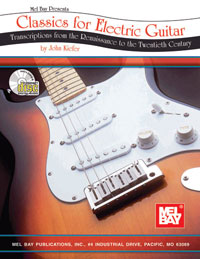
CLASSICS FOR ELECTRIC GUITAR John Kiefer LIBRO CD TABLATURE GIUSEPPE VERDI-DEBUSSY-BACH

CLASSICS FOR ELECTRIC GUITAR, John Kiefer. SHEET MUSiC BOOK with CD & GUITAR TABLATURE .

LIBRO DI MUSICA CLASSICA PER CHITARRA ELETTRICA CON CD,

SPARTITI PER CHITARRA. PENTAGRAMMA E TABLATURE.


Collezione delle trascrizioni "classiche" per la chitarra eletrica moderna. La selezione include alcune Fantasie per flauto di Telemann, C.P.E. Bach's Solfegietto, Saint Saens' Danse Macabre, Debussy's Syrinx e altri. Le tecniche chitarristiche comprendono alternate e hybrid picking, string skipping e sweep picking. Contiene CD con tracce bonus di altri proggetti del autore con Mel Bay.

A collection of "classical" transcriptions for modern electric guitar; selections include several of Telemann's flute Fantasias, C.P.E. Bach's Solfegietto, Saint Saens' Danse Macabre, Debussy's Syrinx and more. Guitar techniques involved include alternate and hybrid picking, string skipping and sweep picking in a time-tested context. Includes companion CD of the selections in a variety of settings. CD also features bonus tracks from the author's other Mel Bay projects.

Product Number: 98672BCD
Formato: Libro/CD

Contenuto:

Saltarello I -- Anonymous
Saltarello II -- Anonymous
Fantasia 1: Vivace -- G.P. Telemann
Fantasia XI: Allegro -- G.P. Telemann
Fantasia VIII: Largo -- G.P. Telemann
Fantasia VIII: Spirituoso -- G.P. Telemann
Fantasia X: A Tempo Giusto -- G.P. Telemann
Fantasia VI: Dolce -- G.P. Telemann
Trio from Suite in A Minor -- G.P. Telemann
Solfeggietto -- C.P.E. Bach
Danse Macabre -- Camielle Saint-Saens
Requiem Dies irae (opening) -- Guiseppe Verdi
Syrinx -- Claude Debussy

Prezzo: €29,99
€29,99

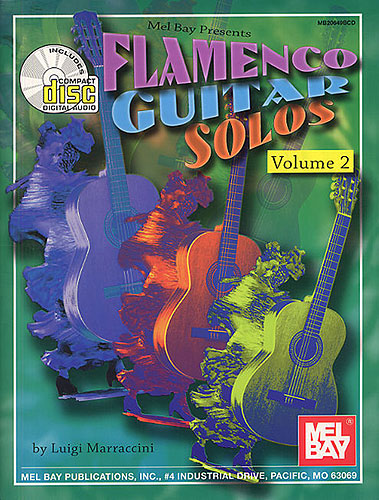
FLAMENCO GUITAR SOLOS VOLUME 2 Luigi Marraccini BOOK CD TABLATURE LIBRO SPARTITI CHITARRA

FLAMENCO GUITAR SOLOS VOLUME 2, Luigi Marraccini. BOOK WITH CD & GUITAR TABLATURE

LIBRO DI MUSICA FLAMENCO CON CD.

SPARTITI PER CHITARRA CON :

ACCORDI, PENTAGRAMMA, TABLATURE.  

Product Description:
This book will appeal to any guitarist intrigued by the soulful and magical sound of the flamenco guitar. Presents 10 engaging, intermediate to advanced flamenco guitar solos in traditional forms in standard notation and tab with performance notes. All selections appear on the book's companion CD. So grab your guitar and get into flamenco, the musical heart of Spain!
Format: Book/CD Set
Publisher: Mel Bay Publications, Inc.

Contents:

Verdiales -- Luigi Marraccini
Bulerias Jerezanas -- Luigi Marraccini
Granadinas -- Luigi Marraccini
Zambra -- Luigi Marraccini
Alegrias -- Luigi Marraccini
Serranas -- Luigi Marraccini
Tanguillos -- Luigi Marraccini
Tientos -- Luigi Marraccini
Tangos -- Luigi Marraccini
Malaguena -- Luigi Marraccini

Prezzo: €24,99
€24,99

POPULAR GUITAR STYLES LATIN & SALSA Burkhard Buck Wolters FINGERSTYLE CD TABLATURE LIBRO

POPULAR GUITAR STYLES, LATIN & SALSA. Burkhard Buck Wolters. BOOK WITH CD & GUITAR TABLATURE

LIBRO DI MUSICA LATINA E SALSA CON CD.

SPARTITI PER CHITARRA FINGERSTYLE CON:

ACCORDI, PENTAGRAMMA E TABLATURE.


FOR FINGERSTYLE GUITAR 

Product Description:
Popular Guitar Styles: Latin & Salsa reflect recent popular styles and transfer them to classical or fingerstyle technique. Guitar players who want to add Latin and salsa music to their solo-repertoire will find an original and unique collection of compositions which will give joy to both players and listeners. The playing-level is intermediate to advance. Left-hand difficulties like barrés and stretches are minimized as much as possible to make it easy to make the music groove. Written in standard and TABLATURE notation.
Format: Book/CD Set


Buck Wolters belongs to the very small company of guitar players and composers who are familar with nearly every style. His authentic mix of jazz, world and latin music, combined with a mastery of classical guitar technique is very unique and outstanding. Born in 1961 in Dortmund, Germany, he began to play the guitar as an autodidact at the age of five. After hearing a recording of Big Bill Broonzy he took his first guitar lessons at the age of thirteen, digging into the blues for several years. At the age of sixteen he went to the conservatory in his hometown where he studied classical guitar. The music of Agustin Barrios, Heitor Villa-Lobos and David Qualey were his main influences. After leading the life of a busker in his twenties, he went to the School of Arts in Amsterdam to study jazz guitar and composition and spent most of his time then copying jazz solos from musicians like John Coltrane, Keith Jarrett, Pat Metheny and Wes Montgomery. He completed his studies as a bachelor with distinction. Today Buck Wolters is very busy performing, composing, recording and teaching throughout Europe. His greatest success belongs to his composition "Dshamilja" ordered in commission by the Opera of Frankfurt.

Since latin music is very popular today, many fingerstyle or classical guitar players want to add it to their repertoire. These five compositions are intended for those players. Because of the complexity of latin rhythms, special attention should be placed on the independence between the right-hand thumb (bass pattern) and the other right-hand fingers (chord pattern or melody lines). So most of the focus is put on right-hand coordination, while left hand difficulties like stretches or use of the barre are minimized in the compositions. The introduction of each composition (first 4 to 16 bars of each piece) represents the typical rhythmic motion of the certain styles, which are characterized by three elements: 1. The clave (Spanish "key" or "code"), a rhythmic pattern of two bars, which must be kept up throughout the entire piece. Since the clave can be referred to rythmically as the "heart" of each latin style, it is mostly played on good, audible, high-pitched percussion instruments (e.g. woodsticks). Many styles can be recognized by an additional typical percussion pattern (e.g. Bolero and Merengue).

2. The bass pattern.

3. The piano or rhythm guitar pattern.

Practical advice on learning the pieces:

1. Listen to the cd several times.

2. Try to clap the clave of each piece along with the cd. (See the condensed rhythmic pictures on the following pages!)

3. Once you have the clave down try to add your feet tapping on beats "one" and "three".

4. Hit the rhythm of the bass pattern on your body. Once you have it down try to add your feet on "one" and "three".

5. Try the same with the piano/rhythm guitar pattern.

6. Learn the intro of each piece by heart before you start working through the entire piece. This guarantees your ability to keep up the rhythmic feeling of the piece while working through it.

7. Dance to the music and have fun.


Contents:

Luna Cubana -- Buck Wolters
Zapato Blanco -- Buck Wolters
El Alma de Agustin -- Buck Wolters
Bella Bailadora -- Buck Wolters
Merenguitis -- Buck Wolters

Prezzo: €21,99
€21,99

DADGAD Understanding For Fingerstyle Guitar Doug Young CD TABLATURE LIBRO CHITARRA METODO

DADGAD Understanding For Fingerstyle Guitar. Doug Young. BOOK WITH CD & TABLATURE

LIBRO METODO DI MUSICA PER CHITARRA ACUSTICA IN ACCORDATURA DADGAG, CON CD
SPARTITI CON: ACCORDI, PENTAGRAMMA, NOTE, TABLATURE.

MANUALE, METODO, STUDIO, 

Product Description: 144 pages.
Understanding DADGAD is a complete introduction to using the DADGAD tuning for fingerstyle acoustic guitar. The book systematically explores the tuning, starting with simple chords and scale patterns, ultimately showing how DADGAD can be used to play in nearly any key and in many different musical styles. Topics include moveable and open-string chords and scales, intervals, the harp-effect, common chord progressions in DADGAD and more, all in the context of either short musical examples or complete tunes.

Rather than just providing scales, chords, or tunes, this book guides the reader through the process of understanding the guitar from the perspective of DADGAD tuning. Topics are organized as a series of small self-contained sections ideal for a single study session or lesson. After exploring extremely easy ways to get started with DADGAD, involving as little as a single finger on the fretting hand, the book progresses to examples that will interest even more advanced players. 200 musical examples, including several full performance-quality pieces, demonstrate each concept. The companion recording features the author playing many of the examples.

A complete introduction to DADGAD tuning for fingerstyle acoustic guitar.
Begins with simple chords and scale patterns and progresses to more complex musical examples in many different keys.
Topics include moveable and open-string chords and scales, the harp-effect, intervals, common chord progressions in DADGAD and more.

Book/CD Set

Contents:

INTRODUCTION
Tuning In DADGAD
How To Use This Book
GETTING STARTED
Three Easy Chords
Playing Simple Melodies
Improvising With Third String Melodies
Improvising In Other Keys
Improvisation Examples
Learning More Chords
Simple Scale Patterns
Minor Scale Patterns
Putting It All Together
LEVERAGING STANDARD TUNING
Using Standard Tuning Chord Shapes In DADGAD
Creating Chords By Shifting Strings
Moveable Chord Forms
Converting Scales From Standard To DADGAD
Creating Blues Scales In DADGAD
The CAGED System
CAGED In DADGAD
Putting It All Together
INTERVALS AND HARMONY
Introducing Intervals
Harmonizing With Thirds
Harmonized Thirds On The Fourth And Fifth Strings
Harmonized Thirds On The Third And Fourth Strings
Harmonized Thirds On Second And Third Strings
More Harmonized Thirds
Harmonizing With Sixths
Applying Sixths
Harmonizing With Tenths
Tenths As Skeletal Chords
Using Tenths With Open Strings
Unisons
Octaves
Octave Examples
Putting It All Together
TRICKS AND TECHNIQUES
Cross-String Patterns
Slurs And Cross-String Patterns
More Cross-String Picking Patterns
Parallel Harmony
Cheater Chords
Harmonics
Harmonic Patterns
Hammer-Ons And Pull-Offs
Percussive Techniques
Ten Things You Can’t Do In Standard Tuning
Putting It All Together
CHORD PROGRESSIONS
The Blues Progression
Blues Progression With Minimalist Chords
The II-V-I Progression
Moveable II-V-I Chord Patterns
Altered Chords
Rhythm Changes
Rhythm Changes Using Open String Chords
SCALES AND ARPEGGIOS
Movable Major Scales
Learning Scale Forms
Scale Patterns
Minor Scales
Movable Minor Scales
Minor Scale Patterns
Cross-String Scales
Minor Cross-String Scales
Cross-String Examples
Arpeggios
Cross-String Arpeggios
EXPLORING DIFFERENT KEYS
C Major
D Major
D Minor
F Major
G Major
G Minor
A Major
A Minor
B Flat Major

Prezzo: €29,99
€29,99

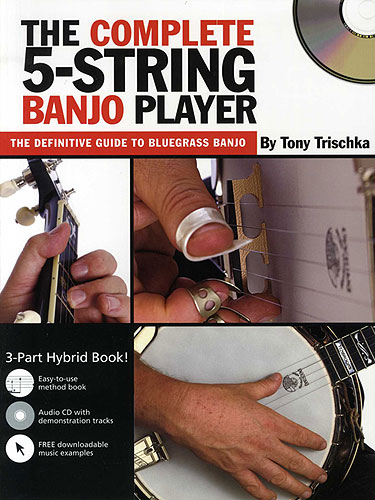
COMPLETE 5-STRING BANJO PLAYER Tony Trischka CD TABLATURE LIBRO SPARTITI METODO

COMPLETE 5-STRING BANJO PLAYER, Tony Trischka. CD TABLATURE

LIBRO METODO DI MUSICA, CON CD.

SPARTITI PER BANJO CON: 

ACCORDI, DURATA DELLE NOTE E TABLATURE. 

TECNICA, MANUALE DIDATTICO, NUMEROSE FOTOGRAFIE.  


Written by Tony Trischka, one of the leading authorities in banjo education, The Complete 5-String Bluegrass Banjo Player sets the standard for bluegrass banjo instruction from beginning to advanced. From holding the banjo and reading tablature to melodic banjo style and standard bluegrass repertoire, this book is the definitive guide to learning authentic bluegrass technique. The audio CD includes demonstration tracks of the music examples, techniques, and songs.

The Complete 5-String Bluegrass Banjo Player features include:
All bluegrass techniques
Scale patterns
Chords illustrated with photographs and diagrams
New and clear engravings
Composition and Arranging
Improvisation techniques
The most influential banjo players' styles
And more! 254 pages.


Complete song list for "The Complete 5-String Banjo Player": 

Buffalo Gals
Amazing Grace
Shortenin' Bread
Cripple Creek
Good Night Ladies
Roving Gambler
Loch Lomond
Shady Grove
Hard, Ain't It Hard
Skip To My Lou
Wildwood Flower
Little Maggie
Dance
Corn Liquor
Boil 'Em Cabbage Down
Red River Valley
Spanish Fandango
My Bonnie Lies Over The Ocean
Long Journey Home
John Hardy
Whoa Mule, Whoa
Train 45
Salty Dog
Devil's Dream
Chipping Norton
Camptown Races
Arkansas Traveler
Salty Dog
Nine Pound Hammer
Pretty Polly
Old Dan Tucker
Snuffy's Sally Goodin'
Little Maggie
That Daring Young Man On The Flying Trapeze
Down In The Valley
Drunken Hiccups
Felipe's Waltz
Reuben
Banks Of The Ohio
Coal Creek March
Noah Came To Eden
Cold Dime
Soldier's Joy
Bluesy Reuben
Cumberland Gap
Sugar Baby
Bunnies In The Springtime
Etude Brute
Turkey In The Straw
You Are My Sunshine
Hard, Ain't It Hard
Joni Mitchell Etude
Old Joe Clark
Blackberry Blossom
Ida Red
Cotton Eyed Joe
June Apple
One String Reel
Cluck Old Hen
Train 45
Heather's Reel
Winnipeg Waddle
Railroad Bill
Swing Low, Sweet Chariot
Salty Dog
Turkey Knob
Banjo Boy Chimes
Bill Cheatham
Old Cane Pole
John Hardy
Red Haired Boy
Angeline Baker
Nine Pound Hammer
Funky Mountain Special
He Came From North Carolina
Sourwood Mountain
Good Liza Jane

bury me beneath the willow

you are my sunshine

blues

zoe's step dance

salt river

sean's top O' the morning 

Prezzo: €42,99
€42,99

TWO TO TANGO AND MILLENNIUM DUET GUITAR DUETS COMPOSED Jorge Morel LIBRO CD SPARTITI

TWO TO TANGO AND MILLENNIUM DUET, COMPOSED by Jorge Morel. CD

LIBRO DI MUSICA CON CD, SPARTITI PER DUE CHITARRE. PENTAGRAMMA . 


Product Description:
These two pieces for classic guitar duo were composed for the Hanser-McClellan Guitar Duo. "Two to Tango" is a tango rhapsody for two guitars using mainly tango rhythm combined with that of the milonga, another Argentinean dance closely related to the tango. The interaction of the two guitars playing single lines at times and then changing roles between the melody and the rhythm makes it more interesting for both players. "Millennium Duet" was written as a homage to Chet Atkins. The piece opens with a brief reflection of country and western rhythmic ideas, with a melody of a different character. It later moves on to other patterns, at times combining some Latin American rhythms with a little touch of jazz harmony. This book includes two separate guitar parts and a combined score written in standard notation only. The companion CD features the premiere recording of the pieces by the Hanser-McClellan Guitar Duo.

Prezzo: €21,99
€21,99

A CHRISTMAS PASTORALE arranged Michael Newman & Laura Oltman CD DUO SPARTITI SILENT NIGHT

A CHRISTMAS PASTORALE, arranged by Michael Newman & Laura Oltman. SHEET MUSIC BOOK WITH CD & STANDARD NOTATION.

LIBRO DI MUSICA CLASSICA CON CD. 

SPARTITI PER DUO DI CHITARRE CON: PENTAGRAMMA.  

MUSICA SACRA, NATALE. 


Product Description:
Celebration of the Christmas holiday includes a rich musical tradition. For this score and accompanying CD, the internationally-renowned Newman & Oltman Guitar Duo presents a ravishing collection of sacred music written for Advent, Christmas, and Epiphany. The duo has chosen music from six centuries in a wide variety of musical styles, including familiar Christmas tunes, little-known gems, and interesting variations on familiar themes written by such composers as Bach, Handel, Pachelbel, Mendelssohn, and Brahms. Selections range from beautiful Renaissance tunes suitable for beginning guitarists to concert repertoire for advanced players.

From Canta No. 147, Jesu, Joy of Man's Desiring -- Johann Sebastian Bach, Arranged by Michael Newman and Laura Oltman
From Cantata No. 140, Wake, Awake -- Philipp Nicolai, Arr. by Michael Newman and Laura Oltman
From Cantat No. 140, Zion Hears the Watchmen Singing -- Johann Sebastian Bach, Arr. by Michael Newman and Laura Oltman
Chorale: Wake, Awake -- Philipp Nicolai, Arr. by Michael Newman and Laura Oltman
The Holly and the Ivy -- Arranged by Michael Newman and Laura Oltman
From William Ballet's Lute Book (Lulla, Lulla) -- Arranged by Michael Newman and Laura Oltman
I am so Glad each Christmas Eve -- Arranged by Michael Newman and Laura Oltman
Chorale: (Lo, how a Rose e'er blooming) -- Arranged by Michael Newman and Laura Oltman
Chorale Prelude: Op. 122 Lo, how a Rose e'er blooming -- Johannes Brahms, arranged by Michael Newman and Laura Oltman
The Son of Mary -- Edited by Michael Newman and Laura Oltman
Chorale: Dearest Emmanuel -- Arranged by Michael Newman and Laura Oltman
Chorale: A Child is born to us -- Johann Sebastian Bach, arranged by Michael Newman and Laura Oltman
From Christmas Concerto - Adagio-Allegro-Adagio -- Arcangelo Corelli, arr. by Michael Newman and Laura Oltman
From Christmas Concerto -- Arcangelo Corelli, Arr. by Michael Newman and Laura Oltman
O Come, O Come, Emmanuel -- Arranged by Michael Newman and Laura Oltman
There is No Rose -- Arranged by Michael Newman and Laura Oltman
Greensleeves (What Child is This?) -- Arranged by Francis Cutting, Trans. by Michael Newman and Laura Oltman
Chorale: A Boy born in Bethlehem -- Johann Sebastian Bach, Arr. by Michael Newman and Laura Oltman
Joy to the World! -- George Frideric Handel, Arr. by Michael Newman and Laura Oltman
Chorale: From Heaven Above -- Martin Luther, Arr. by Michael Newman and Laura Oltman
Chorale Prelude: From Heaven Above -- Johann Pachelbel. Arr. by Michael Newman and Laura Oltman
Hark! The Herald Angels Sing -- Felix Mendelssohn-Bartholdy, Arr. by Michael Newman and Laura Oltman
From Pageant of the Shearmen and Tailors Coventry Carol -- Arranged by Michael Newman and Laura Oltman
Chorale: The Newborn Child -- Melchior Vulpius, Arr. by Michael Newman and Laura Oltman
Chorale: In Sweet Jubilation -- Arr. by Michael Newman and Laura Oltman
Prelude: In Sweet Jubilation -- Arr. by Michael Newman and Laura Oltman
From Cantata No. 208 Sheep May Safely Graze -- Johann Sebastian Bach, Arr. by Michael Newman and Laura Oltman
From Messiah Pifa -- George Frideric Handel, Arr. by Michael Newman and Laura Oltman
Silent Night -- Arr. by Michael Newman and Laura Oltman

Prezzo: €29,99
€29,99
Condividi contenuti