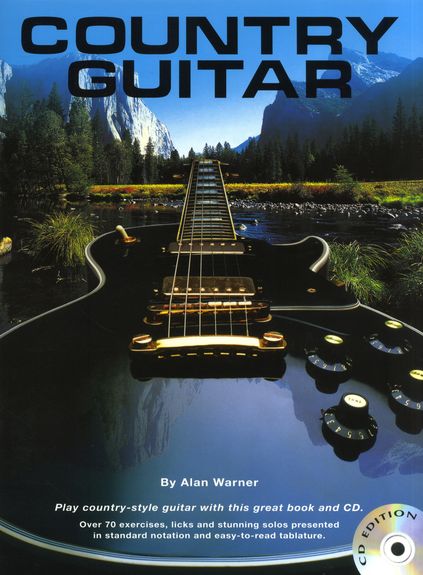
COMPLETE COUNTRY GUITAR BOOK. Fred Sokolow. CD TABLATURE
Product Description:
This book is an encyclopedia of Carter flatpicking style back-up, bluegrass back-up, Carter flatpicking style lead, Doc Watson-style lead, Clarence White-style bluesy lead, Atkins/Travis fingerpicking style, rockabilly guitar style, Nashville lead styles, and Western swing. The tunes and exercises in the book are included on the CD. Fred introduces each tune with page numbers to locate the corresponding material in the text. Stereo split track recordings allow you to hear the guitar through one speaker, separate from the band. In notation and tablature.
Product Number: 93935BCD
Format: Book/CD Set
ISBN: 0786628413
UPC: 796279042567
ISBN13: 9780786628414
Series: Complete
Publisher: Mel Bay Publications, Inc.
Date Published: 11/11/1997
Song Title: Composer/Source:
Amazing Grace Arr. By: Fred Sokolow
Arkansas Traveler Arr. By: Fred Sokolow
Banks Of The Ohio Arr. By: Fred Sokolow
Beautiful Brown Eyes Arr. By: Fred Sokolow
Bluegrass Back-Up Arr. By: Fred Sokolow
Bury Me Beneath The Willow Arr. By: Fred Sokolow
C & W Vamp Arr. By: Fred Sokolow
Can The Circle Be Unbroken Arr. By: Fred Sokolow
Careless Love Arr. By: Fred Sokolow
I Am A Pilgrim Arr. By: Fred Sokolow
I Never Will Marry Arr. By: Fred Sokolow
Jimmie's Blue Yodel Arr. By: Fred Sokolow
Just A Closer Walk With Thee Arr. By: Fred Sokolow
Lonesome Road Blues Arr. By: Fred Sokolow
Luther's Walk Arr. By: Fred Sokolow
Nine Pound Hammer Arr. By: Fred Sokolow
Railroad Bill Arr. By: Fred Sokolow
Red Apple Juice Arr. By: Fred Sokolow
Rockabilly Rave-Up Arr. By: Fred Sokolow
Rockin' With Carl Arr. By: Fred Sokolow
Roll In My Sweet Baby's Arms Arr. By: Fred Sokolow
Sally Goodin Arr. By: Fred Sokolow
Scotty's Boogie Arr. By: Fred Sokolow
Shamblin' Along Arr. By: Fred Sokolow
Soldier's Joy Arr. By: Fred Sokolow
Steel Bending Arr. By: Fred Sokolow
Take This Hammer Arr. By: Fred Sokolow
Talking Guitar Blues Arr. By: Fred Sokolow
The Great Speckled Bird Arr. By: Fred Sokolow
Turkey In The Straw Arr. By: Fred Sokolow
Wabash Cannonball Arr. By: Fred Sokolow
Wildwood Flower Arr. By: Fred Sokolow
Worried Man Blues Arr. By: Fred Sokolow
Wreck Of Old 97 Arr. By: Fred Sokolow
INTRODUCTION
Country guitar means a lot of things to different people. To some it's the easy strumming
of Hank Williams; to others it's Albert Lee or Jerry Reed playing a hot electric lead in a con-
temporary C&W tune; to still others it's Mother Maybelle Carter picking the "Wildwood Flower,"
Eldon Shamblin playing jazzy riffs on Bob Wills' "San Antonio Rose, " Lester Flatt backing up
Earl Scruggs on the "Foggy Mountain Breakdown, " or Carl Perkins rocking out, hillbilly
style, on "Blue Suede Shoes."
And there are still more performers who shaped the diverse traditions and styles of
country guitar playing: Jimmie Rodgers, Doc Watson, Merle Travis and many more.
All the traditions sparked by these major artists are very much alive. Listen to a country
radio station for an hour and you'll hear most of the above-mentioned styles demonstrated by
lead and back-up guitarists. Your enjoyment of one or two of these traditions prompted you to
pick up this book.
A discography at the end of "The Complete Country Guitar" will help you put these musical
influences in historical perspective. More importantly, the body of the book shows you how to
play in the styles of all these artists. Everything from mountain music to the modern Nashville
sound is examined. Licks and s cales are diagrammed and written out in music and tablature,
and a recording enables you to listen to all the tunes and musical examples while studying
the charts and paperwork. (The greatest pickers of all time learned by listening to records
and imitating them -- and few of them ever had any written aids.)
If you're a beginner, you'll want to start with the basics (tuning up, playing simple chords
and strums); otherwise you can open up to the chapter on your favorite type of country music ...
listen to the recorded tunes on the recording .... study the notes and diagrams that precede the
accompanying music and tab ... and finally, comparing the music/tab to the recording, play
like Clarence White or James Burton.
Whether you're a professional picker looking for some new licks or just someone who
wants to pick and sing some country favorites, I hope you find something useful and enjoyable
in this gold mine of guitar riffs.
SONGBOOKS
Countless songbooks are available that contain your favorite country tunes with
the words and music. Since most of them include chord grids, you can learn songs
from them. Just figure out (by ear or trial and error) which strum fits a given tune,
and read the chord grids while you strum. If the song is written in a difficult key
(Eb or B, for example) you can use the transposing method in the MUSIC THEORY
APPENDIX to change the key, or you can use a capo to make difficult keys easy.
HOW TO USE A CAPO
Various capos, made of rubber, metal and plastic are available at guitar stores. They depress
all of the guitar strings at whichever fret the capo is placed, which then raises the guitar's pitch.
If you playa G chord with the capo on the 2nd fret (acting as though the fret in front of the capo
were the 1st fret of the guitar), it's the same pitch as an A chord-because A is two frets higher
than G.
One of the capo's main uses is to enable you to raise a song's key (e. g. from G
to A) and still play in the original key's chord fingerings. This is handy if a song is
written in G but you can sing it better in A; or if you learned an arrangement using
G fingering but need to sing in a higher key. Here are some other situations in which
the capo is handy:
1. If a song is written in a difficult key (Ab or B, for example), or if someone's
singing voice calls for a difficult key, pick a nearby easy-to-play-in- lower
key and capo up the difference between the two keys. To play in Ab: G is one
fret below Ab, so capo up one fret and play G fingering. (You can use the
transposing method in the MUSIC THEORY APPENDIX to change all the
chords in the tune from the original key to the capoed key. ) To play in B: A
is two frets below B, so capo up two frets and play A fingering.
2. If you want to play higher up the neck - for variety's sake, or to sound different
from another guitar - but you want to stay in a given key: use the same
process as above. For instance, to playa tune in E, higher up the neck: C is
four frets below E, so capo up four frets and play in the key of C (using the
transposing chart if you need to). To play in G, way up the neck: D is five
frets below G, so capo up five frets and play in D.
PRACTICING SUGGESTIONS
Practice your chords and strums by playing along with the tunes on the recording.
Whether a song is an exercise in fingerpicking or electric lead styles, you can
accompany it with the strums in this chapter. The music /tab will tell you which chords
to play and your ear will tell you whether the rhythm is a country shuffle, waltz or
country frock beat.
It's also excellent practice to try to find by ear the appropriate strums and chords
to familiar songs. From childhood on, we all learn hundreds of nursery rhymes,
folk songs and country and pop tunes, most of which only use three or four chords.
Hunt for these - trusting your ear - on your guitar.
Try using songbooks or sheet music to learn some simple tunes. Once you know
the changes* to a tune, the best way to smooth out your rhythm and chord-changing
technique is to play with another guitarist -- especially one whose playing is at a
slightly higher level than yours. This can be demanding on both of you at times, but
it can also be a lot of fun.
Changes" = the musician's shortened term for "chord changes."
CONTENTS
INTRODUCTION .
HOW TO READ TABLATURE.
BEGINNINGS
TUNING UP
FIRST POSITION CHORDS
HOW TO HOLD A FLATPICK .
STRUMMING PATTERNS
SONGBOOKS
HOW TO USE A CAPO
PRACTICING SUGGESTIONS
CARTER·STYLE BACKUP
THE CARTER·STYLE LICK
BASS RUNS (BURY ME BENEATH THE WILLOW IN 5 KEYS)
I NEVER WILL MARRY
AMAZING GRACE
JIMMIE RODGERS-STYLE BACKUP:
JIMMIE'S BLUE YODEL. .
HAMMERING·ON
PULLING-OFF
TAKE THIS HAMMER
I NEVER WILL MARRY
TALKING BLUES (TALKING GUITAR BLUES)
BLUEGRASS BACKUP
THE G RUN
MORE TAGS
EXTRA RHYTHM STROKES
LESS STROKES
ENDINGS
BANKS OF THE OHIO
ROLL IN MY SWEET BABY'S ARMS
WABASH CANNONBALL
AMAZING GRACE
CARTER·STYLE LEAD
FIRST POSITION MAJOR SCALES
G MAJOR SCALE & WILDWOOD FLOWER
C MAJOR SCALE
WABASH CANNONBALL & D MAJOR SCALE
THE GREAT SPECKLED BIRD
A MAJOR SCALE & WRECK OF OLD 97
E MAJOR SCALE & CAN THE CIRCLE
BE UNBROKEN
A WALTZ·TIME CARTER-STYLE LEAD:
BEAUTIFUL BROWN EYES
DOC WATSON-STYLE LEAD
FAST FLATPICKING TECHNIQUE
FIDDLE TUNES
SOLDIER'S JOY
TURKEY IN THE STRAW
ARKANSAS TRAVELER
SALLY GOODIN
EMBELLISHING A SIMPLE MELODY:
WRECK OF OLD 97 (PART I)
WRECK OF OLD 97 (PART II)
LONESOME ROAD BLUES
FLATPICKING EXERCISES
CLARENCE WHITE-STYLE BLUESY LEAD
BLUE NOTES (FLAT 3RDS. 5THS & 7THS)
CHOKING THE STRINGS
LONESOME ROAD BLUES
CROSSPICKING
NINE POUND HAMMER
RED APPLE JUICE
CROSSPICKING PATTERNS
FINGERPICKING MERLE TRAVIS CHET ATKINS-STYLE
FINGERPICKS
FINGERPICKING PATTERNS:
RAILROAD BILL .
I AM A PILGRIM
BASS RUNS & FINGERPICKING: .
I AM A PILG RIM
FINGERPICKING MELODY
RAILROAD BILL .
BANKS OF THE OHIO .
WORRIED MAN BLUES .
FANCIER FINGERPICKING & BANJO
ROLLS: WORRIED MAN BLUES .
MOVEABLE CHORD & HOW TO USE THEM .
FINGERPICKING ALL OVER THE FRET-
BOARD: I AM A PILGRIM .
CARELESS LOVE .
JUST A CLOSER WALK WITH THEE .
ROCKABILLY A LA SCOTTY MOORE & CARL PERKINS .
SCOTTY'S BOOGIE (pART I)
SCOTTY'S BOOGIE (PART II) .
THE MOVEABLE BLUES SCALE: .
ROCKIN' WITH CARL
BOOGIE WOOGlE BASS PATTERNS: .
ROCKIN' WITH CARL (BACKUP)
ROCKABILLY RAVE-UP .
CARELESS LOVE .
NASHVILLE LEAD STYLES .
CHORD FRAGMENTS HANK SNOW-STYLE:
WABASH CANNONBALL .
BURY ME BENEATH THE WILLOW .
CHORD FRAGMENT MAJOR SCALES: .
GREAT SPECKLED BIRD .
C & W VAMP .
SOME NEW F·FORMATION LICKS AND
A JAMES BURTON-STYLE SOLO .
BEAUTIFUL BROWN EYES
I NEVER WILL MARRY .
CHICKEN PICKIN' & SLIDING SCALES: .
RED APPLE JUICE .
ROLL IN MY SWEET BABY'S ARMS
MORE STRING-BENDING WITH THE SLIDING
SCALE: STEEL BENDING (pART I) .
PEDAL STEEL LICKS: .
STEEL BENDING (PART II)
NINE POUND HAMMER .
SOME PRACTICE SUGGESTIONS
THE LUTHER PERKINS-STYLE BACKUP
LICK: LUTHER'S WALK .
WESTERN SWING .
SALLY GOODIN
TAKE THIS HAMMER
A DIMINISHED SCALE .
WHEN TO USE THE DIMINISHED SCALE .
SHAMBLIN' ALONG
CARELESS LOVE .
TEXAS-STYLE CHORD COMPING: .
SALLY GOODIN BACKUP
MORE ABOUT PASSING CHORDS:
SHAMBLIN' ALONG BACKUP .
CARELESS LOVE BACKUP
EQUIPMENT APPENDIX .
GUITARS & STRINGS
AMPS & ELECTRICAL EQUIPMENT .
MUSIC THEORY APPENDIX .
NOTES ON THE GUITAR FRETBOARD
MAJOR SCALE & INTERVALS
CHORDS
CHORD FAMILIES & TRANSPOSING .
HOW TO PRACTICE WITH RECORDS .
DISCOGRAPHY .

 Italiano
 English