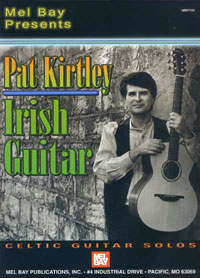
IRISH GUITAR Celtic Guitar Solos, Pat Kirtley. CD TABLATURE
LIBRO PER CHITARRA CON TABLATURE E CD
transcribed by John Roberts & Mark Pritcher
Product Description:
World traveling fingerstyle guitarist Pat Kirtley presents 17 solo guitar arrangements of traditional Irish tunes including a few original compositions in the same vein by himself, Pierre Bensusan, and Duck Baker. As all of the tunes in this 1997 recording were arranged in altered tunings (DADGAD, EADEAE or DADEAD), each appears in both standard notation and tablature with insightful performance notes. In general, these transcriptions from Pat Kirtley’s 1997 album of the same title are extremely accurate; The Red-Haired Boy, however, played as a duet with Steve Rector on the album - appears as a solo arrangement in this book. Recommended for the intermediate to advanced player, the author provides insightful performance notes for each tune.
Format: Book/CD Set
Song Title: Composer/Source:
Blind Mary Turlough O'Carolan
Chase the Weasel Pat Kirtley
Fannie Power Turlough O'Carolan
Finn MacCool's Reel Pat Kirtley
Lord Mayo Arr. Davey Graham
Moran's Return Arr. Pat Kirtley
Morgan Magan Turlough O'Carolan
Planxty Irwin Turlough O'Carolan
Rodney's Glory Arr. Pat Kirtley
Sergeant Early's Dream Arr. Pat Kirtley
Shi Beg Shi Mhor Arr. Pat Kirtley
The Blarney Pilgrim Arr. Pat Kirtley
The Last Pint Pierre Bensusan
The Pretty Milkmaid Arr. Pat Kirtley
The Rakes of Waterloo Duck Baker
The Red-Haired Boy Arr. Pat Kirtley
The South Wind Arr. Pat Kirtley
Voyage for Ireland Pierre Bensusan
REVIEWS OF PAT KIRTLEY'S IRISH GUITAR
(from the Boston Irish Reporter / January 1998)
Irish Guitar Pat Kirtley / Mainstring Music
That O'Carolan's music continues to remain part of the tradition is evident in the fact that every Irish guitarist's repertoire includes O'Carolan pieces. Pat Kirtley's latest recording is a testament to that as it contains five of the itinerant harper's compositions. Kirtley, the 1995 National Fingerstyle Guitar Champion, has his roots in the music of his native Kentucky and his two previous CD's
highlighted the traditional American musical styles he grew up with.
This wonderful recording, his first foray into Irish music, is all solo acoustic guitar except when joined by Mark Cannon's flute on O'Carolan's Blind Mary and Steve Rector's guitar on the 'Kentuck-ification' of the well known Red-Haired Boy. New compositions like Kirtley's own Finn MacCool's Reel as well as two pieces by French guitarist Pierre Bensusan help to lend balance to the recording which relies heavily on the tried and true Irish guitar repertoire like Si Beag Si Mhor, The South Wind and Fannie Power. It is Kirtley's masterful playing though, which stands out and begs to be listened to. On his lovely first foray into the world of Irish music, Kirtley has produced a winner and a must-have for any fan of Celtic guitar.
(from Dirty Linen Magazine Nov '97 issue)
Pat Kirtley / Irish Guitar
Irish Guitar features 17 instrumentals, mostly traditional, by fingerstyle guitarist Pat Kirtley. Kirtley is firmly rooted in the Pierre Bensusan, John Renbourn, Duck Baker school of playing. The tunes are given an honest airing, never hurried, letting the melody lines develop fully. Even though most of the tunes have been done dozen's of times elsewhere, Kirtley's interpretations shine a fresh light
on them. A joy to listen to and one of the best albums of traditional guitar I've heard.
(from Acoustic Guitar Magazine April '98 issue)
Pat Kirtley / Irish Guitar
Kirtley's nimble and heartfelt renderings of 17 traditional and Irish and Irish-influenced tunes are a delight. The sway of John Renbourn, Duck Baker, and Pierre Bensusan is obvious, yet Kirtley articulates the emotional quality of each piece (the deep melancholy of "The Pretty Milkmaid", the agile gaiety of "Rodney's Glory") according to his own vision and sensitivity. The solo guitar format is nicely augmented on "Blind Mary" by by Mark Cannon on Irish wooden flute, and by guitarist Steve Rector on a spirited "Red Haired Boy". A generous portion of Turlough O'Carolan makes this a potent listening experience.
-Jim Ohlschmidt
(from Fingerstyle Guitar Magazine July/August '97 issue)
Irish Guitar
It's been a couple of years since Pat Kirtley's last CD. His current offering, Irish Guitar, is well worth the wait. This hefty collection of 17 tracks of mostly traditional tunes is ingeniously arranged and brilliantly played by one of the emerging stars of the fingerstyle world. -James Jensen
(from Guitar Magazine December '97 issue) "-Best of 1997-"
PAT KIRTLEY Irish Guitar (Mainstring Music)
Despite having won the National Fingerpicking Championship with his rip-snorting version of "Ghost Riders In The Sky:' Pat Kirtley's fingerpicking forte remains his delicate touch combined with subtle and craft-laden melodic invention. This is exhibited in abundance on his new recording, Irish Guitar, a collection of 17 drop-dead gorgeous arrangements of mostly solo, well-known airs.
dances, and songs from the Celtic side of acoustic guitar repertoire. Each piece is artfully rendered and beautifully recorded, and
Kirtley's arrangements are nonpareil. Witness his version of the chestnut "The Pretty Milkmaid," which, in Kirtley's hands, is transcendent.
-Jon Chappell. Guitar Magazine
PAT KIRTLEY AND IRISH GUITAR
Pat is a gifted performer who blends a rich Southern musical heritage with modern imagination and masterful contemporary technique. As a creator of new acoustic music, Pat has penned a virtual library of fresh, lyrical compositions for guitar. His talents won him the title of US National Fingerstyle Champion in 1995, and his playing has since garnered international praise. His CD Kentucky Guitar was named one of the "Top 59 Acoustic Albums of the Year" by Japan's Player Magazine, and he's been hailed as one of "The Next Generation: Hot New Acoustic Acts for the Millenium" by Acoustic Guitar Magazine. In 1999 Pat was selected as the cover feature of the German Akustik Gitarre magazine, Europe's largest acoustic guitar publication. A recent tour of Japan and China included an appearance as headliner of the Japan National Fingerpicking Day festival in Tokyo. Pat is also known and respected as a guitar educator, traveling thousands of miles each year in the USA and presenting musician workshops internationally for Taylor Guitars, conducting master classes, and producing acclaimed instructional videos.
The 1997 CD Irish Guitar represents Pat's favorite pieces from the world of Irish jigs, reels, airs, and dances. "I've collected these tunes in my head and on guitar for years." says Kirtley. "Traditional Irish music is important, and I wanted to create new arrangements that do justice to these beautiful melodies and rhythms."
Tunes in the collection include a lively, up-tempo Morgan Magan, one of four pieces here by 17th century composer O'Carolan, and a Kirtley composition, Finn MacCool's ReeL,which also appears on a Narada Recordscollection entitled "Dance of the Celts". Earle Hitchner, well-known Celtic music journalist, writing about Finn MacCool's ReeLfor Narada, said "Pat creates a remarkable effect through the largerthan- usual intervals he's written into the melody. These spacious, skillfully etched tones evoke the image of Finn MacCool, an Irish mythological giant whose American counterpart would be Paul Bunyan, stepping across Ireland. It's a quietly impassioned tour de force..." Also in the collection are evocative slow melodies, like Moran'5 Return, Blind Mary, and The Pretty Milkmaid. Kirtley: "These are unforgettable melodies with an indefinable aura of sadness. Much of the traditional Irish music, especially the dance music, has an exuberant, happy energy, but the slow airs move right to the heart with a strength that cannot be expressed in words. It's powerful music."
Irish Guitar is a solo guitar project, without overdubs, with the exception of two duos. Celtic multiinstrumentalist Mark Cannon and award-winning guitarist Steve Rector,join Kirtley for duets on Blind Mar, and a rousing bluegrass-crossover version of The Red-Haired Boy.
PERFORMANCE NOTES FOR IRISH GUITAR
I spent more than five years gathering, learning and arranging these tunes. During that time I listened
to groups like the Bothy Band, the Chieftains, DeDanaan, the Tannahill Weavers, and to individual
musicians like Alisdair Fraser, Tim Britton, Tommy Peoples, Sharon Shannon-fiddlers, pipers, whistle
players, and button accordianists. I paid attention to the elemental guitarists of the genre; Dave Evans,
Davey Graham, Duck Baker, John Renbourn, Pierre Bensusan, and Pat Kilbride. I began attending Irish
sessions" whenever possible, and learned how to join in with the guitar and become part of the sound. I
played gigs with pipers and fiddlers. These experiences became part of the preparation for recording Irish
Guitar.
Some of the arrangements are challenging, and some are relatively easy. They all demand attention to
detail, and a sense of the basic elements of Irish traditional music-melody, ornamentation, and rhythmic
'groove'.
Note: Many of the tunes featured here appear on the videos "Ramble to Cashel" and "The Blarney
Pilgrim" on DVD and VHS from Vestapol Videos (available through Mel Bay). The videos were filmed "for
guitarists" with good shots of the fretboard and hands, and watching them will help in learning these tunes
(as well as show you some other great players in action).
THE TUNES:
Morgan Magan
This is a challenging piece to learn. It should be played at a brisk tempo, which can only be built up
over time, so don't be impatient. The technique includes a few finger stretches (as in measure 4) and a
couple of potentially awkward passages in terms of left hand fingering (for instance, measures 25-27).
The Last Pint
This is a reel by Pierre Bensusan. When I first heard it played on his 1987 album "Spices", I wondered
how anyone could playa tune like that. At first hearing it seemed like a barrage of notes, but I liked it. I
didn't try to play it at first. When I heard Pierre do it in a concert later, he took off way too fast and did a
hyper-speed version of it. Afterward I thought, if he can do it 3x as fast as he originally recorded it, I should
be able to do it 1x as fast! This tune imitates the style of bagpipes, with large melodic leaps and
characteristic ornamentation. The ending run (measure 75) is a "cascading arpeggio" which is played with
the right hand pattern i-p-m (index-thumb-middle) in a repeating pattern.
Blind Mary
A slow, stately melody where every note counts!
Moran's Return
I recorded this tune at capo 3 so it would be in the key of F like the fiddle version I learned it from. It
works fine with no capo (key of D) too.
Finn MacCooI's Reel
The C part (beginning measure 24) was the most difficult for me to learn well, I think mostly because
I was impatient with it. Working on this tune slowly will prove worthwhile.
Lord Mayo
Beautifully arranged in EADEAE by Davey Graham, this is one of the first Irish tunes I ever learned. It
is easy to play, but demands attention to make it flow and to play it expressively.
Rodney's Glory
This one is a real challenge. I use my left hand thumb to fret many of the notes on the 6 th
string. At the beginning of the B part (measure 11), keep a barre across 3 strings at fret 7 with your index finger. Then in the middle of the next measure, you slide the barre down to the 5 th
fret. The rest of the B part is playable but tricky because the melody jumps all over the place and doesn't stick to a standard scale. Just work through it very slowly and don't give up!
Voyage for Ireland
Originally titled in French "Voyage pour L'lrlande", this a beautiful, atmospheric piece written by Pierre Bensusan. It's a good example of how the D minor tonality works in DADGAD. I always hold the F bass note (6 th string 3 rd fret) with my left hand thumb when the melody is on the top string.
The Blarney Pilgrim
The difficulty in playing this arrangement is in the right hand. It is necessary to use the thumb and all three fingers (i-m-a), and there's no repeating right hand pattern to simplify things. Try to work out the fingering so as to avoid getting your fingers in a knot. To memorize this piece and play it fluidly, you'll have to memorize the right hand fingering as well as the left, and work on keeping your thumb thumping away on a muted low D for rhythm.
Shi Beg Shi Mhor
I arranged this piece with the capo on the 4 th fret purely for the harplike tone it affords. The resulting key of F# isn't conducive to ensemble playing of the tune! If you play with others, the natural key is D (no capo).
The Red-Haired Boy
There must be an easier way to play this tune than the leaps and jumps required by the EADEAE
tuning, but it sounded so good that I decided to keep it there. It does offer a distinctive sound, and the melody is clear. I always hold the 6 th string G note (3 rd fret) with my left hand thumb. On the album, I am joined by Steve Rector in a duet, but the arrangement here works fine as a standalone fingerstyle piece.
Fannie Power
The arrangement of this O'Carolan tune is straightforward and uses the technique of playing alternate notes on fretted and open strings for maximum sustain, to get a harplike quality.
Planxty Irwin
This is one of O'Caroian's most beautiful melodies, arranged in the tuning DADEAD. Pay attention to the bass progression in measures 46-49.
The Rakes of Waterloo
Duck Baker originally composed this tune in Drop D tuning, but it also works in DADGAD. The intro is played freely and slowly, and then the tune itself is a jig with a strong rhythmic pulse. Much of the melody is played on the lower strings, and you have to be careful to make the melody come out clearly while thumping away on the bass string. I recorded this tune as a set with Chase the Weasel, and the interlude at the end (measure 42) is the segue between the two. You can also play either one as a standalone.
Chase The Weasel
There is a technique in this tune that is not obvious from the written score. It is a percussive right hand "smack" of the strings where you brush the string or strings with the top side of the fingernail in a downward motion. The first place it appears is halfway through measure 5, the 2 nd
"7" on the top string. If you listen to the recording, you will notice several places where this technique is used instead of the normal upward stroke of the right hand fingers.

 Italiano
 English