LIBRO CON CD

HILAND JOHNNY LICKS & TRICKS VOL.2 LIBRO CD TABLATURE CHITARRA COUNTRY B-BENDER

HILAND JOHNNY, LICKS & TRICKS VOL.2. CD TABLATURE

LIBRO DI MUSICA, SPARTITI PER CHITARRA CON CD E TABLATURE. 


Product Description:
Recorded lessons from one of America's greatest guitarists Johnny Hiland teaches essential Licks and Tricks every great country player should know. Lessons in standard notation and TAB with complete audio instruction.

Song Title:
B-Bender Chord Licks
B-Bender Licks
B-Bender Licks Without Using The B-Bender
Bending Behind The Nut
The Funky Chicken Lick
The Tractor Trailer Lick
Train Whistle Lick

Prezzo: €23,99
€23,99

HILAND JOHNNY LICKS & TRICKS VOL.1 LIBRO CD TABLATURE CHITARRA COUNTRY

HILAND JOHNNY, LICKS & TRICKS VOL.1. CD TABLATURE

LIBRO DI MUSICA, SPARTITI PE CHITARRA CON CD E TABLATURE. 

Product Description:
Recorded lessons from one of America's greatest guitarists Johnny Hiland teaches essential Licks and Tricks every great Blues and Rock player should know. Lessons in standard notation and TAB with complete audio instruction.

Song Title: Composer/Source:
Bending Blues Licks Johnny Hiland
Blues Rhythm Pattern Johnny Hiland
Classic Blues Licks Johnny Hiland
Heavy Metal Style Harmonics Johnny Hiland
Pick-Hand Finger Tapping Johnny Hiland
Slide Licks in Standard Tuning Johnny Hiland
Slide/Rhythm Licks in Open G Tuning Johnny Hiland

Prezzo: €24,99
€24,99

SMOOTH JAZZ PIANO CD HAL LEONARD KEYBOARD comping soloing scales chords harmony voicings

SMOOTH JAZZ PIANO. CD

Smooth Jazz Piano
Keyboard Style Series
Series: Keyboard Instruction
Format: Softcover with CD
Author: Mark Harrison
Artist: Various

This comprehensive book and CD package will teach you the basic skills you need to play smooth jazz piano. From comping to soloing, you'll learn the theory, the tools, and the tricks used by the pros. The accompanying CD features many of the examples in the book performed either solo or with a full band. Specifically, you'll learn: scales and chords, harmony and voicings, progressions and comping, rhythmic concepts, melodies and soloing, characteristic stylings, the history of jazz, and more. THE HAL LEONARD KEYBOARD STYLE SERIES provides focused lessons that contain valuable how-to insight, essential playing tips, and beneficial information for all players. Comprehensive treatment is given to each subject, complete with a companion CD with 89 tracks. 

Inventory #HL 00311095
ISBN: 9780634073946
UPC: 073999048414
Width: 9.0"
Length: 12.0"
80 pages

Prezzo: €19,99
€19,99

ESSENTIAL BLUES GUITAR Dave Celentano Centerstream Publications BOOK CD TABLATURE CHITARRA LIBRO

ESSENTIAL BLUES GUITAR, Dave Celentano. SHEET MUSIC BOOK WITH CD & GUITAR TABLATURE .

Series: Guitar
Publisher: Centerstream Publications
Medium: Softcover with CD
Composer: Dave Celentano

This handy guide to playing blues guitars emphasizes the essentials, such as: chord changes, scales, rhythms, turn arounds, phrasing, soloing and more. Includes lots of examples, plus 10 rhythm tracks for soloing and improvising. 80 pages. 

Prezzo: €99,95
€99,95

STRIDE & SWING PIANO John Valerio Hal Leonard Keyboard Style Series CD LIBRO PIANOFORTE BOOGIE WOOGIE

STRIDE & SWING PIANO. John Valerio. CD

Hal Leonard Keyboard Style Series
Series: keyboard instruction
Medium: Softcover with CD
Author: John Valerio

Focusing on styles such as classic ragtime, early blues & boogie woogie, New Orleans jazz, stride and swing, this new book/CD pack in the Hal Leonard Keyboard Style Series teaches left- and right-hand techniques including chords, bass runs, patterns and more. Key players of these styles Scott Joplin, Jimmy Yancey, Pete Johnson, Jelly Roll Morton, James P. Johnson, Fats Waller, Teddy Wilson and Art Tatum are prominently referenced. Includes 14 full songs to play, and an accompanying CD! 96 pages


INTRODUCTION
Welcome
to Stride and Swing Piano! This book is an in-depth look at early solo jazz
piano styles from the 1900s to the 1940s. Many pianists know the term stride as an accompaniment
technique in which the left hand alternates between a bass note and a
chord in an "oom-pah, oom-pah" manner. But stride was also the label given to a style of piano
music that emerged in the 1920s. This was an early form of jazz that evolved from predecessors like
ragtime, blues, and New Orleans style, and culminated in the swing style of the 1930s and' 40s.
Most of the early jazz piano styles up to and including swing piano feature this striding left-hand
motion.
This book traces the evolution of stride and swing piano styles-from their predecessors to their
fullest development; each chapter focuses on a particular style and player:
Classic Ragtime: Though not jazz per se, ragtime was an important forerunner, serving
as a model for styles like New Orleans and stride. Invented by Black Americans, ragtime
emerged during the 1890s and was a strictly written music with formal and rhythmic constraints.
Scott Joplin was its most famous composer.

Blues & Boogie Woogie: Also invented by Black Americans (in the 1800s), blues
was another important forerunner of stride and swing jazz styles. A looser music, blues had
its own melodic material, accompaniment style, and rhythmic feel. Jimmy Yancey was a premiere
blues pianist; Pete Johnson was a well-known player in the faster, boogie woogie style.

New Orleans Jazz: In the early 1900s, New Orleans pianists developed jazz, a style that
merged ragtime with blues, and added improvisation. Jelly Roll Morton was the most important
early jazz pianist. He loosened the "even subdivisions" of ragtime and made jazz swing.

Stride: Stride was a fast, virtuosic piano music born in Harlem during the 1920s and' 30s.
Early stride,
ala James P. Johnson, was more appropriately called "Eastern ragtime" than
later stride, which evolved into a lighter, smoother music, as played by Fats Waller.

Swing: Swing emerged during the mid '30s with jazz big bands. The driving accents of
stride were ironed out, and an even 4/4 pulse became the norm. Teddy Wilson best represented
the swing style; Art Tatum took it to its highest point.

The one element that all of these styles have in common is the almost continuous playing of the
pulse (on every beat) by the left hand. This was accomplished by: 1) bass note vs. chord alternation,
2) the playing of bass lines, or 3) the continuous playing of chords.
Modern jazz piano styles have done away with the left hand's time keeping role [or the most pat1,
and contemporary players are often at a loss when called upon to play the left hand in an older solo
style. Stride and Swing Piano offers an introduction to the usage of traditional left-hand devicesincluding
characteristic chord voicings and bass note intervals, such as octaves and tenths-as well
as right-hand techniques such as single-note lines, chord voicings, intervals, mns, and improvisation.
Each chapter culminates in one or more original tunes demonstrating the style and its techniques.
Practice suggestions are also included. The reader is encouraged to learn and study these
tunes, and to apply all of the techniques in the book to standard jazz and pop songs of the era.
About the CD
The accompanying CD features many of the examples in the book-including 14 original tunesperformed
on solo piano. Listen to the CD to better understand each style and to practice your
own solo playing.


Early jazz had always been evolving on two simultaneous fronts-as a small ensemble
music, and as a solo piano music. By the mid 1930s, ensembles were changing. Jazz
bands were growing larger, into "big bands"-essentially, hybrids of the jazz combos and
larger dance bands of the '20s. Along with the transition from smaller to larger groups, a
"smoothing out" process took place in the music, and a distinctly new piano style emerged.
One crucial defining characteristic of swing* music is the evenness of all four beats played by the
rhythm section. The rhythm sections of the big bands used a bassist who usually played on all
four beats of the measure, laying down an even 4/4. This was different from the tuba or bass
players of older New Orleans style, who usually played on beats I and 3, with occasional walking
fills. The epitome of a swing rhythm section was Count Basie's band; they played all four beats
of each measure with such evenness and precision they sound like one person.
Swing pianists were caught between two worlds. Still rooted in the stride/ragtime model, they
began exploring new ways to establish the 4/4 pulse while freeing up the left hand. Swing demanded
a lighter touch and a looser feel; the driving accents of stride piano were ironed out.
Although the left hand still relied on an oom-pah striding motion, dynamic levels became more
consistent for bass notes and after-chords. So-called "walking bass" lines became commonplace.
The consummate swing pianist was Teddy Wilson (1912-1986). His playing represents the highest
cultivation of the pure swing style. Balance and restraint characterize his approach. Classically
trained, Wilson had a refined sense of touch. His technique was supple, and his music, subtle.
One reason for the lighter touch of the swing pianists was the use of the microphone; the earlier
jazz pianists had to pound on the piano to be heard within a group setting. Wilson gained notoriety
when he teamed up with clarinetist Benny Goodman and drummer Gene Krupa to form the
Benny Goodman Trio. This group was historically important not only for the great music they
created but also for being the first publicized interracial jazz performing group. The fact that this
trio had no bass player is a testament to Wilson's astounding left-hand technique and conception.
Wilson played solo piano in much the same way as he approached playing with a group.
*The term swing as used here refers to the style of jazz that evolved from the mid 1930s to the mid' 40s. It should not be confused
with the more general use of the word denoting the rhythmic conception associated with most jazz.
Left-Hand Techniques
Most of the left-hand techniques used by swing pianists were already used by the late stride players.
As with earlier styles, the left hand mostly kept time by playing the quarter-note pulse.
Crucial differences were that now all of the beats were played with equal stress, the touch was
much lighter, and the feeling was more relaxed. The hard-driving left hand of the stride pianists
was replaced by a steady, relaxed groove. There was also a difference in when and how often the
swing pianists applied each left-hand technique. These newer approaches are described in the following
pages.


CONTENTS

1 CLASSIC RAGTIME .
Scott Joplin

2 BLUES & BOOGIE WOOGIE
Jimmy Yancey & Pete Johnson

3 NEW ORLEANS JAZZ .
Jelly Roll Morton

4 STRIDE PIANO I.
James P. Johnson

5 STRIDE PIANO II.
Fats Waller

6 SWING PIANO I .
Teddy Wilson

7 SWING PIANO II .
Art Tatum
 

Prezzo: €18,99
€18,99

THE BEST OF BLUES GUITAR SIGNATURE LICKS Step-By Styles Techniques of Blues Legends LIBRO CD TABLATURE

THE BEST OF BLUES GUITAR, SIGNATURE. CD TAB.

A Step-By-Step Breakdown of the Guitar Styles and Techniques of the Blues Legends
Series: Signature Licks Guitar
Softcover with CD - TAB
Author: Dave Rubin

Learn the trademark riffs and licks of the blues masters with this informative book/CD pack. Features lessons on 12 classics:

All Your Love (I Miss Loving) (Otis Rush) - Boom Boom (John Lee Hooker) - Born Under a Bad Sign (Albert King) - Cross Road Blues (Crossroads) (Eric Clapton) - Pride and Joy (Stevie Ray Vaughan) - (They Call It) Stormy Monday (Stormy Monday Blues) (T-Bone Walker) -The Thrill Is Gone (B.B. King), and more.

All Your Love (I Miss Loving)
Boom Boom
Born Under A Bad Sign
Catfish Blues
Collins' Mix
Cross Road Blues (Crossroads)
I Smell A Rat
I'm Tore Down
It Hurts Me Too
Pride And Joy
(They Call It) Stormy Monday (Stormy Monday Blues)
The Thrill Is Gone

56 pages

Prezzo: €21,00
€21,00

ROCKIN' THE BLUES-The Best American and British Blues-Rock Guitarists: 1963-1973 CD TABLATURE SPARTITI

ROCKIN' THE BLUES, The Best American and British Blues-Rock Guitarists: 1963-1973. BOOK WITH CD & GUITAR TABLATURE

LIBRO METODO DI MUSICA BLUES, CON CD. 

SPARTITI PER CHITARRA CON: 

ACCORDI, PENTAGRAMMA, NOTE, TABLATURE. 

METODO, MANUALE, STUDIO, TECNICA. 


Lessons - Music - Historical analysis - rare Photos
Series: Guitar Educational
Softcover with CD - TABLATURE
Author: Dave Rubin

Take a journey inside the blues with Dave Rubin's latest book, Rockin' the Blues: 1963-1973. This seminal 10 years produced some of the most influential blues-rock guitarists of all time. Learn about the lives of these trail-blazing guitarists, their individual styles, accomplishments, and techniques, then play along with the accompanying CD and taste the magic yourself. Each chapter delves into the world of a key blues-rock guitarist from this period, with rare photos, historic insights, interviews, and guitar solos written in standard notation and tablature and performed by a full band on the included audio CD. Explore this exciting time in music history with a book that covers it like no other. Artists covered include: Duane Allman, Jeff Beck, Roy Buchanan, Eric Clapton, Alvin Lee, Keith Richards, Robbie Robertson, and others. 104 pages

ROCKIN' THE BLUES: From the U.S. to the U.K.

The history of the blues is laced with irony. The national tragedy of the transatlantic slave trade begun in the 1600s sought to deprive Africans of their culture, but inadvertently exposed them to European musical traditions and instruments that led to the birth of the blues in the American south circa 1890. Some in the Anglo population had their ears open early on as evidenced by a white man, Arthur Seals, beating W.e. Handy to the distinction by just two months with the first published blues, "Baby Seals' Blues" in 1912. After "Crazy Blues" by Mamie Smith was recorded in 1920 there began a lengthy period of the blues as an integral component in the African-American community until it was superseded by soul music in the early 1960s. Throughout this entire period of time most, though certainly not rdl, white listeners in America applied basically benign neglect to the blues. By the early 1950s, however, white country musicians in the South began incorporating blues licks and phrasing into a new, embryonic form of music as yet unnamed. Often they learned directly from their black neighbors or family employees out in the sticks. Merle Travis, Chet Atkins, and Scotty Moore were some of the earliest and most prominent, with Moore applying his seamless blending of country and blues licks to the music of an ambitious young man in the summer of 1954. The greasy, astoundingly charismatic singer Elvis Presley was joined by Moore and upright, "doghouse" bassist Bill Black at Sun Studios in Memphis, and their revolutionary hybrid of hillbilly boogie and blue would eventually come to be called rockabilly a few years later. In fact, it was the official, if not absolute, beginning of rock 'n' roll as a style of music and as an unprecedented youth movement. Other white cats like Carl Perkins, Jerry Lee Lewis, Dale Hawkins (whose 1957 recording of "Suzie-Q" featured James Burton's seminal blues-rock licks), Roy Orbison, and even Johnny Cash would build on Presley's success. Meanwhile, Chuck Berry was concurrently combining blues with country and western music and swing jazz (by way of jive-talking shuffler Louis Jordan) to create a distinct style that rocked and swung, and his influence on rock is inestimable. In addition, the chugging boogie blues of Jimmy Reed would also exert a considerable effect on both future American and English blues-rockers. It took some time for the I-IV-V progressions of 1950s rock 'n' roll to give way to a new form of rocked up blues in the early 1960s. Roy Buchanan in the Washington, D.e. area, Robbie Robertson in Toronto, and Lonnie Mack in Cincinnati, to name three of the most prominent, began bringing an edge and energy to their version of the blues rarely found outside of black blues guitarists like Lafayette "Thing" Thomas and Auburn "Pat" Hare. Keenly aware of the potential contained in the right combination of axe and amp, they were the sonic pioneers who would fry their vacuum tubes in order to achieve the thick, overloaded sound that would thrill fans and fellow musicians alike. The blues-based San Francisco bands like Big Brother and the Holding Company, Creedence Clearwater Revival, Quicksilver Messenger Service, the Steve Miller Band, and the early Santana band that arose in the mid-1960s (and contributed so much to the music of the counterculture movement in the latter part of the decade) also understood that the "medium (loud, distorted guitars) was the message." Technology played a significant part because as the amps got bigger, so did the sound, and savvy guitarists got hip to the fact that they could riff and solo with the expressiveness and power that had previously been the domain of honking tenor saxophonists. Perhaps no one delivered this powerful, earth-shaking message better than Jimi Hendrix, at once a true hluesman and blues-rock icon. The Allman Brothers Band with dual axemen Duane Allman and Dicky Betts were arguably the most important American group to bring all the elements together in an accessible style also steeped in authentic blues roots. Still at it after thirty-five years, they spawned a new genre known as Southern Rock that was in fact, blues-rock with a Dixie accent. Lynyrd Skynyrd, the Marshall Tucker Band, 38 special


TABLE OF CONTENTS


Introduction

John McVie Interview 

Scales for Blues-Rock Guitar 

Duane Allman

Jeff Beck

Roy Buchanan

Eric Clapton

Rory Gallagher

Billy Gibbons

Peter Green

Bugs Henderson

Alvin Lee

Steve Miller

Jimmy Page

Keith Richards

Robbie Robertson

Mick Taylor

Mick Taylor Interview

Leslie West

Guitar Notation Legend 

Prezzo: €31,99
€31,99

GUITAR ATLAS: MIDDLE EAST Jeff Peretz CD TABLATURE MAROCCO ALGERIA EGITTO SUDAN TURCHIA ISRAELE KUWAIT

GUITAR ATLAS: MIDDLE EAST. Jeff Peretz. CD TABLATURE

LIBRO PER CHITARRA CON CD, IN NOTAZIONE E TABLATURE

Guitar Atlas: Middle East
By Jeff Peretz

SERIES: National Guitar Workshop
CATEGORY: Guitar Method or Supplement
FORMAT: Book & CD

The Guitar Atlas series is your passport to a new world of music. Learn the characteristic rhythms and techniques of some of the world's most remarkable guitar music, discovering the history, origins, and pioneering artists of distinctive styles from around the globe.

This introduction to the exotic music of Algeria, Egypt, Israel, Kuwait, Morocco, Nubia, and neighboring regions includes insights into cultural and religious influences and the major musicians of each locality. Discover unique plucked instruments, the Arabic tone system and exotic scales, and open your mind to new forms of improvisation that will forever alter your approach to soloing. The examples and compositions throughout all 48 pages are presented in standard notation and TAB and demonstrated on an enclosed CD.


An introduction to the exotic and exciting music of:
Algeria
Morocco
The Bedouins
Nubia
Egypt
Sudan
Israel
Turkey
Kuwait
and more
Examples in standard music notation and TABLATURE
JEFF PERETZ


Jeff Peretz, author of Zen and the Art of Guitar, takes you on a whirlwind tour of the exotic and diverse music of the regions of "The Dry World": Mashrig ("where the sun rises" in the Eastern Mediterranean), Mahgrib ("where the sun sets" in North Africa), the Arabic peninsula, and Asia Minor. The roots of the wonderful musical traditions from the Middle East are taught in a way the contemporary guitarist can understand, including cultural and religious infiuences, unique plucked instruments (predecessors of the guitar), the major musicians of the region, the Arabic tone system,and exotic scalesand forms. Discover the basicsofTaqsim, an improvisatory form that will open your mind to a new dimension in music,forever altering your approach to guitar soloing.
The CD demonstrates all the examples and compositions featured in the book.


INTRODUCTION
This book assumes that you are an intermediate guitarist with the ability to read guitar tablature and/or standard music notation. You should have a good grasp of basic music theory, including scales and chords. You should also have some experience using scales to improvise, although the style you prefer to play is not important.
With this book, you'll be learning to create new sounds that will stretch your imagination, and the imaginations of your listeners.
About the Written Music in This Book The written examples printed in this book are doorways into the performance of this music. The key that unlocks them, however, is the CD. The musics of the Middle East are aural traditions, and capturing them in writing is only partially possible. While the written music examples are not literal transcriptions of the performances on the CD, they will serve as maps to what you are hearing.


HISTORY
Music has been on the planet longer than humans have been recording them history.
Archeologists have discovered musical instruments dating back almost 30,000 years; many
believe that music may even predate human speech. Ancient Mesopotamia (modern day
Iraq) is believed to be where it all started.
The Middle East is the birthplace of many things in this world, from civilization and
religions to paper, our alphabet and recorded history (not to mention calendars and
time keeping). It should come as no surprise that the Middle East is also a birthplace of
improvised music. The music of the region that we call the Middle East is a tradition
that has been cultivated for thousands of years. It is mentioned in the Bible and has been
academically documented since the late 6th century. Many styles which are still played
today date back as far as the Sassanid Dynasty (Persia, 224-651 A.D.), the Byzantine
Empire (4th-5th century) and earlier. The concept of using a stringed instrument as a
vehicle for melodic improvisation comes from these ancient stYles.
To truly understand how the music of the region evolved, we must paint a picture of
what life was like during pre-Islamic Arabia. The era that predated Mohammed and the
birth of Islam was a time of tribal unions, trade routes and gypsies. From North Africa
through the Eastern Mediterranean coast up to the Caspian and Aegean seas, and as
far east as the Zagros mountains and the Iranian Highlands, life was defined by tribal
association. Its story was told through the sung poetry known as Laya/i. The sung poetry
was often accompanied by an ud (also spelled oud) or other string instruments that were
light and portable and could be carried easily in a trade caravan.
There were three ways in which people lived in the early days of the Middle East. One
either lived in an urban center such as Baghdad or Damascus, a rural region as a farmer
or a shepherd, or you were a nomad (Bedouin/Gypsy) and traveled the land according
to the seasons and trade. While each way of life had its own unique contribution to the
musical development of the region, the concept of using a group of notes (scale) as a basis
for free expression (solo) is a common theme in the ancient music of the Middle East.
The ud, along with the tanbar, saz, bazooki, tar and setar, all precursors to the guitar, are
the key instruments in the development of melodic plucked string improvisation. The
approach to playing these instruments is the genesis of the way we play the guitar today.
In other words, this is where the pre-historic Hendrixs and Wes Montgomerys came
from. It is the birthplace of the guitar solo.


ABOUT THE AUTHOR
PRONUNCIATION GUIDE/GLOSSARY

CHAPTER I-Introduction
History
Geography: Four Regions
Musical Diversity of the Four Regions
Religious/Cultural Influence
The Guitar/Instruments
The Arabic Tone Systems

CHAPTER 2-The Maqam Phenomena
How the Maqam Are Created (Tetrachords)
Maqam Playable by the Guitar
Taqsim
Temple of Dum 15
Harmonic Major/Harmonic Minor Modulation
People of the Dark (Modulation)
Daftze's Dilemma

CHAPTER 3-Wasn Rhythm .
Basic Belly Dance Rhythms .
Belly Dance Excerpt .
Maqsum Belly Dance .
Morrocan 6 .
Cafl Shohor 9 .
CHAPTER 4-Musical Forms and Styles .
Sung Poetry .
Oriental Art Styles .
Sama-I. .

CHAPTER 5-Modern Middle Eastern Styles .
Rai .
2:30 A.M .
Other Styles and Artists .
Rosh Shel Lee (My Head) .

APPENDIX: Middle Eastern Tonal Systems .
The Persian Dhagsta System .

The author wishes to thank his wife, Neta, and his children Maya and Zohar, for their
patience and support.

A compact disc is included with this book. This disc can make learning with
the book easier and more enjoyable. The symbol shown at the left appears
next to every example that is on the CD. Use the CD to help ensure that
you're capturing the feel of the examples, interpreting the rhythms correctly,
and so on. The track number below the symbol corresponds directly to the
example you want to hear. Track 1 will help you tune your guitar to this CD. Have fun!
 

Prezzo: €16,00
€16,00

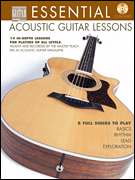
Magazine, ESSENTIAL ACOUSTIC GUITAR LESSONS CD TABLATURE CELTIC- RHYTHM-BASICS-LEAD-HAWAIIAN

acoustic guitar magazine, ESSENTIAL ACOUSTIC GUITAR LESSONS. CD TABLATURE

LIBRO CON CD, IN NOTAZIONE E TABLATURE

8 FULL SONGS TO PLAY

BASICS

RHYTHM

LEAD

EXPLORATION

Essential Acoustic Guitar Lessons
14 In-Depth Lessons for Players of All Levels
Series: String Letter Publishing
Publisher: String Letter Publishing
Format: Softcover with CD - TAB
Author: Various Authors

Inventory #HL 00695802
ISBN: 9780634068355
UPC: 073999958027
Width: 9.0"
Length: 12.0"
66 pages

This book/CD pack offers a superb selection of lessons and songs for the acoustic guitar, expertly played by teachers on the accompanying CD. It includes exercises, licks and 8 full songs to play, in standard notation and tablature with chord diagrams. The CD includes two versions of each song: one played slowly and the other, up to tempo. The book is divided into four main sections: Basics - covering the fretboard, barre chords and flatpicking; Rhythm - bluegrass in dropped D, bass lines, classic pop changes; Lead - Celtic jigs, melodic improvisation, soloing with arpeggios; and Exploration - capo use, Hawaiian slack key, classical etude variations; and modal harmony. Players of all levels will find lessons to benefit them. 66 pages


Introduction

There
has never been a better time to play the guitar! Guitar makers call this the Golden Age of Lutherie for good reason; it's a time where players of all levels can find high-quality guitars in an price range. But this era could just as easily be called the Golden Age of Guitar Instruction. Never before have we had so many high-quality instructional materials and accurate song transcriptions for virtually any style of music. In Essential Acoustic Guitar Lessons, the experienced teachers at Acoustic Guitar offer up something for everyone. The Basics section will help you learn the notes on the guitar's fret board and get started with barre chords and flatpicking. More advanced lessons include styles as diverse as jazz improvisation, Celtic jigs, slack-key guitar, alternate tunings, and more. You'll even learn how to play your guitar like a bass, if the need arises! If one style particularly grabs you, log on to where you'll find a multitude of books delving into specific styles and techniques. So pick up your guitar, and let's get started!
Andrew DuBrock Music Editor


DAVID HAMBURGER
David Hamburger is a performer and writer who lives in Austin, Texas. He has been playing
folk and blues music since first picking up the guitar at the age of 12 and has been on the
faculty of the National Guitar Workshop since 1988. Hamburger's guitar, slide guitar, and
Dobro playing can be heard on his solo albums King of the Brooklyn Delta (Chester, 1994)
and Indigo Rose (Chester, 1999), as well as on numerous other independent recordings.
Hamburger is the author of many books, including The Acoustic Guitar Method, and has
contributed dozens of lessons and articles to Guitar Player and Acoustic Guitar magazines.
For a discography, performance schedule, and other information, visit his website at

KAREN HOGG
Karen Hogg is a multi-instrumentalist, music teacher, yoga teacher, and freelance writer living
in New York City. She has written two instructional books for Workshop Arts/Alfred
Publishing: Women in Rock and Guitar Made Easy. Hogg has been teaching for ten years and
is an instructor at the National Guitar Summer Workshop and the American Institute of
Guitar. She performs regularly on guitar and mandolin in various country and rock bands
around New York.

PAUL KOTAPISH
Paul Kotapish started playing guitar in bands shortly after he first heard the Beatles on his
transistor radio. He has toured the globe and recorded numerous albums with Irish fiddler
Kevin Burke, the Hillbillies from Mars, and Wake the Dead an acoustic ensemble that meshes Grateful Dead songs with traditional Irish music. During the day he messes around on computers doing forensic multimedia work for an Oakland,
California law firm.

TONY MARCUS
Tony Marcus plays lead guitar and violin in the '30s and '40s swing band Cats and Jammers,
which records for the Tuxedo label (2557 Wakefield Ave., Oakland, CA 94606). He's also
played with the Arkansas Sheiks, the Cheap Suit Serenaders (featuring counter-culture cartoonist
Robert Crumb), and the Royal Society Jazz Orchestra.

PETER MULVEY
Peter Mulvey began his musical career playing guitar in the subways of Boston and on the
streets of Dublin. Since those early busking days, he has recorded four critically acclaimed
albums (his latest, Ten Thosand Mornings, was released in 2002) and has captivated audiences
across the U.S. and Ireland with his intelligent lyrics and percussive, inventive guitar
work. You can find him.


CONTENTS

CD Track List
Introduction
Music Notation Key
About the Teachers

BASICS

Unlocking the Fretboard - KAREN HOGG

Barre Chords - DAVID HAMBURGER

Flatpicking 101 - DAVID HAMBURGER
Blackberry Blossom

RHYTHM
Bluegrass in Dropped D - HAPPY TRAUM
Angel Band

Bass Lines for Guitarists - PAUL KOTAPISH
Levis Beaulieu

Classic Pop Changes - ANDREW DUBROCK

Swing Voice Leading - TONY MARCUS

LEAD

Celtic Jigs - DAVID SURETTE
Coleraine/Monferrine

Melodic Improvisation - CHRIS GRAMPP

Soloing with Arpeggios - JAMIE FINDLAY

EXPLORATIONS

Getting Low Lows with a Partial Capo - PETER MULVEY

Hawaiian Slack Key - KEOLA BEAMER
A Grandmother's Wish
Wa'apa

Classical Etude Variations - MARK SMALL
Prelude

Modal Harmony - SCOTT NYGAARD
Winter Waltz 

Prezzo: €20,99
€20,99

GUITAR ATLAS: INDIA Sanjay Mishra LIBRO CD TABLATURE devotional north

GUITAR ATLAS: INDIA. Sanjay Mishra. CD TABLATURE

LIBRO CON CD, IN NOTAZIONE E TABLATURE

By Sanjay Mishra
SERIES: National Guitar Workshop
CATEGORY: Guitar Method or Supplement
FORMAT: Book & CD

The Guitar Atlas series is your passport to a new world of music. Learn the characteristic rhythms and techniques of some of the world's most remarkable guitar music, discovering the history, origins, and pioneering artists of distinctive styles from around the globe.

Whether you play jazz, rock, blues, or any other style, the beautiful musical language of India will infuse your playing with a new, unique flavor. Explore ornamentation, modes, and rhythms of folk music from Darjeeling, Assam, Bengal and other regions. Learn how ragas are structured, and discover the subtle, graceful improvisational art form of Hindustani music. The examples and compositions throughout all 48 pages are presented in standard notation and TAB and demonstrated on an enclosed CD.

In November 2006, Guitar Atlas: India and its author Sanjay Mishra were featured on NPR radio's "Sanjay Mishra: A Cross-Cultural Exploration in Music."


SANJAY MISHRA
 The most important elements of Indian music, including:
- Folk Music
- Devotional Music
- Ragas, the classical music of India
- Ornamentation, modes (thaats) rhythms (taals)

 Examples in standard music notation and TABLATURE


Visit the exotic land of India through its exciting and beautiful

musical language.Sanjay Mishra. who first came to public acclaim

for his album "Blue Incantation" with guitarist Jerry Garcia of

The Grateful Dead, makes this mysterious body of music easy

to understand and play for contemporary guitarists. Learn folk

music from places like Darjeeling, Assam, Bengal,and Rajasthan;

devotional music of Rishikesh,and the Sufis;and even one of

Mahatma Gandhi's favorite songs.

You'll be introduced to Hindustani music,the classicalmusic

of North India,and learn how ragas are structured. A true

improvisor's art form, the subtlety and grace of Indian music

will infuse your playing- whether you play jazz, rock, blues or

any other style -with a new, unique flavor. Discover why some

of the greatest guitarists of our time have been drawn to this

unusual music.This thorough yet concise introduction will make

it fun and easy to get started playing music influenced by the

rich musical traditions of India.

The CD demonstrates all the examples and compositions featured in the book.


The lines between East and West are increasingly crossed and occasionally obliterated.

In this spirit, we will explore the modalities of the East on an instrument generally

thought of as Western. Not that it matters; music is an international language-like

mathematics, but with much more heart.

Before we can appreciate the emotional component of any style of music, we must learn

the rational aspects. This is the point of this book. It is a point of departure from which

you can take this music and give it life and meaning through your performance.

The musical examples presented in this book are arrangements. It assumes you:

- Read standard music notation and/or tablature.

- Have the ability to fingerpick simple arpeggios and chord/melody.

- Have a basic knowledge of music theory (scales and intervals).

This book is divided into three parts, each of which focuses on a different aspect of

Indian music: folk, devotional and classical. The first two parts, concerning folk and

devotional music, focus on songs with chordal accompaniment or repeating bass lines

and do not require extensive knowledge of the Indian system of music. The guitar is

very popular as an accompanying instrument in many forms of music in India.

The third part deals with the raga system of classical music-the "art music" of India.

To learn raga thoroughly, one must find a teacher. The nuances of this music cannot be

written down. Thus, the purpose of the raga chapter in this book is not to enable one

to perform a raga in the traditional sense, but to provide an insight into various modes

and their usage in a non-Western context. You can then use them as new colors in your

improvisation. Some Indian theory and historical background is provided, as well, to

help you understand some Eastern musical concepts. This chapter can only serve as an

introduction to this large body of music.

These three broad divisions of the book are almost independent of each other. Use them

in any order you like. The first two parts are more suited to a fingerstyle technique, the

third part can also be played with a pick.

A CD provides performances of all the examples in the book. The songs are played as

notated to help you get a feel for the sound and style. The performances of the ragas

on the CD will be very close to what is written in the book, but may not be exact. The

notation is just a skeleton, in keeping with the spirit of the music. Also, keep in mind

that real performances of ragas are quite extended, and these brief examples are just little

windows into the style. The CD also provides drones and backing percussion tracks for

the reader to improvise over. Feel free to try your own ideas!


ABOUT THE AUTHOR

INTRODUCTION


CHAPTER I-Getting Started

Tunings

Ornaments

Notation

Guitar Fingering

About the Drone

Indian Music Appreciation 101


CHAPTER 2-Folk Music of India

Chol Mini Assam Jabo

(Come Let Us Go to Assam)

Sohag Chand Baddni Nacho to Dekhi

(Let Me See you Dance in the Moonlight)

Folksongfrom Rajasthan


CHAPTER 3-Devotional Music in India

Om Jai Jagdish Hare

(Praise be The Almighty)

Raghupati Raghav Raja Ram

(Glory to Lord Ram, the Most Glorious

One of Ragu's Race)

Qawwali Tune

Dadra


CHAPTER 4-Hindustani Music-

The Classical Music of North India .

A Brief History .

Raga .

Some Important Aspects of Raga .

Form of a Raga .

Performing a Raga .

Classification of Ragas .

Permutations .

Rhythm in Indian Music .

Sample Ragas .

Raga Bageshri (Thaat Kafi) .

Raga Khamaj (Thaat Khamaj) .

Raga Scales .

Final Word .

References for Further Study .

Pronunciation Guide .


A compact disc is included with this book. This disc can make learning with

the book easier and more enjoyable. The symbol shown at the left appears

next to every example that is on the CD. Use the CD to help ensure that

you're capturing the feel of the examples, interpreting the rhythms correaly,

and so on. The track number below the symbol corresponds direcdy to the

example you want to hear. Track 1 will help you rune your guitar to this CD. Have fun!


Born in India and residing in the United States, guitarist-composer Sanjay Mishra

plays with an eclecticism well suited to his multicultural background. After completing

his studies at The Peabody Conservatory of Music, he began composing music

that combined Eastern and Western influences. In an interview with The Washington

Post, he explains "I come from a tradition that has a lot of improvisation. Sometimes

Western classical music can seem a little rigid, I had to find some middle ground."

Sanjay came to public acclaim with his highly-praised recording "Blue Incantation"

with Grateful Dead guitarist Jerry Garcia. His music has been released on Ryko,

PolyGram-Philips, Melodia (France), Putumayo World and others, as well as his own label, Akar.


ACKNOWLEDGEMENTS

My thanks to Nat Gunod, Samir Chatterjee, Barun Pal, Gus Wanner, Dr. Mark

Whitmire and Chris Hagan for their advice.

Prezzo: €15,99
€15,99
Condividi contenuti