LIBRO CON CD

MOCK DON MASTERING THE DOMINANT CHORD LIBRO CD TABLATURE SPARTITI METODO CHITARRA

MOCK'S DON, MASTERING THE DOMINANT CHORD. REAL-WORLD CONCEPTS AND TECHNIQUES FOR IMPROVISING. BOOK WITH CD & TABLATURE .

LIBRO METODO DI MUSICA, CON CD. MP3 AUDIO DI 2 ORE E MEZZA . 

SPARTITI PER CHITARRA :

ACCORDI, PENTAGRAMMA E TABLATURE . 

GUITAR AXIS
AUDIO WORKSHOP SERIES

By Don Mock
Category: Guitar Method or Supplement
Format: Book & CD

DOMINANT MASTER SCALES

DEMO SOLOS

USEFUL DOMINANT 7TH VOICING

EXTENDED AND ALTERED 7THS

FLAT-FIFTH SUBSTITUTION

EQUIVALENT MINOR CHORDS

7Ths IN BLUES, ROCK, AND JAZZ

PRACTICE TRACKS OF CLASSIC TUNES AND PROGRESSIONS


Real - World Concepts and Techniques for Improvising By Don Mock
Guitar Book & CD

Additional Information

Series: Audio Workshop Series
Author: Don Mock
Instrument: Guitar
Format: Book & CD
Page Count: 64
Item Number: 53-31949
ISBN 10: 0-7390-5756-1
ISBN 13: 978-0-7390-5756-8
UPC: 038081345697 

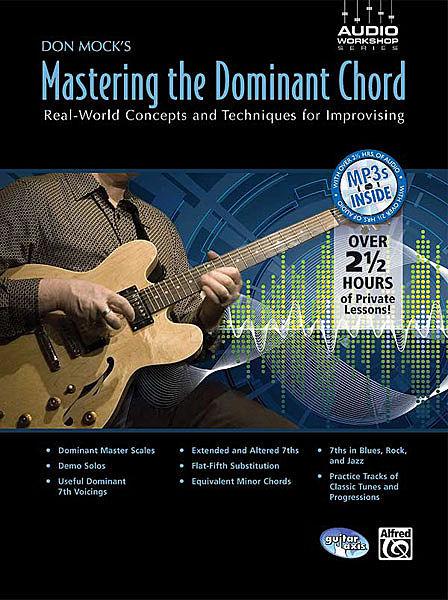
This powerful book and audio lesson will expand your knowledge of not only the familiar V dominant 7th, but all of the secondary dominant 7ths that can be found in major and minor keys. Join Don Mock as he builds "master scales" for each dominant 7th and shows you the best voicings and the theory behind how they function. You’ll also explore the subject of extensions and alterations that can be added to dominants and the two basic ways dominants operate which are "static" and "functioning." You’ll play them in progressions and tunes and learn sample solos that demonstrate the correct scales, arpeggios and melodies for the various dominants. Discover why the study of dominant 7th chords will offer you the "keys to the kingdom" for truly understanding the workings of music. This one magical little chord gives music it’s movement, energy and tension. Knowing how dominants work will also greatly improve your dealings with other chord types including major and minors.

Welcome to this lesson on dominant 7th chords. A whole lesson on a single chord may sound a bit boring but stay tuned. With the aid of the pages here in the book and the audio recording, I hope to expand your knowledge of not only the familiar "V" dominant 7th, but all of the other secondary dominant 7ths that can be found in major and minor keys. We'll learn the best voicings and uses for dominant 7ths and the theory behind how they function. We'll also explore the subject of extensions and alterations that can be added to dominants and the two basic ways dominants operate which are "static" and "functioning." We'll play them in progressions and tunes and learn some sample solos that demonstrate the correct scales, arpeggios and melodies for the various dominants. And you'll learn that the study of dominant 7ths offer you the "keys to the kingdom" for understanding the workings of music. This one magical little chord gives music it's movement, energy and tension. Knowing how dominants work will also greatly improve your dealings with other chord types including major and minors. We will begin with understanding the diatonic system, it's "cycle of 5ths" and secondary dominants. Most players don't have a clear understanding of how and why there can be several "secondary" dominants in a single key. I was one of those players. I learned to play Rock, Blues and Jazz primarily by ear, and although I could play convincing chords and melodic lines over secondary dominants, I really didn't fully understand what they were or where they came from. This led to a lot of frustrating playing situations on gigs where I had to basically "fake it" by ear through certain chord changes. Even during my early years teaching theory at GIT, I did not clearly understand the big picture of the diatonic system's secondary dominants. I figured they were based in some form of "classical" theory and didn't relate to the modern music I was playing. Was I ever wrong. When I finally pieced together the complete story of secondaries, I found it much easier to negotiate even the most difficult chord changes. And my chord choices and melodic lines began to make much more musical sense. This lesson may appear to be very intense with lots of lists, details and the "do's and don'ts" of dominant 7ths. And to an extent, it is, but after we learn the specifics of each dominant type, there is a very important section later on where we will simplify and streamline all the information covered into an easy and practical "player's approach" to dealing with dominant 7ths. But for now, let's start at the beginning and learn as much as you can about each dominant chord. Learn the master scales and chord voicings and check out the sample solos which are full of melodic phrases you can use in lots of situations. And play all the chord progressions to help train your ear. You'll find that each dominant has it's own unique personality and sound. And once you start to "hear" those, you'll have much more success dealing with them.

About the Music Notation in This Book.

The point of the lesson is to learn the theory and application of dominant 7ths in the easiest and most practical way. Some traditional "classical" notation rules are not followed such as lower-case Roman numerals usedfor minor chords. Only upper-case numerals are used. Also, chord symbols will always be notated as; "m" for minor, "maj" for major, "dim" for diminished and "aug" for augmented. Alterations will not be in parenthesis with very few exceptions. And to help you clearly understand and analyze dominants in "keys," chord symbols in the examples will usually be shown as basic "seventh chords" with no extensions or alterations added. 


The dominant 7th gives music movement, energy, and tension. This powerful audio lesson and book will expand your understanding of not only the familiar “V” dominant 7th, but all the secondary dominant 7ths in major and minor keys. Join Don Mock as he builds “master scales” for each dominant 7th, demonstrates the best voicings, and explains the theory behind how they function. You’ll explore extensions and alterations of dominants, as well as the two basic ways dominants operate, “static” and “functioning.” The included progressions and tunes give you a chance to practice, and sample solos demonstrate the correct scales, arpeggios and melodies. Discover why the study of dominant 7ths offers you the “keys to the kingdom” for truly understanding the workings of music. 


Don Mock has become one of America's most respected guitar educators and players. Growing up in the Seattle area, his musical upbringing probably parallels that of any guitarist who started out in the 60's. First influenced by the Beatles, and guitar hero's like Jimi Hendrix, Alvin Lee, Eric Clapton and Mike Bloomfield, Don soon discovered Jazz and emulated many of the top players of the time. Don's reputation grew from the rock guitarist to the jazz guitarist in the Northwest. His ability to quickly learn the styles of other guitarists turned out to be quite an advantage in the long run. After evolving through the various rock, blues and jazz phases, borrowing from all the best, Don is now the master of his own style, a style that is literally a "fusion" in the purest sense of the word. Don is well known among guitarists for his amazing technique and total command of the instrument. His improvising concepts have been documented in several instructional books including: "Hot Licks," "Fusion - Hot Lines," "Ariful Arpeggios," "Ten," his popular Warner/Alfred Guitar Scale Secrets series: "Melodic Minor Revealed," "Harmonic Minor Revealed" and "Symmetric Scales Revealed." His recent Guitar Axis Masterclass series include; "Octaves," "Turnarounds" and "Target Tones." Don's latest work; "Modal Mojo" is the definitive study of modal playing. He also has three instructional videos: "The Blues from Rock to Jazz," "Jazz Guitar Tips" and "Jazz Guitar Rhythm Chops." Don began his teaching career in 1972 at the Cornish School of the Allied Arts and Olympic Jr. College, both in Washington State. In 1974 Don met guitar legend Howard Roberts and soon managed guitar-teaching seminars in the Northwestfor Howard. In 1977, Howard brought Don to Los Angeles to help start the Guitar Institute of Technology (GIT). Don became a primary instructor and curriculum author for the school. That same year, Don teamed up with publisher Roger Hutchinson (REH) to write and produce guitar method books. Don taught full time at GIT until 1983 when he began a part-time arrangement commuting back and forth from Seattle to LA. He also traveled around the U.S. and to Europe giving seminars to promote GIT. LA., Don had an exciting fusion band and performed at most of the top jazz venues. The band developed a large following of students and fans alike. He became well known for his intense style and amazing guitar synthesizer. In 1983, Don was brought in to direct most ofGIT's 300 plus videos. And in 1988, when REH began its very successful instructional video line, Don was hired as the primary director and producer. His talent and expertise as a player and teacher, as well as video producer, have been a huge benefit to the many artists who have been featured in REH videos. Artists include: Joe Pass, Allan Holdsworth, Robben Ford, Scott Henderson, Herb Ellis, Steve Morse, Paul Gilbert, Pat Martino, Albert Collins, Frank Gambale, Al DiMeola, Keith Wyatt, John Petrucci, Joe Diorio, Clint Strong and many more. As a recording artist, Mock has appeared as a sideman on several albums and has two solo efforts: "Mock One" and "Speed of Light. " In 2004, Don joined Jay Roberts, son of Howard Roberts, to establish the Roberts Music Institute in Bellevue, Washington. Don added his expertise in developing the schools curriculum and also teaches classes on contemporary guitar playing.


CONTENTS

Title

Introduction .

What Is a Secondary Dominant? .

Diatonic Harmony .

The Diatonic Cycle of 5ths .

Static and Functioning Dominant 7ths .

Building "Dominant Master Scales" .

I7-C7 (The Secondary Dominant 17 Chord) .

II7-D7 (The Secondary Dominant 117Chord) .

III7-E7 (The Secondary Dominant 1117Chord) .

IV7 -F7 (The Secondary Dominant IV7 Chord) .

V-G7 (The Primary Dominant V Chord) .

VI7 -A 7 (The Secondary Dominant VI7 Chord) .

VI17-B7 (The Secondary Dominant VII7 Chord) .

Combining the Master Scales .

All Dominant Demo .

Extensions and Alterations for Dominant 7ths .

Useful Dominant 7th Voicings: Extended .

Useful Dominant 7th Voicings: Altered .

Additional Altered Dominant Voicings .

Extensions and Alterations that can be added to Dominant 7ths .

Diatonic Chord Substitutes for Dominant 7ths .

Dominant 7ths in Progressions .

I7-The Secondary Dominant 17 Chord .

I7 Demo Solo .

I7 continued .

II7- The Secondary Dominant 117Chord .

II7Demo Solo .

II7continued

III7-The Secondary Dominant 1117Chord .

III7Demo Solo .

III7continued .

IV7 - The Secondary Dominant IV7 Chord .

IV7 Demo Solo .

IV7 continued .

V- The Dominant V Chord .

V Demo Solo .

V continued .

VI7 - The Secondary Dominant VI7 Chord .

VI7 Demo Solo .

VI7 continued .

VI17-The Secondary Dominant VI17 Chord .

VI17 Demo Solo .

VI17 conti nued .

bV117-The Dominant bV117Chord .

bV117Demo Solo .

Flat-Fifth Substitution .

Diminished and Augmented Chords are Dominants Too .

Diminished and Augmented Scales .

Diminished/Whole Tone Demo Solo .

Minor/Major 7ths as Dominants .

Using Equivalent II Minor 7th Chords with Dominants .

Simplifying the 8 Dominants into 3 Basic Groups .

Chord Charts: Dominants in Tunes .

Prezzo: €247,99
€247,99

MOCK'S DON JAZZ GUITAR MASTERCLASS CD TABLATURE CHITARRA LIBRO METODO SPARTITI

MOCK'S DON, JAZZ GUITAR MASTERCLASS. LIBRO CON CD E TABLATURE

LIBRO METODO DI MUSICA JAZZ CON COMPACT DISC

SPARTITI PER CHITARRA.

ACCORDI, PENTAGRAMMA E TABLATURE.


Category: Guitar Method or Supplement
Format: Book & CD
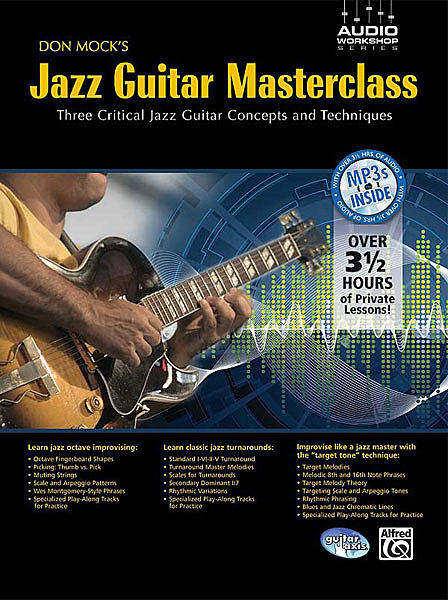
This amazing three-section set of personal lessons with jazz guitar guru Don Mock features hours of personal audio instruction, play-along tracks, and demonstrations, with a complete accompanying book of music examples, exercises, and transcriptions in notation and TAB. Section 1 covers the all-important, Wes Montgomery-inspired Octave Technique. Section 2 is devoted to the target tone concept, which simplifies the improvising process, enabling you to play sophisticated lines that resolve beautifully into the correct chord tones. Section 3 is devoted to turnarounds: short four-chord progressions often found at the end of tunes to setup and return to the beginning.

"Don, I know, mastering jazz guitar can take a lifetime, but are there a few concepts and techniques I can work on now to improve my playing?'" This is a pretty common question, and one I hear from students all the time. To many, the world of jazz guitar seems like it's made up of hundreds of difficult concepts and techniques along with a dizzying amount of complex theory. But a lot of players just want to learn a few manageable ideas to get under their fingers without being drowned in heavy concepts. I usually answer the question by reminding them that learning to play jazz can be a life-long endeavor, but it's also an ongoing "work in progress." You can't wait around practicing until you think you are good enough to playa gig. As Howard Roberts always said, "You are a guitar player from the first day you pick it up." Learn a few things and get out and play, then continue to develop your skills. The three ideas outlined in this book, octaves, turnarounds, and target tones, are important cornerstones of jazz guitar. Serious players at any level can jump into these subjects and have great results. It's important to remember that this is really an audio lesson with a companion book, not the other way around. Most of the in-depth discussion, demonstrations, and performances are on the CD; the book is for reference, showing the examples and short descriptions. And don't be surprised if, when I've finished performing some of the examples, I keep on playing to demonstrate additional ideas, or just 'cause I'm having too much fun to stop! Without a doubt, one of the single most emulated and beloved techniques in jazz guitar are octaves played in the style of the great Wes Montgomery. Virtually every jazz guitarist today uses octaves to some degree. I highly recommend to my students that they become proficient with octaves and able to play at least the melodies to tunes. It's one technique that can bring soulful fullness to melodies. This book focuses on the right-hand pick, or Wes/thumb techniques, and octave fingerboard shapes. You'll learn lots of Wes-inspired phrases as well as useful scale and arpeggio patterns. Arguably, the most powerful chord progression in jazz is the turnaround. Turnarounds are a lot more than a short group of chords found at the end of tunes. On closer examination, they are made up from smaller chord moves that are the essence of jazz and pop music, like major and minor II-V-I progressions. Numerous examples of substitution ideas, such as fiat-fives and secondary dominants, can be applied to turnarounds. Like a lot of players, I struggled with turnarounds, especially at faster tempos. My frustration led me to break down and analyze each of the four chords, and to learn some classic melodic lines for turnarounds. Then, I could at least manage improvising and comping over faster turnarounds. But when I came up with the simple idea that is outlined in this book, turnarounds quickly became my favorite type of progression. This book teaches you a simple approach to mastering turnarounds, centering on a basic "master melody" that captures the sound of each of the four chords. Then, it's simply a matter of moving the notes to different octaves to create variations of the line. All my students who apply this concept have made huge leaps in their playing of turnarounds, and e-mails from players around the world confirm they've had the same positive results. Another topic that sits at the top of my list of "must learn" concepts for jazz guitar is target tones. "Target tones" is really a cliche name for the art of using chromatics in improvising. I discovered early in my career that the chromatic scale alone was not the solution for creating melodic lines with chromatics. My search to understand it allIed to several books and recordings of everything from classical music to modern jazz. It became clear that good melodies often had mini-melodies contained within them that used the "wrong" non-scale tones to support, strengthen, and set up strong tones. I began using very basic fournote target-tone melodies within my scales and arpeggios. Immediately, I was creating lines that contained some, or even all, the "in-between" tones. But more importantly, the lines retained the sound of the chord I was soloing over. We'll go over a few easy target melodies and take aim at chord tones. It' a surprisingly simple but powerful concept that should have you playing traditional, modem, and bebop jazz chromatic melodies in a fairly short time. I hope you enjoy working on the three topics in this book. Feel free to begin with anyone of them. Be sure to listen to the CD, and take advantage of the play-along tracks.


Title MP3 File

Preface

Introduction

Tuning Notes

Fingerboard Octave Shapes

Muting Strings

Picking: Thumb vs. Pick

Octave Exercises

Octave Arpeggios

Octave Scales

Melodic Lines Using Octaves

"Blues Axis" Jazz Blues Tune

Conclusion

"Blues Axis" Play-Along Track

Am7 Groove Play-Along Track

II-V-I in C Play-Along Track

F7 Groove Play-Along Track

Minor II-V-I in Am Play-Along Track


Title MP3 File

Turnarounds

Introduction

Tuning Notes

The Standard I-VI-II-VTurnaround

Turnaround Master Melody

The Secondary Dominant in a Turnaround

Scales for Turnarounds

Turnarounds in Blues

8th-Note Turnaround Etude

Rhythmic Variations

Rhythmic Turnaround Etude 2

Flat Fifth Substitution

I-VI7-II-V in G Play-Along Track

I-VI7-117-Vin Bb,Play-Along Track

Jazz Blues in C Play-Along Track

I-VI7-II-V in G Latin Play-Along Track


Title MP3

Target Tones

Introduction

Tuning Notes

Target Melodies

Arpeggio Fingerings

Melodic 8th-Note Phrases Using Target Melodies

Targeting with 16th Notes

Target Melody Theory

Targeting Scale Tones

Rhythmic Phrasing

Blues and Jazz Chromatic Lines

Jazz Blues Solo Etude"

C7 Groove Play-Along

Cm7 Groove Play-Along

Cmaj7 Groove Play-Along

II-V-Iin C Play-Along Track

II-V-Iin E Minor Play-Along Track

Jazz Blues in Bb,Play-Along Track

Conclusion

About the Author

Don Mock is one of America's most respected guitar educators and players. Growing up in the

Seattle area, his musical upbringing parallels that of any guitarist who started out in the '60s.
First influenced by The Beatles and guitar heroes like Jimi Hendrix, Alvin Lee, Eric Clapton,
and Mike Bloomfield, Don soon discovered jazz and emulated many of the top players of the
time. His ability to learn the styles of other guitarists turned out to be quite an advantage, and
his reputation as a rock and jazz guitarist grew in the Northwest. After evolving through various
rock, blues, and jazz phases, borrowing from all the best, Don is now the master of his own
style, one that is a "fusion" in the purest sense of the word.
Don is well known among guitarists for his excellent technique and total command of the
instrument. His improvising concepts are the topic of several instruction books, including Hot
Licks, Fusion-Hot Lines, Artful Arpeggios, and Ten, and his popular Guitar Secrets series from
Alfred: Melodic Minor Revealed, Harmonic Minor Revealed, and Symmetrical Scales Revealed.
Don's latest works, Modal Mojo (the definitive study of modal playing) and Mastering the
Dominant Chord are also published by Alfred, as are his instructional videos The Blues from
Rock to Jazz and Jazz Guitar Rhythm Chops.
Don began his teaching career in 1972 at both the Cornish School of the Allied Arts and
Olympic Junior College in Washington state. In 1974, he met guitar legend Howard Roberts
and soon began to manage guitar teaching seminars in the Northwest for him. In 1977, Howard
brought Don to Los Angeles to help start the Guitar Institute of Technology (GIT), where Don
became a primary instructor and curriculum author. That same year, he teamed up with publisher
Roger Hutchinson (REH) to write and produce guitar method books. Don taught full time at GIT
until 1983, when he began a part-time arrangement, commuting back and forth from Seattle to
L.A. He has traveled around the U.S. and Europe, giving seminars to promote GIT.
In 1983, Don was called upon to direct most ofGIT's 300-plus videos, and in 1988, when REH
began its very successful instructional video line, he was hired as the primary director and
producer. His talent and expertise as a player and teacher, as well as a video producer, have been
a huge benefit to the many artists featured in REH videos, including Joe Pass, Allan Holdsworth,
Robben Ford, Scott Henderson, Herb Ellis, Steve Morse, Paul Gilbert, Pat Martino, Albert
Collins, Frank Gambale, Al DiMeo la, Keith Wyatt, John Petrucci, Joe Diorio, and Clint Strong.
Don is also a well-established live performer and recording artist, and became known for his
intense style and amazing guitar synthesizer while playing with an exciting fusion band in L.A.
The band performed at most of the top jazz venues and developed a large following of students
and fans. As a recording artist, he has appeared as a sideman on several albums and has two solo
efforts: Mock One and Speed of Light.
In 2004, Don joined Howard Roberts's son, Jay, in establishing the Roberts Music Institute in
Bellevue, Washington, where he lent his expertise to help develop the school's curriculum and
currently teaches classes on contemporary guitar playing.
Prezzo: €69,99
€69,99

BURRELL KENNY Step-By-Step Guitar Styles Techniques Jazz Legend LIBRO CD TABLATURE CHITARRA

BURRELL KENNY, A Step-By-Step Breakdown of the Guitar Styles and Techniques of a Jazz Legend.

LIBRO DI MUSICA JAZZ,

SPARTITI PER CHITARRA CON CD : 

ACCORDI, PENTAGRAMMA, TABLATURE . 

All Night Long -All Of You -Autumn Leaves -Do What You Gotta Do -Groovin' High -In A Sentimental Mood -K.B. Blues -Lyresto -Moment's Notice -My Favorite Things -Since I Fell For You -Soulful Brothers -This Time The Dream's On Me -Wholly Cats. CD TABLATURE


Techniques of a Jazz Legend
Series: Signature Licks Guitar
Format: Softcover with CD - TAB
Artist : Kenny Burrell
Author : Wolf Marshall

Inventory #HL 00695830
ISBN: 9780634074431
UPC: 073999567892
Width: 9.0"
Length: 12.0"
128 pages

It is hard to think of a jazz artist-make that any artist·with as much breadth depth, and sheer longevity as Kenny Burrell. His career, now over a half long has spanned all the major epochs of the art form and continues to flourish. Him gegan his professional life in the mid forties as swing music made its inexorable trans to bebop and modern jazz. He was one of the earliest guitarists in the medio to assimilate the novel innovations of Charlie Parker, Dizzy Gillespie, Clifford Brown, O. Peterson and mix them with his seminal swing and blues influences. Burrell early mosaic, already a diverse mix of swing, blues, and modern jazz, included Christian, Django Reinhardt, and Oscar Moore as well as T-Bone Walker, John L. Hooker, Waters, Floyd Smith, Johnny Moore, and the full gamut of jazz and keyboard players. The results were heard in strong relief with his output of the mid '50 on the Blue Note and Prestige labels. From there, Burrell assumed the role of trendsetter and has si ce been viewed as one of the genre's major innovators and leaders. By decade's end he as redefining the sonic possibilities of jazz guitar on his groundbreaking guitar-bass-drums recordings and set new standards in the organ-trio medium through his inventive and sympathetic work with Jimmy Smith. A Night at the Vanguard (1959) demonstrated wha a gui ar could do as the sole melodic/harmonic instrument in a combo setting. And Jimmy Smith recordings like The Sermon (1958), Home Gookin' (1959), Back at the Ghicken Shack (1960), and Midnight Special (1960) produced a template which is followed assiduously to this day. Never content to rest on his laurels, Burrell continued with a number of ambitious and successful experiments mating the jazz guitar to a wider variety of combo and orchestral applications. Moreover, Burrell's landmark efforts in the burgeoning soul-jazz style influenced legions of guitar players and other instrumentalists across various stylistic divides and indeed presaged the funk styles percolating and emerging in the late sixties. Since then, Burrell has touched virtually every form in the genre from the grittiest, folksy blues, funky soul-jazz, and traditional gospel hymns to esoteric modal jazz and the loftiest post-bop modern styles-always delivered with taste, musical sensitivity, and his personal, highly identifiable stamp. His appropriately titled opus Guitar Forms (1965), presented another side of his artistry and showcased many of his diverse tangents in microcosm, from the acoustic classical guitar/amplified jazz guitar and orchestral combinations in "Greensleeves" and his solo nylon-string adaptation of George Gershwin's "Prelude #2" to his Spanish/Mexican-influenced original "Loie," the down-home blues bent of "Downstairs," and the straight-ahead jazz rendition of "Breadwinner." Kenny Burrell continues to lead and inspire guitarists to the present day. His legacy is assured and implicit in his overriding credo: "Let your spirit come through and you will always touch others. Give the music your personal best. Be yourself-it works.". Truer words were never spoken. Kenny Burrell personifies and epitomizes the word and mood "blue." An attribute that permeates the heart of jazz, blue is a universal feeling, a resonance extending to all forms of music. Kenny said as much, in words and sounds, in his aptly titled work Blues: the Gommon Ground. And he has done much to show us the many hues of blue in his copious repertory. Over the years, Kenny has gained considerable cachet with evocative titles like K.B. Blues, Blue Moods, Blue Lights, Bluesin' Around, Midnight Blue, Blue Bash, Blues: the Gommon Ground, and his recent Blue Muse. Each underscores the fact that shades of indigo are primary colors in his artistic palette and convey the essence of his musical persona.

Take an in-depth look at Kenny Burrell's jazz guitar mastery with Wolf Marshall, who will teach you how to play some of his hottest licks. Wolf covers 14 tunes. The CD features a demo of each. 128 pages

Preface
Introduction
The Kenny burrell sound
Discography
The Recording
History and Highlights
Tuning
Guitar Notation legend

1959 - All Night Long - All night long, 1959
1954 - All Of You - COLE PORTER - Burrell, 1957
1947 - Autumn Leaves - JOSEPH KOSMA, parole: JACQUES PREVERT - sunup to sundown, 1991
1971 - Do What You Gotta Do - God bless the child, 1971
1944 - Groovin' High - John "Dizzy" Gillespie - Groovin' high, 1981
1935 - In A Sentimental Mood - DUKE ELLINGTON - Lucky so and so, 2001
1957 - K.B. Blues 
1958 - Lyresto - Kenny Burrell - BURRELL with JOHN COLTRANE 1958 - 
1957 - Moment's Notice - JOHN COLTRANE - Guilding spirit, 1989
1959 - My Favourite Things - RICHARD RODGERS - the sound of music, 1966
1948 - Since I Fell For You ('Round midnight) - Buddy Johnson - 'ROUND MIDNIGHT, 1972
1968 - Soulful Brothers - BURRELL, WARREN STEVENS - Blues the common ground, 1968
1941 - This Time The Dream's On Me - Music: HAROLD ARLEN - Parole: Johnny Mercer - Burrell, 1956
1941 - Wholly Cats - BENNY GOODMAN - a genaration ago today, 1966

Prezzo: €32,99
€32,99

BLUES DELUXE Dave Rubin Guitar Masters Series CD TABLATURE SPARTITI CHITARRA LIBRO ACCORDI

BLUES DELUXE. Dave Rubin. SHEET MUSIC BOOK & CD WITH GUITAR TABLATURE

LIBRO DI MUSICA BLUES CON CD. 

SPARTITI PER VOCE E CHITARRA CON: 

ACCORDI, PENTAGRAMMA, TABLATURE. 


CD WITH ORIGINAL RECORDINGS !


Blues Deluxe
Guitar Masters Series
Series: Guitar Masters Series
Format: Softcover with CD - TAB
Author: Dave Rubin
Artist: Various

Learning authentic blues has never been more fun! Not only does this deluxe edition provide accurate transcriptions of ten blues classics plus performance notes and artist bios, it also includes a CD with the original Alligator Records recordings of every song! Tunes: All the King's Horses (Luther Allison) • Are You Losing Your Mind? (Buddy Guy) • Don't Take Advantage of Me (Johnny Winter) • Give Me Back My Wig (Hound Dog Taylor) • Gravel Road (Magic Slim) • Look Now, Baby (Son Seals) • Master Charge (Albert Collins) • The Moon Is Full (Albert Collins & Robert Cray) • Somebody Loan Me a Dime (Fenton Robinson) • Two-Headed Man (Lonnie Brooks).

Inventory #HL 00699918
ISBN: 9781423424925
UPC: 884088136468
Width: 9.0"
Length: 12.0"
120 pages

Series: Guitar Masters Series
Format: Softcover with CD - TAB
Author : Dave Rubin
Artist : Various


TiTLEs:

All The King's Horses - LUTHER ALLISON - 1995
Are You Losing Your Mind? - BUDDY GUY - 1981
Don't Take Advantage Of Me - JOHNNY WINTER - 1984
Give Me Back My Wig - HOUND DOG TAYLOR - 1971
Gravel Road - MAGIC SLIM - 1982
Look Now, Baby - SON SEALS - 1973
Master Charge - ALBERT COLLINS - 1978
The Moon Is Full - ALBERT COLLINS & ROBERT CRAY - 1985
Somebody Loan Me A Dime - FENTON ROBINSON - 1974
Two Headed Man - LONNIE BROOKS - 1988

Prezzo: €99,99
€99,99

KESSEL BARNEY Step-by-Step Guitar Styles Techniques CD TABLATURE LIBRO SPARTITI CHITARRA

KESSEL BARNEY, passo per passo il suo stile tecnico e chitarristico. BOOK CD TABLATURE

LIBRO DI MUSICA JAZZ.

SPARTITI PER CHITARRA.

ACCORDI, PENTAGRAMMA E TABLATURE.

This entry in the Guitar Signature Licks series is dedicated to the sounds and techniques of Barney Kessel. Barney is a guitarist who is acclaimed as an important transitional figure, one who was pivotal-essential-in the jazz genre as the music evolved past its swing roots into bebop, hard bop, and modern jazz. The selections in this volume are gathered from, arguably, his most significant and influential period: the 1950s, when jazz guitar was still in its infancy. Several pieces are presented in their entirety: "Tenderly," "Salute to Charlie Christian," "Speak Low," and three Poll Winners trio tunes, "Minor Mood," "Foreign Intrigue," and "I'm Afraid the Masquerade Is Over." These are guitar intensive arrangements that showcase Barney's guitar role prominently and must be studied as complete works. Listen to the whole track and follow along with the detailed analysis of the distinct sections. Others, like "Barney's Blues," "Indiana," and "64 Bars on Wilshire," are offered in specific sections, where the guitar is stating the theme, interacting with the ensemble, or featured as the solo instrument. The time codes displayed in the selections refer to the original recordings.

Barney Kessel is one of the most famed and beloved jazz guitarists in music history. To many aficionados, his name is synonymous with jazz guitar. Bred on swing music of the 1940s, Kessel was one of the earliest players to absorb the language of modern jazz and bebop, mixing the new and old sounds with a swinging delivery, rhythmic vitality, and musical imagination all his own. His work remains towering and influential to the present, and he is widely acknowledged as one the leading voices of jazz guitar. Born in Muskogee, Oklahoma, on October 17, 1923, Barney Kessel decided on a career in music at an early age. He bought his first guitar at age twelve with money saved from selling newspapers. Essentially self-taught, Kessel received a few rudimentary essons in a Federal Music Program of the WPA in the summer of 1935. His earliest influences included swing musicians Charlie Christian (guitar) and Lester Young (tenor sax). Over the next four years, Kessel progressed quickly and established a strong regional following, enhanced by performances with the Varsitonians, a twelve-piece college band, while still a young teenager. By 1939, Kessel's reputation had grown to the point that his mentor Charlie Christian sought him out during a visit back home (Oklahoma was also Christian's home state). At age sixteen, Kessel met, hung out, and jammed with his idol, a duly impressed Christian, in early October of 1940. This experience inspired him to pursue a full-time professional career in music. In 1942, Kessel moved to Los Angeles and worked as a dishwasher while he made the musical rounds, sought auditions, and developed contacts. He was soon hired to play in comedian Chico Marx's band, led by drummer Ben Pollock. Kessel rapidly became a major player in the burgeoning West Coast jazz scene, performing and recording with Charlie Parker, Howard McGhee, Wardell Gray, Sonny Criss, and many others. Like many jazz musicians of the era, he also began accepting studio work on radio networks and Hollywood film scores and joined Frank De Vol's commercial orchestra. In 1944, Kessel appeared in Norman Granz's award-winning jazz documentary Jammin'the Blues. He was the only white musician in the film. Kessel also played in numerous big bands between 1945 and 1947, including the ensembles of Charlie Barnet and Artie Shaw. Kessel performed on record dates with Shorty Rogers and Benny Goodman, toured with the Oscar Peterson Trio in 1951-1952, and participated in Norman Granz's prestigious Jazz at the Philharmonic concert series. His contributions to Charlie Parker's legacy, contained in important tracks from 1947 like "Carvin' the Bird" and "Relaxin at Camarillo," brought further acclaim and broadened is jazz credentials. These and other high profile concerts and recordings led 0 e's greater exposure and recognition in America and Europe.


Titoli:

(I'm Afraid) The Masquerade Is Over [Magidson, Herb] [Wrube, Allie]

64 Bars On Wilshire

Barney's Blues

Begin The Blues

Contemporary Blues

Easy Like

Foreign Intrigue

Indiana (Back Home Again In Indiana) [Macdonald, Ballad] [Hanley, James]

Minor Mood

On A Slow Boat To China [Loesser, Frank]

Salute To Charlie Christian

Speak Low (One Touch Of Venus) [Weill, Kurt] [Nash, Ogden]

Tenderly [Gross, Walter] [Lawrence, Jack]

Vicky's Dream


CD TABLATURE


Wolf Marshall insegna lo stile e la tecnica di una leggenda del jazz, esaminando attentamente 14 titoli. 96 pagine.

Prezzo: €33,99
€33,99

BUSTER B. JONES JUST US 14 Complete Notation & Tab Transcriptions CD TABLATURE LIBRO SPARTITI

BUSTER B. JONES, JUST US: 14 Complete Notation & Tab Transcriptions. SHEET MUSIC BOOK WITH CD & TABLATURE .

LIBRO DI MUSICA ACUSTICA, CON CD.

SPARTITI PER CHITARRA FINGERPICKING CON: 

PENTAGRAMMA E TABLATURE.

Product Description:
Although his scorching fingerpicking was most impressive at first glance, a closer look at "Just Us" reveals that he is equally adept at what many musicians consider as a more difficult task: playing fewer notes... ones that mean more, and say more with less, as he does on album opener "A Simple Gift", title cut "Just Us", and "One Sad Clown".

"Just Us" is an album consisting largely of his own compositions inspired by his two main guitars "Merle" and "Pearl". Along the way we are treated to a barn-storming version of "Alabama Jubilee" (it must be tunes like this that caused Chet Atkins to say of Jones "He plays like he's double-parked"), "Collage-a-Reed" and "Clawin'" (each inspired by mentor Jerry Reed), while "Let the Sun Shine In" sounds like an instant fingerpicking classic that you could swear you have heard before, but haven't. Including detailed notation on 15 of Buster’s songs from "Just Us", this Book/CD lesson will challenge even the best players. Presented in standard notation and tablature.

Biography Buster B. Jones was a master of the guitar styles of Chet Atkins, Merle Travis and Jerry Reed. He explored their music, styles and techniques, but developed his own unique style and depth. Buster was known as a blazing fast and dynamic player, and was given the nickname "The Machine Gun" by admiring fans in France, but his original compositions expose a lyrical and gentler side to his musical personality. Raised in Ames, Iowa, Buster began playing guitar and mandolin at an early age, following in the footsteps of his older brother Ron, who Buster idolized as the "best left-handed guitarist ever." It became apparent however that by Buster's mid-teens he would have a special gift for music, and his musical ability exploded. Buster never took formal lessons, but developed his mastery of the guitar through sheer trial and error, and by diligently trying to learn the complex styles of players like Chet Atkins and Jerry Reed. "I touch on many different styles and approaches to playing lead and rhythm guitar. My goal as a player is to expand these perimeters and express what I feel musically," says Buster, who often played for other guitar players at conventions like the CAAS in Nashville and NAMM. 'Playing to a bunch of guitar players and fans is like watching Dawn of the Dead on video. They just stare 'ou slack-jawed, looking like they want to eat your brain. It's a wonderful feeling!" Buster B. Jones has several early albums, which are out of print and three CDs, Fingers in Flight, Guts and Steel and Just Us. He also has produced 12 teaching videos for Stefan Grossman's Guitar Workshop. Buster B. Jones lived in Eugene Oregon and performed regularly across Canada and the United States. He was the 1990 winner of the National Fingerpicking Championship held yearly in Winfield, Kansas. Buster was not just a great guitar player but a teacher and a friend to many. He spent countless hours sharing his knowledge and skills with young players and I am grateful to have had the opportunity to work closely with Buster on this CD. Tom Redmond


As a child, I grew up listening to such greats as Hank Williams, Jimmy Rodgers, Hank Snow and Merle Travis. My father Buster Jones was a great entertainer; and with my mom and big brother Ron played polkas and square dances. Dad even had a radio show of his own. He would do the weather and time and then play some music. Although my dad's playing ability was somewhat limited, his ability to capture an audience was what intrigued me the most. Dad said "Talk to the folks like they are old friends and they'll become old friends." I live by those words. I've never met a stranger. My dad Buster, mom Allene and Ron were my first influences, although in time I had many others, like Chet Atkins, Jerry Reed, Thorn Bresh and Nokie Edwards. In the game of life, however, I admire none more than my family: Dad and Mom Jones, Ron Jones, Collene McGlenn, Darlene Sanchez, Kay Anderson, and Roger and Gary Jones. This recording is dedicated to them, because I love and miss them.

- Buster B. Jones (2007)

Song Title: Composer/Source:

A Second Glance
A Simple Gift
Alabama Jubilee
Be Like Dad
Collage-A-Reed
Flight Path
Just Us
Last Request
Let the Sun Shine In
One Sad Clown
Pierpaolo
Still Live Five
The Thoughts of One
Thom's Thumb

Prezzo: €39,99
€39,99

FLUID PENTATONICS Book 2. 84 Melodic Studies for Guitar Tim Quinn CD TABLATURE CHITARRA

FLUID PENTATONICS Book 2. 84 Melodic Studies for Guitar, Tim Quinn. CD TABLATURE

MBGU Rock Curriculum: Fluid Pentatonics, Book 2
84 Melodic Studies for Guitar
by Tim Quinn

Product Description:
Fluid Pentatonics for Guitar: 84 Melodic Studies for Rock Guitar is a comprehensive manual for developing blistering pentatonic motion that moves freely over the entire fretboard, using position-shifting slides, hammer-ons, and pull-offs for speed and fluidity. Emphasis is on overcoming the restrictive nature of traditional pentatonic "box" scale fingerings by developing pathways that continually shift between and connect the five pentatonic “boxes”. Complete whole-neck control is developed through an extensive series of repeating melodic exercises and etudes. Section One presents 35 sequential whole-neck studies, each of which spans the range of twelve frets, thus unlocking virtually every possible position shift. Section Two develops complete non-shifting control through a series of 15 interesting and useful sequential patterns, applied to each of the five pentatonic "boxes". Section Three presents 10 whole-neck/position-shifting studies that are non-sequential in design, in order to develop unpredictable melodic flow. Then, in Sections Four and Five, two vital extensions/variations of the pentatonic scale are fully explored; the Hexatonic and Dominant Pentatonic scales.

The result is a complete matrix of pentatonic moves and connections that allow the guitarist to float freely across the entire fretboard without being locked into any single particular pentatonic "box". The resulting sound is definitely NOT bluesy (very little string bending), but closer to a modern jazz-rock fusion style; fluid and unpredictable. Great for all guitarists in rock, jazz, fusion, blues, country, and pop styles who want to unlock complete whole-neck freedom and develop a fast, modern pentatonic sound. CD included. Presented in standard notation and tablature.

Aheartfelt thanks goes out to all the teachers who profoundly impacted my own playing and ~ learning ... thank you jack Petersen, Dan Haerle, Rich Matteson, and Tom johnson at the University of North Texas, as well as to my teachers at Berklee College of Music.To the musicians who have been so inspiring ... Steve Morse, Pat Martino. john Coltrane, Eric johnson, Chick Corea, jimi Hendrix, Frank Zappa, Barney Kessell, Wes Montgomery, Stevie Ray Vaughan, Albert King, jeff Beck, Steve Vai, Dexter Gordon, Cannonball Adderly, joe Satriani, Igor Stravinsky, EddieVan Halen, AI DiMeola, Greg Howe,joe Pass, Robben Ford, Vinnie Moore, Allan Holdsworth, and Carlos Santana; for the teachings of Paramahansa Yogananda; also to Bill Bay and the fine staff at Mel Bay Publications, Inc.;to Bruce Saunders for his caring engraving; to Dave Austin and George Sanchez for their generous assistance; to josquin DePres at Track Star Studios for much inspiration and guidance; to the many students who have been indispensable in helping me streamline these materials; to my parents who provided the music education and encouraged the young performer; and especially to my wife, Mari, who lovingly tolerated the thousands of hours with me at the guitar while I formulated these concepts ... thank you.

introduction

FLUID PENTATONICS is a scientific manual for developing fast and fluid pentatonic motion on the guitar that connects and constantly shifts between the traditional five pentatonic "box" scale fingerings, using position-shifting slides, hammer-ons, and pull-offs.Traditional pentatonic scales on the guitar consist of five "box-like" scale fingerings, each fingering having two notes on every string, which creates their box-like nature. These traditional patterns are extremely important and useful, but they can be very restrictive. This book is all about overcoming the restrictive nature of pentatonic boxes by developing fast and flowing whole neck fluidity and freedom that continually shifts between and connects the traditional five pentatonic box scale fingerings.

FLUID PENTATONICS develops fast pentatonic motion that defies stylistic categorization, which can be applied to all styles of music without sounding "bluesy". Blues-style pentatonic soloing is extremely useful, but it can also sound rather dated if that's all you do with pentatonic scales. This book unlocks an almost magical way of moving through pentatonic scales that is fast and flowing, which could perhaps be better described as "modern-age" pentatonic motion, because it is definitely NOT bluesy in its sound. In addition, FLUID PENTATONICS also has two chapters that develop interesting alternative takes on the pentatonic scale. These studies, in the sections on "Hexatonic" and "Dominant Pentatonic" soloing, offer two vital extensions/variations on the traditional pentatonic scale. These chapters present two collections of extremely powerful and practical melodic studies that are indispensable for developing a modern pentatonic sound. By playing the patterns and studies herein on a regular basis, for weeks, months, and years, the player's control over the instrument will continue to unfold and grow ever more ferocious and powerful. This book is the second book in the 'FLUID SOLOING SERIES',a unified set of four books that develops different aspects of whole neck fluid motion on the guitar. The two "Comprehensive" soloing etudes at the very end of this book are included to demonstrate some of the techniques from the other three books, as well as the techniques in this one, all used in combination to create an exciting soloing style that is flowing and varied in its melodic patterns. Ifyou like the content of this book, check out the other books in the series as well. Happy pentatonics, friends, and may the force be with you!

Contents:

Introduction

Section One: HORIZONTAL SHIFTING STUDIES
This section develops 7 different sequence patterns, showing each sequence pattern applied in 5 whole neck studies.

Section Two: NON-SHIFTING SEQUENCING
15 Non-shfiting sequence patterns for continual motion within a single "blues-box" pentatonic scale fingering.
How to Apply a Sequence to All Five Pentatonic Fingerings

Section Three:WHOLE NECK MOTION STUDIES
5 Side-Shifting Studies
5 Whole Neck Motion Studies

Section Four: HEXATONIC STUDIES
5 Melodic Etudes
5 Scale Sequencing Exercises

Section Five: DOMINANT PENTATONIC RUNS
Section Six: SOLOING ETUDES
Appendix: "Guide For Using This Book"
Tablature Symbols Key

86 PAGES.

Prezzo: €27,99
€27,99

ASAP CLASSICAL GUITAR Learn How to Play the Classical Way James Douglas Esmond LIBRO CD TABLATURE gymnopedie

ASAP CLASSICAL GUITAR, Learn How to Play the Classical Way, James Douglas Esmond. CD TABLATURE.

LIBRO PER CHITARRA CON CD E TABLATURE


Per chi incomincia a suonare la chitarra classica, ASAP, As Soon As Possible, con il significato di: "al più presto possibile".

Serie: Guitar
Editore: Centerstream Publications
Copertina morbida con CD - TAB
Autore: James Douglas Esmond

Manuale facile anche per studiare da soli. Questo libro e CD per i principianti e chitarristi di livello intermedio propone pezzi classici ed esercizi presentati progressivamente nelle note e tablature, con le spiegazioni precise e brani eseguiti sul CD. Un perfetto metodo per imparare a suonare Più veloce possibile! 36 pagine.

Teacher-friendly or for self-study, this book/CD pack for beginning to intermediate guitarists features classical pieces and exercises presented progressively in notes and tab, with each explained thoroughly and performed on the accompanying CD. A great way to learn to play ASAP! 36 pages.


List of piece playing tips and explanations of exercises

R.H.Exercise Group #1
An easy introduction to the most basic finger patterns used in these pieces as well as good reading for the open strings.

R.H.Exercise Group #2
Moreindex and middle combinations. Start slowly and work for balance in the hand and an even tone.

L.H.Exercise #1
Stay on one string for as long as necessary to get perfect. Moving each finger deliberately and independent of others.

L.H.Exercise #2
Work to keep fingers down until they absolutely need to move.

Spanish Theme
Use this as a reinforcing piece for first position reading by saying notes out loud while playing. Index and Middle throughout for the top line. Work this line separately for awhile before adding the Bassline.

Ode to Joy
This piece, like the last is introduced in two parts and the Bassline will require a bit more attention.

Minuet in C
This piece should be approached like the last two but the parts require even more attention. Follow the left hand fingerings very closely. Get the left hand and the Bassline very good before adding together.

R.H.Exercise Group #3
These arpeggiations will be useful and comprehensive in regards to learning the next pieces in the book. Take one at at a time and practice very slowly.

L.H.Exercise #3
The L.H. and RH. should be practiced equally in this exercise. Practice the right hand alone and don't go too fast.

Pastoral Theme
Feel the left hand being free even thought the 3rd finger is rooted to the low G. Practice the top line by itself as well.

Gymnopedie #1
This is the first Chordal piece and therefore working on it by "Blocking" the left hand and just practicing the motions that the left hand uses from ms. to ms. will be beneficial. Also practice the Bassline and right hand motions alone.

New World Theme
Approach this piece the same way as the first three "Break-Down" pieces.

Etude in C
For this piece just looking at the tablature and practicing the arpeggio patterns by themselves with no left hand is a good way to start. Then incorporate blocking the left hand motions as well before putting together slowly.

Etude in A minor
Approach this piece the same way as the Etude in C.

Musette
Approach this piece by breaking up the two lines, but pay very close attention to the top line. De-emphasize the
Bass notes as much as possible. A light touch when holding down the repeated C and G is good for the other fingers.

Academic Festival Overture
Practice the chords that happen on every other beat to start. Try to de-emphasize the middle voices as well.

A Dance
Get familiar with the repeating Bassline in this piece so it can be put into the background while the top voice and middle voices can focused on more. Follow the fingering strictly.

Simple Lamentation
Practice the Bassline a lot by itself, being careful to shape it and work on having a good volume and even tone.

Soldier's March
Practice the chords without worrying about the rhythm at first and then after working the RH. motions, combine.

Sunrise
Approach this piece in the same way as Musette, being careful to have a light left hand, especially when moving up
the neck.

Reflections
Practice the RH. arpeggio pattern by itself before learning the L.H. Focus on some of the harder chord changes.

Adagio
Practice the melody by itself a lot to get a very good, even sound. Make sure to de-emphasize the middle voices.

Musetta's Waltz
Use the same approach as with Adagio, take your time to plant the L.H./ RH. fingers on the ending 8th note run

Cannon
Practice the repeating Bassline first to get it very solid, then work on each 4 measure piece before connecting them.

Eine Kleine Nachtmusic
Special care on the opening octaves should be taken. Be careful not to tense up the right hand on repeated fingerings throughout.


Foreword - How to use the Book
This book, while organized progressively, is constituted of all pieces that are developmental in nature for a beginner's technique. It is therefore recommended but not necessary to go through the book in a stepwise fashion. In addition the pieces can be broken in to several technique categories( i,m studies, arpeggio studies, chordal, etc.) and some pieces fall in to several of these categories. To ease the student into reading on the guitar the pieces have been arrange in very manageable keys, no more than 1# used.
I strongly suggest following all the fingerings that are suggested, however, if there are places in the book where a teacher or student wishes to change a fingering then that should be fine as long as the student adheres to it. There are many options for fingerings on the guitar and the important thing to remember is that the student is building what I like to call a "Technique Memory" and that each piece, or section of a piece can be seen as a set of directions that will, if practiced carefully, be absorbed and adhered readily to the next similar piece. As Guitarists, we are always building towards more difficult pieces but in a way always dealing with some of the same as well so it makes sense to stick closely to fingerings for some time.
Write in even more if necessary.
The exercises and 1st section of Broken-Down pieces are meant to really help the student ease into the book. The exercises do not have to be mastered before studying the pieces, especially due to the reading aspect, but should be incorporated into a daily practice routine.
I hope you enjoy the pieces and find this to be fun and helpful on your journey as a Classical guitarist.


Biography
James Douglas Esmond started playing the guitar
seriously in his teens. He received his Bachelor's
of Music Theory and Classical Guitar performance
from Ithaca College, Ithaca, N.Y.Upon graduating
he became involved in church music. He has held
positions in various churches, as a guitarist, organist,
singer and conductor. In addition to his church
work, he also teaches Guitar and Piano at Blue Sky
Studios in Delmar, N.Y., and writes and arranges
compositions in various genres and styles. He currently
serves as the Organist/Music Coordinator at
Newtonville Methodist Church in Loudonville, N.Y.
He resides in Albany N.Y.with his wife Meighan.


Table of Contents and C.D. Track List

Exercises and Pieces in graded order, with playing Tips

Foreword and Biography

Track 1. -R.H.Exercise Group #1
Track 2. - R.H.Exercise Group #2 .
Track 3. -L.H.Exercise #1 .
Track 4. -L.H.Exercise #2 .
Track 5. -Spanish Theme (Melody and Bassline) .
Track 6. -Spanish Theme .
Track 7. - Ode to Joy (Melody and Bassline) .
Track 8. - Ode to Joy .
Track 9. - Minuet in C (Melody and Bassline) .
Track 10. - Minuet in C .
Track 11. -R.H.Exercise Group #3 .
Track 12. -L.H.Exercise #3 .
Track 13. - Pastoral Theme .
Track 14. - Gymnopedie #1 .
Track 15. - New World Theme .
Track 16. -Etude in C .
Track 17. -Etude in A minor .
Track 18. -Musette .
Track 19. - Academic Festival Overture .
Track 20. - A Dance .
Track 21. - Simple Lamentation .
Track 22. - Soldier's March .
Track 23. - Sunrise .
Track 24. - Reflections .
Track 25. - Adagio .
Track 26. - Musetta's Waltz .
Track 27. - Cannon .
Track 28. - Eine Kleine Nachtmusic .

Prezzo: €16,99
€16,99

JAMAICA GUITAR ATLAS CD TABLATURE reggae-bob marley-ska-calypso-palm mute-libro chitarra

JAMAICA, GUITAR ATLAS. LIBRO CD E TABLATURE

LIBRO METODO DI MUSICA REGGAE, SKA, CON CD.

SPARTITI PER CHITARRA CON:

ACCORDI, PENTAGRAMMA E TABLATURE . 

Your passport to a new world of music
By Raleigh Green

SERIES: National Guitar Workshop
CATEGORY: Guitar Method or Supplement
FORMAT: Book & CD

Jamaican music is loved throughout the world for its laid-back feel as well as its intense, lively rhythms. Its influence is apparent across many musical styles, from reggae rhythms in the songs of popular bands like The Police, to ska beats in the music of groups such as The Mighty Mighty Bosstones and The Toasters. Even rap music evolved from the Jamaican vocal style called "toasting," and the influence of Bob Marley is evident throughout the world of music and pop culture.

Guitar Atlas: Jamaica teaches many of the styles that make Jamaican music so unique, from early movements like mento (the calypso-inspired style popular in the 1950s) to modern styles like dub (an electronic form of reggae). You’ll learn about the spiritual influence of the Rastafarian religion and explore the work of numerous Jamaican musicians, including Lord Flea, Count Lasher, The Maytals, The Skatalites, Lynn Taitt, Bob Marley, Black Uhuru, Ernest Ranglin, and many others. With a wealth of chordal and melodic ideas for the guitar, this book will improve your technique, increase your knowledge, and make you a more well-rounded musician.

The CD demonstrates all the examples and compositions featured in the book.

Guitar Atlas Jamaica. (Your passport to a new world of music). By Raleigh Green. For Guitar. Guitar Method or Supplement; Method/Instruction. National Guitar Workshop: Guitar Atlas. Multicultural; World. Book & CD. Published by Alfred Music Publishing (AP.33486). ISBN 0739062816. Multicultural; World.


Guitar Atlas:jamaica is an introduction to the rich musical tradition of
jamaica. From a guitarist's perspective, there is much to love in jamaican
music, especially the guitar-centric styles of mento, ska, rocksteady, and
reggae. In this book, the most important jamaican musicians, guitarists, styles,
and techniques are demonstrated through numerous musical examples. Most of these
examples are meant to be played with a pick, although there is some fingerpicking as
well. You will get the most from this book if you have experience reading standard
music notation and/or TAB, as well as some experience with common open chords,
barre chords, and basic guitar technique. The Notation Guide on page 3 should help
you with any unfamiliar notation. Welcome to Guitar Atlas: jamaica, and let's begin our journey!

Jamaican music is loved throughout the world for its laidback feel as well as its intense, lively rhythms. Its influence is apparent across many musical styles-from reggae rhythms in the songs of popular bands like The Police to ska beats in the music of groups like The Mighty Mighty Bosstones and The Toasters. Even rap music evolved from the Jamaican vocal style called "toasting," and the influence of Bob Marley is evident throughout the world of music and pop culture.

Guitar Atlas: Jamaica teaches many of the styles that make Jamaican music so unique, from early movements like mento (the calypso-like style popular in the 1950s) to modern styles like dub (an electronic form of reggae).You'll learn about the spiritual influence of the Rastafari religion and explore the work of numerous Jamaican musicians, including Lord Flea,Count Lasher,The Maytals,The Skatalites, Lynn Taitt, Bob Marley, Black Uhuru, Ernest Ranglin,and many others. With a wealth of chordal and melodic ideas for the guitar, this book will improve your technique, increase your knowledge, and make you a more well-rounded musician.
The CD demonstrates all the examples and compositions featured in the book.


JAMAICAN HISTORY
The island of jamaica is located in the Caribbean Sea. It is situated 90 miles south of
Cuba and is a part of the Greater Antilles, a group of islands that also incluJe~ Puerto
Rico and Hispaniola. With a tumultuous history of slavery, war, poverty, and natural
disasters, jamaica is a true melting pot of mixed ethnicities. jamaica is smaller than the
state of Connecticut, however, the global impact that this Caribbean island has had on
the rest of the world is enormous.
When Christopher Columbus first arrived to jamaica in 1494, the native Arawak people
(also known as Taino Indians) had already been there since 650 A.D. Sadly, soon after
Spain's occupation of the country began in 1509, the indigenous population was wiped
out by slavery, disease, and war. By 1655, Britain seized jamaica and soon, through
intense colonization and a booming slave trade, Jamaica became the largest producer
of sugar in the world. After many uprisings, slavery was abolished in 1838. In 1872,
Kingston became the capitol, and in 1962, jamaica became an independent nation.

JAMAICAN MUSIC OVERVIEW
In the early 19th century, when the percussive musical traditions brought over by West
Mrican slaves mixed with the music of the European quadrille (a precursor to the square
dance), the jamaican folk music style called mento was born. Mento was jamaica's most
popular music throughout the 1930s and 1940s; however, during this period, American
jazz also became immensely popular in jamaica. By the 1950s, mento was still alive,
but American R&B had largely taken hold of the jamaican popular music scene. In
the 1960s, all of these various influences came together to create a unique jamaican
musical style called ska.
The quick tempo of ska was a reflection of the upbeat mood in jamaica after gaining
independence in 1962. jamaicans soon observed, however, that serious social problems
remained, and in 1966, the music changed with the mood. A new style called rocksteady
emerged, replacing the upbeat pace of ska with a much slower feel. A short-lived
movement, rocksteady was only around for two years when jamaica's most famous
musical style, reggae,was born. From the late 1960s to the mid-1980s, reggae became
a worldwide sensation. During this time period, the Rastafari (those belonging to
the religious and cultural Rastafari movement covered on page 33) garnered a strong
association with reggae due to the international fame of Bob Marley and others. English
bands like The Clash and The Police started to incorporate reggae sounds into their own
music. By the latter half of the 20th century, a wide array of reggae subgenres developed,
including dancehall, toasting, dub, raggamuffin, reggaeton, 2-tone, and lovers rock, just to
name a few. Despite being a small island, jamaica and its varied musical traditions have
greatly inspired and influenced musicians and music lovers throughout the world.


A compact disc is included with this book. Using it with the book can make learning Track easier and more enjoyable. The symbol 1 shown at the left appears next to every example that is on the CD. Use the CD to help ensure that you're capturing the feel of the examples and interpreting the rhythms correctly. The track number below the symbol corresponds directly to the example you want to hear. Track 1 will help you tune to this CD. Enjoy!

Raleigh Green, based in the Boston area, is known for his versatility
as a guitarist and his expertise as a music educator. Proficient in
many styles of music, Raleigh is the author of The Versatile Guitarist
(Alfred/National Guitar Workshop #28243). He teaches guitar at
Phillips Academy in Andover, Massachusetts and is a long-time
instructor for the National Guitar Workshop and DayJams. Raleigh
teaches online guitar lessons at WorkshopLive.com and is endorsed
by D'Addario strings. After receiving a B.F.A. from the University
of Missouri with a concentration in art and computer-aided
multimedia, Raleigh attended the Berklee College of Music where
he graduated summa cum laude and was awarded both the Quincy
Jones Award and the Professional Music Achievement Award.
Raleigh lives in Medford, Massachusetts with his wife, Laura, their
son Cole, and an Australian cattle dog named Max.

ACKNOWLEDGEMENTS
Very special thanks to Laura and Cole, Ken and Linda Green, the Breretons, and all of my friends, students, and colleagues at Phillips Andover Academy; David, Barbara, and Jesse Smolover; Burgess Speed, and everyone else in the Workshop family. Also thanks to Kevin "K-Don" Michaels, Wayne Marshall, and Carl Johnson for research assistance; D'Addario & Co.; and Pete Sweeney and Matthew Liston for playing great music on the CD.
This book is dedicated to Cole Leven Brereton-Green.


NOTATION GUIDE
H = Hammer-on.
P = Pull-off.
SL = Ascending slide.
= Descending slide.
P.M. = Palm Mute.
= Fermata. Pause, or hold note longer than its indicated duration.
> = Accent. Emphasize the note or chord.

1,2,3,4,0 = The left-hand fingers starting with the index finger;
0= open string. Thelen-hand fingers are indicated under the TAB.
rit. = Abbreviation for ritardando. Become gradually slower.
Swing 8ths = Eighth notes written like straight eighth notes, but played with a long-short rhythm that produces the shuffie feel.When Swing Bths appears at the beginning of a piece, eighth notes are played like triplets with the first two eighth notes tieden =.en).
= 185 = Tempo marking. In this case, there are 185 quarter nores, or beats, per minute. (If you have a metronome, set it to 185.
4x = Play four times.
D.S. al Fine = Dal Segno al Fine. Go back to the symbol .. and play to the Fine, which is the end of the piece.

= Staccato. Make note shorter than its indicated duration.
= Chuck. Muted, percussive, unpitched nore.
p, i, m, a = The right-hand fingers starting with the thumb.

= Repeat signs. Repeat music between the two symbols When only the end repeat sign is present, repeat music from the beginning.

ABOUT THE AUTHOR
Acknowledgements
otation Guide

INTRODUCTI0N
Jamaican History
Jamaican Music Overview .

CHAPTER I-Mento
History of Mento
Mento Strumming
Lord of the Fleas
Mento Mama
Men to Lead Melodies
Facing Forward
Check YtJurPockets
Papaya Paradise
Mento-Calypso
Color Me Calypso

CHAPTER 2-Ska
The Beginnings of Ska
Jamaican Lady
The Skank
Straight Ahead
Fountain ofYtJuth
Ska Horn Lines
Strum It Up
Tie the Knot
The Skatalites
Skanks for the Memories

CHAPTER 3-Rocksteady
History of Rocksteady
Slow It Down
Rude Boyfriend
Slow Skank
Keep It Muted
Chill Out Rude Boy
Steady Sixteenths
Stay Steady
Alphabet Soup

CHAPTER 4-Reggae
Early Reggae
Jamaican Peach
Roll with the Punches
All Aboard
The Rastafari Movement and Roots Reggae
The "Bubble"
Never Forget
African Riddim
Reggae Rhythm Embellishment
Back Alley Dreadlock
Dub-Style Effects
The Question

CHAPTER 5-Bob Marley
In the Style of "Stir It Up"
Natty Dreadlock
In the Style of "Rasta Man Chant" .
Nyabinghi Beat
In the Style of "I Shot the Sheriff" .
Dread Man "Walking
In the Style of "Exodus"
On the Run
In the Style of "Redemption Song" .
Rasta Farewell

CHAPTER 6-Ernest Ranglin .
The Journey Begins .
Conclusion
 

Prezzo: €21,99
€21,99

HOOKER JOHN LEE Guitar Styles Techniques CD TABLATURE LIBRO SPARTITI CHITARRA ACCORDI

HOOKER JOHN LEE, A Step-by-Step Breakdown of His Guitar Styles and Techniques. CD TABLATURE

LIBRO DI MUSICA BLUES CON CD.
SPARTITI PER CHITARRA. ACCORDI, PENTAGRAMMA E TABLATURE.

Series: Signature Licks Guitar

Format: Softcover with CD - TAB
Author : Dave Rubin
Artist : John Lee Hooker

Explore the earthy blues of inimitable guitar legend John Lee Hooker with this book/CD pack! Dave Rubin explores licks from:

Blues Before Sunrise
Boogie Chillen No. 2
Boom Boom
Bottle Up And Go
Catfish Blues
Dimples
Hoogie Boogie
It Serves Me Right To Suffer
Mama, You Got A Daughter
Moaning Blues
One Bourbon, One Scotch, One Beer
This Is Hip (This Is It)
Tupelo (Tupelo Blues)
Wednesday Evening Blues

Prezzo: €26,99
€26,99
Condividi contenuti